
Severe Weather Safety Tips for Elderly With Medical Needs
Severe weather can disrupt healthcare access for weeks, making medication continuity and medical device backup power a matter of life and death. This caregiver checklist covers a 30-day medication buffer, power planning, and an evacuation decision-tree to protect older adults long after the storm passes.
The dangerous part of severe weather for an older adult with medical needs often starts after the sirens stop. In a 2026 study of older Americans after Hurricane Harvey, researchers reported an unadjusted estimate of 3,738 attributable deaths in the following year, compared with 103 deaths officially attributed to the storm itself. The same study found that mortality risk among older adults with Alzheimer’s disease or related dementia was 5% higher after exposure, with risk peaking 3 to 6 months after the storm rather than during the immediate disaster window.[1]
That finding should change how families read severe weather safety tips for older adults. The question is not only whether a parent has bottled water and a flashlight. It is whether their refill can be authorized, whether insulin can stay cold, whether a CPAP or oxygen concentrator can run, whether an aide can reach the house, and whether the walker path will still be clear when wet branches, extension cords, and flood-damaged rugs are in the way.
A Fast Caregiver Checklist Before Severe Weather
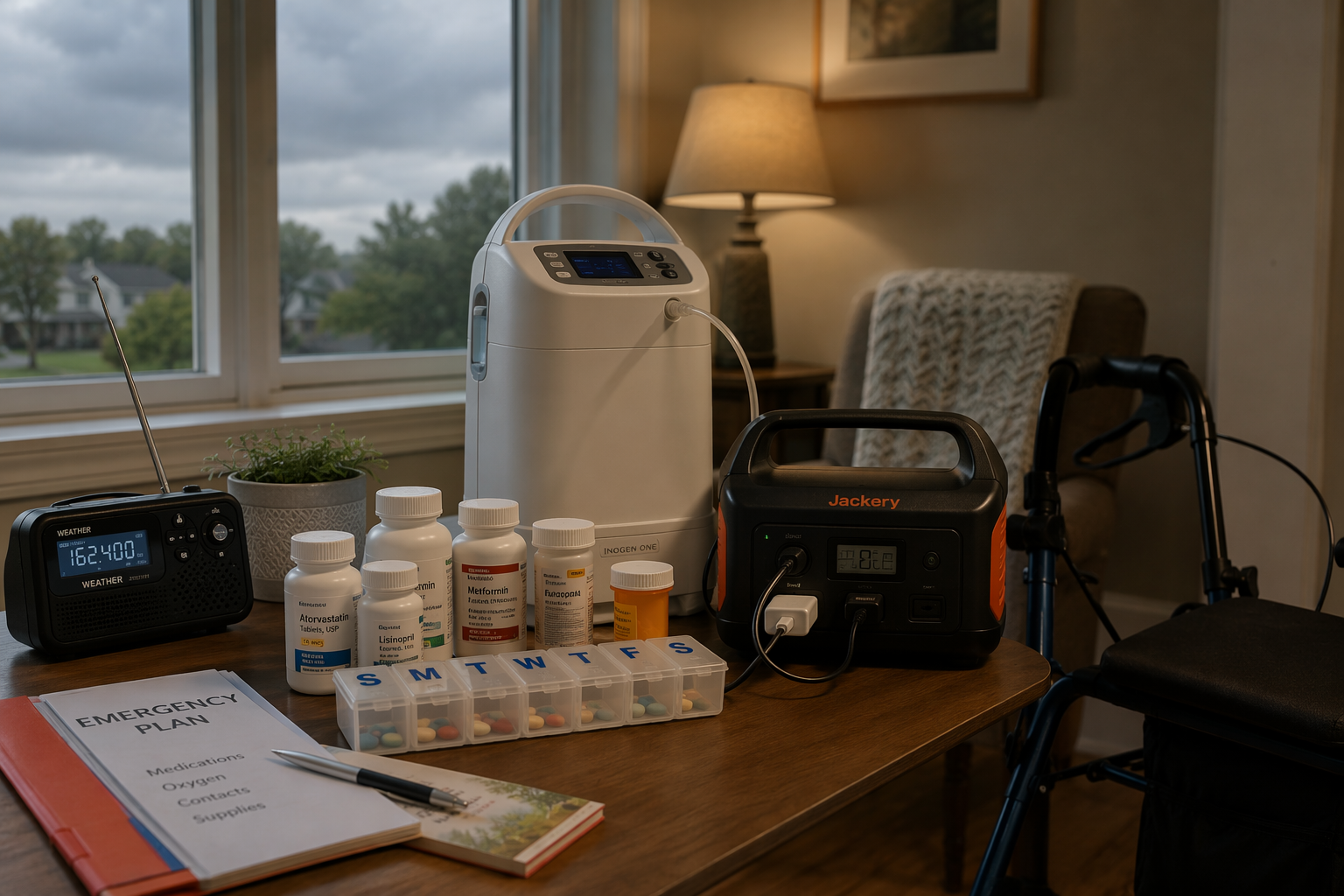
If a warning is already active, start here. This is the part a caregiver should be able to print, photograph, or walk through by phone with a parent, neighbor, home health aide, or sibling.
- Medications: Confirm at least a 30-day supply, refill dates, prescriber names, pharmacy phone numbers, and a current medication list in the go-bag, on the refrigerator, and with the primary caregiver.
- Temperature-sensitive drugs: Prepare an insulated cooling plan for insulin or other refrigerated medications, and ask the pharmacist what temperature range and discard rules apply.
- Powered medical devices: List every device that needs electricity, including CPAP, oxygen concentrator, nebulizer, lift chair, hospital bed, dialysis supplies, glucometer charging equipment, power wheelchair, and communication devices.
- Backup power: Record battery runtime, charging time, car adapter options, generator or battery station limits, and what care step fails first if power is lost.
- Evacuation trigger: Decide in advance what condition means “we leave now,” such as loss of oxygen support, indoor heat or cold becoming unsafe, floodwater near the home, no caregiver access, or no way to recharge essential equipment.
- Transportation: Confirm who can physically help the older adult leave, what vehicle can hold the walker or wheelchair, and where pets or service animals can go.
- Contacts: Put emergency contacts, diagnoses, allergies, medication list, device instructions, insurance cards, clinician contacts, and pharmacy contacts in one folder and one phone photo album.
- After the storm: Schedule medication recovery, device recharging, home pathway clearing, fall-risk checks, and daily check-ins for at least the first several days.
Medication Continuity Comes Before the Weather App
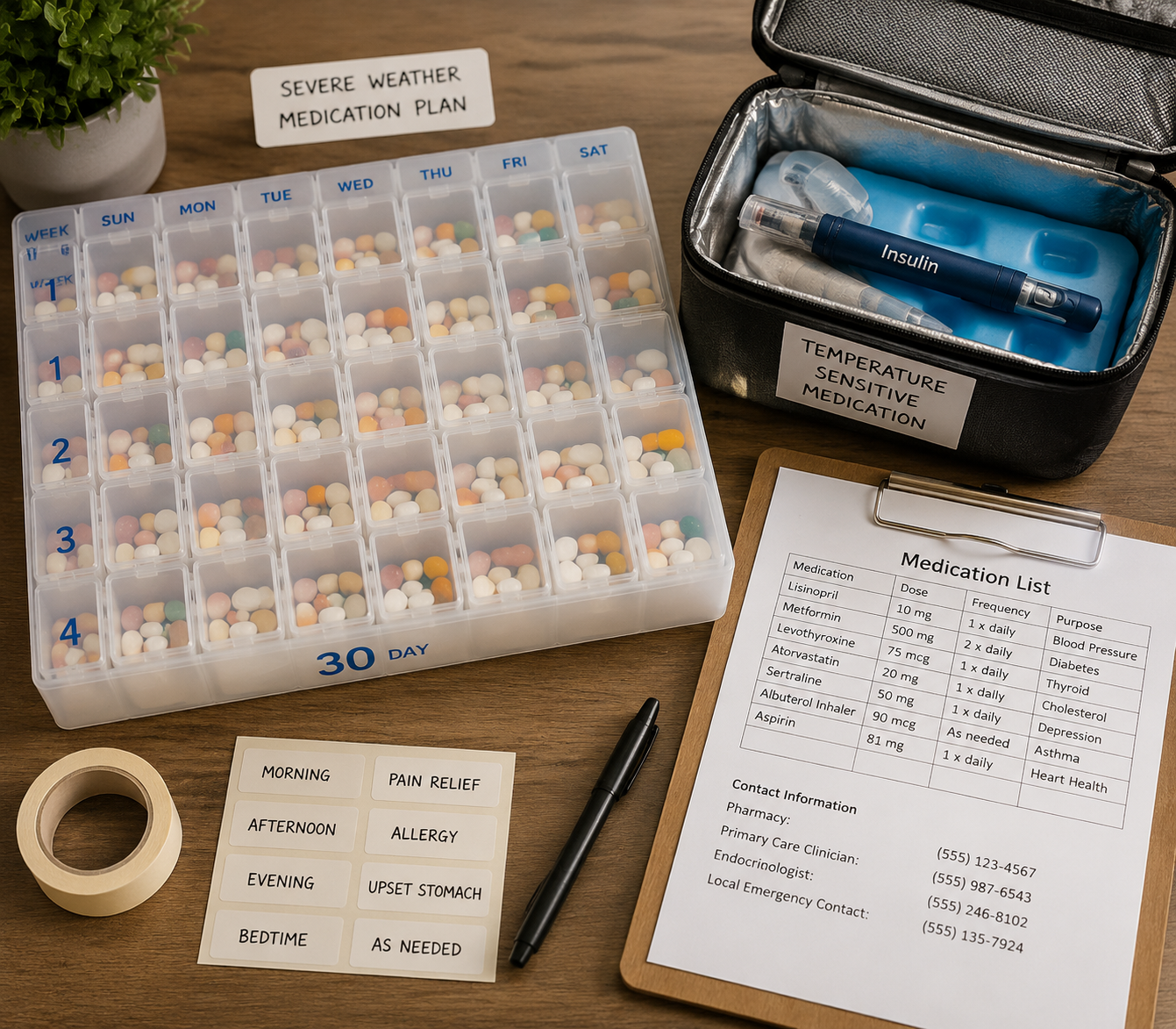
Generic emergency lists often say “pack medications.” For an older adult taking heart medication, diabetes medication, blood thinners, dementia medication, inhalers, eye drops, pain medication, and supplements, that sentence is not enough. The American Red Cross advises older adults to keep at least a 30-day supply of medications, along with medical supplies and copies of prescriptions.[3]
The 30-day number matters because severe weather does not have to destroy a home to interrupt care. A pharmacy may be closed. Roads may be blocked. A prescriber’s office may be without power. A mail-order shipment may stall. A caregiver who usually picks up refills may be caring for children, returning to work, or unable to cross town.
Build the Medication Plan Around Refills, Not Bottles
A medication bottle on the counter does not tell a caregiver whether the next dose is safe. The plan needs to show what is taken, why it is taken, who prescribed it, how much is left, and what has to happen before the supply runs out.
| Medication task | What to write down | Who should have it |
|---|---|---|
| Current medication list | Drug name, dose, schedule, reason, prescriber, pharmacy, allergies, and recent changes | Older adult, primary caregiver, backup caregiver, go-bag |
| Refill review | Number of days left, refill date, whether refills remain, and whether prior authorization is needed | Primary caregiver and pharmacy contact |
| Emergency supply | Which medications have a 30-day buffer and which still need approval | Primary caregiver and prescribing office |
| Refrigerated medication | Storage temperature instructions, cooling method, and what to do after a power outage | Older adult, caregiver, pharmacist |
| Controlled or restricted medication | Prescriber instructions and pharmacy process before a storm | Primary caregiver only, with secure storage |
Do this review before the forecast becomes urgent. Call the pharmacy and ask which medications can be refilled early, which require prescriber approval, and whether the pharmacy can transfer prescriptions if the usual location closes. For mail-order medications, ask how early shipment can be requested when severe weather is expected.
For insulin and other temperature-sensitive medications, do not rely on a vague plan to “keep it cold.” Ask the pharmacist what temperature range is required, how long the medication can be outside that range, whether a cooler is acceptable, and when the medication should be replaced. Label the cooler so a tired caregiver or neighbor does not use it for food or drinks.
Put the Medication List Where Help Will Actually Look
The list should not live only in a portal password that one adult child knows. Keep a printed copy in the emergency folder, a copy in the go-bag, a copy near the medication organizer, and a photo on the phones of the people most likely to help. If a neighbor has permission to check in, make sure that person knows where the list is, even if they do not manage the medications.
The list also needs a date. After a hospital discharge, urgent care visit, or medication change, replace every copy. Old lists are common after storms because families grab the nearest folder and assume it is current.
Medical Device Power Planning Is a Care Plan, Not a Gadget List
Power failure is not an inconvenience when breathing, sleep, mobility, glucose monitoring, communication, or wound care depends on electricity. Yet a University of Michigan survey of 2,256 older adults, cited by PBS NewsHour, found that only 25% of older adults who use electricity-dependent medical equipment had an alternative power source.[2]
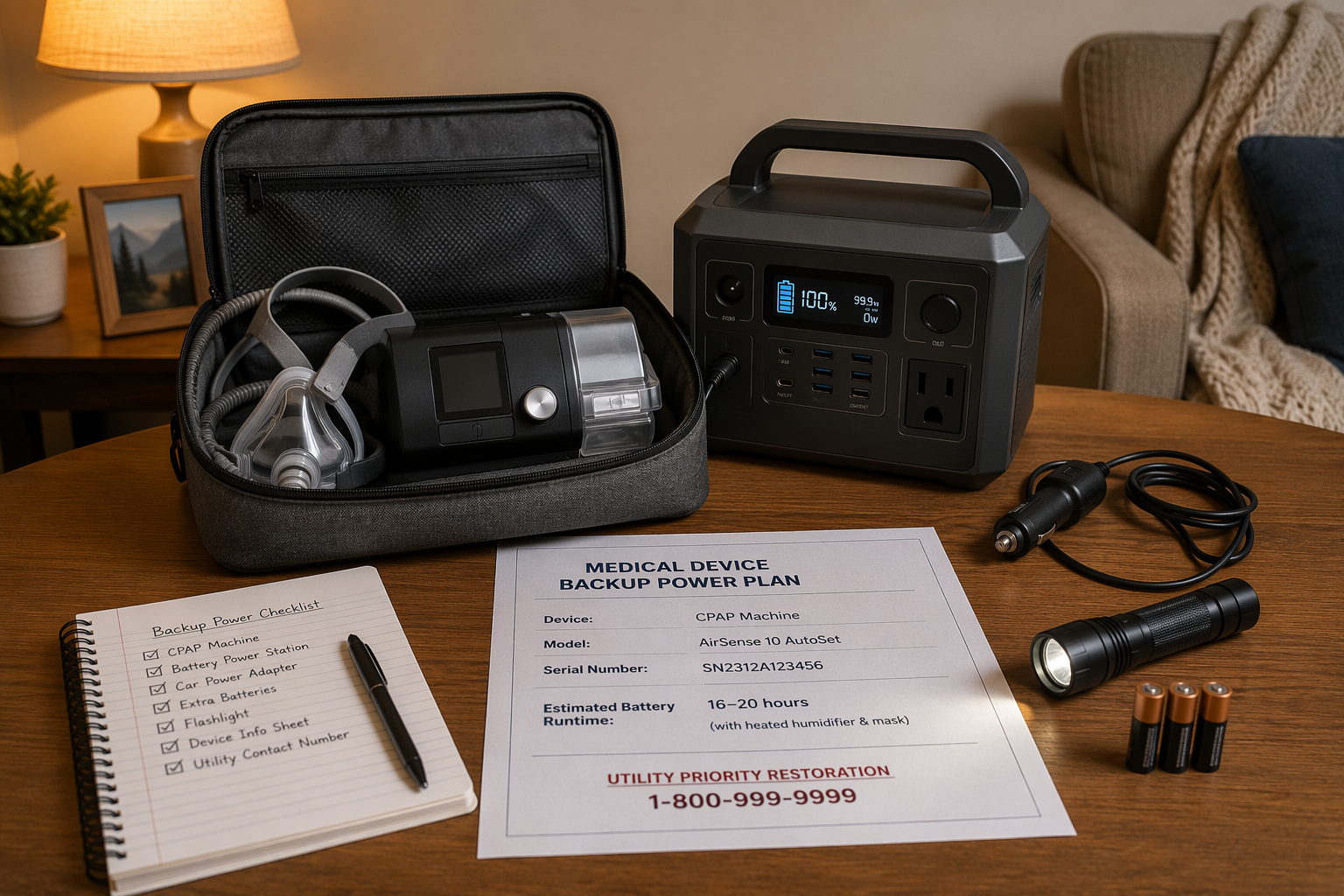
Families often assume there is a backup because the device has a battery symbol, a charging cord, or a travel case. That is not the same as knowing how long the device will run, whether the battery is still healthy, whether the car adapter works, or what happens if power is out overnight.
Inventory Every Device That Changes Care if It Stops
Walk through one ordinary day and one ordinary night. Write down every device that uses wall power, rechargeable batteries, disposable batteries, Wi-Fi, cellular service, or a powered accessory. Include the devices that do not look medical at first glance: an adjustable bed, lift recliner, stair lift, power wheelchair, phone needed for telehealth, medication dispenser, or medical alert system.
| Device | Power questions to answer | Care consequence if it fails |
|---|---|---|
| CPAP or BiPAP | Battery runtime, humidifier power draw, car adapter, cleaning needs | Poor sleep, breathing risk, confusion or fatigue the next day |
| Oxygen concentrator | Backup oxygen supply, battery runtime, supplier emergency process | Immediate breathing risk if oxygen support cannot continue |
| Nebulizer | Battery or manual alternative, medication supply | Breathing treatment may be delayed |
| Home dialysis equipment | Clinic instructions, emergency contact, backup treatment plan | Treatment interruption may require urgent medical direction |
| Power wheelchair or scooter | Charge level, manual backup, transport plan | Older adult may be unable to evacuate or reach bathroom safely |
| Medical alert or monitoring system | Battery backup, cellular dependence, Wi-Fi dependence | Falls or distress may not trigger help as expected |
The Red Cross advises documenting medical equipment details such as model and serial numbers and including instructions for use.[3] Put that information on a single device sheet, not scattered across manuals. Add the supplier phone number, clinician contact, battery type, replacement schedule, and any warning lights or error codes the caregiver should recognize.
Test the Backup Before You Need It
A backup plan has to be tested under ordinary conditions. Charge the battery station. Plug in the CPAP. Time how long it actually runs with the settings the older adult uses. Check whether the humidifier changes runtime. Confirm whether the oxygen supplier provides emergency tanks, what delivery limits apply during severe weather, and who is allowed to request help.
Car adapters need the same treatment. Make sure the adapter fits the device, the vehicle outlet supports it, and the older adult can safely reach the car if that becomes the charging location. A car-based plan is weak for someone who cannot transfer without help, lives in a flood-prone area, or would be exposed to unsafe heat or cold while waiting.
If a generator is part of the plan, write down who can operate it, where it can be placed safely, how fuel is stored, and what devices it is allowed to power. Do not make a frail spouse or cognitively impaired parent responsible for equipment they cannot safely manage.
Register, But Do Not Depend on Priority Restoration
Many utilities allow customers who use electricity-dependent medical equipment to register for priority restoration or medical alerts. Registration is worth doing, and the Red Cross includes utility contact planning in emergency preparation for older adults.[3] It should not be treated as a guarantee that power will return before a device fails.
After registration, keep the confirmation number or account note in the emergency folder. Then make the harder decision: if the device cannot be powered for the full outage window, where will the older adult go, who will take them, and what equipment must travel with them?
When Staying Home Becomes Riskier Than Leaving
“Just evacuate” is not a plan for an older adult who uses oxygen, cannot climb into a high vehicle, becomes disoriented outside familiar routines, depends on a home aide, has pets, or cannot afford a hotel. The same PBS report citing the University of Michigan survey noted that 24% of older adults could not afford to be away from home for a week.[2]
The decision still has to be made before conditions collapse. A caregiver should not be trying to compare shelter options for the first time while the power is already out and a parent’s oxygen battery is running down.
| If this is true | Staying home is becoming unsafe because | Next action |
|---|---|---|
| A powered medical device cannot run through the expected outage | Essential care may stop before power returns | Move to a location with reliable power or medical support |
| The older adult cannot safely maintain indoor temperature | Heat or cold can worsen chronic illness and confusion | Relocate before transportation becomes harder |
| Floodwater, ice, debris, or wind damage blocks exits | Emergency help and caregivers may not reach the home | Leave early if an evacuation route is still safe |
| The usual aide, nurse, or family caregiver cannot get there | Medication, toileting, meals, transfers, and wound care may be missed | Activate backup caregiver or move closer to support |
| Dementia symptoms worsen with stress, darkness, noise, or routine disruption | The person may wander, refuse medication, or become unsafe | Choose the calmest available setting with familiar supplies |
| Pets or service animals are part of daily function | Refusing evacuation may become more likely if animals cannot come | Use pet-inclusive or service-animal-appropriate options identified in advance |
Ready.gov advises older adults to plan for transportation, assistive devices, communication needs, and pets or service animals before disasters.[4] For a caregiver, that means calling ahead rather than assuming a shelter, hotel, relative’s home, or medical respite option can handle a walker, wheelchair, oxygen equipment, dementia-related wandering, incontinence supplies, or a service animal.
For hurricane-specific preparation, families who need a deeper storm plan can use this companion guide on hurricane preparedness for seniors with medical needs. The same medical-continuity questions apply to winter storms, heat waves, floods, tornadoes, and multi-day outages.
Communication Plans Should Name the Person, Not Just the Phone Number
A contact list is useful only if everyone knows their job. One person calls the older adult. One person calls the pharmacy. One person checks the home if roads are passable. One person talks with the oxygen supplier or utility. One person updates out-of-town family so the primary caregiver is not fielding repeated calls while making decisions.
- Make an emergency contact card with diagnoses, medications, allergies, devices, clinicians, pharmacy, insurance information, preferred hospital, and caregiver contacts.
- Put one card in the wallet, one on the refrigerator, one in the go-bag, and one with the primary caregiver.
- Choose a backup communication method if cell service fails, such as a neighbor check-in, landline, or prearranged meeting point.
- Set check-in times before, during, and after the event, especially for an older adult living alone.
- Keep chargers, battery packs, hearing aid batteries, glasses, and written instructions together.
The Red Cross recommends emergency contact cards for older adults, and Ready.gov points families toward alert tools such as the FEMA app and NOAA Weather Radio.[3][4] Alerts matter, but someone still has to translate an alert into a medication, power, transportation, or check-in action.
The After-Storm Plan: Refills, Recharging, and Falls
The post-storm period is where fragile routines break quietly. A parent may be back home but sleeping poorly without CPAP, rationing medication, skipping a diuretic because the bathroom path is hard, or walking around wet carpet with a cane. The Bell et al. finding that mortality risk peaked months after Hurricane Harvey is a warning to keep care continuity on the calendar after the visible cleanup begins.[1]
Do a Medication Recovery Check Within the First Few Days
- Count remaining doses and compare them with the medication list.
- Ask whether any doses were skipped, doubled, spilled, spoiled, or taken at the wrong time.
- Call the pharmacist about refrigerated medications exposed to uncertain temperatures.
- Restart refill requests before the emergency buffer is gone.
- Tell the clinician about missed doses of high-risk medications rather than guessing how to catch up.
Clear the Walking Route Before the Older Adult Tests It
Falls are already a major threat for older adults. The CDC reports that falls are the leading cause of injury for adults age 65 and older.[5] After severe weather, the home adds new hazards: damp flooring, rolled rugs, cords from temporary power setups, poor lighting, displaced furniture, swollen doors, broken steps, icy entries, and debris where a walker usually turns.
Before the older adult resumes normal movement, check the bed-to-bathroom route, medication area, kitchen path, entryway, stairs, ramp, and route to the device charging area. If oxygen tubing, extension cords, or battery cables cross a walkway, reroute them or tape them down only as a temporary measure. Wet rugs and mats should come up, not be trusted to dry in place.
For storm-specific fall-prevention work, caregivers can use guides on preparing for storms and preventing falls in elderly adults, fall prevention during a tropical storm, or a printable fall prevention handout for seniors and caregivers. If monitoring tools are part of the plan, review whether the system still works after a power or internet outage; this guide to choosing elderly home safety products can help families think through device limits.
Keep Checking After the Obvious Crisis Ends
For the first week, assign someone to ask direct questions: Did you take every dose today? Is the oxygen supply full? Did the CPAP run all night? Is the refrigerator working? Can you get to the bathroom safely? Did the aide come? Do you have a way to get to dialysis, wound care, lab work, or a follow-up visit?
For the next several weeks, keep watching for the problems that do not look like storm injuries: worsening confusion, swelling from missed medication, shortness of breath, blood sugar instability, dehydration, weakness, missed appointments, or a new fear of walking through the house. Those are reasons to call the clinician, not signs that the family failed. They are exactly why the severe weather plan has to extend beyond the day the sky clears.
References
- Variation in One-Year Mortality Following Severe Weather Exposure Among Older Americans, Journal of the American Geriatrics Society, 2026.
- Why it can be more difficult to evacuate older adults in a disaster, PBS NewsHour.
- Older Adults Emergency Preparedness, American Red Cross.
- Older Adults, Ready.gov.
- Facts About Falls, CDC.
Related reading
Noticed something outdated or inaccurate on this page? Flag a correction. We review every report against CDC, NIA, and AARP HomeFit guidance before updating a page.
Part of the Fall Prevention section.