
When Home Is No Longer Safe: A Crisis-to-Plan Transition Guide for Dementia Caregivers
Most dementia caregivers wait until a crisis forces a placement decision. This guide provides a measurable, 4-domain safety-threshold framework — wandering, falls, medication management, and caregiver capacity — to help families make proactive, less traumatic transitions to higher levels of care.
Why Waiting for a Crisis Is the Most Common — and Costliest — Mistake
The decision to move a loved one with dementia out of the family home rarely happens calmly. More often, it arrives in the wake of a traumatic event: a middle-of-the-night wandering episode that ends with a police search, a fall that fractures a hip, a hospitalization for a medication error, or a moment when the primary caregiver simply cannot get out of bed themselves. These crises do not just cause emotional trauma — they compress the timeline for decision-making, limit the available options, and often lead to rushed placements that are more expensive and less suited to the person's needs.
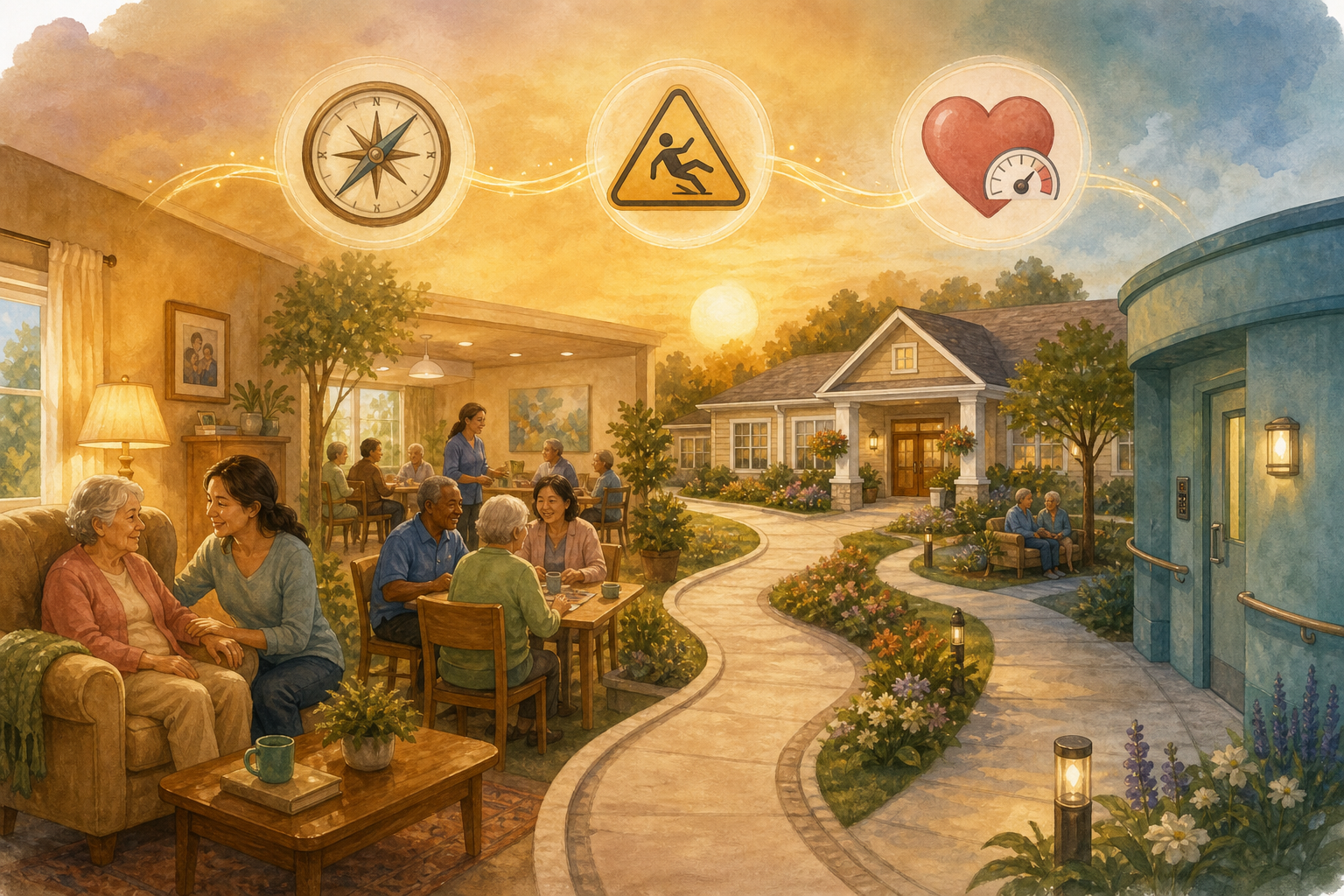
There is a better path. The core thesis of this guide is that measurable, objective safety thresholds exist across four critical domains — wandering and elopement risk, fall risk, medication management, and caregiver capacity — that families can use to make proactive, planned transitions before a crisis forces their hand. By monitoring these domains systematically, you can identify the moment when home is no longer safe and begin planning a move on your own terms, with more options, less financial pressure, and significantly less emotional fallout.
The 4-Domain Safety-Assessment Framework
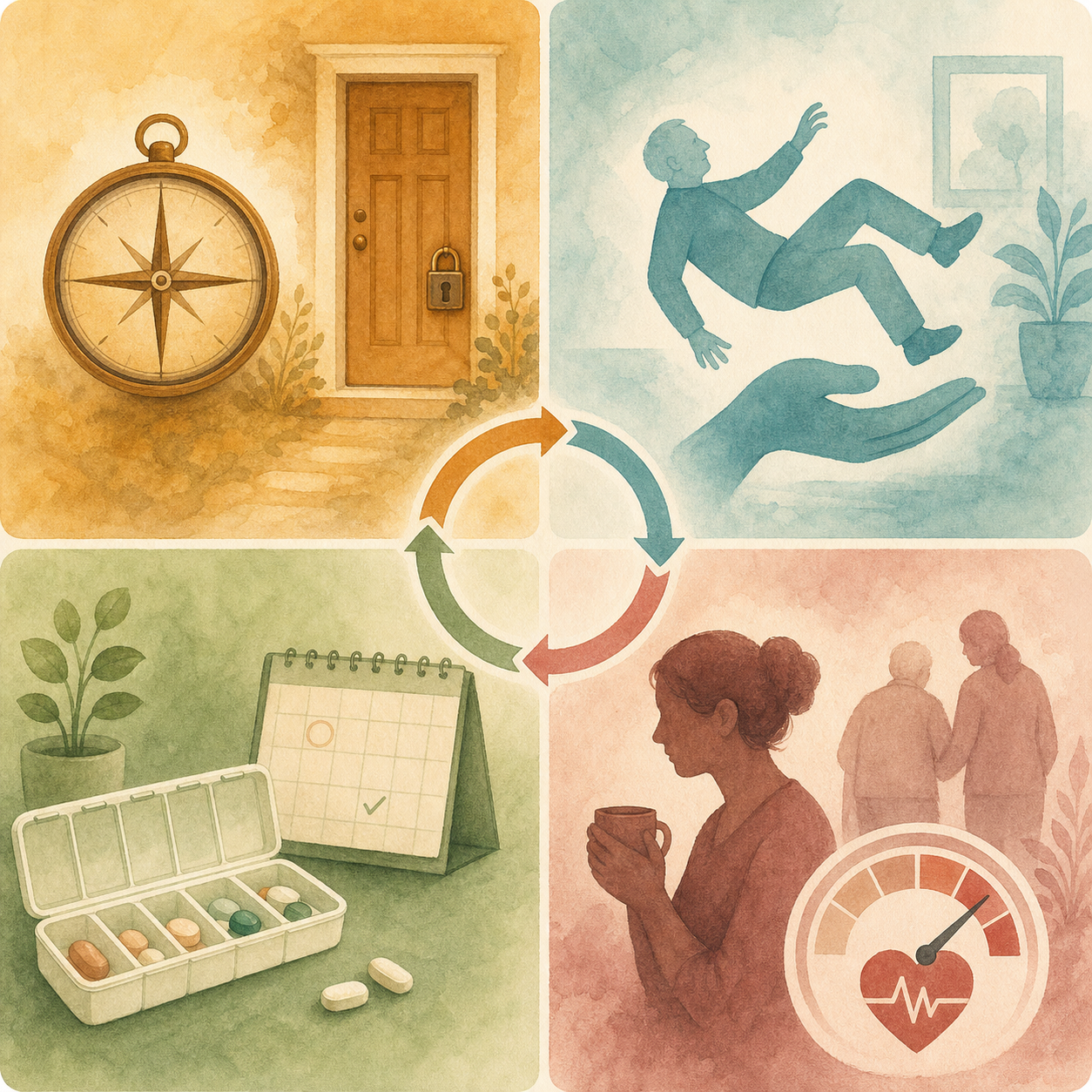
Most existing guidance treats wandering, falls, medication errors, and caregiver burnout as separate problems, each with its own checklist and its own set of recommendations. That approach misses the critical insight: these four domains interact. A caregiver who is exhausted from sleep disruption (caregiver capacity) is less vigilant about locking doors (wandering risk). A person with dementia who has fallen and is now afraid to move (fall risk) may become more agitated and refuse medication (medication management). The safety of the entire care arrangement depends on the weakest link in this chain.
The framework below integrates all four domains into a single assessment tool. Each domain has a defined red-line threshold — a point at which the risk has escalated beyond what home-based interventions can reliably manage. When two or more domains cross their red lines, it is time to begin a planned transition to a higher level of care.
Wandering Risk: When Home Safety Measures Are No Longer Enough
Wandering is one of the most dangerous and distressing behaviors associated with dementia. According to the Alzheimer's Association, six in ten people living with dementia will wander at least once, and many do so repeatedly. Wandering can be life-threatening: a person who becomes lost may be unable to ask for help, may not recognize familiar surroundings, and may be exposed to extreme weather, traffic, or other hazards. The Alzheimer's Association advises that if a person with dementia is not found within 15 minutes, call 911 and inform authorities the person has dementia.
Home Safety Checklist for Wandering
Before concluding that home is unsafe, implement these evidence-based safety measures recommended by the Alzheimer's Association and the National Institute on Aging:
- Install deadbolts placed out of the line of sight — high or low on the door, where the person is less likely to notice them.
- Use door alarms or smart doorbells that chime when a door is opened.
- Place pressure-sensitive mats in front of exterior doors to alert you when someone steps on them.
- Camouflage doors by painting them the same color as the surrounding wall or covering them with a curtain or removable mural.
- Secure the yard with fencing and a locked gate.
- Use STOP or DO NOT ENTER signs at eye level on doors the person should not use.
- Keep shoes, keys, coats, and purses out of sight — these items can trigger the impulse to leave.
- Enroll in the MedicAlert + Alzheimer's Association Safe Return program (call 800-432-5378) and provide neighbors and local police with a recent photograph.
The Red-Line Threshold for Wandering
Home safety measures are effective for many families, but they have limits. The red-line threshold for wandering is crossed when any of the following occur despite having implemented the checklist above:
- The person wanders frequently — more than once per week.
- Wandering becomes unpredictable, occurring at any time of day or night without a discernible trigger.
- The person has been found outside the home and could not find their way back.
- The person attempts to leave at night while the caregiver is asleep.
- The person has been brought home by police or a neighbor.
At this point, home modifications alone are insufficient. A secured memory care environment with 24-hour supervision, alarmed exits, and trained staff is the appropriate level of protection. For more on managing nighttime wandering specifically, see our guide on When Your Parent Wanders at Night: Understanding Sundowning and Building a Nighttime Safety Plan.
Fall Risk: The One-in-Four Reality and Its Cascading Consequences
Falls are the leading cause of injury among older adults, and the data from the CDC is stark: more than one in four older adults falls each year, and less than half tell their doctor. Falls cause approximately 3 million emergency department visits and about 1 million fall-related hospitalizations annually among older adults. About 37% of those who fall report an injury requiring medical treatment or restricted activity for at least one day.
For a person with dementia, a fall is not just a physical injury — it can trigger a cascade of negative outcomes. The trauma and hospitalization can accelerate cognitive decline. Fear of falling often causes the person to reduce their activity level, which leads to muscle weakness and balance deterioration, which in turn increases the risk of another fall. The CDC notes that falling once doubles the chances of falling again. This downward spiral is particularly dangerous for someone who cannot reliably communicate pain or follow a rehabilitation plan.
| Fall Risk Indicator | What It Means | Action |
|---|---|---|
| One fall in 12 months | Elevated risk; implement home safety measures | Conduct a room-by-room fall prevention audit; review medications with a doctor |
| Two or more falls in 6 months | Red-line threshold crossed | Begin planning for a higher level of care; consult with an occupational therapist |
| Any fall resulting in fracture or hospitalization | Red-line threshold crossed | Initiate transition planning immediately; the home environment is no longer safe |
| Fear of falling causing activity reduction | Secondary risk factor | Address through physical therapy and environmental modifications; monitor closely |
The red-line threshold for fall risk is clear: two or more falls in six months, or any fall that results in a fracture or hospitalization. At this point, home-based fall prevention — grab bars, non-slip mats, improved lighting, removing tripping hazards — is no longer adequate. A memory care environment with staff trained in fall prevention, lowered beds, padded flooring, and 24-hour monitoring is the appropriate next step.
Medication Management: The Hidden Safety Domain
Medication management does not have the same volume of published data as wandering or falls, but it is equally critical to the safety of a person with dementia living at home. Common errors include missed doses, double-dosing, taking medication at the wrong time, and outright refusal. Each of these errors can have serious consequences: missed doses of cholinesterase inhibitors (like donepezil) can accelerate cognitive and behavioral decline; missed doses of blood thinners or diabetes medications can lead to emergency room visits; and double-dosing can cause dangerous side effects or toxicity.
The complexity of the medication regimen is a key factor. A person taking three or more daily medications — which is common among older adults with dementia, who often also manage hypertension, diabetes, heart disease, or other chronic conditions — requires a level of organizational consistency that dementia progressively erodes. The caregiver must track not only what to give and when, but also whether the medication was actually swallowed, whether the person is experiencing side effects, and whether prescriptions need to be refilled.
Common Medication Management Errors in Dementia Care
- Missed doses due to the person refusing or hiding the medication.
- Double-dosing because the caregiver cannot remember whether a dose was already given.
- Incorrect timing, such as giving a morning medication at night or vice versa.
- The person spitting out medication after the caregiver leaves the room.
- Mixing up medications with similar-looking pills or bottles.
- Failure to refill prescriptions on time, leading to gaps in treatment.
The Red-Line Threshold for Medication Management
The red-line threshold is crossed when a caregiver cannot reliably manage a medication regimen of three or more daily medications, or when a medication error has led to an emergency room visit or hospitalization. At this point, the safety of the entire care arrangement is compromised. A memory care community with licensed nursing staff who manage medication administration, monitor for side effects, and coordinate with prescribing physicians is the appropriate level of support.
Caregiver Capacity: The Overlooked Clinical Signal
Caregiver burnout is often treated as a personal failing — a sign that the caregiver is not strong enough, organized enough, or dedicated enough. This framing is not only unhelpful, it is clinically inaccurate. Caregiver burnout is a measurable, predictable consequence of providing sustained, high-intensity care without adequate support. It is a clinical signal that the current care arrangement is unsustainable, and it deserves the same seriousness as a fall or a wandering episode.
The data bears this out. According to Caregiving in the US 2020, 61% of family caregivers report that caregiving has impacted their work, and 45% report some financial impact. A 2018 Genworth study found that 52% of caregivers did not feel qualified to provide physical care. The Administration for Community Living reported that 37.1 million family caregivers provided unpaid care to someone age 65 or older in 2021–2022, and the value of that unpaid care is estimated at $375 billion per year. These are not small numbers — they represent a massive, invisible workforce that is burning out at an alarming rate.
| Caregiver Capacity Indicator | What It Signals | Action |
|---|---|---|
| Sleep disruption most nights | The caregiver is not getting restorative sleep; cognitive function and patience are impaired | Seek respite care immediately; consider overnight care or a short-term memory care stay |
| Missed work repeatedly | Caregiving is interfering with the caregiver's livelihood and long-term financial security | Explore employer leave policies (FMLA), adult day programs, or in-home respite |
| Feeling resentful, angry, or hopeless toward the care recipient | Emotional exhaustion has reached a critical level; the caregiver-care recipient relationship is at risk | Seek counseling or a caregiver support group; begin transition planning |
| Healthcare provider has told the caregiver their own health is declining | The physical toll of caregiving is now measurable; the caregiver is becoming a patient | Initiate transition planning immediately; the current arrangement is harming both people |
| Caregiver has experienced a fall, injury, or illness that prevented caregiving | The caregiver's capacity has been physically compromised | Activate emergency backup plan; begin transition planning |
The red-line threshold for caregiver capacity is crossed when the caregiver experiences sleep disruption most nights, has missed work repeatedly, reports feeling resentful or hopeless, or has been told by a healthcare provider that their own health is declining. At this point, the care arrangement is harming both the caregiver and the care recipient. For deeper support on recognizing and addressing burnout, see our guides on Caregiver Burnout Is Not Your Fault: What the 2025-2026 Data Says About the Real Causes of Exhaustion and Caregiver Stress and Burnout: Warning Signs, Prevention Strategies, and When to Seek Help.
Your Red-Line Indicators: A Summary Checklist for Decision-Making
The following checklist consolidates the red-line thresholds from all four domains into a single, scannable tool. If your family has crossed red lines in two or more domains, it is time to begin a planned transition to a higher level of care. If you have crossed red lines in three or four domains, the transition should be treated as urgent.
| Domain | Red-Line Threshold | Status (Check if Met) |
|---|---|---|
| Wandering Risk | Frequent (more than once/week), unpredictable, or nighttime wandering despite safety measures; person has been found lost or brought home by police | |
| Fall Risk | Two or more falls in six months, or any fall resulting in fracture or hospitalization | |
| Medication Management | Cannot reliably manage 3+ daily medications; medication error has led to an ER visit or hospitalization | |
| Caregiver Capacity | Sleep disruption most nights; repeated missed work; feelings of resentment or hopelessness; healthcare provider has flagged the caregiver's own health decline |
How to Plan a Non-Crisis Transition: Touring, Trial Stays, and Financial Steps
Once you have identified that a transition is needed, the goal is to execute it as a planned move — not as an emergency evacuation. Planning ahead gives you more options, better pricing, and significantly less trauma for your loved one. Here is how to approach each phase of the process.
Touring Memory Care Communities with a Safety-Focused Checklist
When you tour memory care communities, bring a checklist that prioritizes the four safety domains. Do not be swayed by aesthetics alone — the most important features are the ones that address your specific red-line concerns.
- Wandering safety: Are all exits alarmed? Is the outdoor area secured with fencing and locked gates? Is there a protocol for when a resident is not found within 15 minutes?
- Fall prevention: Are floors non-slip? Are beds low to the ground? Is there padding on sharp corners? Is there 24-hour monitoring, including overnight checks?
- Medication management: Is there a licensed nurse on staff? How are medications stored and administered? What is the protocol for missed doses or medication errors?
- Staff-to-resident ratio: What is the ratio during the day and overnight? Are staff trained in dementia-specific care and non-pharmacological behavior management?
- Respite or trial stay option: Does the community offer short-term respite stays? This allows your loved one to try the environment before committing to a permanent move.
The Value of Trial or Respite Stays
Many memory care communities offer short-term respite stays — typically ranging from a few days to a few weeks. These serve two critical purposes. First, they give your loved one a chance to acclimate to the new environment gradually, which reduces the trauma of a sudden, permanent move. Second, they give you, the caregiver, a chance to rest, recover, and evaluate the community from a distance. A respite stay can also serve as a trial run: if the community does not meet your standards, you have not committed to a long-term contract.
Financial Planning Steps
Memory care is expensive. According to SeniorLiving.org, the national median cost for memory care is $8,019 per month as of May 2026, and memory care typically costs 15–25% more than assisted living. The total cost of dementia care in the US was projected at $781 billion in 2025 by the USC Schaeffer Institute. Planning ahead financially is essential.
| Funding Source | What It Covers | Key Considerations |
|---|---|---|
| Medicaid | May cover memory care costs in facilities that accept Medicaid | Memory care communities accept Medicaid less frequently than other facility types; check availability in your area |
| Medicare | Does not cover memory care in assisted living or dedicated memory care communities | Medicare covers only short-term skilled nursing or rehabilitation stays, not long-term custodial care |
| VA Aid and Attendance | May provide a monthly pension supplement for eligible veterans and surviving spouses | Requires a VA application and medical certification; can take several months to process |
| Long-Term Care Insurance | May cover a portion of memory care costs depending on the policy | Review your policy carefully for dementia-specific exclusions, elimination periods, and daily benefit caps |
| Personal Savings / Family Contributions | Out-of-pocket payment | Most common funding source; plan for at least 2-3 years of expenses |
Resources for the Next Step
You do not have to navigate this transition alone. The following organizations provide free, expert guidance and support for dementia caregivers.
- Alzheimer's Association 24/7 Helpline: Call 800-272-3900 for free, confidential support, crisis assistance, and referrals to local resources.
- Eldercare Locator: Call 800-677-1116 or visit eldercare.acl.gov to find local aging services, including memory care options, support groups, and respite care.
- National Institute on Aging (NIA): Visit nia.nih.gov for evidence-based information on Alzheimer's disease, dementia care, and caregiver support.
- MedicAlert + Alzheimer's Association Safe Return Program: Call 800-432-5378 to enroll in the wandering prevention and response program.
For ongoing support as you navigate this journey, explore our related guides on sundowning and nighttime safety, caregiver burnout prevention, and communicating with a resistant parent. You have already taken the most important step: recognizing that the current situation needs to be evaluated with honesty and courage. The next step is acting on what you have learned.
Related reading
Noticed something outdated or inaccurate on this page? Flag a correction. We review every report against CDC, NIA, and AARP HomeFit guidance before updating a page.
Part of the Fall Prevention section.