
STEADI: intervene
How to Create a Wildfire Evacuation Plan for Your Elderly Parent
Learn the concrete steps to build a wildfire evacuation plan that accounts for your parent's mobility, medications, and cognitive needs — because generic disaster advice can put them at serious risk.
A wildfire evacuation plan for elderly parents cannot begin with “grab the go-bag and leave when told.” That may work for a healthy adult with a car, good hearing, charged phone, clear thinking under stress, and the ability to move quickly. It does not work for a parent who uses a walker, depends on oxygen, forgets instructions, cannot hear alerts, needs help transferring into a car, or insists they will “wait and see.”
The first job is not packing. It is finding the exact point where the plan would fail if smoke, power loss, traffic, fear, and time pressure all arrived together.
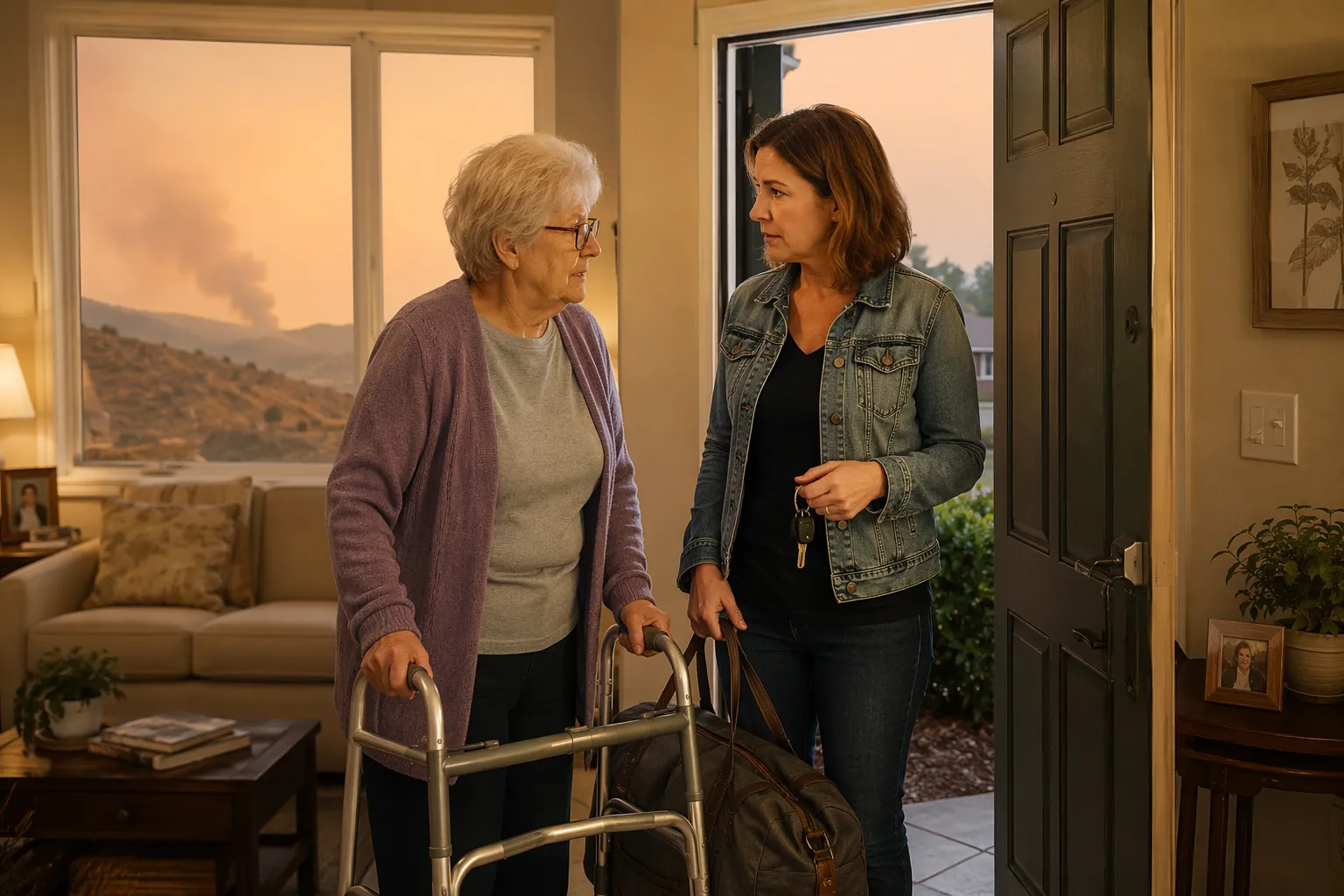
That sounds severe until you look at who is harmed when evacuation advice assumes too much. Reporting after the January 2025 Southern California wildfires found that several victims were disabled and that most were over 70, based on CalMatters reporting that cited NBC News victim data. The same fires prompted about 2,500 nursing home residents to be evacuated, which Los Angeles County’s Aging & Disabilities Department director Laura Trejo described as the largest simultaneous facility evacuation in the county’s history and unprecedented in her 35 years of work.[1]
Older adults also face higher fire mortality risk in general. The California Caregiver Resource Centers, citing the New York State Department of Health, reports that people over 65 are twice as likely to die in a home fire as the general population, and people over 85 are four times as likely.[2] Those figures are not a prediction for your parent. They are a warning against treating age, disability, and dependence on equipment as small details.
Start With A Parent-Specific Capability Profile
Write this profile before fire season, and write it as if someone outside the family may need to use it. A neighbor, facility worker, paid caregiver, paramedic, or backup driver should be able to read it and understand what your parent can and cannot do without guessing.
Do not soften the answers to preserve everyone’s feelings. If your parent can walk to the mailbox but cannot cross a parking lot safely in smoke, write that. If they can manage medication on a normal morning but not after being awakened at midnight, write that too. A plan built around the best version of your parent is not a plan; it is a family hope with supplies attached.
| What To Assess | What To Write Down | Evacuation Decision It Changes |
|---|---|---|
| Mobility | Walks independently, uses cane, walker, wheelchair, scooter, power chair, or is bedbound; distance they can safely travel | Vehicle choice, number of helpers, route from bedroom to car, whether accessible transport is required |
| Transfers | Can or cannot get into a specific car, SUV, van, or paratransit vehicle; whether a transfer board or lift is needed | Who can drive, whether one helper is enough, whether leaving early is mandatory |
| Medical equipment | Oxygen, concentrator, portable tank, CPAP, nebulizer, stair lift, hospital bed, refrigerated medications, power wheelchair | Backup power, spare batteries, evacuation timing, destination choice |
| Cognition | Dementia, Alzheimer’s disease, confusion at night, wandering risk, inability to follow multi-step instructions | Need for direct supervision, simplified scripts, earlier departure, identity documents |
| Sensory needs | Hearing loss, vision loss, glasses, hearing aids, difficulty hearing phone alerts or sirens | Alert methods, communication backup, packing priorities |
| Social isolation | Lives alone, caregiver schedule, neighbor access, who has keys, who can arrive within minutes | Check-in chain, backup driver, whether waiting for official orders is too risky |
Ready.gov tells older adults to create a support network of family, friends, caregivers, neighbors, and others who can assist during emergencies, and to make sure those people know the plan.[3] For an elderly parent, that network is only useful if it is specific. “The neighbors will help” is not specific. “Maria next door has a key, can knock loudly because Dad may not hear the phone, and can stay with him until Daniel arrives” is specific.
Mobility Is The Main Evacuation Risk
Wildfire evacuation is a fall-risk event: rushed walking, smoke irritation, poor lighting, uneven pavement, unfamiliar bathrooms, crowded shelters, and transfers into vehicles that were never chosen with your parent’s body in mind. Treat every movement as a step that has to be tested.
Walk the route from your parent’s usual chair, bedroom, bathroom, and kitchen to the exit. Then walk from the exit to the vehicle. Notice thresholds, loose rugs, steps, narrow turns, gravel, steep driveways, garage clutter, and the place where a walker cannot pass unless someone moves a trash bin. If your parent uses a wheelchair, check whether the chair can actually reach the vehicle, not just the front door.
Then test the vehicle. A low sedan, tall SUV, pickup, or crowded back seat may be unrealistic. If your parent needs two people to transfer, write down who those two people are. If the only workable vehicle belongs to one adult child who lives 45 minutes away, the plan needs a nearer backup or an earlier trigger.
Medical Equipment Changes The Clock
A parent who depends on electricity cannot use the same timeline as a parent who does not. Oxygen concentrators, CPAP machines, nebulizers, stair lifts, power wheelchairs, adjustable beds, refrigerated medications, and phone-based monitoring all add failure points when power is unstable or roads are closing.
For each device, write the plain answer to four questions: Does it require electricity? Is there a charged battery? How long does the backup last under real use? What happens if the device fails during a two-hour drive or overnight stay? If no one knows, the plan is not ready.
Call the oxygen supplier, durable medical equipment company, pharmacy, and physician’s office before fire season if your parent uses life-sustaining or hard-to-replace equipment. Ask what can be duplicated, what requires a prescription, what can travel, and what paperwork a shelter, hotel, or facility may need. Do not wait until evacuation traffic starts to learn that a portable oxygen setup is empty, missing tubing, or too heavy for the person assigned to carry it.
Cognitive And Sensory Needs Decide How Much Supervision Is Required
A parent with dementia may sound composed on the phone and still be unable to execute a wildfire plan. They may pack the wrong bag, refuse to leave, forget that an order was given, wander while someone loads the car, or become frightened by uniforms, smoke, pets, sirens, and rushed relatives. The plan should not depend on them remembering instructions under stress.
Use fewer instructions, not better speeches. A simple card by the door can say: “If Daniel, Maria, or emergency responders say we are leaving because of fire, put on shoes and take the red bag.” That does not replace supervision. It reduces argument and confusion at the worst moment.
Hearing and vision needs deserve the same seriousness. If your parent does not reliably hear phone alerts, sirens, or someone knocking, they need a human check-in plan. If they cannot read evacuation maps or text messages easily, assign someone else to monitor alerts and give one clear instruction. If they need glasses, hearing aids, or spare batteries to function safely, those items belong in the evacuation bag, not scattered across the bathroom and nightstand.
Build Transportation Around The Weakest Day, Not The Best Day
Transportation is where many family plans become fiction. Everyone agrees that someone will drive Mom, but no one has checked whether Mom can climb into that person’s car, whether the driver will be at work outside the evacuation zone, whether the wheelchair fits, whether the facility releases residents to family, or whether the parent will refuse to leave with anyone except one person.
Name the primary driver and at least two backups. Put their phone numbers on paper in the go-bag and on the refrigerator. Include who has keys or keypad codes, who can enter if your parent cannot reach the door, and who is responsible for pets if pets are part of the reason your parent may delay.
- Test the transfer into the actual vehicle before fire season.
- Confirm the walker, wheelchair, oxygen tank, and go-bag fit without blocking the passenger seat your parent needs.
- Choose a destination that can handle the parent’s equipment, bathroom needs, medication schedule, and mobility.
- Write down an accessible backup destination in a different direction in case the preferred route closes.
- If wheelchair-accessible transport is needed, identify the provider now and ask how they operate during evacuation warnings.
For a parent in assisted living, memory care, skilled nursing, or another facility, do not accept “we have an emergency plan” as the whole answer. Ask who orders evacuation, how residents are triaged for transport, how medications and oxygen travel, where residents are taken, how families are notified, how staffing is maintained, and whether families may pick up residents directly. The 2025 Los Angeles County facility evacuations show that formal care settings can be forced to move large numbers of medically vulnerable people at once.[1]
If your parent lives alone and has no nearby driver, the plan needs a community solution before there is smoke. Contact the local emergency management office, fire department non-emergency line, aging services office, paratransit provider, senior community manager, or faith community to learn what registries or assistance programs exist. Then write down exactly how to request help and who will make the call.
Decide What “Leave Early” Means Before Anyone Is Scared
For many older adults, especially those with mobility limitations, oxygen dependence, dementia, or no nearby driver, waiting for a mandatory evacuation order can be the most dangerous version of the plan. CAL FIRE’s Ready for Wildfire guidance tells families to prepare an evacuation plan and leave as soon as evacuation is recommended by fire officials.[4] For a medically fragile parent, the family may need an even earlier private threshold.
A useful threshold is concrete enough that no one has to negotiate it during panic. For example: “If our area is under an evacuation warning, Daniel leaves work and drives to Mom.” Or: “If power is out for more than one hour during a red flag event and the portable oxygen setup is not fully available, Mom relocates to Karen’s house.” These are hypothetical examples, but the structure matters: condition, person responsible, action.
Early departure is not about taking control away from an older adult. It is about preserving choices while choices still exist. Leaving during daylight, before roads jam and smoke thickens, may allow your parent to use their preferred driver, bring the right equipment, avoid a rushed transfer, and go to a familiar home instead of an emergency shelter.
Pack The Go-Bag After The Assessment, Not Before
The go-bag should answer the parent’s actual risks. A bag for a parent with hearing loss looks different from one for a parent with incontinence, diabetes, oxygen dependence, or dementia. Red Cross guidance for older adults recommends including at least a 30-day supply of medications and extra assistive items such as canes and eyeglasses.[5]
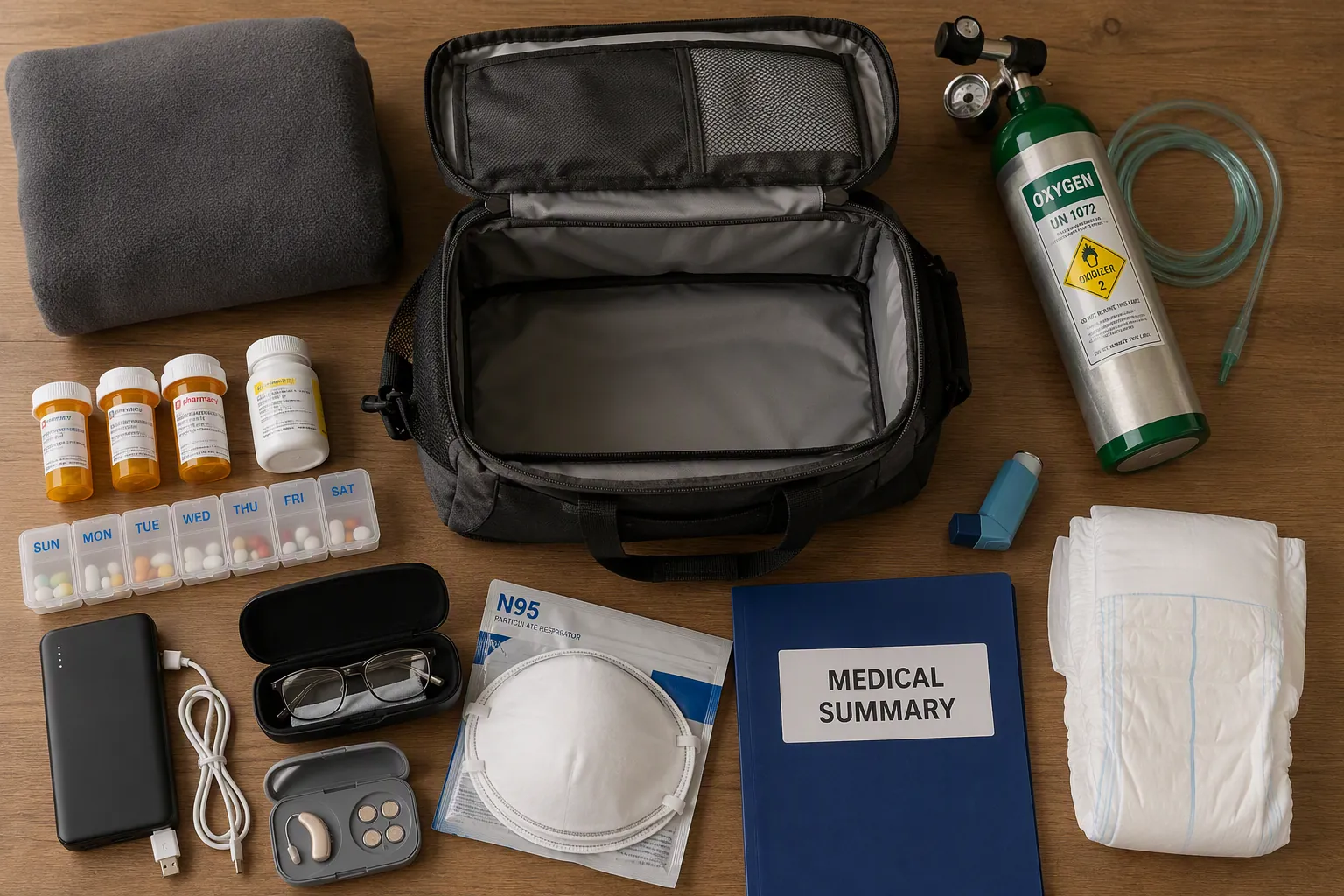
Medication planning takes more than dropping pill bottles into a tote. Keep a current medication list with drug names, doses, timing, prescribing clinicians, pharmacy phone number, allergies, diagnoses, and insurance information. Add copies of important documents, a photo ID, emergency contacts, and a short medical summary that a new clinician could understand quickly.
- Medications, medication list, allergy list, pharmacy information, and copies of prescriptions when available
- Eyeglasses, hearing aids, hearing aid batteries, dentures, mobility aids, and labeled spare assistive items
- Chargers for phone, medical devices, power wheelchair, hearing aids, CPAP, or other equipment
- Portable power banks or other backup power appropriate to the equipment, with charging dates checked
- N95 masks, inhalers if prescribed, tissues, hand wipes, and items needed for respiratory comfort
- Incontinence supplies, skin-care items, disposable gloves if caregivers use them, and a change of clothing
- Comfortable closed-toe shoes, socks, a light layer, flashlight, spare batteries, and a written contact list
- A familiar object, simple activity, or comfort item for a parent with dementia or anxiety
Date the bag. Medication quantities, batteries, oxygen tubing, glasses prescriptions, phone numbers, and wound-care or incontinence supplies change. A bag packed once and ignored for two years is not reliable; it is storage.
Plan For Smoke, Not Just Flames
For an older adult with COPD, asthma, heart disease, frailty, or oxygen dependence, smoke can make “shelter in place until the last minute” a bad bargain. A scoping review on wildfires and older adults summarizes evidence that wildfire smoke exposure is associated with increased respiratory harm, including a Liu et al. study finding a 7.2% increase in respiratory hospital admissions among Medicare enrollees in the Western United States during intense smoke days.[6]
The same review notes evidence that wildfire PM2.5 may be more toxic than equal doses of ambient PM2.5, based on Aguilera et al.[6] That does not mean every smoky day requires evacuation. It does mean respiratory vulnerability belongs in the evacuation threshold, not as an afterthought once your parent is already coughing.
If your parent has a respiratory condition, ask their clinician what symptoms, oxygen readings if used, or medication needs should trigger relocation to cleaner air. Keep N95 masks in the bag, but do not make the mask the whole plan. Some older adults cannot tolerate a tight-fitting mask, cannot put it on correctly, or cannot breathe comfortably while wearing it. Cleaner indoor air, earlier relocation, and a destination outside the smoke path may matter more.
Make Communication Boring And Redundant
During a fire, phones die, alerts are missed, cell service fails, and family group texts become a mess of fear and half-information. The communication plan should be simple enough to work when everyone is tired.
- Choose one person who monitors official alerts and tells the rest of the family what action is being taken.
- Choose one person who contacts the parent, facility, caregiver, or neighbor.
- Keep a printed contact list in the parent’s home, go-bag, caregiver binder, and primary driver’s car.
- Include out-of-area contacts in case local calls fail or family members become separated.
- Write a short script for the parent: who is coming, what to put on, what to take, and where they are going.
California’s emergency-preparedness gaps are not theoretical. CalMatters reported that a 2019 California state audit found Butte, Sonoma, and Ventura counties had not assessed vulnerable populations’ needs or pre-arranged evacuation assistance before the 2017–2018 wildfires. The same reporting noted that only about 4,000 of approximately 600,000 In-Home Supportive Services caregivers in California had received emergency planning training since 2021, according to the Center for Caregiver Advancement.[1]
That does not mean public agencies, facilities, and paid caregivers are unconcerned. It means families should not assume every vulnerable person has already been mapped, called, transported, supplied, and medically protected by someone else. Verify the pieces that affect your parent.
Practice The Plan In Small, Unheroic Pieces
A full drill may be too much for a frail parent, but the critical pieces still need practice. Practice putting on shoes quickly. Practice moving from the bedroom to the exit with the walker. Practice getting into the actual car. Practice loading the wheelchair, oxygen, and bag. Practice the route to the backup destination in daylight, then think through what changes after dark or during a power outage.
For a parent with dementia, practice should look calm and familiar, not like a surprise test. Use the same words, same bag, same exit, and same helper when possible. If practice causes distress, shorten it. The goal is not to prove your parent can perform under pressure; it is to learn what support they need before pressure arrives.
After each practice, change the written plan. If the walker catches on the threshold, fix the threshold or choose another exit. If the oxygen tank is too heavy for the assigned driver, reassign that task. If your parent cannot tolerate the car transfer, solve that now rather than hoping adrenaline will make it easier.
What A Finished Plan Should Contain
A finished wildfire evacuation plan for an elderly parent is short enough to use and specific enough to trust. It should live on paper, not only in one adult child’s head or phone.
- A written parent-specific profile covering mobility, transfers, cognition, hearing, vision, medical equipment, medications, and social support
- A named primary driver and at least two backup drivers, with keys, access instructions, and vehicle-transfer needs confirmed
- Verified facility, senior-community, caregiver, paratransit, or local assistance procedures if your parent does not live fully independently
- A dated go-bag with medications, medical summary, assistive items, chargers, respiratory supplies, incontinence supplies, shoes, and paper contacts
- Medication continuity steps, including pharmacy information, prescriber contacts, refill timing, and copies of key documents
- A practiced route from the parent’s usual rooms to the exit, from the exit to the vehicle, and from the home to at least two destinations
- A pre-agreed early-leave threshold that states who acts, when they act, and where your parent goes
This is safety planning, not medical, legal, or facility-compliance advice. Clinicians, pharmacists, emergency managers, facilities, and equipment suppliers all have roles that a family plan cannot replace. But the family usually knows the uncomfortable details first: the wheelchair that is never charged, the parent who refuses help until too late, the spare oxygen tubing no one can find, the neighbor who has a key but is out of town half the summer.
The plan is not done when the bag is packed. It is done when the weakest point has been found before the fire does.
References
- How can CA prepare disabled households for the next wildfire?, CalMatters
- 13 Fire Season Tips for the Elderly and their Family Caregivers, California Caregiver Resource Centers, July 12, 2022
- Older Adults, Ready.gov
- Prepare Your Family — Ready for Wildfire, CAL FIRE
- Older Adults Emergency Preparedness, American Red Cross
- Wildfires and Older Adults: A Scoping Review, PMC/NIH
Related reading
Noticed something outdated or inaccurate on this page? Flag a correction. We review every report against CDC, NIA, and AARP HomeFit guidance before updating a page.
Part of the Fall Prevention section.