
STEADI: intervene
Wildfire Evacuation Plan for Seniors With Limited Mobility
A standard wildfire evacuation plan puts seniors with mobility limitations at risk. This step-by-step guide covers pre-season preparation, safe evacuation execution, and post-fire recovery, including fall prevention, medication continuity, and equipment needs.
A standard emergency evacuation plan for seniors during wildfires often sounds complete: keep a go-bag, know two routes, watch alerts, leave when officials say to leave. That may work for someone who can move quickly, carry a bag, step over a threshold, and sleep anywhere for a few nights. It is not complete for an older adult who uses a walker or wheelchair, depends on oxygen or a CPAP, takes multiple daily medications, or needs another person to help transfer safely from bed to car.
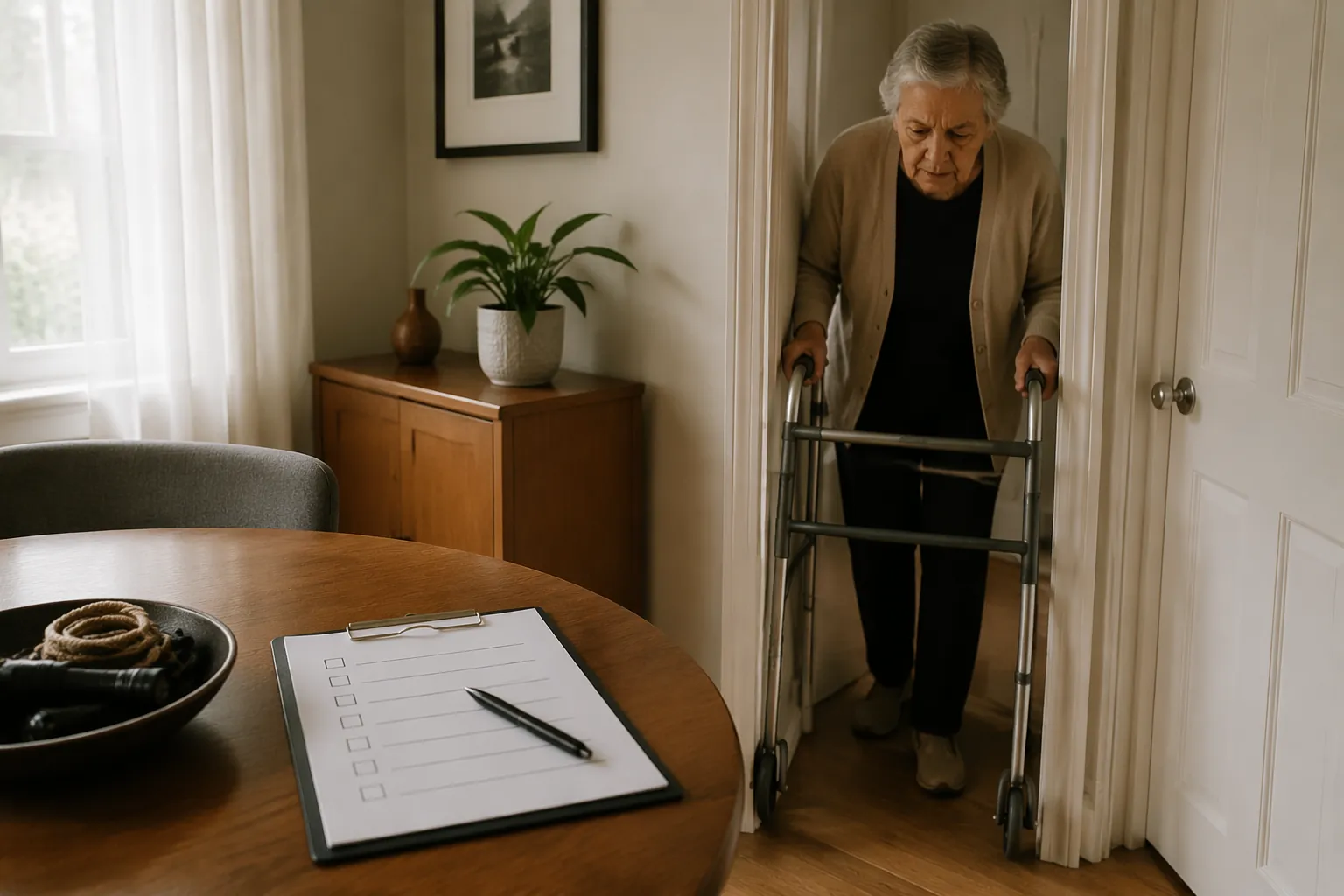
For seniors with limited mobility, the plan has to answer smaller, less glamorous questions before the smoke is visible: Does the walker clear every exit? Can the wheelchair turn in the hallway? Who lifts the portable oxygen concentrator? Where is the 30-day medication supply? Who comes if the adult child is at work, out of town, or blocked by a road closure?
The stakes are not theoretical. U.S. Fire Administration data for 2014–2023 show that adults 65 and older had a fire death risk 2.5 times higher than the population as a whole.[1] Early reporting on the 2025 Los Angeles wildfires described 25 confirmed deaths and said the majority were older adults or people with disabilities who could not evacuate without assistance.[2] That reporting is preliminary, not a final government fatality analysis, but it points to the same practical gap families already know: an evacuation order is only useful if the person can actually leave.
Start With the Parts a Standard Go-Bag Misses
General wildfire guidance from agencies such as the Red Cross, Ready.gov, and CAL FIRE is still the right foundation: sign up for alerts, know evacuation routes, pack essentials, and follow local evacuation orders. The senior-specific work begins where those instructions become too clean for a body that moves slowly or needs equipment.
For a senior with limited mobility, the plan should protect four things at the same time: movement, medication, medical equipment, and human support. If any one of those fails, the rest of the plan can fail with it.
| Planning area | What must be decided before fire season |
|---|---|
| Movement | Which exit, transfer path, vehicle, and assistive device will be used; whether every doorway and turn is wide enough |
| Medication | Where the 30-day supply, medication list, pharmacy information, and prescriber information are kept |
| Medical equipment | How oxygen, CPAP, hearing aids, mobility devices, chargers, and backup batteries travel with the person |
| Human support | Who warns, who drives, who helps transfer, who checks in afterward, and who serves as backup |
| Recovery | Where the person can stay safely, breathe safely, refill medications, charge devices, and move without new fall hazards |
Before Fire Season: Build the Plan Around the Actual Body and Home
The most important work happens before the alert. Once smoke is in the air, nobody should be discovering that a walker catches on the front threshold, the wheelchair cannot turn by the laundry room, or the oxygen tubing snags on the bedroom door.
Measure the Exit Path, Not Just the Door
Ready.gov tells older adults to plan for their specific needs, including mobility and medical equipment, and CAL FIRE’s evacuation guidance emphasizes preparing routes and supplies before a wildfire threatens.[4][5] For someone using a walker or wheelchair, that means physically measuring and testing the full path from bed or favorite chair to the vehicle.
- Measure each doorway the person may need to pass through, including bedroom, bathroom, hallway, garage, patio, and front door exits.
- Test the route with the actual walker, wheelchair, cane, or transfer chair, not an estimate of its size.
- Check whether the device catches on rugs, raised thresholds, cords, pet gates, doorstops, or uneven flooring.
- Confirm there is turning space where turns are required, especially near beds, bathrooms, laundry rooms, narrow hallways, and garage entries.
- Choose one primary exit and at least one backup exit, then keep both routes clear during fire season.
The practice run should be slow enough to notice ugly details. If the walker has to be lifted over a threshold on an ordinary afternoon, it will be worse when the person is tired, scared, coughing, or trying to move in the dark. If the wheelchair cannot fit through the side gate, that is not a backup exit; it is a false reassurance.
Plan the Bed-to-Car Transfer
Many evacuation checklists begin at the door. A limited-mobility plan begins wherever the older adult may be when the order comes: in bed, in the bathroom, in a recliner, on the porch, or connected to a device. Write down the exact transfer sequence for the hardest common scenario, such as leaving from bed at night.
- Which side of the bed is safest for standing or transferring?
- Where are shoes with closed backs kept?
- Where is the walker, wheelchair, cane, or transfer belt kept overnight?
- Can the person get from bed to bathroom to exit without crossing loose rugs or cords?
- Which vehicle seat is easiest to enter, and does the person need a step stool, swivel cushion, transfer board, or two-person assist?
This is also where the older adult’s preferences belong. A person who lives independently may know which chair is easiest to rise from, which shoes feel stable, and which helper makes transfers feel safer. The plan should not treat those details as decoration; they are part of the safety system.
Keep 30 Days of Medication Ready
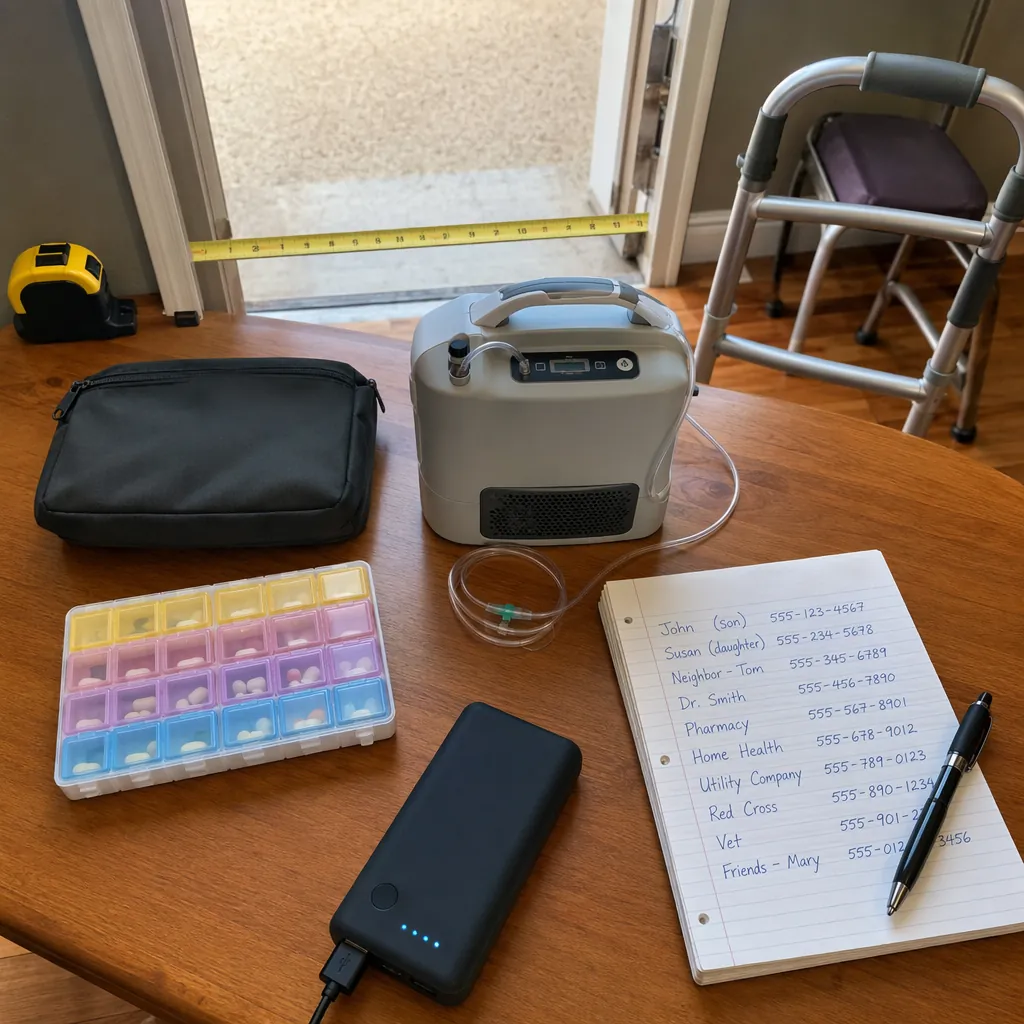
For older adults, the Red Cross and Ready.gov recommend keeping a 30-day supply of medications and medical supplies when possible.[3][4] That is a major difference from the short emergency kit many families picture. A wildfire evacuation can turn into days away from home, pharmacy disruption, insurance refill problems, or a move between a relative’s house, hotel, shelter, and clinic.
- Store a current medication list with drug names, doses, timing, prescriber names, pharmacy information, allergies, and major diagnoses.
- Keep medications in a grab-ready container that travels with the person, not in a separate bag that can be loaded into another car.
- Include inhalers, insulin supplies, glucose monitoring supplies, eye drops, hearing-aid batteries, wound-care supplies, and over-the-counter items used daily.
- Ask the pharmacist or clinician ahead of fire season what refill flexibility is available during evacuation or local emergency declarations.
- Review the medication plan after any hospital stay, dosage change, or new prescription.
Do not rely on memory. Under stress, even careful caregivers forget routine things because attention goes to the plume, the alert, the road, the dog, the oxygen cord, the locked gate, or the neighbor knocking. The written medication list is there for the moment when nobody’s memory is at its best.
Make Medical Equipment Travel-Ready
Power-dependent equipment needs its own evacuation plan. Ready.gov specifically advises older adults to consider how they will manage medical devices, assistive equipment, and power needs during an emergency.[4] For wildfire planning, that means deciding what goes in the car first, what stays attached to the person, and what backup power is realistic.
- Label oxygen equipment, CPAP, chargers, batteries, hearing-aid supplies, mobility devices, and cases with the person’s name and phone number.
- Keep device chargers in the same place every day during fire season, preferably already packed with the equipment.
- Charge portable batteries on a schedule, not only when a fire starts.
- Ask equipment suppliers what backup batteries, car adapters, oxygen cylinder options, or replacement procedures apply during evacuation.
- Write down model numbers, supplier contacts, and instructions for switching from home power to portable use.
If the older adult uses oxygen, the plan should also account for tubing management. Tubing that is harmless on a quiet morning can become a trip line when someone is moving fast, turning sharply, or being helped by a neighbor who does not know the house.
Replace the Single Emergency Contact With a Support Network
One emergency contact is fragile. Phones die, roads close, caregivers work, and alerts arrive when the most reliable person is not nearby. A scoping review on wildfire impacts and older adults found that limited social support can increase risk because older adults may not receive adequate warning or may be unable to evacuate alone.[6] The same review also noted that wildfire-and-older-adult research remains limited, so the safest conclusion is practical rather than sweeping: a plan that depends on one person is too easy to break.
Build a contact list with assigned jobs, not just names.
| Role | Assigned person | Backup |
|---|---|---|
| Warning check | Person who confirms alerts were received | Second person who calls if there is no answer |
| Transportation | Person who drives the older adult | Neighbor, relative, or ride plan if roads split the family |
| Transfer help | Person trained to help with walker, wheelchair, or vehicle transfer | Second trained helper if a two-person assist is needed |
| Equipment lead | Person responsible for oxygen, CPAP, chargers, batteries, and mobility device | Backup who knows where everything is stored |
| Medication lead | Person responsible for medication container and medication list | Backup who can contact pharmacy or prescriber |
| Post-evacuation check | Person who confirms safe arrival, breathing needs, device charging, and medication access | Second caller if the first cannot reach the family |
The Center for Caregiver Advancement describes caregivers as a vital link in wildfire emergencies while also noting that caregivers often lack appropriate resources and support.[9] That fits what many families experience: the person expected to solve the evacuation may also be the person driving through smoke, lifting equipment, calling siblings, and trying to keep a parent from falling.
Practice Once Before It Is Urgent
A practice evacuation does not need to be theatrical. It should answer whether the plan works at ordinary speed with ordinary equipment. Start from the place the older adult is most likely to be, move to the chosen exit, load the assistive device and medical equipment, sit in the vehicle, and confirm that the medication container is physically with the person.
Time matters, but speed is not the only measure. Watch for loss of balance, rushed standing, unsafe reaching, confusion over who carries what, and any point where the older adult has to let go of a stable surface before the next one is available. If a helper has to say, “Just hurry,” the plan needs repair.
When a Fire Threatens: Leave Earlier Than the Standard Plan Assumes
This guide is educational planning information, not a substitute for evacuation orders, emergency services, clinician advice, or instructions from local fire agencies. If officials order evacuation, follow that order. For seniors with limited mobility, the safer practical approach is to leave earlier when possible, because every transfer, device change, medication check, and doorway takes longer than a standard checklist assumes.
The fall risk deserves special care, but it should be described accurately. The available materials do not show a measured fall rate specifically during wildfire evacuations. What they do show is that falls are already a major risk for older adults: the CDC reports that more than 38,000 adults 65 and older died from falls in 2021, and about 1 in 4 older adults falls each year.[7] The National Council on Aging also identifies falls and fires as serious home hazards for older adults.[8] It is reasonable to treat rushed, smoky, unfamiliar evacuation conditions as a moment when known fall-prevention basics matter more, not less.
Use a Short, Physical Departure Sequence
At the moment of departure, long checklists can become noise. Use a short sequence that keeps the person, mobility device, medication, and power-dependent equipment together.
- Confirm the evacuation instruction or local threat information, then start the support-network calls.
- Help the older adult put on stable shoes, glasses, hearing aids, and any brace or mobility support used for safe walking.
- Move medications, medication list, identification, phone, charger, and essential medical supplies into the same bag or container that stays with the person.
- Switch oxygen, CPAP, or other equipment to the planned portable setup if needed, following clinician or supplier instructions.
- Use the tested exit path and avoid improvising unless the primary route is unsafe.
- Load the mobility device, medical equipment, and medication container before leaving the driveway.
The medication container should not go in a trunk that might be unloaded separately, and the walker should not be buried under luggage. If the first stop is a shelter, hotel, clinic, or relative’s house, the person may need both before anyone has time to reorganize.
Slow Down the Dangerous Moments
Evacuation creates pressure to move quickly, but the most dangerous moments for a person with limited mobility are often brief: standing from bed, stepping over a threshold, turning with a walker, descending stairs, crossing a wet driveway, or entering the vehicle. Those moments deserve deliberate slowing.
- Keep both hands available for the older adult whenever possible; bags and devices should be carried by someone else.
- Do not ask the person to rush a transfer from sitting to standing.
- Use the walker, wheelchair, cane, or transfer device the person normally trusts unless conditions make it unsafe.
- Avoid loose slippers, backless shoes, long robes, and dragging blankets during departure.
- Treat fire-hose runoff, ash, gravel, curbs, and uneven pavement as fall hazards, especially in low visibility.
- If stairs are unavoidable, use the planned helper arrangement rather than an improvised lift by one panicked person.
A neighbor who wants to help may need one clear job: carry the oxygen concentrator, open doors, move the walker into the car, or stand by the vehicle while the caregiver handles the transfer. Vague help can become crowding. Assigned help creates room for the older adult to move.
Keep Communication Simple
Smoke, sirens, alerts, and multiple callers can overwhelm the person evacuating and the people helping. Use plain statements: “We are leaving now.” “Use the front door.” “Your walker is next to you.” “Your medications are in this bag.” “Sit before we move the oxygen.”
If the older adult has hearing loss, cognitive changes, anxiety, or low vision, the practice plan should already account for that. During the evacuation, the goal is not to explain every possibility. The goal is to make the next safe action obvious.
At the Evacuation Destination: Rebuild the Safety Setup Immediately
Arrival is not the end of the evacuation. A hotel room, shelter, clinic waiting area, or relative’s house can introduce new fall hazards and medication problems within the first hour.
- Put the walker, wheelchair, cane, glasses, hearing aids, phone, water, and medications within reach before the caregiver steps away.
- Check the route from bed or chair to bathroom for rugs, cords, low furniture, pets, poor lighting, and thresholds.
- Charge phones, hearing aids, oxygen batteries, CPAP batteries, and other essential devices as soon as power is available.
- Confirm the next medication doses and document any missed or delayed doses to discuss with a clinician or pharmacist if needed.
- Tell the support network where the older adult is, what equipment arrived, and whether any supplies are missing.
If the destination is a public shelter, ask early about accessible bathrooms, charging access for medical equipment, refrigeration if a medication requires it, and a place where the person can sit without blocking pathways. These are not comfort extras; they affect whether the older adult can move, breathe, sleep, and continue medications safely.
After the Fire: Do Not Let Return Home Become the Second Emergency
The return home should wait for official clearance and local instructions. The CDC’s wildfire safety guidance warns that returning after a wildfire can involve hazards such as smoke, ash, damaged structures, and other health risks.[10] The National Center for Healthy Housing also emphasizes monitoring conditions and protecting health during wildfire smoke and recovery periods.[11]
Check Air, Power, and Medication Before the First Night Back
For an older adult with respiratory disease, oxygen use, heart disease, or frailty, “home is standing” is not the same as “home is safe.” Before the first night back, confirm indoor air quality guidance from local officials, whether power is stable enough for medical devices, whether backup batteries are charged, and whether enough medication remains to get through pharmacy delays.
- Follow local fire, public health, and emergency management instructions about when to return.
- Check whether smoke, ash, or odors remain inside the home, especially in bedrooms.
- Verify that oxygen, CPAP, refrigeration, lighting, phone charging, and mobility-device charging needs can be met.
- Count remaining medications and contact the pharmacy, prescriber, or insurer promptly if refills are needed.
- Schedule medical advice when symptoms, missed medications, breathing problems, dizziness, confusion, wounds, or a fall occurred during evacuation.
Recheck Fall Hazards Created by the Evacuation
Even if the home was not damaged by fire, the evacuation may have changed the environment. Bags may be left in hallways. Cords may be stretched to charge devices. Rugs may have shifted. Outdoor surfaces may be coated with ash, mud, or water. A walker may have been adjusted, bent, or loaded into a car in a way that loosened a part.
- Walk the bed-to-bathroom route before the older adult uses it at night.
- Clear the main exit path again, including bags that came back from evacuation.
- Inspect walker tips, wheelchair brakes, cane tips, oxygen tubing, and charging cords.
- Restore night lights, grab points, stable seating, and frequently used items to their normal safe locations.
- Update the written plan with anything that failed, slowed down, or frightened the older adult during the evacuation.
That last step matters. A real evacuation, even a near miss, is the most honest test the plan will get. If the pill organizer was left behind, it needs a new storage place. If the walker caught at the threshold, the threshold needs repair or the route needs to change. If the only helper did not answer, the contact list needs more than one backup.
A Practical Wildfire Evacuation Checklist for Seniors With Limited Mobility
Use this as a working checklist, then adapt it with the older adult, clinicians, equipment suppliers, local emergency guidance, and the people who will actually show up.
| When | Action |
|---|---|
| Before fire season | Measure and test every exit route with the actual walker, wheelchair, cane, or transfer chair. |
| Before fire season | Choose a primary and backup exit, then keep both free of rugs, cords, clutter, and blocked gates. |
| Before fire season | Practice the bed-to-car route, including shoes, transfer, device change, and vehicle loading. |
| Before fire season | Keep a 30-day medication and medical-supply plan when possible, with a current written medication list. |
| Before fire season | Label medical equipment and keep chargers, backup batteries, and supplier contacts ready. |
| Before fire season | Assign warning, transportation, transfer, equipment, medication, and post-evacuation roles to more than one person. |
| When fire threatens | Leave earlier when possible and follow local evacuation orders and fire-agency instructions. |
| During evacuation | Keep medications, assistive devices, oxygen or device supplies, phone, charger, hearing aids, and glasses with the person. |
| During evacuation | Slow down transfers, thresholds, stairs, wet pavement, ash, gravel, and vehicle entry. |
| At destination | Set up the walker or wheelchair, bathroom route, medications, chargers, and equipment before the caregiver steps away. |
| After return | Wait for official clearance, monitor air and power conditions, refill medications, and recheck fall hazards. |
For seniors with limited mobility, evacuation safety is not just a route and a bag. It is a tested support system that protects movement, medication, equipment, breathing needs, and footing before, during, and after the fire.
References
- Older Adults Fire Death and Injury Risk, U.S. Fire Administration
- Wildfire Evacuations Spell Difficulties for Disabled, Elderly Residents, AJMC
- Older Adults Emergency Preparedness, American Red Cross
- Older Adults, Ready.gov
- Go! Evacuation Guide, CAL FIRE Ready for Wildfire
- Older Adults and Wildfire: A Scoping Review of Literature, PMC
- Facts About Falls, Centers for Disease Control and Prevention
- Hidden Home Hazards: Older Adults More Likely to Die From Falls and Fires, National Council on Aging
- Navigating Wildfire Emergencies, Center for Caregiver Advancement
- Wildfire Safety, Centers for Disease Control and Prevention
- Wildfires: During the Fire, National Center for Healthy Housing
Related reading
Noticed something outdated or inaccurate on this page? Flag a correction. We review every report against CDC, NIA, and AARP HomeFit guidance before updating a page.
Part of the Fall Prevention section.