
How long does wildfire smoke affect seniors in NYC?
A timeline-based guide for NYC caregivers on how long wildfire smoke symptoms typically last in seniors, when delayed symptoms may appear, and when to seek medical attention — based on national health sources and recent NYC emergency data.
For an older parent in NYC, the practical answer is this: mild wildfire-smoke irritation may settle within 24 to 48 hours after the smoke exposure ends, but symptoms can also first appear or get worse during that same 24- to 48-hour window. A cough or shortness of breath that persists beyond that period is not something to simply watch indefinitely, especially if the person has asthma, COPD, heart disease, or diabetes. UCLA Health describes mild symptoms as usually improving within 24 to 48 hours after exposure stops, while the American Lung Association warns that symptoms can begin 24 to 48 hours after exposure has ended.[1][2]
That timing matters because the official smoke alert and the body do not always end the event at the same moment. A parent may sound fine on the phone the evening the sky clears, then cough more the next morning. Another may insist that a little chest tightness is normal, even though they are doing less walking around the apartment than usual. For caregivers, the question is not only how smoky the air looks now, but what has changed since the exposure.
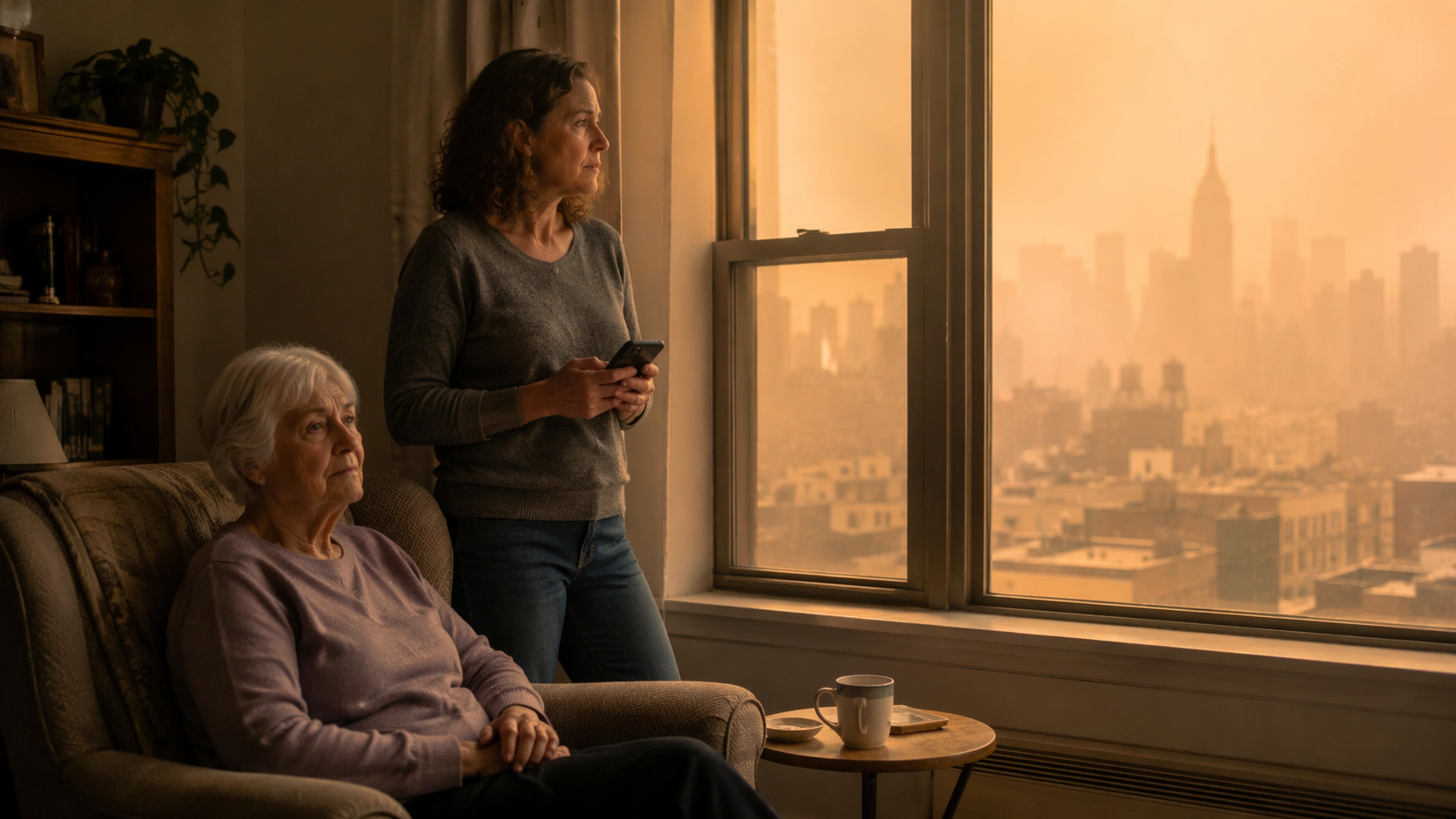
The 24- to 48-hour window caregivers can actually use
NYC Health classifies adults 65 and older as a sensitive group during fire, smoke, and high-ozone air-quality events.[3] That does not mean every older adult will have a serious reaction. It does mean the wait-and-see period should be shorter and more deliberate than it might be for a younger adult with no health conditions.
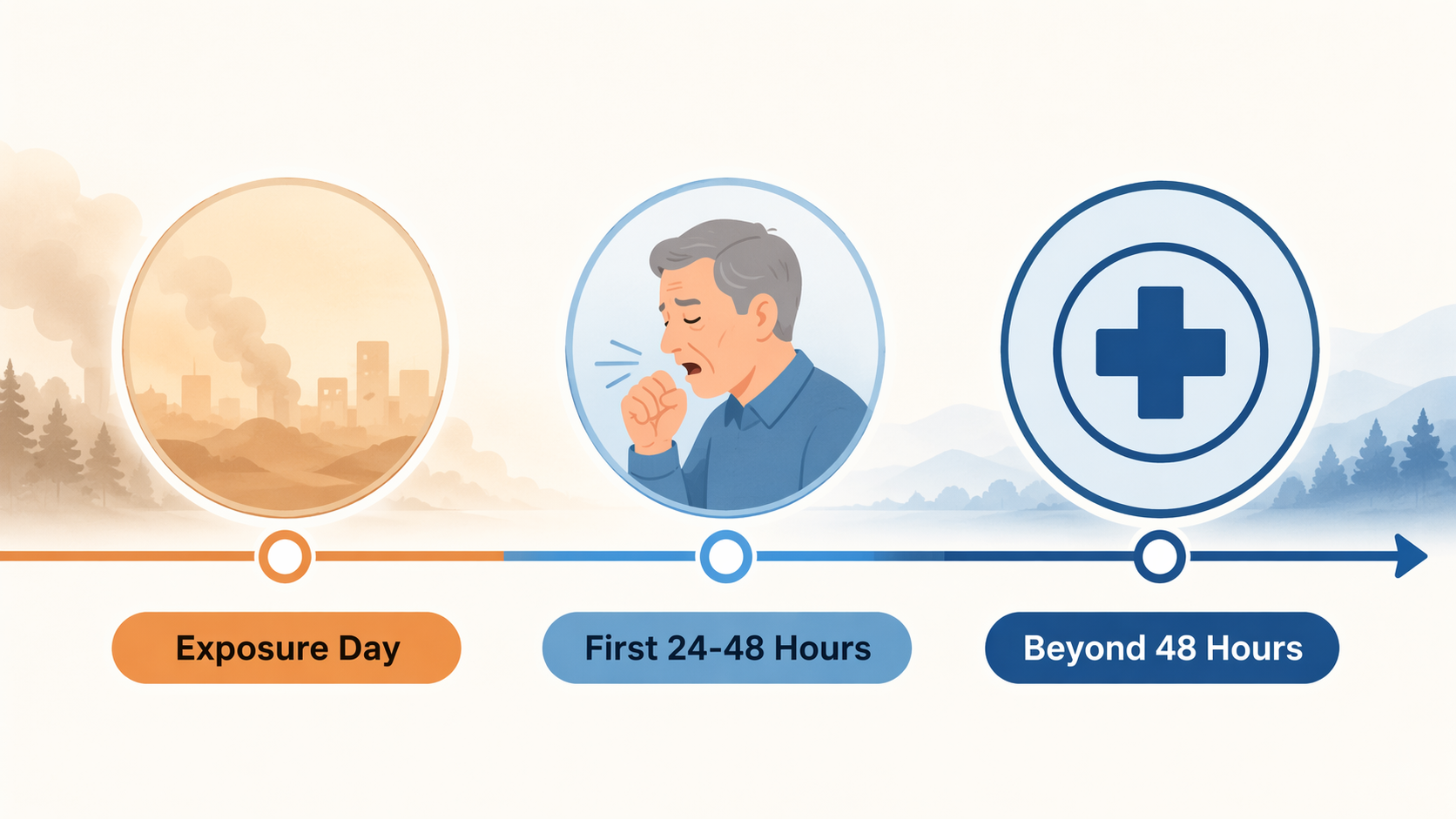
| Time period | What may happen | Caregiver decision point |
|---|---|---|
| Exposure day | Irritation or breathing symptoms may happen while smoke levels are high. | Reduce exposure where possible and note what is new for this person. |
| First 24 hours after exposure ends | Mild symptoms may start improving, but delayed symptoms may also begin. | Check whether cough, breathing, or usual activity is better, stable, or worse. |
| 24 to 48 hours after exposure ends | Mild symptoms often continue to settle; delayed symptoms can still appear or worsen. | Be more cautious if the person has asthma, COPD, heart disease, or diabetes. |
| Beyond 48 hours | Persistent cough or shortness of breath deserves medical attention. | Call a clinician or seek care, especially if symptoms are worsening or limiting activity. |
Exposure day: do not judge only by how the sky looks
On the smoky day itself, the apartment becomes part of the care plan. Windows, errands, air conditioning, masks, and heat all become medical-adjacent decisions. The useful baseline is simple: what is different for this parent today? Are they coughing more than usual? Are they avoiding normal movement around the apartment? Do they sound breathless during ordinary conversation? The answer may be obvious, or it may be the kind of small change that only a caregiver notices.
This is also the day to write down or text yourself the starting point. Not a medical chart, just a short note: when the smoke was worst, what symptoms were present, and whether the parent has a known heart or lung condition. That note helps later, when the city alert has passed but the coughing has not.
The first 24 hours: improvement is reassuring, but absence of symptoms is not final
If exposure has ended and mild irritation is already improving, that is a good sign. UCLA Health's 24- to 48-hour recovery window is most useful here: mild symptoms should generally move in the direction of settling once the person is no longer breathing smoky air.[1]
But a quiet first night does not completely close the file. The American Lung Association specifically notes that symptoms can show up 24 to 48 hours after exposure ends.[2] For a caregiver, that means the next day still counts. A parent saying "I'm fine" immediately after the event is helpful, but it is not the same as knowing how they are doing the next morning.
24 to 48 hours later: the delayed-symptom zone
This is the period that gets missed. The air may look better, the alert may have changed, and everyone may be tired of talking about smoke. Still, delayed cough or breathing symptoms can appear here, and mild symptoms that were supposed to be fading may instead become more noticeable.[2]
The most useful check is comparative, not dramatic. Is the cough less frequent than yesterday, about the same, or worse? Is shortness of breath new? Is the person avoiding stairs, walking, or routine tasks more than usual? If they have asthma, COPD, heart disease, or diabetes, it is reasonable to treat uncertainty as a reason to call rather than a reason to wait longer.
After 48 hours: lingering breathing symptoms need a different response
By the time the 48-hour mark has passed, the caregiving question changes. It is no longer only "Is this from the smoke?" It becomes "Why is this still happening, and does someone need to examine them?" Persistent cough or shortness of breath after that window deserves medical attention, particularly in an older adult with known lung or heart risk.
There is no NYC-specific study that gives a clean recovery clock for every senior after wildfire smoke, and the national 24- to 48-hour window is not a guarantee for people with chronic disease. That limit is worth saying plainly. A timeline is useful because it gives caregivers a way to organize the next two days, not because every older body follows it.
Why NYC caregivers should take symptoms seriously even after one smoke event
The strongest recent NYC-specific emergency-care signal comes from June 2023, when wildfire smoke affected New York. On the worst day, asthma-associated emergency-department visits increased 81.9% statewide, and among adults 70 and older the increase was 76.5%, according to a CDC MMWR report.[4] That data does not tell us exactly how long an individual senior's cough will last, and it is not July 2026 data. It does show that wildfire-smoke days produced a real emergency-care response among older adults in New York.
For a caregiver, the point is not to panic over every cough. It is to avoid dismissing a change just because the smoke was outdoors and the parent was mostly inside. Fine-particle smoke can turn a familiar apartment routine into a respiratory stress test, especially for someone whose lungs or heart already have less reserve.
The July 2026 NYC context: smoke precautions can collide with heat safety
For the July 2026 wildfire-smoke event, NYC Emergency Management said the air-quality forecast for Thursday, July 16, was expected to reach an AQI of 200, in the Unhealthy category. The city activated Code Grey and announced free KN95 mask distribution at libraries, NYPD precincts, and FDNY firehouses.[5]
The same city announcement included an important reminder from the health commissioner: when heat and smoke guidance conflict, heat safety takes precedence.[5] That matters in real apartments. Keeping windows closed may reduce smoke exposure, but an overheated apartment can become dangerous for an older adult. A caregiver may need to choose the safer room, use air conditioning if available, relocate temporarily, or ask for help rather than follow smoke advice in a way that creates a heat problem.
Masks are also practical, but not magic. A KN95 may help reduce exposure during a necessary errand or while moving between buildings, but it does not answer the recovery question afterward. The 24- to 48-hour symptom watch still matters once the errand is over.
When to call a clinician or seek care
The boundary should be clearer than most public warnings make it: persistent cough or shortness of breath beyond the 24- to 48-hour window after exposure ends deserves medical attention. Shortness of breath should carry more weight than general irritation. In an older adult, especially one with asthma, COPD, heart disease, or diabetes, breathing symptoms are not a place to prove toughness.
- Call a clinician if cough or breathing symptoms are not improving after 24 to 48 hours.
- Call sooner if shortness of breath is new, worsening, or limiting normal movement.
- Be more cautious when the person has asthma, COPD, heart disease, or diabetes.
- Do not rely only on whether the official smoke alert has ended; delayed symptoms can still appear.
- If you are judging by phone, listen for pauses, effort, or a change from the person's usual voice and activity level.
A long-distance caregiver has a harder job because the evidence is filtered through someone who may be minimizing symptoms. In that situation, the question "Are you short of breath?" may get a quick no. More useful questions are often concrete: Did you walk to the bathroom normally? Did you need to sit down after getting dressed? Are you coughing more than yesterday? Has anyone else heard you breathing differently?
If the answers are vague but the parent has a serious heart or lung history, it is reasonable to involve a clinician. The risk is not that every cough becomes an emergency. The risk is that a real change gets normalized because smoke events feel temporary.
Several smoky days are different from one bad afternoon
A short smoke episode and repeated smoky days should not be treated as the same exposure. Stanford researchers have described wildfire smoke as about 10 times more toxic than ambient fossil-fuel pollution and note that repeated exposure over 5 to 7 days can damage the lungs, blood, and heart.[6] That does not mean one smoky day will cause lasting harm in every senior. It does mean a week of recurring smoke deserves a lower threshold for checking symptoms and seeking medical advice.
Older-adult research points in the same direction. A scoping review reported a 7.2% increase in respiratory hospital admissions among Medicare enrollees during intense smoke days.[7] That is a population-level finding, not a prediction for one parent in one apartment. Still, it supports the practical caution caregivers already feel when a senior with limited respiratory reserve spends multiple days in poor air.
What to watch without turning the apartment into a clinic
The monitoring does not need to be elaborate. It needs to be consistent for two days after exposure ends. Track whether cough and breathing are improving, stable, or worsening. Notice whether the person is doing their usual activities or quietly cutting them back. Keep the medication list nearby if you already maintain one, especially inhalers, heart medications, and diabetes medications.
Use current air-quality information rather than memory of yesterday's sky. NYC alerts and AirNow.gov are the better guides when conditions are changing. If the air improves, the symptom clock still runs for 24 to 48 hours. If smoke persists or returns, the clock is not clean; you are dealing with continuing or repeated exposure, not a finished event.
The endpoint is practical: after wildfire-smoke exposure ends, watch an older parent closely for the next 24 to 48 hours. Mild irritation should generally improve in that window. Symptoms can still appear late. Persistent or worsening cough or shortness of breath, especially in a senior with heart or lung disease, is the point to call a clinician or seek care.
References
- The effects of wildfire smoke on your lung health, UCLA Health
- Wildfire Smoke and Lung Health, American Lung Association
- Air Quality Guidance: Fire, Smoke, and High Ozone, NYC Health
- Notes from the Field: Asthma-Associated Emergency Department Visits During a Wildfire Smoke Event — New York, June 2023, CDC MMWR
- NYC Emergency Management's Emergency Plan Moves Into Thursday's Wildfire Smoke, NYC Emergency Management, July 15, 2026
- What we know about the health effects of wildfire, Stanford Report
- Wildfires and Older Adults: A Scoping Review of Impacts, Risks, and Interventions, PMC
Related reading
Noticed something outdated or inaccurate on this page? Flag a correction. We review every report against CDC, NIA, and AARP HomeFit guidance before updating a page.
Part of the Fall Prevention section.