
How to use AC for seniors during wildfire smoke and heat
When wildfire smoke and extreme heat overlap, seniors face a dangerous choice between heat stroke and smoke inhalation. Air conditioning with the right filter and settings resolves both hazards simultaneously, but only if used correctly.
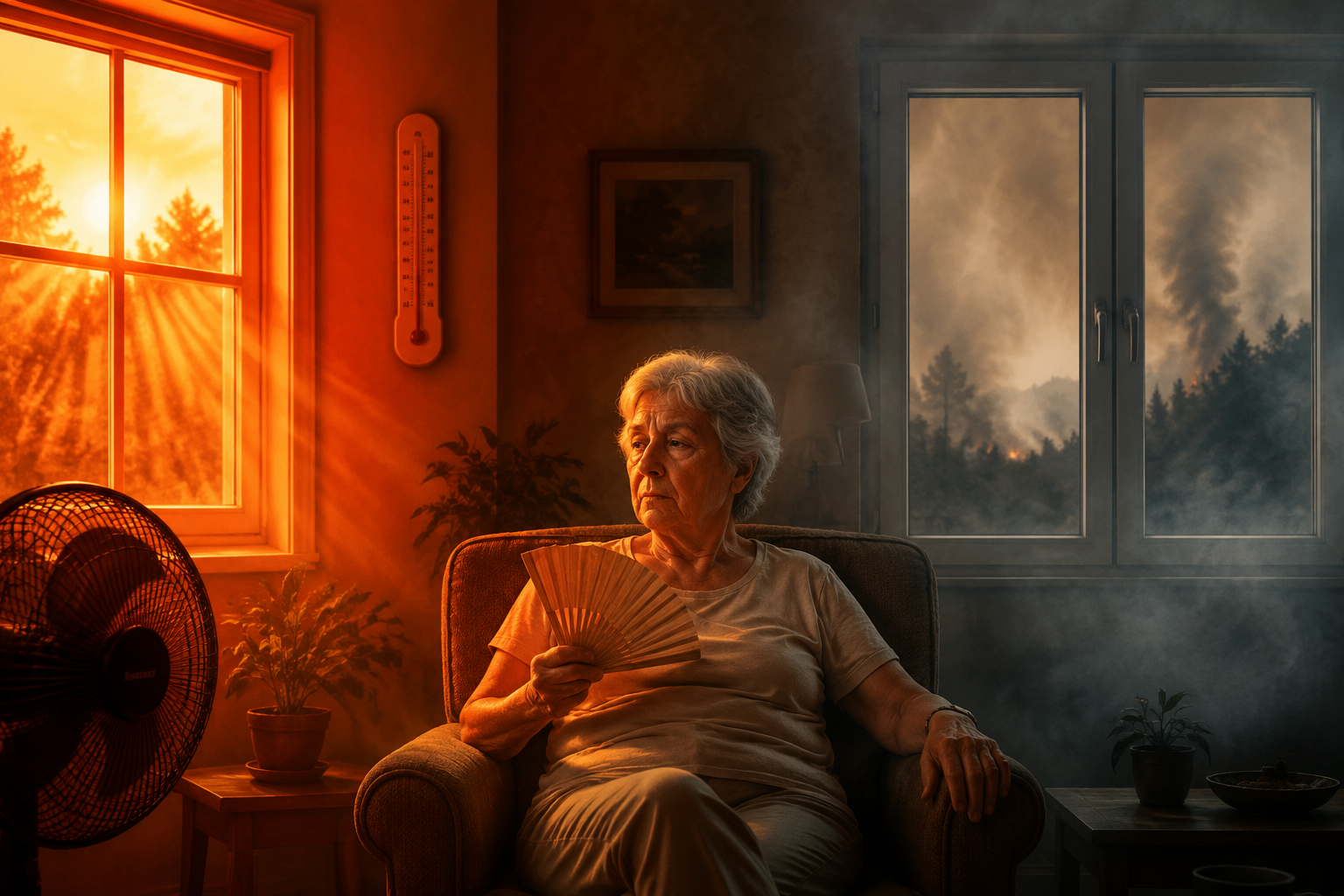
When wildfire smoke and a heat wave arrive together, an older adult should not be left with only two bad choices: open the windows and breathe smoke, or seal the house and sit in dangerous heat. The safest home answer is usually air conditioning, but only when it is set up to cool the room without pulling smoky outdoor air inside.
That setup matters. A central system with a good filter and closed outdoor-air intake is a very different tool from an evaporative cooler that deliberately brings outside air indoors. A portable single-hose unit in a leaky room is different again. In a real house, the right advice starts with the equipment in front of you.
Why Heat Plus Smoke Is Not a Small Inconvenience
Extreme heat is already associated with about 10,000 premature deaths each year in the United States, and wildfire smoke PM2.5 with about 16,000 more, according to a 2026 Federation of American Scientists analysis.[1] EPA training materials on wildfire smoke and heat describe co-exposure as producing worse cardiopulmonary outcomes than either hazard alone.[2] In plain home-safety terms: the sealed, hot room and the cool, smoky room are both unsafe rooms.
The heart-risk signal is especially hard to ignore for older adults. AARP, citing a Circulation study, reports that the risk of dying from a heart attack nearly doubled during extreme heat waves with high PM2.5 levels, with greater risks for women and older people.[3] That does not mean every smoky hot day creates the same danger for every person. It does mean a caregiver should treat heat-and-smoke overlap as a health event, not as a comfort problem.
Air conditioning access also appears to change smoke-related health risk. A 2025 study discussed by Eos analyzed more than 50 million California emergency department visits from 2012 through 2019 and found that people in areas with low AC availability had a 22% greater risk of respiratory ED visits associated with wildfire-smoke PM2.5 exposure.[4] That is one California-based analysis, so it should not be stretched into a universal household guarantee. But it supports what caregivers often see: cooling equipment can become health protection when smoke closes off the usual way to cool a house.
The Fast Decision: Use AC, Then Control the Air It Moves
For older adults during wildfire smoke, the working rule is simple enough to act on: cool the occupied room, reduce outdoor-air intake, and filter the recirculated air as well as the system safely allows. Do not spend the first hour debating the whole house. Start with the room where the older adult is actually sitting or sleeping.
- Close windows and exterior doors once active cooling is available.
- Set the AC to recirculate if that option exists, or close the outdoor-air intake damper.
- Use a MERV 13 filter or higher if the HVAC system can handle it; otherwise use the highest compatible filter while seeking professional guidance.
- Keep the older adult in the cleanest, coolest room rather than trying to make every room perfect.
- Do not use an evaporative cooler during smoke unless public-health guidance for your area says outdoor smoke has cleared.
CDC identifies adults 65 and older as more vulnerable to heat because of factors such as chronic medical conditions, reduced ability to adjust to temperature changes, and medications including some beta blockers, diuretics, and blood pressure drugs that can increase heat sensitivity.[5] CDC also warns that people with chronic heart or lung disease are at higher risk from wildfire smoke.[6] A parent with heart failure, COPD, asthma, prior stroke, or significant coronary disease is not starting from the same risk level as a healthy younger adult.
Check the System Before You Trust It
A caregiver can usually make the first useful check in a few minutes. Find the type of cooling system, then look for the part that either blocks outdoor air or brings it in. The goal is not to become an HVAC technician during a smoke event. The goal is to avoid using the wrong machine in the wrong mode.
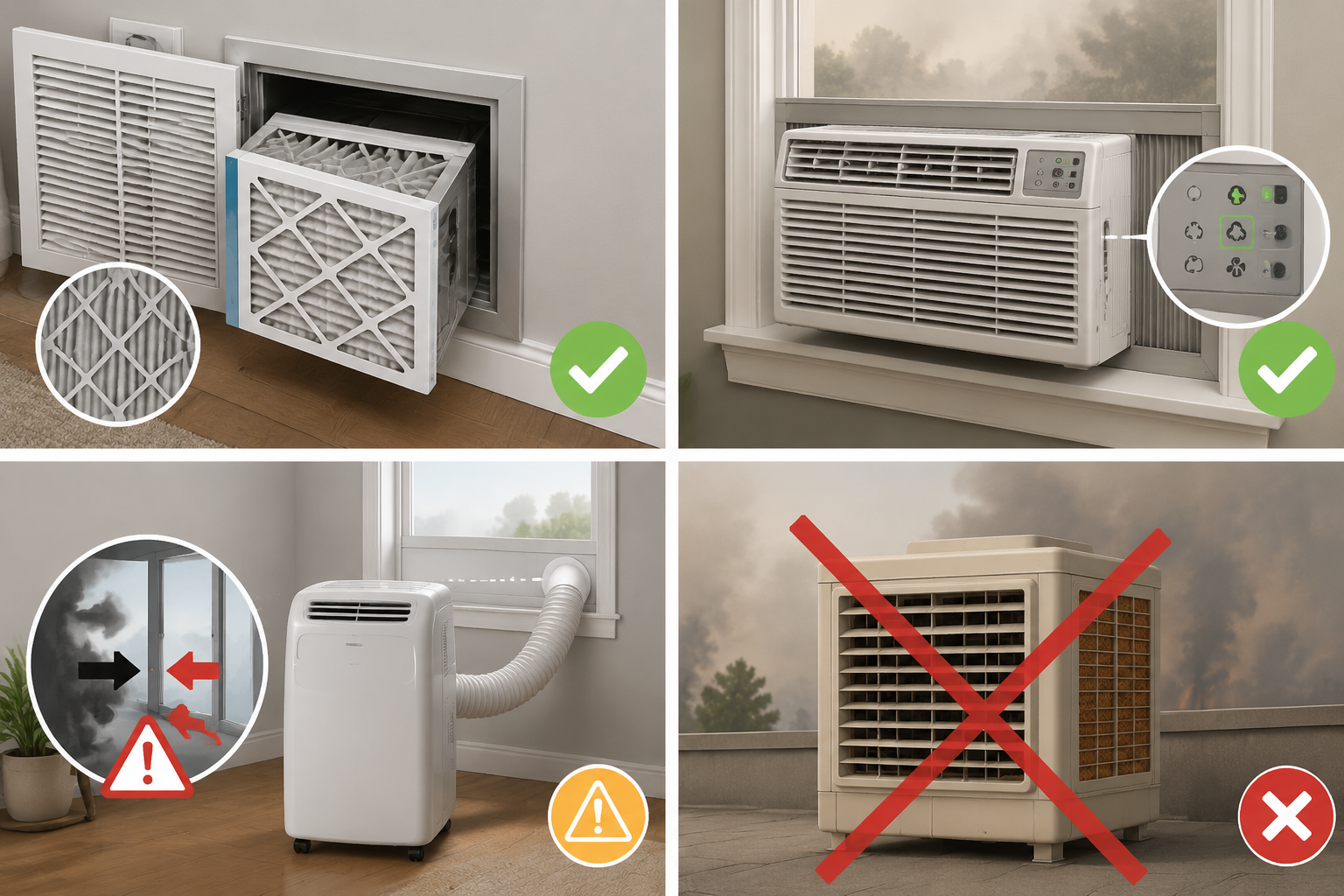
| Cooling equipment | What to do during wildfire smoke and heat | What to watch |
|---|---|---|
| Central HVAC | Run cooling with the outdoor-air intake closed or on recirculate where available. Use MERV 13 or the highest compatible filter. | Older systems may struggle with higher-resistance filters; watch for poor airflow, icing, or system strain. |
| Window AC | Use the cooling setting with the fresh-air vent closed if the unit has one. | Some units have small levers or sliders that are easy to miss; check the manual or label. |
| Portable dual-hose AC | Generally preferable to single-hose models for smoke events because intake and exhaust air are more controlled. | Hoses and window panels still need a tight seal. |
| Portable single-hose AC | Use cautiously; it may cool the room but can create negative pressure that pulls smoky air through leaks. | Check the model guidance, seal gaps, and stop using it as the only plan if smoke smell or symptoms increase. |
| Evaporative cooler | Do not use during smoke because it brings outdoor air indoors. | Switch to refrigerated AC, a clean-air cooling center, or another safe location. |
EPA advises keeping indoor air cleaner during wildfire smoke by closing windows and doors, setting HVAC systems to recirculate when possible, closing outdoor-air intakes, and upgrading filters to MERV 13 or higher if the system can accommodate them.[7] Those are not decorative details. They are the difference between using AC as a heat-and-smoke control and using it as a fan attached to a leaky shell.
Central HVAC: Filter First, Then Intake
For a central system, go to the return grille or filter slot and read the filter size and rating. If a MERV 13 filter that matches the required size is already installed and airflow is normal, that is the best starting point. If the current filter is a low-rated, dirty, or bent filter, replacing it can matter quickly, but do not jam in the wrong size and leave gaps around the edges.
Next, look for outdoor-air intake controls. Some homes have a damper or ventilation control near the air handler, thermostat, or fresh-air duct. Some do not have a meaningful outdoor-air intake to close. If there is a marked outdoor-air damper, close it for the smoke event unless a qualified professional has told you the system must operate differently.
The thermostat should be set to cool the occupied space, not to prove endurance. CDC describes 78°F as a reasonable thermostat setting for older adults, while still emphasizing that needs vary by health status and indoor conditions.[5] If the room is hotter than that and the older adult is drowsy, confused, faint, short of breath, or having chest discomfort, the thermostat setting is no longer the main question.
Window AC: Close the Little Vent
A window air conditioner can be useful during smoke if it is recirculating indoor air. Many units have a small fresh-air vent, exhaust lever, or slider. During wildfire smoke, that control should be closed. If the unit has a “fan only” mode, avoid using that mode as a substitute for cooling if it does not help keep the room temperature safe.
Also check the side panels and the top of the unit. A window AC surrounded by cracked foam, loose accordion panels, and visible daylight can cool the room while letting smoke seep in around it. Tape, weatherstripping, or a temporary seal can help, provided the unit remains safely supported and water can still drain as designed.
Portable AC: Single-Hose Units Need More Suspicion
Portable units are where generic advice gets sloppy. A dual-hose portable AC has one hose for intake and one for exhaust. A single-hose unit exhausts indoor air outdoors, which can create negative pressure in the room. That pressure can pull replacement air through cracks, gaps, wall cavities, fireplace openings, or under doors. During wildfire smoke, the replacement air may be smoky.
Better Health Channel notes that portable air conditioners vary and that some types can draw outdoor air into the room, while evaporative coolers actively bring smoky outdoor air inside and should not be used during smoke.[8] For a single-hose portable unit, the practical question is whether it is improving the room’s total safety: lower heat without noticeable smoke odor, worsening breathing, or visible leakage around the window kit.
- Seal the window insert and hose connection as tightly as the manufacturer allows.
- Close fireplace dampers, unused exterior doors, and obvious gaps where smoky air is entering.
- Keep the older adult near the cooled air, but not directly in a cold blast for hours.
- If smoke smell increases after the unit starts, do not assume the room is protected just because the temperature is falling.
Evaporative Coolers: The Wrong Tool for Smoke
Evaporative coolers, often called swamp coolers, work by drawing outdoor air through wet media and pushing that air indoors. That design can be useful in dry heat when outdoor air is clean. It is a bad bargain during wildfire smoke because the cooling method depends on outdoor-air intake. Better Health Channel specifically advises against using evaporative air conditioners when it is smoky outside.[8]
If an older adult’s home relies on an evaporative cooler and the windows must be closed because of smoke, this is the moment to move to a different cooled, filtered place if one is available. A neighbor’s home with refrigerated AC, a family member’s apartment, a public clean-air cooling center, or a medical facility may be safer than trying to make a swamp cooler behave like filtered AC.
Filtration Helps, but the System Has to Survive It
MERV 13 is a good target because it captures more fine particles than lower-rated common residential filters, and EPA recommends MERV 13 or higher where the system can accommodate it during wildfire smoke.[7] The phrase “where the system can accommodate it” is not a footnote for old houses. It is often the whole problem.
A higher-MERV filter can create more airflow resistance. In a newer, well-sized system, that may be fine. In an older system with undersized ducts, a neglected blower, or a filter slot that already whistles when the fan runs, the wrong filter can reduce airflow enough to impair cooling or strain the equipment. During a heat-and-smoke event, losing cooling is not a small trade.
- Use MERV 13 if the system manual, HVAC professional, or prior service history says the system can handle it.
- If MERV 13 causes weak airflow, unusual noise, icing, short cycling, or poor cooling, step down to the highest filter the system can tolerate and get HVAC advice.
- Do not stack multiple filters unless the system is specifically designed for it.
- Do not run the system with no filter because a better filter is unavailable.
- Keep spare correctly sized filters on hand before smoke season if the older adult depends on home cooling.
A portable HEPA air cleaner can help in the room where the older adult spends the most time, especially when the HVAC filter is limited. It does not replace cooling. In a smoke-and-heat event, a fan-and-filter setup in a room that is still too hot is not an adequate plan for a frail adult.
Make One Clean, Cool Room Instead of Chasing the Whole House
When the house is old, leaky, or only partly air conditioned, choose a room. A bedroom with a door, a central return nearby, few exterior leaks, and enough space for the caregiver to check in is often better than a large living room with a fireplace, sliding door, and afternoon sun. The best room is the one that can stay both cooler and cleaner with the equipment you actually have.
Move medications, water, phone chargers, glasses, hearing aids, mobility aids, and the older adult’s usual chair or walker route into that room. This is not just convenience. A person who has to cross a hot hallway repeatedly to reach the bathroom, pills, or phone is still being exposed to the conditions you are trying to control.
- Close the room door if it helps the room cool and does not block needed supervision.
- Use shades, curtains, or temporary window coverings on sun-facing glass.
- Avoid indoor particle sources: candles, frying, smoking, incense, and unnecessary vacuuming.
- Place a portable air cleaner where airflow is not blocked by curtains, furniture, or bedding.
- Check the person, not just the thermostat: breathing, alertness, chest symptoms, dizziness, and ability to drink matter.
When AC at Home Is No Longer Enough
Air conditioning with recirculation and filtration is risk reduction. It is not a promise that the home is safe under every smoke plume, every heat index, or every medical condition. The more fragile the person and the worse the outdoor conditions, the less patience a caregiver should have for household improvisation.
Relocation becomes the safer plan when the caregiver cannot keep the occupied room cool without bringing in smoke, when the only cooling is an evaporative cooler during active smoke, when a single-hose portable unit appears to be drawing smoke indoors, or when the central system cannot cool adequately with a protective filter in place. It also becomes more urgent when the older adult has advanced COPD, heart failure, unstable angina, recent heart attack or stroke, or needs oxygen or other respiratory support.
Medical advice is needed promptly for chest pain, severe shortness of breath, fainting, new confusion, blue lips, severe weakness, or signs of heat illness. A clean-air shelter, cooling center, family home with properly filtered AC, or healthcare setting may be a better intervention than another filter change. The point is not to win the argument with the house. It is to get the older adult into air that is cool enough and clean enough to breathe.
References
- Heat and Wildfire Smoke: Preparing for Co-Occurring Public Health Emergencies, Federation of American Scientists, 2026.
- Co-exposure to Wildfire Smoke and Heat, U.S. Environmental Protection Agency.
- Wildfire Smoke Health Risks for Older Adults, AARP, 2026.
- Access to Air Conditioning May Affect Wildfire-Related Health Outcomes, Eos.
- Heat and Older Adults Aged 65+, Centers for Disease Control and Prevention.
- Wildfire Smoke and People with Chronic Conditions, Centers for Disease Control and Prevention.
- Wildfires and Indoor Air Quality (IAQ), U.S. Environmental Protection Agency.
- Using air conditioners when it's smoky outside, Better Health Channel.
Related reading
Noticed something outdated or inaccurate on this page? Flag a correction. We review every report against CDC, NIA, and AARP HomeFit guidance before updating a page.
Part of the Fall Prevention section.