
Aftershock Safety for Seniors Who Use Mobility Devices
Aftershocks can follow a major earthquake for days or weeks, and the standard 'drop, cover, hold on' protocol is dangerous for seniors who use walkers, wheelchairs, canes, or are bed-bound. This guide provides a device-specific protocol: stay in place, lock wheels, protect your head and neck, and hold on until shaking stops — supported by pre-identified safe spots in each room.
The main earthquake has stopped. Someone has checked the gas, called family, maybe swept up the first broken glass. Then the floor moves again.
For a senior who uses a walker, wheelchair, cane, or cannot get out of bed, aftershock safety starts with one rule: do not try to transfer while the shaking is happening. Stay where you are, stabilize the device or body position you are already in, cover your head and neck, and hold on until the shaking stops.
That is the practical substitute for the standard “drop, cover, and hold on” instruction when dropping to hands and knees could become the injury. See our main earthquake guide for first-quake response, then use this guide for the aftershocks that follow.
The Aftershock Rule To Repeat Every Time
Use the same short sequence for any shaking, even if it seems small at first:
- Stay where you are. Do not stand up, cross the room, move from bed to chair, or try to reach a doorway during shaking.
- Stabilize what is already supporting you. Lock wheelchair or walker wheels if they have locks; brace yourself against the bed, chair, or mobility device.
- Get lower only if you can do it safely. “Lower” may mean leaning forward in a wheelchair, bending over a walker, or staying flat in bed—not going to the floor.
- Cover your head and neck. Use your arms, a pillow, a blanket, a book, or whatever is already within reach.
- Hold on until the shaking stops. After it stops, wait a moment before moving; the room may be darker, messier, or more slippery than it was seconds earlier.
This is not because every aftershock will be severe. It is because no one can judge the final strength of shaking in the first second, and a person with limited mobility has less room for a bad guess.
The CDC says aftershocks can happen minutes, days, weeks, or even months after the main earthquake.[1] That long tail is what makes a repeatable plan necessary. Family may be present for the first quake and gone for the next one.
The injury pattern also argues against unnecessary movement. The CDC notes that most earthquake-related injuries and deaths are caused by falling or flying objects—such as TVs, lamps, glass, and bookcases—or by being knocked to the ground.[1] For many older adults, the safest aftershock response is not a dramatic move to a supposedly safer place. It is making the place they are already in less dangerous.
If You Use A Walker
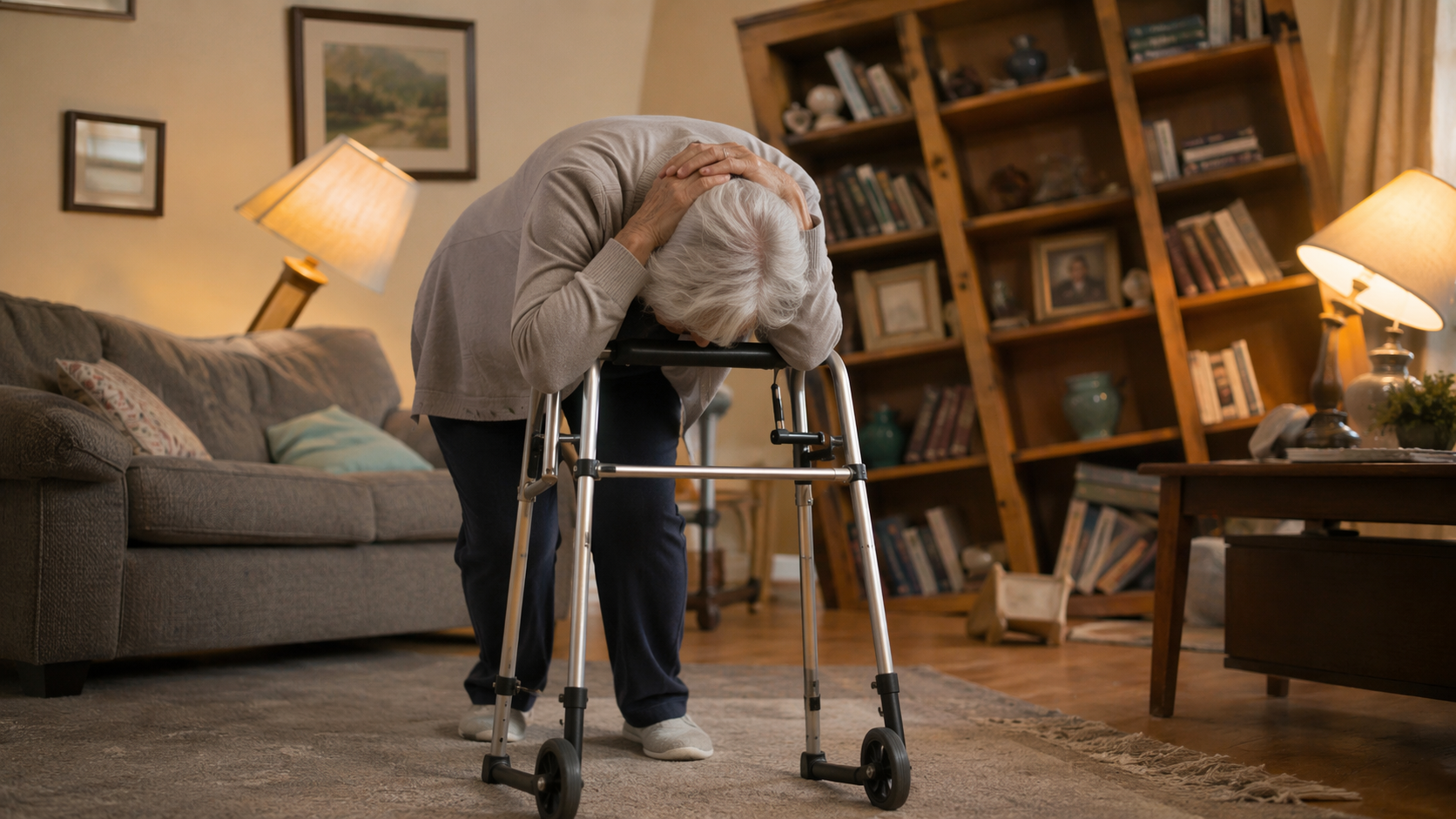
A walker is support, but during shaking it can also roll, tip, or pull the person forward. Ready.gov’s earthquake guidance for people using walkers is to lock the wheels, carefully get as low as possible, bend over, cover the head and neck, and hold on until the shaking stops.[2]
In a real living room, that means this:
- Stop walking as soon as shaking starts.
- Lock the walker wheels if the walker has locks and you can reach them without bending so far that you lose balance.
- Keep both hands on the walker until you feel steady enough to cover.
- Bend forward only as far as your legs, back, and balance allow.
- Cover your head and neck with one arm, both arms, a nearby cushion, or a book.
- Hold the walker or a stable surface until the shaking stops.
Do not try to “drop” beside the walker unless you already know you can get down and back up safely without help. Do not abandon the walker to cross to a table. Do not turn around looking for a better spot while the floor is moving. Turning is often where the fall happens.
After the shaking stops, pause before taking the first step. Look for shifted rugs, spilled water, broken glass, fallen books, and furniture that has moved into the walking path. If the walker basket or tray has loose items, remove anything that could fall underfoot before the next aftershock.
If You Use A Wheelchair
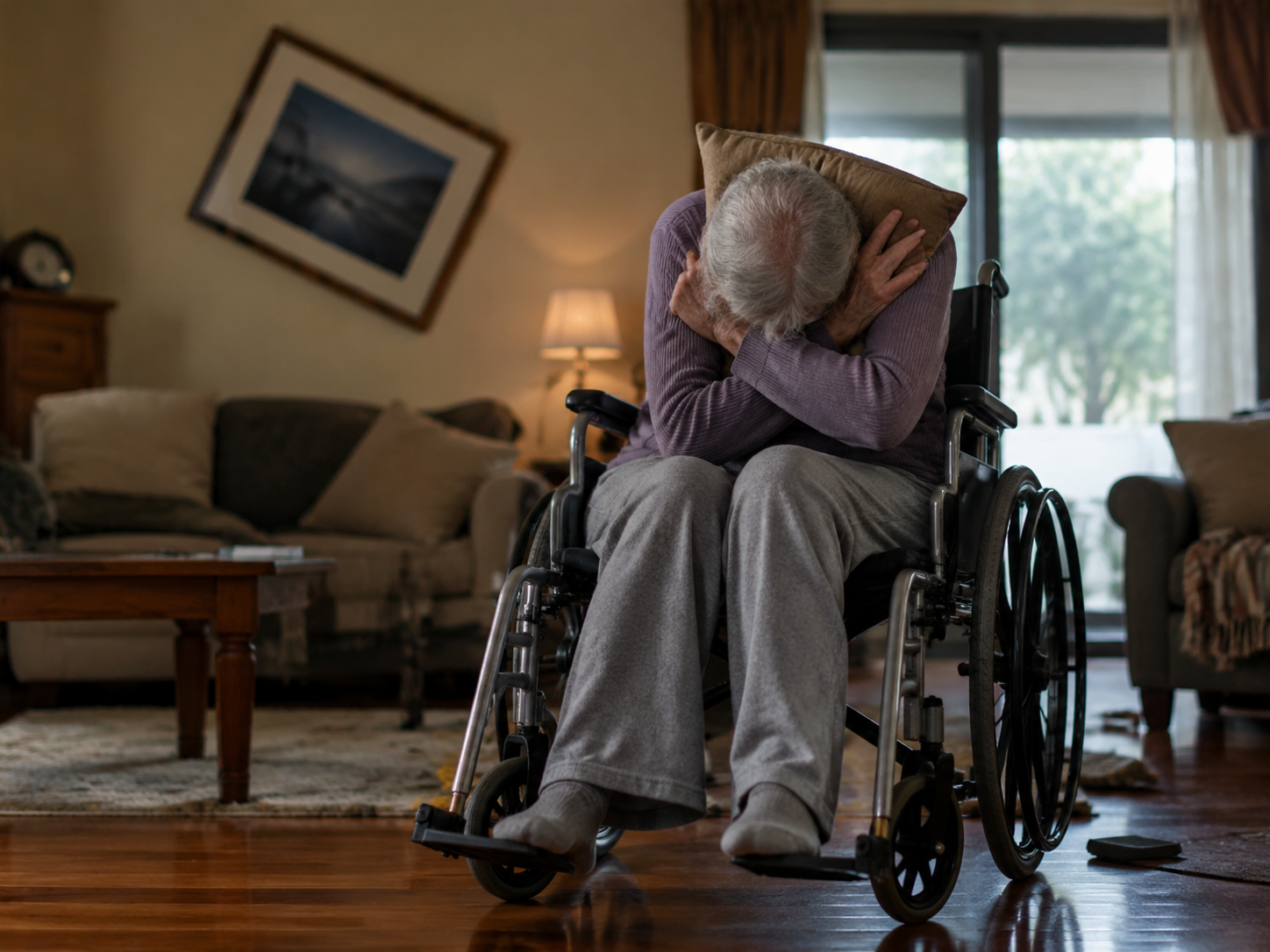
For wheelchair users, the transfer is the hazard. The CDC’s earthquake guidance says to lock the wheels, remove items that are not securely attached to the wheelchair, cover the head and neck with arms, a pillow, or a book, and hold on.[3]
The aftershock protocol is:
- Lock the wheels immediately.
- Stay in the chair. Do not transfer to a bed, sofa, toilet, or floor during shaking.
- Remove or push away loose items only if they are easy to reach and likely to fall onto you or into the wheels.
- Lean forward if you can do that without sliding or losing trunk control.
- Cover your head and neck with your arms, a small pillow, a folded jacket, or a book.
- Hold on to the wheelchair frame, armrest, or another stable point until the shaking stops.
A lap blanket, backpack, oxygen tubing, charging cord, or loose side bag can become a problem if it slips into the wheels or catches on furniture. After the first quake, caregivers should clear those items from the wheels and keep a head-covering item within reach. A pillow that lives across the room is not an aftershock tool.
For a power wheelchair, the same idea applies: stop, lock or power down according to the chair’s controls if that is the user’s normal safe method, protect the head and neck, and do not attempt a transfer until shaking stops. If the chair has tilt or recline features, use only positions the person already uses safely. An aftershock is not the moment to experiment with a control sequence.
If You Use A Cane
A cane gives less support than a walker, so the decision point comes quickly: can you safely get low, or should you sit?
Ready.gov includes two options for cane users: drop, cover, and hold on, or sit on a chair or bed and cover the head and neck with both hands; the cane should stay nearby for after the shaking stops.[2]
| If this is true when shaking starts | Do this instead of forcing a drop |
|---|---|
| You are already beside a sturdy chair, sofa, or bed | Sit down, cover your head and neck, and keep the cane within reach. |
| You are standing in open space and cannot safely lower to the floor | Widen your stance if possible, brace against the nearest stable surface, cover your head and neck, and wait. |
| You can safely get low and get back up without help | Use drop, cover, and hold on as your body allows. |
| You feel dizzy, weak, or unsure | Sit if a seat is immediately available; otherwise brace and cover rather than walking. |
The cane should not be tossed aside. When the shaking stops, it may be the only way to step over a threshold, turn away from broken glass, or reach a phone. Keep it against your leg, hooked over the chair arm, or laid on the bed within easy reach.
If standing transfers are already difficult on ordinary days, do not build an aftershock plan around getting to the floor. The better plan is a chosen chair or bed in each room, with a pillow, folded blanket, or sturdy book close enough to grab.
If You Are Bed-Bound

Bed-bound aftershock guidance is thinner than it should be. CDC and Ready.gov give useful adapted instructions for walkers, wheelchairs, and canes, but they do not provide a dedicated aftershock protocol for someone who cannot get out of bed. So the safest advice has to be assembled carefully from broader earthquake and older-adult planning guidance, without pretending the source is more specific than it is.
The Illinois Emergency Management Agency planning guide for seniors notes that older adults may not be agile enough to get under furniture and recommends identifying safe spots in each room before shaking begins. It also describes using a pillow over the head, staying face-down, and covering with blankets to protect from falling debris.[4]
For a bed-bound senior during an aftershock:
- Stay in bed unless there is an immediate life-threatening hazard in the bed itself.
- Do not attempt a bed-to-chair transfer while the room is shaking.
- If able, roll or turn face-down enough to protect the face and airway without creating breathing difficulty.
- Put a pillow over the head and neck, or use folded bedding if a pillow is not reachable.
- Pull a blanket over the body if it is already within reach and does not interfere with breathing, tubing, drains, or medical equipment.
- Hold the pillow, blanket, bed rail, or mattress edge until the shaking stops.
Caregivers should adapt this for the person’s actual medical situation. Someone with breathing limits, pain with rolling, pressure-injury risk, recent surgery, or lines and tubes may need a different position. The fixed point is not “face-down at all costs.” The fixed point is: stay in the safest bed position already known to be tolerable, protect the head and neck, and avoid a rushed transfer.
Choose The Safe Spot Before The Next Shaking
Aftershocks punish vague plans. “Go somewhere safe” is not useful to a person who needs both hands to stand up. Each room needs one named safe spot that works from the senior’s real starting positions: recliner, bed, toilet, kitchen chair, wheelchair charging area, or the side of the sofa where the walker is usually parked.
The Illinois guide’s advice to identify safe spots in each room matters especially for older adults who cannot quickly get under furniture.[4] The safe spot should reduce the chance of being hit by glass, lamps, tall furniture, wall decor, or loose objects, while also avoiding a long walk during shaking.
| Room | A workable aftershock safe spot | What to move before the next aftershock |
|---|---|---|
| Living room | The usual chair or wheelchair position, angled away from windows and tall shelves | Loose lamp, narrow TV stand, stacked books, rolling side table |
| Bedroom | The bed position with pillow and blanket reachable | Heavy wall items above the bed, glass lamp, clutter beside the transfer path |
| Kitchen | A seated position away from cabinet doors and glass-front storage | Items near counter edges, rolling carts, breakables stored high |
| Bathroom | A seated position on the toilet, shower chair, or wheelchair with brakes locked | Loose toiletries, slippery rugs, unsecured storage over the toilet |
| Hallway | A braced position against an interior wall, away from pictures or mirrors | Shoes, cords, baskets, and anything that narrows the walker path |
This is the same room-by-room hazard thinking caregivers may already use for storms or flooding. If you are already reviewing the house after a disaster scare, our guide to flood-proofing an older parent’s home room by room can help you keep the inspection practical, but the earthquake priority is narrower: stop things from falling, flying, rolling, or blocking the next safe movement.
What Caregivers Should Fix After Each Aftershock
Once the shaking stops, the job is not to reset the house perfectly. It is to make the next aftershock easier to survive from the place the senior is most likely to be.
- Return the walker, cane, wheelchair, phone, glasses, hearing aids, and shoes to reachable positions.
- Move broken glass, books, cords, and loose rugs out of transfer and walking paths.
- Put a pillow, folded blanket, or sturdy book within reach of the bed, recliner, wheelchair, and favorite chair.
- Check that wheelchair and walker brakes still work and are not blocked by debris.
- Move unstable lamps, rolling carts, and small tables away from where the senior waits or sleeps.
- Keep the safest route to the bathroom clear, because that is where many rushed transfers happen after the emergency feels “over.”
Remote caregivers have a different problem: they may be trying to direct all of this by phone while neighbors, aides, or relatives are doing the hands-on checking. This is where an emergency contact binder for aging parents helps, especially if it includes medication lists, medical device details, equipment vendors, backup power needs, and names of people who can physically enter the home.
If you live far away, pair this room-level aftershock plan with a first-hour emergency response plan for long-distance caregivers. The call script should include one direct question: “Where are you sitting or lying right now, and what can you reach to cover your head?”
Do Not Turn The Reset Into Another Fall Risk
The urge to get up after shaking is strong. People want to check the kitchen, find the cat, look outside, call a neighbor, or prove they are all right. That urge is understandable. It is also exactly when a person with weak balance, low blood pressure, pain, or fear may move too fast.
Before standing after an aftershock, pause in place. Look first. Then move. If dizziness on standing is already a problem, use the same slow transition habits described in our guide to preventing falls in seniors with orthostatic hypotension. An aftershock plan should not ask a person to stand faster than they safely stand on an ordinary morning.
A good plan is one the senior can say out loud without coaching: “I stay here. I lock the wheels. I cover my head. I hold on.” For someone in bed: “I stay in bed. I cover my head. I protect my body. I wait.”
When the safest spot in each room is named and the aftershock response matches the person’s actual body or device, the plan has done its job.
References
- Safety Guidelines: After an Earthquake, Centers for Disease Control and Prevention, February 2024.
- Earthquakes, Ready.gov, April 2026.
- Safety Guidelines: During an Earthquake, Centers for Disease Control and Prevention, February 2024.
- Earthquake Preparedness Guide for Seniors, Illinois Emergency Management Agency.
Related reading
Noticed something outdated or inaccurate on this page? Flag a correction. We review every report against CDC, NIA, and AARP HomeFit guidance before updating a page.
Part of the Fall Prevention section.