
Wildfire Smoke Safety Checklist for Seniors and Caregivers
Wildfire smoke poses greater risks to older adults than the general population. This three-phase checklist helps family caregivers prepare ahead, safely shelter indoors, and manage recovery steps — including the often-overlooked connection between smoke exposure and fall risk.
Wildfire smoke safety tips for seniors need to cover more than closing the windows. For an older adult with COPD, asthma, heart disease, diabetes, limited mobility, oxygen equipment, refrigerated medication, or a history of falls, smoke can start a chain reaction: breathing gets harder, rescue inhalers get used more often, dizziness or confusion shows up, routines change, power or pharmacy access becomes uncertain, and a normally safe walk to the bathroom becomes less safe.
The CDC identifies older adults as one of the groups more likely to be affected by wildfire smoke, especially when chronic heart or lung disease is already part of daily life.[1] The EPA is even more specific for planning: adults 65 and older are considered at increased risk beginning at AQI 101, the Orange “Unhealthy for Sensitive Groups” level.[2] That matters because many families wait until the air looks dramatic. For a frail parent, the action point may arrive before the sky turns orange.
| Phase | Caregiver goal | Actions that matter most |
|---|---|---|
| Prepare before smoke arrives | Remove guesswork | Know AQI triggers, identify medical risks, set up a clean-air room, protect medications, plan for oxygen/CPAP/power needs, ask clinicians mask and medication questions in advance |
| Shelter during smoke | Keep exposure low without creating new hazards | Stay indoors with filtered air, monitor symptoms, limit outdoor trips, use respirators only when appropriate, manage heat, hydration, equipment, and fall-risk changes |
| Recover after air improves | Reset the household before the next event | Ventilate only when outdoor air is better, check medication and equipment, watch lingering symptoms or weakness, restock supplies, update the plan |
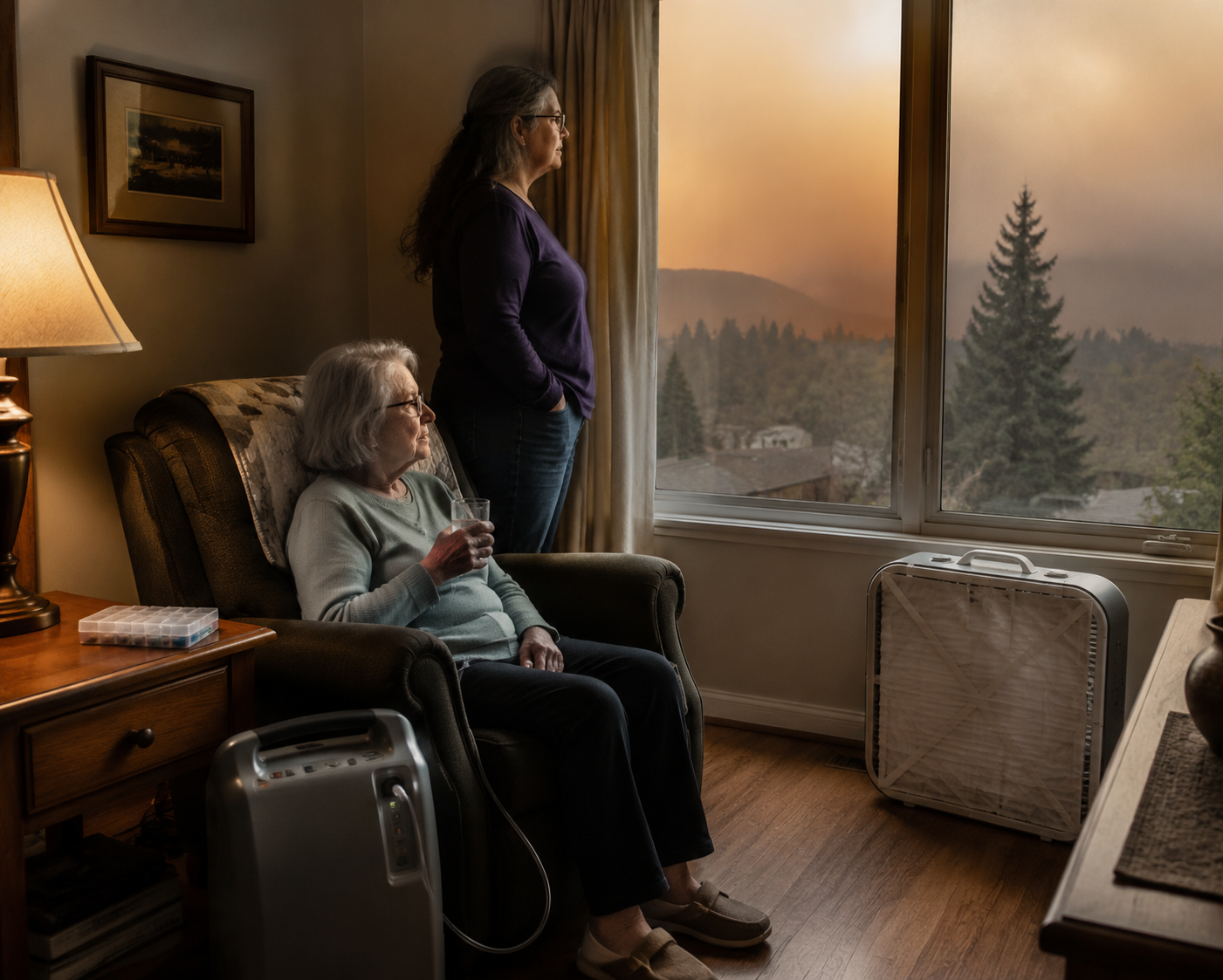
Why smoke planning has to include fall risk
There is not a definitive study showing that wildfire smoke directly increases fall incidence. That should be said plainly. But a caregiver does not need a perfect fall-specific study to notice a dangerous pattern at home. Smoke exposure can bring coughing, wheezing, shortness of breath, chest tightness, irritated eyes, headaches, and dizziness; CDC guidance tells people to seek medical help for more serious symptoms such as trouble breathing or chest pain.[1]
The hospitalization evidence is strong enough to justify treating smoke as a serious older-adult health threat. In a Western U.S. Medicare study, intense smoke days were associated with a 7.2% increase in respiratory hospital admissions among Medicare enrollees.[3] A 2025 JAMA Network Open cohort study also found increased hospitalization risk for older adults exposed to wildfire smoke.[4] Those studies are not fall studies, but they describe the same vulnerable population many family caregivers are trying to keep stable at home.
The fall-risk concern comes from the cascade. Less oxygen delivery, dizziness, fatigue, medication disruption, poor sleep, dehydration during heat, and hurried nighttime trips all make balance less forgiving. The American Lung Association notes that carbon monoxide can reduce oxygen delivery in the body, which is one reason smoke exposure can become more than an airway irritation for people with heart and lung disease.[5] For a parent who already uses a walker, gets lightheaded when standing, or becomes shaky after using a rescue inhaler, wildfire smoke belongs in the fall-prevention conversation.
Prepare before smoke arrives
Preparation is the phase that decides whether the household has a plan or a scramble. It is also the phase most likely to be skipped because the air is still clear. Do as much of this as possible before fire season peaks, before a forecasted smoke event, or whenever AQI begins trending upward.
Set AQI triggers for an older adult, not for the healthiest person in the house
Write down what happens at AQI Orange, Red, and worse. The EPA’s senior-specific threshold makes AQI 101 a reasonable point to start protective steps for many adults 65 and older, especially those with heart or lung disease.[2] That can mean closing windows, switching HVAC settings, turning on portable filtration, postponing errands, and checking whether the parent has new symptoms.
- AQI 101 or higher: treat the older adult as sensitive; reduce outdoor time and start the clean-air setup.
- AQI Red or worse: avoid nonessential outdoor trips and move daily activity into the cleanest indoor space available.
- Any AQI level plus symptoms: follow the symptom plan from the clinician, not the color chart alone.
- Power outage, extreme heat, or equipment failure: treat the situation as a household safety problem, not only an air-quality problem.
For long-distance caregivers, the practical question is who checks the AQI and who acts on it. Put one person in charge of monitoring AirNow, local public health alerts, or the parent’s weather app. Put another person, if possible, in charge of calling the parent and confirming the windows, filtration, medication, and equipment steps were actually done.
Identify the conditions that change the plan
A generic smoke checklist is too blunt for an 82-year-old with COPD, diabetes, and an oxygen concentrator. Before smoke season, make a one-page profile that includes lung disease, heart disease, diabetes, kidney disease, dementia, recent hospitalization, mobility problems, fall history, oxygen use, CPAP use, inhalers, insulin, refrigerated medications, and medications that cannot be skipped.
The point is not to diagnose anything at the kitchen table. The point is to know which risks turn a public-health alert into a household action. A parent who becomes confused when oxygen levels drop needs a different plan than a parent who only needs to postpone gardening. A parent who depends on refrigerated insulin needs a power and cooling plan before the lights go out.
Build one clean-air room that can actually be used
Pick the room where the older adult can spend several hours safely: usually a bedroom or living room with a door or limited openings, a place to sit, access to water, medications, phone charging, mobility aids, and a clear path to the bathroom. AirNow recommends creating a clean-air room and describes DIY air cleaners using a box fan and a high-efficiency filter, such as a MERV-13 filter, as one way to reduce indoor particle exposure when used safely.[6]
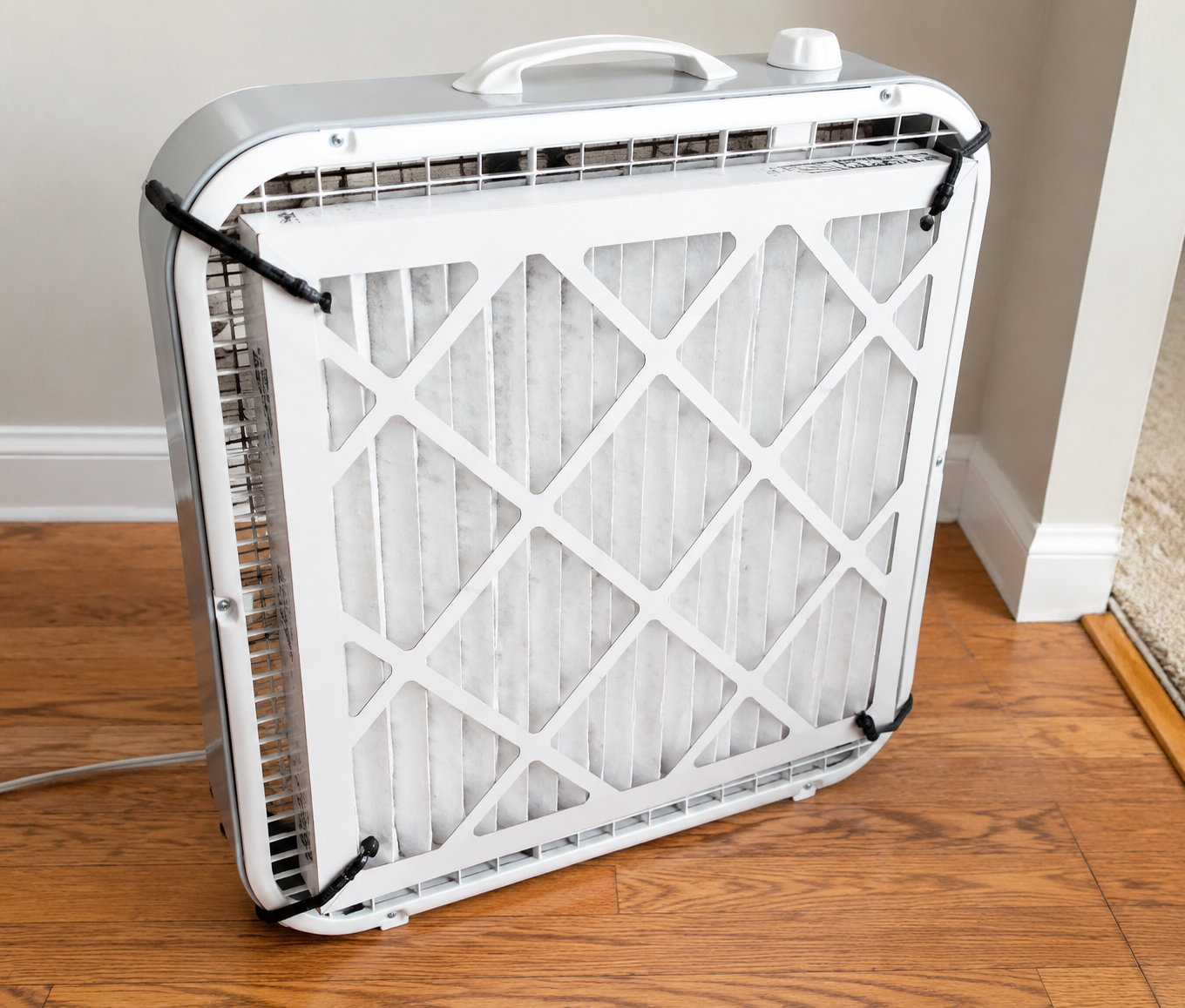
The DIY setup is useful only if it does not create a new hazard. Keep cords out of walking paths. Do not place the fan where a walker, cane, oxygen tubing, or nighttime bathroom route will catch on it. If the fan is old, damaged, unstable, or likely to overheat, replace it rather than improvising. A clean-air room that makes someone trip is not a clean-air plan.
- Choose the room and label it as the smoke room.
- Test the portable air cleaner or HVAC filtration before smoke arrives.
- Place a chair, water, phone charger, medication list, inhalers, glasses, hearing aids, and mobility aid within easy reach.
- Clear the route from the chair or bed to the bathroom.
- Add night lighting if the parent may wake up coughing, short of breath, or disoriented.
Protect medications, refills, and powered equipment
Wildfires can interrupt far more than outdoor activity. A scoping review on wildfires and older adults documented problems with care continuity, including disrupted access to medications, dialysis, cancer treatment, and other services; it also noted that power outages can threaten refrigerated medications and equipment such as oxygen concentrators and CPAP devices.[7] This is where caregivers should be fussy. The refill that seems easy on a normal Tuesday can become hard when roads close, clinics change hours, smoke is heavy, or the person who drives is also trying not to breathe outdoor air.
| Item | Before-smoke action |
|---|---|
| Medication list | Keep an updated list with drug names, doses, prescribing clinicians, pharmacy, allergies, and emergency contacts. |
| Refills | Check refill dates before smoke season and again when smoke is forecast; ask the pharmacy what emergency refill options exist. |
| Refrigerated medication | Plan how it will stay cold during an outage and who can help if refrigeration fails. |
| Oxygen concentrator or CPAP | Confirm backup power, battery duration, supplier contact, and what to do if equipment stops working. |
| Inhalers and nebulizer supplies | Check expiration dates, supply levels, spacer availability, and the clinician’s action plan. |
| Transportation | Identify who can drive if the older adult needs urgent care and outdoor air is unsafe. |
Do not adjust doses, stop medications, or substitute treatments because of smoke without a clinician’s guidance. The useful caregiver move is to remove predictable barriers: expired inhalers, empty rescue medication, no charger, no supplier phone number, no plan for insulin if the refrigerator fails.
Ask the clinical questions while breathing is still normal
A smoke event is a bad time to discover that no one knows how often a rescue inhaler can be used, when a nebulizer should be avoided or started, whether oxygen flow settings should ever change, or whether an N95 is safe for someone with severe lung disease. The American Lung Association advises people with lung disease to talk with a doctor before using an N95 respirator because it can make breathing harder.[5]
- Ask what symptoms mean “call the clinician today” versus “seek emergency care now.”
- Ask how to handle increased rescue inhaler use and what counts as overuse for this person.
- Ask whether an N95 or P100 respirator is appropriate for short outdoor trips.
- Ask what to do if oxygen, CPAP, refrigeration, or pharmacy access is disrupted.
- Ask whether heat, fluid restrictions, heart failure, kidney disease, or diabetes changes the sheltering plan.
Shelter during the smoke event
During heavy smoke, the job is to reduce exposure without trapping the older adult in a hot, dim, cluttered room with failing equipment. This is where “stay indoors” becomes too thin. The real question is whether the indoor space is cleaner, cooler, safer to move through, and medically supported.
Keep indoor air cleaner, then check whether the room is livable
Close windows and doors when outdoor smoke is high. Run the clean-air room setup. Avoid adding indoor particles from candles, fireplaces, smoking, frying, broiling, vacuuming without a HEPA filter, or other activities that stir up dust. If the home has central air, use the best filter the system can safely handle and follow manufacturer guidance.
Then look at the person, not just the device. Is the room getting too hot? Is the parent skipping water because the bathroom feels far away? Is oxygen tubing stretched across the walkway? Is the portable filter loud enough that they remove hearing aids or miss phone calls? The smoke plan has to survive contact with the household.
Use masks for necessary trips, with the lung-disease caveat
If an older adult must go outside briefly, a well-fitting N95 or P100 respirator can reduce inhalation of fine particles, while cloth masks and paper masks do not provide the same protection against PM2.5.[5][8] Fit matters. So does tolerance. A respirator that makes a person with lung disease feel air-hungry may create its own danger, which is why the decision should be discussed ahead of time with the clinician for people with COPD, severe asthma, heart disease, or oxygen dependence.[5]
For many seniors, the better plan is to avoid the trip: move appointments, use delivery, ask a neighbor to bring mail, or have someone else take out trash. If the trip cannot be avoided, keep it short, bring the rescue inhaler if prescribed, use mobility aids, and avoid rushing.
Watch symptoms as a safety signal, not just a comfort complaint
Coughing, wheezing, shortness of breath, chest tightness, irritated eyes, headache, dizziness, unusual fatigue, confusion, or worsening usual symptoms should change the day’s plan. Michigan health guidance lists symptoms from wildfire smoke exposure that include coughing, wheezing, chest tightness, shortness of breath, dizziness, and irritation of the eyes, nose, or throat.[8] The CDC advises getting medical help for severe symptoms such as trouble breathing or chest pain.[1]
Rescue inhaler use deserves special attention. Smoke can lead people with asthma or COPD to use quick-relief medication more often. Some bronchodilators can cause shakiness or palpitations, and in a frail older adult that can make standing, toileting, and walking feel less steady. The caregiver’s job is not to ration a prescribed inhaler. It is to notice escalation, follow the written action plan, and call the clinician when use moves beyond what the plan allows.
Treat dizziness and weakness as fall warnings
During a smoke event, a parent may move less, sleep poorly, cough through the night, drink less, or feel lightheaded when standing. Add dim rooms, closed windows, fan cords, oxygen tubing, and a rushed trip to the bathroom, and the fall risk becomes practical rather than theoretical.
- Keep the main walking path clear from chair to bathroom, bedroom, kitchen, and exit.
- Place the walker or cane where the parent can reach it without standing first.
- Tape down or reroute cords from air cleaners, phone chargers, oxygen equipment, and lamps.
- Use night lights in the hallway and bathroom.
- Encourage slow position changes: sit at the edge of the bed, pause, then stand.
- Bring water, tissues, inhaler, phone, and glasses close enough to avoid repeated unnecessary trips.
This is not overprotective fussing. It is the same fall-prevention work families already do, updated for a day when breathing, balance, sleep, lighting, and equipment may all be worse than usual.
Do not ignore heat while sealing the house
Smoke and heat often collide in the least convenient way. Closing windows can protect lungs but make an apartment dangerously hot if there is no air conditioning. Older adults are less forgiving of that tradeoff, and people with heart disease, kidney disease, diabetes, or fluid restrictions may not be able to solve heat stress by simply drinking more water.
If the clean-air room cannot stay cool, identify a cleaner-air cooling location before the day becomes urgent: a relative’s home with filtration, a community clean-air center if available, or a medically appropriate place recommended by local officials. If relocation is needed, plan the route, oxygen, medications, mobility aid, and mask question before stepping outside.
Keep care connected when services are disrupted
During prolonged smoke, caregivers should check the boring details daily: medication supply, oxygen or CPAP function, battery status, refrigerator temperature if medication depends on it, pharmacy hours, appointment changes, and whether the parent is eating, drinking, sleeping, and toileting normally. The scoping review’s care-disruption findings are a reminder that wildfire health effects include missed care, not only smoke inhalation.[7]
For a long-distance caregiver, a short call script helps: “What is the AQI there? Are the windows closed? Is the filter running? Any chest tightness, dizziness, confusion, or more inhaler use? Do you have all medicines through the week? Is the oxygen or CPAP working? Is the path to the bathroom clear?” It is not elegant, but it catches the problems that become expensive at 10 p.m.
Recover after the air improves
Recovery starts when outdoor air is actually better, not when everyone is tired of being inside. Check AQI and local guidance before opening windows. If smoke has settled indoors, ventilate gradually when outdoor conditions improve, then continue filtration as needed. Do not assume the older adult is back to baseline the first clear afternoon.
- Check for lingering cough, wheeze, shortness of breath, chest tightness, dizziness, unusual fatigue, poor appetite, confusion, or reduced walking confidence.
- Review rescue inhaler use during the event and report concerning increases to the clinician.
- Confirm medications were not missed, damaged by heat, or left unrefrigerated when refrigeration was required.
- Check oxygen, CPAP, nebulizer, batteries, chargers, and supplier contacts.
- Replace used filters, restock masks if appropriate, and return walking paths to normal.
- Write down what failed: too hot, too loud, no ride, wrong mask, missing refill, unsafe cords, or unclear clinician instructions.
If the parent is weaker after several days indoors, restart activity carefully. A short walk inside the home with the usual mobility aid may be more sensible than a long outdoor errand as soon as the sky clears. If breathing, chest symptoms, confusion, dizziness, or weakness persists, contact the clinician. If symptoms are severe, follow emergency guidance.
A printable caregiver checklist
| Before | During | After |
|---|---|---|
| Save AQI source and decide who checks it. | Check AQI and local alerts daily or more often if conditions change. | Open windows only when outdoor air improves. |
| Mark AQI 101+ as an action point for adults 65+. | Keep the older adult in the cleanest indoor room available. | Continue filtration until indoor air and symptoms improve. |
| Create a clean-air room with filtration, seating, water, phone, medications, and clear paths. | Avoid indoor particle sources such as smoke, candles, frying, and unnecessary dust. | Check for lingering cough, wheeze, dizziness, weakness, or confusion. |
| Ask the clinician about inhaler plan, warning symptoms, oxygen/CPAP, and N95/P100 use. | Use N95/P100 only for necessary outdoor trips and only if appropriate for the person’s health status. | Review inhaler use and call the clinician if the action plan was exceeded. |
| Check refills, refrigerated medications, pharmacy contacts, and backup power. | Monitor medication supply, refrigeration, oxygen, CPAP, batteries, and chargers. | Restock medications, filters, masks, batteries, and written instructions. |
| Clear walking paths and plan lighting around filters, cords, oxygen tubing, and bathroom routes. | Treat dizziness, shakiness, fatigue, and confusion as fall-risk warnings. | Update the plan based on what did not work. |
Wildfire smoke safety for seniors is a household system, not a single instruction. The useful plan is specific enough to answer the questions that come up under stress: which AQI level matters, which room is safest, which symptoms change the plan, which medicines and machines cannot fail, who to call, and how to keep an unsteady parent from being asked to navigate a smoky, dark, cluttered house while already short of breath.
References
- Safety Guidelines: Wildfires and Wildfire Smoke. CDC.
- Who is at Increased Risk of Health Effects from Wildfire Smoke Exposure?. EPA.
- A systematic review of the physical health impacts from non-occupational exposure to wildfire smoke. Epidemiology. 2017.
- Wildfire Smoke Exposure and Cause-Specific Hospitalization in Older Adults. JAMA Network Open. 2025.
- Wildfire Smoke and Lung Health. American Lung Association.
- Be Smoke Ready. AirNow.gov.
- Wildfires and Older Adults: A Scoping Review. PMC.
- Your Health and Wildfire Smoke. Michigan DHS.
Related reading
Noticed something outdated or inaccurate on this page? Flag a correction. We review every report against CDC, NIA, and AARP HomeFit guidance before updating a page.
Part of the Fall Prevention section.