
How Does Wildfire Smoke Affect Seniors? Air Quality Tips
Wildfire smoke is far more toxic than typical air pollution and can harm seniors' lungs, heart, brain, and more within hours. This guide explains the multi-system risks and provides practical air quality tips to reduce fall risk and keep older adults safe during wildfire events.
The first clue may not be dramatic. Your father is inside with the windows closed, but he is coughing more than usual. Your mother says she feels lightheaded, then reaches for the wall instead of her cane. A parent with COPD says they feel “a little off,” and it is hard to tell whether that means fatigue, low oxygen, dehydration, anxiety, or the start of something that needs a clinician.
That is the caregiving problem with wildfire smoke: it does not stay neatly in the lungs. Fine particles in smoke can affect breathing, cardiovascular strain, cognition, eyes, skin, diabetes regulation, and overall strength. For an older adult who already has heart disease, COPD, diabetes, osteoporosis, balance problems, or memory changes, those effects can turn an ordinary walk to the bathroom into a fall-risk moment.
Wildfire smoke also deserves more respect than “bad air.” AARP, citing a 2021 Nature Communications study, reports that wildfire smoke PM2.5 is about 10 times more toxic per microgram than standard ambient PM2.5 from fossil fuels.[1] That does not mean every smoke day becomes an emergency. It does mean families should stop treating smoke as if it were just an unpleasant smell outside.
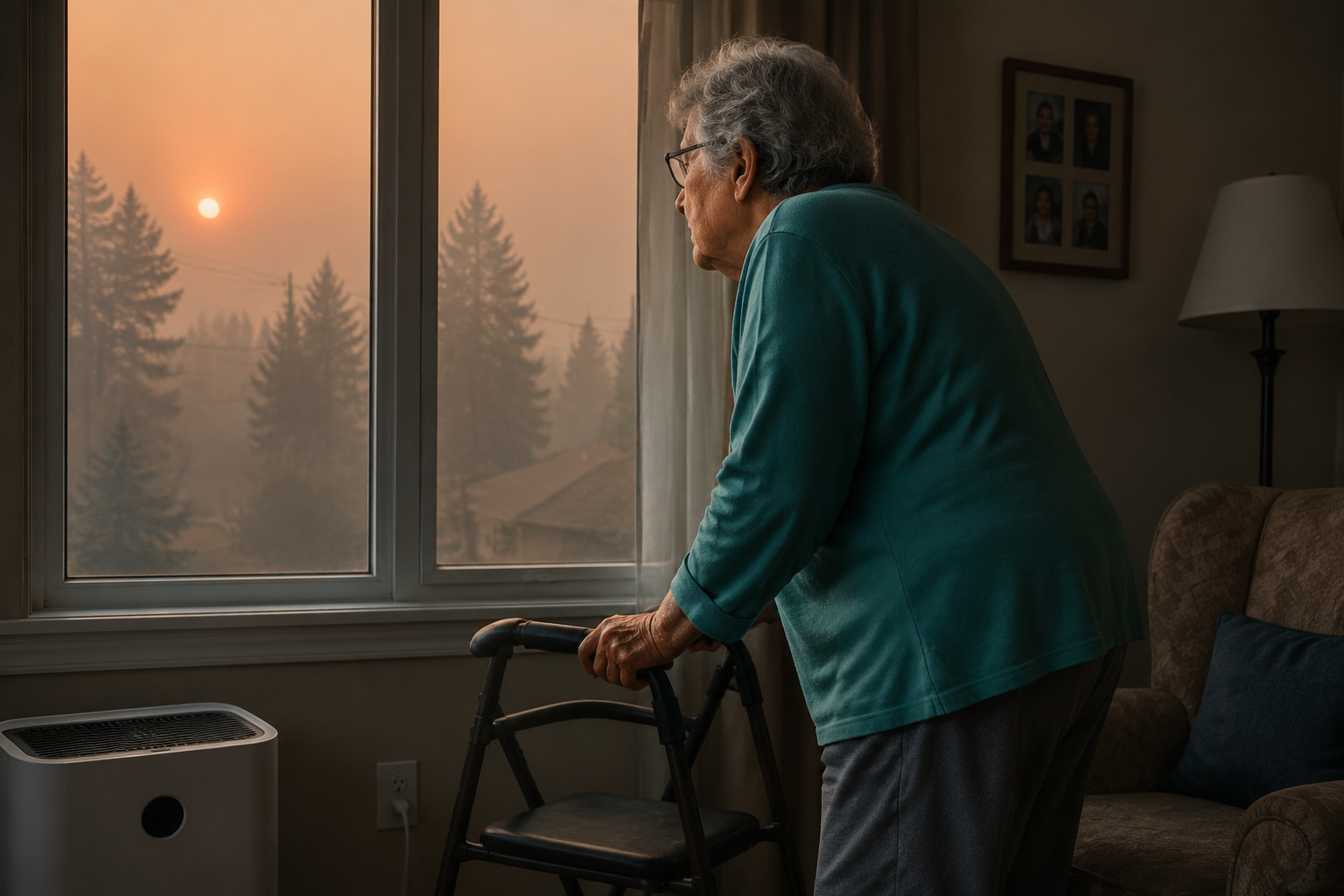
Smoke Days Are Also Fall-Prevention Days
A fall-prevention plan usually starts with throw rugs, lighting, footwear, grab bars, and medication side effects. During wildfire smoke, the plan has to widen. The question is no longer only “Is the hallway clear?” It is also “Can this person breathe well enough, think clearly enough, see comfortably enough, and stand steadily enough to move safely?”
The CDC describes wildfire smoke as a risk to multiple parts of the body, including the lungs, heart, brain, eyes, nose, throat, and skin.[2] For older adults, that matters because a small decline in several systems at once can look deceptively ordinary. A little dizziness, a little confusion, a little shortness of breath, and a little weakness may not sound like an emergency when each symptom is named separately. Together, they can change how safely someone transfers from a chair, climbs a step, handles an oxygen tube, or remembers whether they already took a medication.
The fall-risk connection is a caregiving synthesis, not a claim from one study proving that smoke directly causes falls. The documented pieces are real: respiratory symptoms, cardiovascular warning signs, dizziness, cognitive effects, eye irritation, and disease disruption. The practical inference is also reasonable: anything that makes an older adult lightheaded, foggy, breathless, visually uncomfortable, or physically weaker can make movement less safe.
What Smoke Can Do to an Older Body
Wildfire smoke is a mixture of gases and fine particles. The smallest particles are especially concerning because they can be inhaled deeply. In older adults, the result may be more than coughing or throat irritation. It can be a stacked burden on systems that may already be working with less reserve.
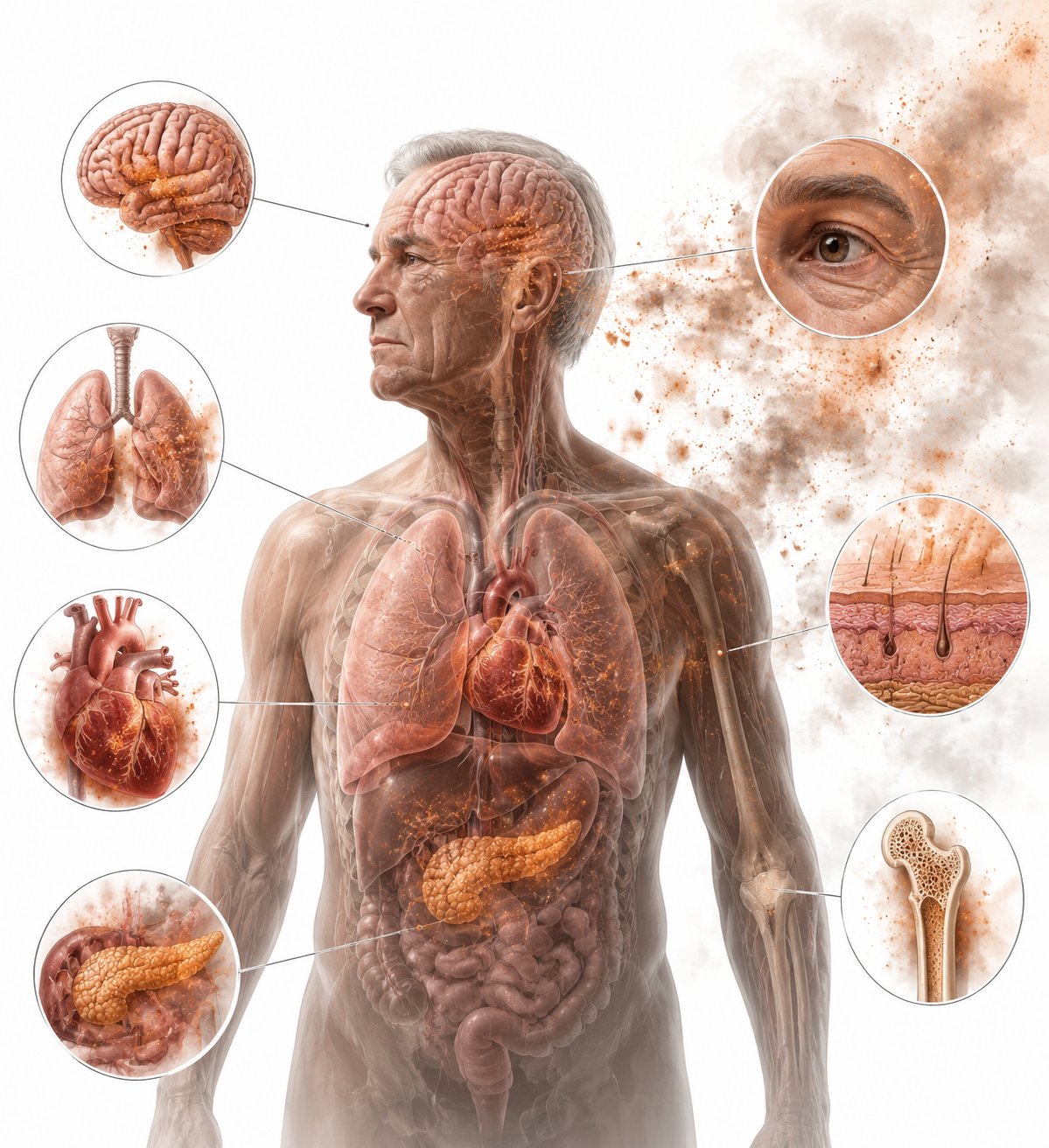
Lungs: more work for every step
For someone with asthma, COPD, chronic bronchitis, or a recent respiratory infection, smoke can make breathing less efficient. The visible result may be coughing, wheezing, chest tightness, faster breathing, or needing more breaks on the way to the kitchen. CDC data cited by AARP found that in 2023, emergency department visits for asthma were 17% higher on days when the Air Quality Index exceeded 101.[1]
A caregiver should translate that into movement risk. Breathlessness changes gait. People rush to sit down, abandon walkers for nearby furniture, skip a prescribed inhaler because they are flustered, or become too tired to finish a normal routine. The danger is not only the breathing symptom itself; it is the hurried, improvised behavior that follows.
Heart and circulation: dizziness is not a throwaway symptom
Smoke exposure can stress the cardiovascular system, and older adults with heart disease, high blood pressure, or a history of stroke deserve close watching. AARP cites research finding that the risk of dying from a heart attack nearly doubled during extreme heat events combined with high PM2.5, with higher risks for women and older adults.[1] That finding is about the combination of heat and particle pollution, not smoke alone, but it is highly relevant because wildfire smoke events often arrive with heat, evacuation stress, and disrupted routines.
For fall prevention, the practical signs are familiar: dizziness, faintness, unusual fatigue, chest discomfort, irregular heartbeat, or looking pale and unsteady after standing. A person who feels faint may not announce “cardiovascular stress.” They may say the room feels strange, they need to sit, or they do not trust their legs.
Brain and cognition: smoke can cloud judgment before anyone names it
Cognitive changes are especially easy to miss in an older adult who already has mild memory loss, poor sleep, or medication side effects. AARP reports that wildfire smoke PM2.5 can reduce cognitive function within hours and has been linked in emerging research to increased dementia risk.[1] The dementia link should be treated carefully; emerging research does not prove a simple one-to-one cause. The short-term caregiving issue is more immediate: confusion changes safety behavior.
A parent who is cognitively foggy may forget to use a walker, misread an AQI alert, open a window because the house feels stuffy, take the wrong pill, or insist they are fine while walking more slowly and unevenly than usual. Smoke-day monitoring should include how the person is thinking, not only how they are breathing.
Eyes, skin, and comfort: irritation can still change mobility
The CDC lists burning eyes, runny nose, scratchy throat, headaches, and skin irritation among possible smoke-related symptoms.[2] These may sound minor compared with chest pain, but they still affect safe movement. Watery eyes blur thresholds and steps. Headache and irritation make people rub their eyes while walking, dim the lights, or move without glasses. Skin discomfort can interrupt sleep, and poor sleep is not a friend of balance.
Bones and diabetes: narrower findings, real caregiving consequences
Some findings should be kept narrow. AARP reports research linking wildfire smoke exposure to greater bone loss in women over 50, especially those in lower-socioeconomic neighborhoods.[1] That does not prove the same effect for every older adult, and it does not mean a single smoke event weakens bones overnight. But for a woman already being monitored for osteoporosis, it is another reason not to treat smoke as only a lung issue.
Diabetes adds another layer. Smoke events can disrupt meals, activity, hydration, sleep, medication timing, and access to supplies. A person whose blood sugar is unstable may become shaky, weak, sweaty, confused, or slow to respond. Whether smoke is the direct trigger or the event disrupts the routine, the caregiver has to manage the same practical risk: an older adult who is less steady and less able to self-correct.
Mortality risk: the background fact that should change the household plan
The larger numbers are sobering. AARP cites a 2024 Science Advances study estimating that long-term wildfire smoke exposure contributed to more than 52,000 premature deaths in California between 2008 and 2018.[1] That number should not make a family panic every time the sky turns gray. It should make the family prepare before symptoms start.
Use AQI Before the House Feels Smoky
The nose is not a reliable monitoring device. By the time smoke is obvious indoors, an older adult may already be coughing, tired, anxious, or foggy. AirNow, a federal air-quality resource from EPA and partner agencies, recommends checking the Air Quality Index and smoke forecasts so people can adjust activity and exposure during wildfire events.[3]
| Caregiver check | What to do with the information |
|---|---|
| AQI is rising before symptoms begin | Move plans indoors, close smoke-entry points, and start cleaner-air measures early. |
| Parent is coughing, wheezing, or more breathless | Reduce activity, check prescribed respiratory equipment or medications, and monitor closely. |
| Parent is dizzy, unusually weak, confused, or walking differently | Treat it as a mobility warning, not just a smoke complaint. |
| Chest pain, irregular heartbeat, slurred speech, severe breathing trouble, or fainting occurs | Seek urgent medical guidance or emergency help. |
This is where many families lose time. They wait for a parent to complain. Some older adults will not complain, either because they do not want to leave home, do not want to worry anyone, or cannot describe what has changed. AQI gives the caregiver an external signal to start the plan without turning the conversation into a debate over whether someone feels “bad enough.”
Build a Cleaner Indoor Air Space
AARP’s smoke-protection guidance emphasizes staying indoors, keeping windows and doors closed, using air conditioning appropriately, and using a portable air cleaner when available.[4] AirNow also advises creating a cleaner-air room and reducing activities that add indoor particles, such as smoking, frying food, burning candles, or vacuuming without a HEPA filter during smoke events.[3]
For a senior with fall risk, the cleaner-air room should be chosen like a care station, not like a storage project. Put it near a bathroom if possible. Keep the walker, cane, glasses, phone, charger, water, medications, inhalers, glucose supplies, and emergency contacts within reach. Clear cords from the path before the air purifier, fan, or extension cord becomes its own tripping hazard.
Oregon State University Extension notes that portable air cleaners with HEPA filters can reduce indoor particulate matter when properly sized and used, and it gives cautions for do-it-yourself box-fan filter setups, including concerns about fan safety and the need to follow instructions carefully.[5] A DIY filter may be better than doing nothing in some situations, but it should not be assembled in a way that overheats equipment, blocks exits, or creates clutter around a person who already needs a walker.
Watch the Symptoms That Change Decisions
A smoke-day check-in should be more specific than “Are you okay?” Many older adults will answer yes out of habit. Ask and observe in body-system terms: breathing, chest comfort, heartbeat, balance, thinking, vision, hydration, and medication use.
- Breathing: new or worse coughing, wheezing, shortness of breath, chest tightness, or needing more rest than usual.
- Heart and circulation: chest pain, pressure, irregular heartbeat, dizziness, faintness, or unusual fatigue.
- Brain and speech: new confusion, unusual sleepiness, trouble following directions, slurred speech, or a sudden change in alertness.
- Mobility: holding furniture more, abandoning the walker, shuffling, swaying, rushing to sit, or avoiding trips to the bathroom.
- Diabetes and medications: missed doses, delayed meals, low supplies, shakiness, sweating, weakness, or blood sugar readings outside the person’s usual plan.
The CDC’s wildfire safety guidance lists symptoms that should prompt medical attention, including trouble breathing, chest pain, palpitations or irregular heartbeat, dizziness, and symptoms such as slurred speech that can signal a serious emergency.[6] Families should follow the person’s existing care plan, but they should not spend an evening “watching” chest pain, fainting, severe breathing trouble, or possible stroke symptoms.
For less severe changes, call the clinician’s office, nurse line, pulmonologist, cardiologist, or diabetes care team according to the person’s condition and care instructions. The useful message is concrete: “The AQI is high, she has COPD, she is more short of breath than usual walking to the bathroom, and she is using the wall instead of her walker.” That tells a care team more than “She seems off.”
Do Not Let Smoke Break the Medication and Equipment Routine
Wildfire planning often focuses on air, but older adults also depend on routines that smoke events can interrupt. A 2023 scoping review on wildfires and older adults describes problems that include evacuation challenges, social support needs, medication continuity, and disruption of medical equipment.[7] Those are not side issues. They are the difference between sheltering safely and sitting in a cleaner room without the supplies that keep someone stable.
Before smoke season, caregivers should know which prescriptions cannot be missed, which supplies run out fastest, which devices need power, and which equipment must travel if evacuation becomes necessary. Oxygen equipment, nebulizers, CPAP machines, glucose meters, insulin storage, mobility aids, hearing aids, glasses, and phone chargers belong in the same conversation as masks and air purifiers.
Evacuation decisions can be emotionally hard for older adults because home feels familiar and leaving may feel more dangerous than staying. That concern deserves respect, but it should be weighed against the actual support available inside the home: indoor air quality, power, medication access, caregiver availability, transportation, mobility, and the person’s current symptoms.
A Caregiver’s Smoke-Event Plan
The plan does not need to be elaborate. It needs to exist before the sky turns orange and everyone is tired.
- Check AQI and smoke forecasts early, especially when a parent has COPD, asthma, heart disease, diabetes, memory problems, osteoporosis, or a history of falls.
- Set up a cleaner-air room with safe walking paths, seating, water, phone access, medications, mobility aids, and necessary medical supplies.
- Reduce smoke entry by closing windows and doors, using appropriate filtration, and avoiding indoor activities that add particles.
- Monitor for breathing changes, chest symptoms, dizziness, confusion, slurred speech, vision irritation, weakness, and changes in walking.
- Protect medication, diabetes, oxygen, respiratory-device, and mobility routines so the smoke event does not create a second health problem.
- Escalate promptly when symptoms move beyond mild irritation, especially with chest pain, irregular heartbeat, fainting, severe breathing trouble, slurred speech, or sudden confusion.
For seniors, wildfire smoke is not only an air-quality problem outside the house. It can become a balance problem in the hallway, a medication problem at dinner, a diabetes problem overnight, and a decision-making problem when someone insists they are fine. Treating smoke days as fall-prevention days gives caregivers a clearer job: manage the air, watch the body systems, protect the routine, and act before a subtle change becomes the reason for an emergency visit.
References
- 8 Ways Wildfire Smoke Affects Your Health, AARP, July 17, 2026.
- How Wildfire Smoke Affects Your Body, CDC.
- Be Smoke Ready, AirNow.gov / EPA.
- How to Protect Yourself Against Wildfire Smoke, AARP, updated Jan 2025.
- Protecting Indoor Air from Wildfire Smoke, OSU Extension, April 2023.
- Safety Guidelines, CDC.
- Wildfires and Older Adults, PMC, 2023.
Related reading
Noticed something outdated or inaccurate on this page? Flag a correction. We review every report against CDC, NIA, and AARP HomeFit guidance before updating a page.
Part of the Fall Prevention section.