
The real health toll of wildfire smoke on older adults
Wildfire smoke is far more dangerous for seniors than most family caregivers realize — it triggers cardiovascular events, respiratory crises, and emerging cognitive effects. This guide explains the biological pathways, reviews recent large-scale studies, and outlines what symptoms to watch for.
Wildfire smoke is too often treated like a bad-air inconvenience: stay inside, wait for the sky to clear, watch for coughing. For older adults, especially those with COPD, asthma, heart disease, diabetes, or frailty, that framing is too small. The main question in how wildfire smoke affects seniors' health is not only whether smoke irritates the lungs. It is whether a fine-particle exposure can destabilize the body systems an older person is already relying on with less reserve.
Recent large-scale studies make the scale hard to dismiss. A 2024 National Bureau of Economic Research working paper estimated that wildfire smoke causes about 10,070 premature deaths and 191,541 excess emergency department visits each year among Americans age 65 and older.[1] A separate 2024 national study in PNAS, covering all 3,108 U.S. counties, estimated that long-term wildland fire smoke PM2.5 contributes to about 11,415 nonaccidental deaths annually in the contiguous United States, with the largest mortality increases among people 65 and older.[2]
Those numbers should not be merged into one bigger statistic. They come from different designs and answer different questions. The NBER estimate focuses on older adults and includes emergency department visits. The PNAS national study estimates mortality associated with long-term smoke PM2.5 across counties. A 2025 UC Berkeley-led PNAS study took yet another approach, following 1.25 million older adults in Southern California and finding a 7% higher all-cause mortality risk over three years for highly exposed people compared with minimally exposed people; the greatest risk appeared among adults ages 60 to 75 and Black individuals.[3]
Taken carefully, the studies point in the same practical direction: smoke days are not just uncomfortable days for seniors. They are periods when chronic disease can tip into an emergency, and when the harm may continue after the outdoor air looks better.
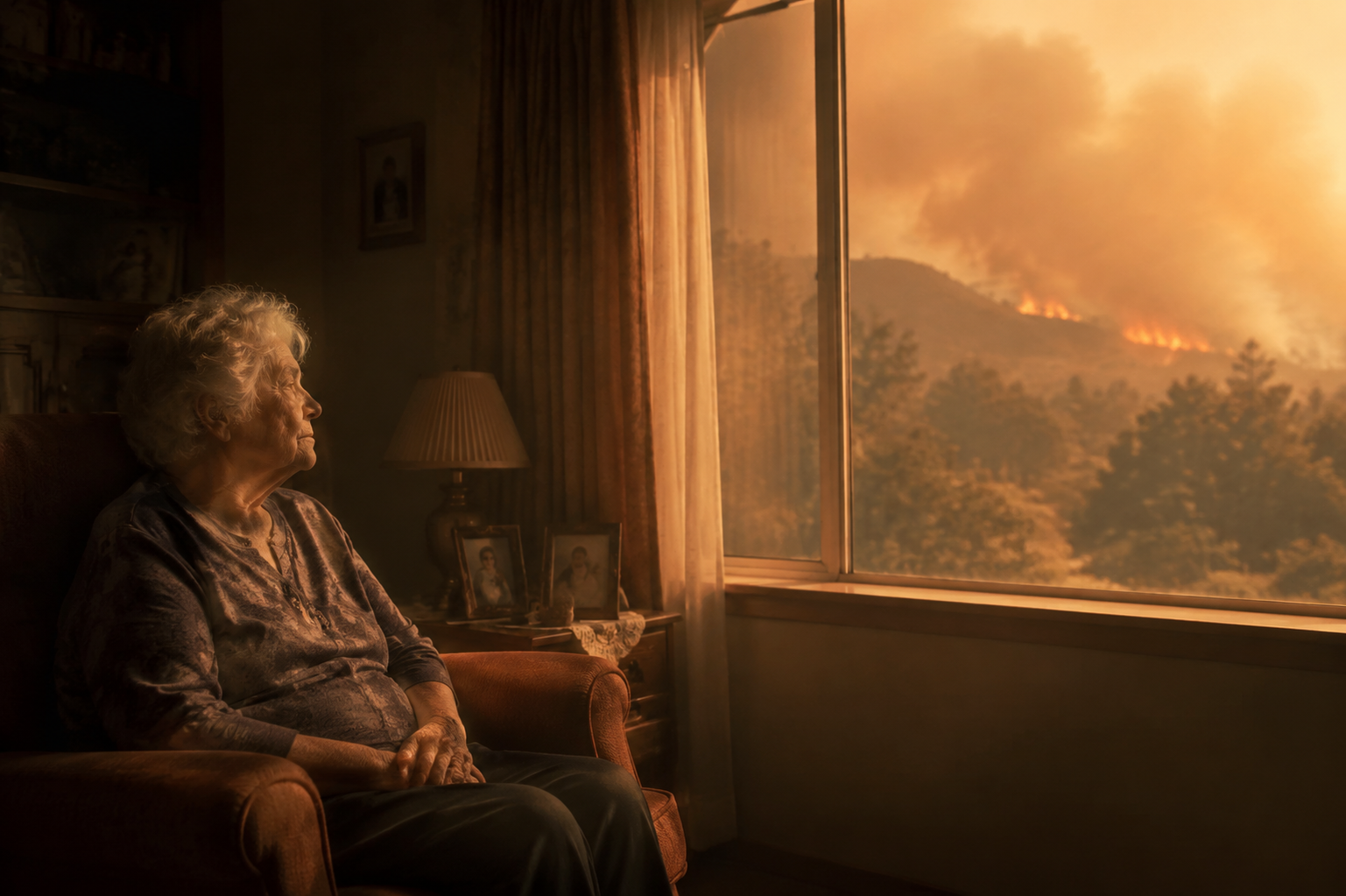
Why Smoke Hits Older Bodies Differently
The dangerous part of wildfire smoke is not only what people can smell or see. Fine particulate matter, especially PM2.5, is small enough to be inhaled deep into the lungs. Once there, it can provoke inflammation, oxidative stress, and changes in the blood vessels that matter far beyond the airways.
In a younger, healthier person, that exposure may still be harmful, but the body often has more reserve. In an older adult, the same exposure may land on narrowed airways, stiffened blood vessels, reduced heart capacity, impaired kidney function, diabetes-related vascular injury, or medications that already affect fluid balance, heart rhythm, or breathing. The smoke is not acting on a blank slate.
The CDC lists people with asthma, COPD, heart disease, and diabetes among those at higher risk from wildfire smoke.[4] That guidance matters because those conditions are common in the very households where smoke decisions get made informally: whether to open a window because the house feels stuffy, whether to keep a routine appointment across town, whether a parent’s new fatigue is just a bad night of sleep.
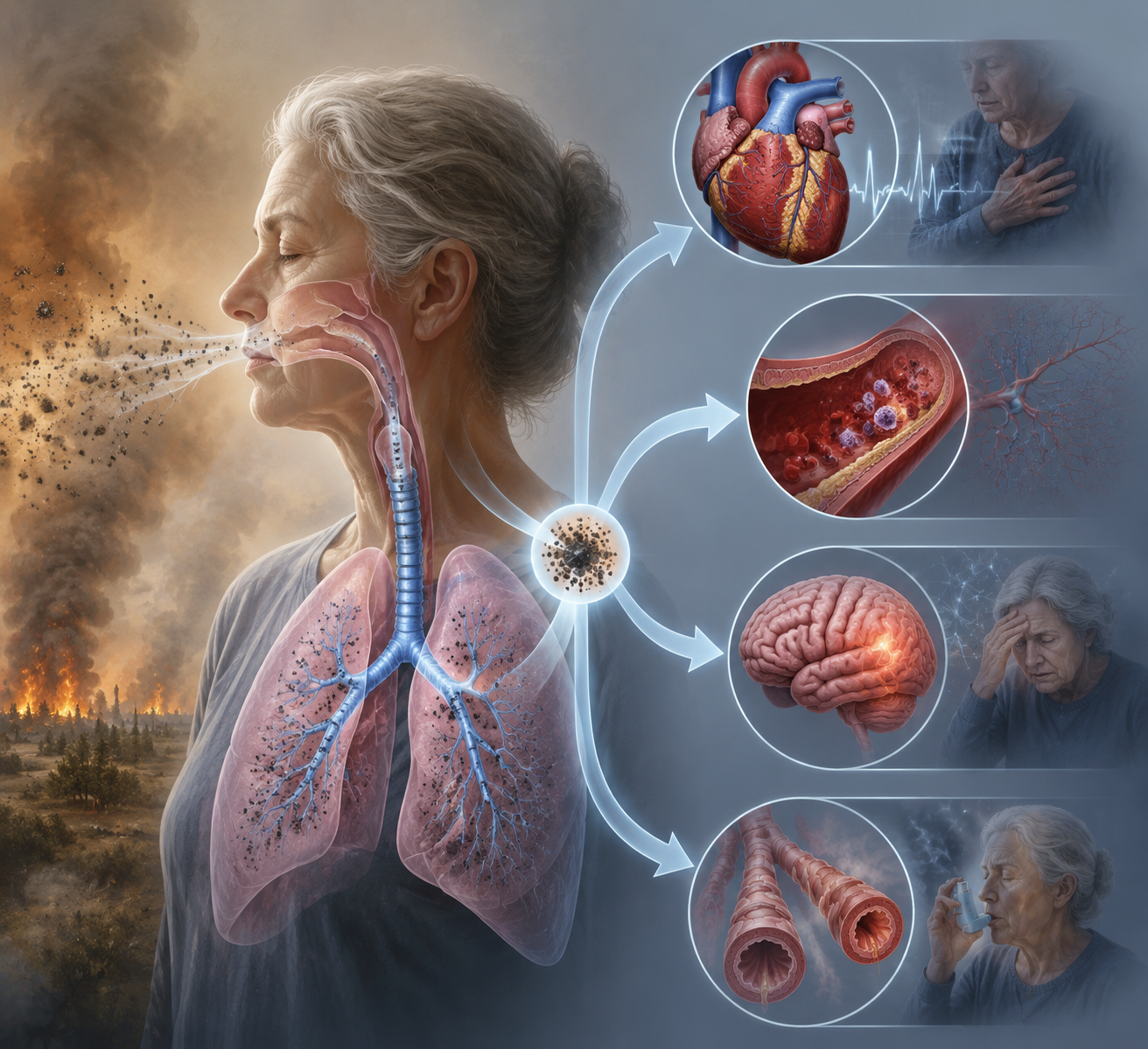
The biological sequence is not mysterious in broad outline. Smoke particles enter the respiratory tract. The lungs respond with irritation and inflammation. Oxygen exchange can become less efficient, especially in someone whose lungs are already damaged by COPD or asthma. Inflammatory signals and oxidative stress can then affect blood vessels, making them less flexible and more reactive. Blood pressure, clotting tendency, heart rhythm, and the workload on the heart can all become more precarious.
That is why the phrase “smoke-sensitive” understates the issue for many seniors. The concern is not simply that smoke makes them cough. It is that inflammation in the lungs can add strain to the heart, that vascular stress can matter in someone with coronary disease, and that a mild drop in oxygenation can be enough to worsen confusion, weakness, or breathlessness in a person who was already close to the edge.
The Harms Caregivers Are Most Likely to Miss
Coughing and wheezing are the obvious smoke symptoms. They deserve attention, but they are not the whole picture. For an older adult, the warning signs can appear in the lungs, the heart, the brain, or in a general decline that looks nonspecific until it becomes urgent.
Breathing symptoms can escalate quickly
Smoke can worsen asthma and COPD, increase coughing and wheezing, and make breathing feel more effortful. The American Lung Association warns that wildfire smoke can trigger asthma attacks, COPD flare-ups, bronchitis, and other respiratory problems, particularly in people with lung disease.[5]
For caregivers, the practical issue is change from baseline. A parent with COPD may already cough. What matters is whether the cough is more frequent, whether usual inhalers are not helping as well, whether walking to the bathroom now causes breathlessness, whether lips or fingertips look bluish, or whether the person is too tired to speak in full sentences. Those are not “smoky day” inconveniences. They are signs that the body may be losing respiratory reserve.
Heart symptoms may be less obvious than lung symptoms
The cardiovascular concern is one reason wildfire smoke deserves more attention in older adults than it usually receives. Fine particles can contribute to vascular inflammation and stress on the heart. In someone with coronary artery disease, heart failure, atrial fibrillation, prior stroke, or diabetes-related vascular disease, that added stress can show up as chest pressure, palpitations, unusual sweating, sudden weakness, faintness, or a decline that the family first describes as “not acting right.”
Stroke-like symptoms should never be attributed to smoke and watched casually at home. Sudden facial droop, arm weakness, trouble speaking, severe dizziness, new confusion, or vision changes call for emergency evaluation. Smoke may be part of the risk environment, but the response should be based on the symptom, not on whether the sky still looks smoky.
Confusion and cognitive change are plausible concerns, but the science is still developing
Cognitive effects are receiving more attention, and caregivers are right to notice them. Reuters reported in July 2026 on serious health risks from wildfire smoke, including research discussion around cognitive changes linked to the Camp Fire and the reality that indoor PM2.5 may average about 50% of outdoor levels.[6] That indoor point is especially important for families who assume that bringing an older adult inside ends the exposure.
Still, the cognitive and dementia evidence should be handled with more caution than the respiratory and cardiovascular evidence. It is biologically plausible that inflammation, vascular stress, oxygen strain, sleep disruption, and repeated smoke exposure could worsen cognition in vulnerable older adults. But the exact long-term dose-response relationship is still being studied, and the evidence is not as settled as it is for breathing and heart-related harms.
That caution does not mean caregivers should ignore confusion. In older adults, new confusion can signal low oxygen, infection, dehydration, medication problems, stroke, heart strain, or another acute illness. During smoke events, it should be treated as a meaningful change, not dismissed because the person is not coughing.
Diabetes and heat can complicate the picture
Diabetes raises concern because it is already a disease of blood vessels, inflammation, and reduced physiologic reserve. The CDC includes diabetes among chronic conditions that increase risk from wildfire smoke.[4] Add heat, poor sleep, dehydration, missed meals, or disrupted medication routines, and a smoke episode can become part of a broader destabilizing event rather than a single exposure.
The interaction between wildfire smoke and extreme heat also makes risk assessment harder. When smoke and heat overlap, an older adult may face respiratory stress, cardiovascular strain, dehydration risk, and difficulty cooling the body at the same time. A caregiver may see only fatigue or irritability at first. That is exactly why baseline matters: what is normal for this parent on an ordinary day, and what has changed since the smoke arrived?
Exposure Is Not Evenly Shared
Wildfire smoke does not affect all older adults equally, and the difference is not only medical. A 2017 American Journal of Epidemiology study documented disparities in smoke exposure and respiratory hospitalization risk in California: 73.4% of Black seniors were exposed to multiple smoke waves, compared with 56% of white seniors, and elderly women faced higher respiratory hospitalization risk than elderly men.[7]
Those findings are a reminder that vulnerability is built from several layers at once. A parent’s risk may reflect chronic disease, age, housing quality, neighborhood smoke burden, access to transportation, ability to keep indoor air cleaner, and whether someone is close enough to notice deterioration early. Long-distance caregivers should not assume that a parent is protected simply because the parent stayed indoors.
Indoor Air Can Still Matter After the Sky Looks Better
One of the most common household mistakes is using visibility as a health gauge. If the sky looks less orange, people open windows, resume errands, or stop checking on a parent. But smoke particles can infiltrate homes, and indoor exposure can remain meaningful. Reuters’ 2026 reporting noted that indoor PM2.5 may average about half of outdoor levels during smoke events.[6]
That figure should not be treated as a universal measurement for every home. Indoor levels depend on building tightness, ventilation, filtration, window and door opening, and how long smoke has been present. But it corrects a dangerous assumption: “indoors” is not the same as “unexposed.” For an older adult with heart or lung disease, a lower indoor dose can still be a biologically relevant dose.
What the Newer Toxicity Claims Do and Do Not Prove
There is also growing concern that wildfire PM2.5 may be more harmful per unit than ambient PM2.5 from other sources. The NBER and UC Berkeley summaries cite research by Aguilera and colleagues suggesting wildfire smoke PM2.5 may be more toxic per unit than ambient PM2.5.[1][3]
That is an important possibility, and it fits with what clinicians and public-health researchers worry about: wildfire smoke is a complex mixture, not a single clean pollutant. But it should not be overstated as settled fact. The finding needs replication, and the exact dose-response relationship for repeated seasonal exposure is still being worked out. Caregivers do not need that question fully resolved before taking smoke seriously; the existing mortality, emergency-care, respiratory, and cardiovascular evidence is already strong enough.
How to Interpret Symptoms During a Smoke Event
A caregiver does not need to become an air-quality scientist. The more useful skill is connecting smoke exposure to changes in an older adult’s condition and taking the right symptoms seriously.
- Breathing changes: new or worsening shortness of breath, wheezing, persistent coughing, trouble speaking in full sentences, bluish lips or fingertips, or usual respiratory medicines not helping as expected.
- Heart and circulation concerns: chest pain or pressure, palpitations, fainting, sudden sweating, severe weakness, new swelling, or a sudden drop in stamina.
- Neurologic warning signs: new confusion, facial droop, arm weakness, trouble speaking, vision changes, severe dizziness, or a sudden severe headache.
- General decline: unusual sleepiness, poor intake, dehydration signs, falls or near-falls, or a parent who is suddenly unable to manage normal routines.
The threshold should be lower when the parent has COPD, asthma, heart disease, diabetes, prior stroke, dementia, kidney disease, or a recent hospitalization. In those situations, smoke is not just another environmental nuisance. It is an added physiologic load on a body that may already have little margin.
It helps to decide in advance whom to call if symptoms change: the primary care office, pulmonologist, cardiologist, home health nurse, local urgent care, or emergency services. A simple emergency contact binder for aging parents can keep those numbers, medication lists, diagnoses, and escalation instructions in one place, so the decision does not have to be reconstructed during a smoke event.
The caregiving judgment is straightforward: wildfire smoke days deserve the same seriousness as other older-adult safety risks because they can destabilize chronic disease and produce harms families may not associate with air quality. Seniors are not simply more bothered by smoke. They are biologically more vulnerable to a systemic exposure that can send them to the emergency department or shorten life, and the warning sign may be chest pressure, weakness, confusion, or sudden decline rather than a dramatic coughing fit.
References
- Health Consequences of Wildfire Smoke, National Bureau of Economic Research, 2024.
- Long-term exposure to wildland fire smoke PM2.5 and mortality in the contiguous United States, PNAS, 2024.
- Wildfire smoke raises risk of death after the air clears, UC Berkeley School of Public Health, 2025.
- Wildfire Smoke and People with Chronic Conditions, CDC.
- Wildfires, American Lung Association.
- Serious health risks posed by wildfire smoke, Reuters, July 16, 2026.
- Disparities in the Impact of Wildfire Smoke on Respiratory Health in California, American Journal of Epidemiology, 2017.
Related reading
Noticed something outdated or inaccurate on this page? Flag a correction. We review every report against CDC, NIA, and AARP HomeFit guidance before updating a page.
Part of the Fall Prevention section.