
Glossary entry
CAPS Contractor: How to Find and Vet a Certified Aging-in-Place Specialist for Home Modifications

What Is a CAPS Credential — and What It Is Not
CAPS stands for Certified Aging-in-Place Specialist. It is a voluntary industry designation developed jointly by the National Association of Home Builders (NAHB) and AARP, established in 2002. To earn it, candidates complete three required courses — CAPS I, CAPS II, and CAPS III — covering topics such as marketing to aging-in-place clients, design concepts for livable homes, and technical solutions for structural modifications. After earning the designation, holders must renew it annually and complete continuing education to keep it active.
This distinction matters more than it might initially seem. Because CAPS is a voluntary designation with no prerequisites — no prior industry experience, licensing, or certification is required to enroll in the courses — the credential tells you that a professional has completed specific aging-in-place training. It does not tell you whether they are licensed to swing a hammer, install plumbing, or perform electrical work in your state.
Who Holds a CAPS Designation — and Why It Matters for Your Project
The CAPS program draws candidates from a wide range of professional backgrounds. Understanding which type of professional you are working with determines what they can actually do for your project.
- Contractors and remodelers — can design and execute structural modifications such as grab bar installation, doorway widening, ramp construction, and bathroom remodels. This is the background most families are looking for when they need construction work done.
- Occupational therapists (OTs) and physical therapists (PTs) — assess functional limitations and recommend what modifications are clinically appropriate for the individual. They typically do not perform construction work themselves but provide the clinical foundation that guides what a contractor builds.
- Interior designers and architects — bring accessibility design expertise to renovation planning, particularly for larger remodels involving layout changes, lighting, and universal design principles.
- Social workers, nurses, and other healthcare professionals — may use the CAPS credential in care coordination and discharge planning roles, helping clients identify what modifications are needed and which resources to access.
- Real estate professionals — use CAPS training to advise clients on the aging-in-place readiness of homes they are buying or selling.
When your goal is to hire someone to plan and manage physical modifications to your parent's home, you need a CAPS holder whose primary background is in contracting, remodeling, or construction — not just someone who completed the courses from a healthcare or real estate context. Always ask about the professional's specific trade background alongside their CAPS designation.
How to Find a CAPS Professional: The NAHB Directory and Alternative Paths
The primary tool for finding a CAPS-designated professional is the NAHB Professionals Directory, which is searchable by zip code, designation type, specialty, and business type. Enter your location and filter for the CAPS designation to generate a list of credentialed professionals in your area. Once you have names, use the directory to confirm that their designation is currently active before reaching out.
The NAHB directory is a starting point, not the only path. Several alternative referral networks can surface qualified candidates — particularly when the directory returns limited local results:
- Occupational therapist referrals — OTs who specialize in home safety frequently work alongside CAPS contractors and can recommend professionals they have collaborated with on previous projects. If your parent's physician or discharge planner has referred you to a home health OT, ask that OT directly for contractor recommendations.
- Area Agencies on Aging (AAA) — your local AAA, reachable through the Eldercare Locator at 1-800-677-1116, can connect you with vetted local contractors and may administer funding programs that require working with approved modification specialists.
- Rebuilding Together — a national nonprofit with local affiliates that coordinates home repair and modification projects for low-income seniors and people with disabilities. Their Safe at Home program specifically addresses aging-in-place modifications.
- Habitat for Humanity Aging in Place — some Habitat affiliates operate programs that assist older homeowners with accessibility modifications. Contact your local affiliate to ask whether they have an aging-in-place program and whether they work with CAPS-credentialed professionals.
- Senior care organizations and hospital discharge planners — social workers attached to hospital discharge planning teams and senior services organizations often maintain referral lists of contractors with aging-in-place experience.
How to Verify a CAPS Specialist's Credentials Before You Hire
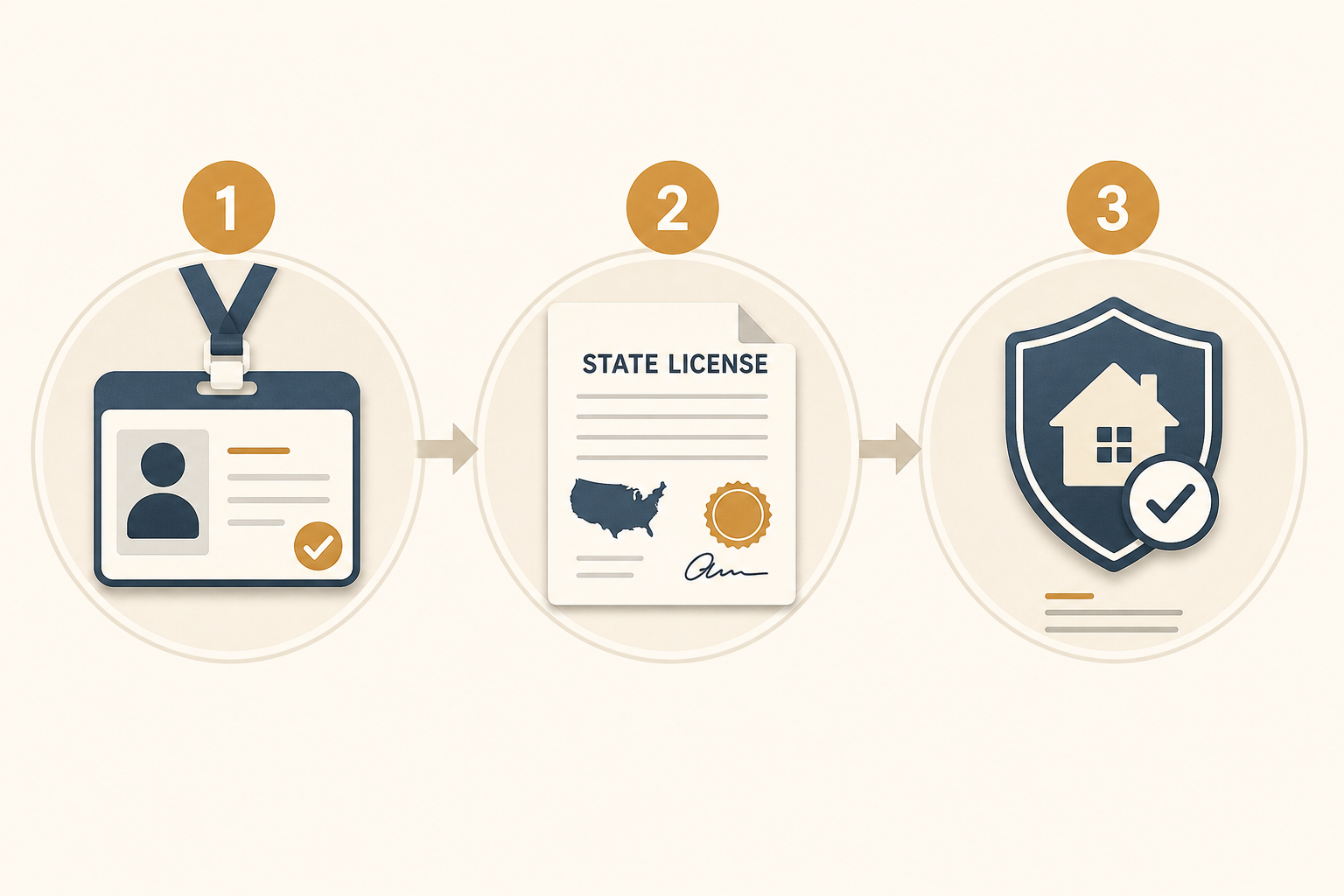
Finding a name in the NAHB directory is step one. Verification requires three separate checks, and none of them substitutes for the others.
- Confirm active CAPS renewal status in the NAHB directory. The directory reflects current designation holders. A lapsed CAPS is not the same as an active one. Annual renewal requires completing continuing education — approximately 4 hours per year — so an active listing signals that the professional has kept their training current.
- Verify the state trade contractor license independently. Each state maintains a contractor licensing board with a searchable online database. Ask the contractor for their license number and look it up directly. Confirm the license type (general contractor, specialty trades such as plumbing or electrical), the license status (active, expired, suspended), and whether any disciplinary actions are on record.
- Confirm current general liability insurance and workers' compensation coverage. Ask the contractor to provide a certificate of insurance directly from their insurer — not a document they hand you themselves. Confirm that the policy is current and that coverage limits are adequate for the scope of your project. Workers' compensation coverage protects you if a worker is injured on your property.
Questions to Ask Before You Hire a CAPS Specialist
Use these questions in your first conversation or during a brief phone screening. A qualified professional will answer them directly and without hesitation.
| Question | What you are evaluating |
|---|---|
| Can you confirm your CAPS designation is currently active, and may I verify it in the NAHB directory? | Whether they welcome credential verification — and whether their renewal is current |
| What is your state contractor license number, and what trade or specialty does it cover? | Whether they hold the license type required for the specific work you need done |
| Can your insurer send me a certificate showing current general liability and workers' compensation coverage? | Whether insurance is current and adequate for your project scope |
| How many aging-in-place modification projects have you completed in the past two years, and what types of work did they involve? | Relevant hands-on experience with the modifications your parent's home needs |
| If the project involves electrical, plumbing, or structural work, how do you handle those trades — do you hold those licenses yourself or subcontract? | How they manage specialty work and whether subcontractors are also licensed and insured |
| Will you provide a written contract that includes scope of work, materials, timeline, payment schedule, and your license number? | Professionalism and willingness to commit to a formal agreement |
| Do you conduct a walk-through after the project is complete to confirm everything meets safety and accessibility expectations? | Whether they take responsibility for the outcome, not just the installation |
Red Flags: Contractor Fraud Targeting Seniors
Older adults and their families are disproportionately targeted by contractor fraud. The urgency that surrounds a parent's fall or new diagnosis creates exactly the conditions that predatory contractors exploit. The following warning signs are drawn from FTC consumer guidance on home improvement scams and from DC consumer protection enforcement data on senior-targeted contractor fraud.
- Unsolicited door-to-door solicitation — legitimate CAPS specialists do not knock on doors claiming to have noticed a problem with your home or to have leftover materials from a nearby job.
- Pressure for an immediate decision — any contractor who tells you the price is only valid today, or that the problem is urgent and cannot wait, is using a high-pressure sales tactic. Take time to compare estimates.
- Demand for full payment upfront — reputable contractors accept a reasonable deposit (some states legally cap how much a contractor can collect before work begins) and structure payments against project milestones. Demanding full payment before work starts is a significant red flag.
- Cash-only payment requirement — legitimate contractors accept checks, credit cards, or other traceable payment methods. Cash-only demands make it nearly impossible to dispute charges or recover funds.
- Inability or unwillingness to provide a verifiable license number — a licensed contractor knows their license number and will give it to you without hesitation. Vague responses, claims that licensing is not required for this type of work, or numbers that do not appear in the state database are warning signs.
- No written contract, or pressure to sign incomplete paperwork — every legitimate home modification project should have a written contract before work begins. Pressure to sign a blank or incomplete document is a fraud indicator.
- Surprise fees or requests for more money mid-project — legitimate contractors provide written estimates and notify you in writing before any scope changes affect the price. Repeated mid-project requests for additional cash are a pattern associated with contractor fraud.
Working with an Occupational Therapist Alongside Your CAPS Contractor
The most effective aging-in-place modification projects typically involve two distinct professionals working in sequence: an occupational therapist who establishes what the individual needs, and a CAPS contractor who determines how to build it.
An OT home evaluation assesses your parent's specific functional limitations — balance, strength, reach, transfer ability, cognitive factors — and translates those findings into a written recommendation for modifications. That clinical picture tells a contractor exactly where to place grab bars relative to your parent's dominant hand and transfer direction, how wide a doorway needs to be for the specific mobility aid in use, and whether a walk-in shower threshold or a roll-in configuration is appropriate. Without that assessment, a contractor is making educated guesses.
For families coordinating modifications that involve mobility equipment — including doorway widening for a wheelchair, ramp grades calibrated to a specific chair's turning radius, or bathroom layouts designed around transfer aids and transfer techniques — the OT assessment is especially important. The structural modifications need to fit the person and the equipment together, not just meet a general accessibility standard.
For homes that also require evaluation of mobility aid navigation — such as assessing whether hallways and turning radii accommodate a walker or wheelchair — the guidance from a wheelchair safety assessment can inform which structural modifications take priority.
What to Expect: Consultation Costs, Project Costs, and Funding Sources
Cost ranges vary significantly by location, project scope, and the specialist's experience level. The figures below reflect typical market ranges as of early 2025 and should be treated as planning benchmarks rather than firm quotes.
| Service or Modification | Typical Cost Range |
|---|---|
| Home safety assessment with written report | $300 – $1,000 |
| Hourly consultation rate | $75 – $200 per hour |
| Grab bar installation (per bar, including hardware) | $100 – $300 |
| Wheelchair ramp installation | $1,500 – $5,000 |
| Stairlift installation | $3,000 – $5,000 |
| Walk-in tub installation | $5,000 – $15,000 |
| Major bathroom accessibility remodel | $10,000 – $50,000+ |
| Major kitchen accessibility remodel | $10,000 – $50,000+ |
Funding Sources to Explore Before You Pay Out of Pocket
Most structural home modifications are not covered by Medicare. Before assuming the full cost falls on the family, investigate these funding programs in order of accessibility:
- Medicaid Home and Community-Based Services (HCBS) waivers — many states offer Medicaid waiver programs that fund home modifications as part of a broader home- and community-based care package. Eligibility and covered modifications vary significantly by state. Contact your state Medicaid office or your parent's Medicaid case manager to ask whether a home modification benefit is available.
- VA Specially Adapted Housing (SAH) and Special Housing Adaptation (SHA) grants — eligible veterans with service-connected disabilities may qualify for VA grants to fund accessibility modifications. Contact the nearest VA regional office or visit va.gov to determine eligibility and current grant limits.
- USDA Section 504 Home Repair program — for homeowners in rural areas, this program offers loans up to $40,000 at 1% interest and grants up to $10,000 for very low-income homeowners to remove health and safety hazards. Eligibility is income-based. Contact USDA Rural Development at rd.usda.gov to check eligibility in your area.
- Older Americans Act programs through Area Agencies on Aging — local AAAs administer federally funded programs that may cover minor modifications, home repair, and safety improvements for older adults. Call the Eldercare Locator at 1-800-677-1116 or visit eldercare.acl.gov to find your local AAA and ask what home modification assistance is available.
- Habitat for Humanity Aging in Place — some Habitat affiliates operate programs specifically for older homeowners needing accessibility modifications. Availability and income eligibility requirements vary by affiliate. Contact your local Habitat affiliate directly.
- Rebuilding Together Safe at Home — a national nonprofit that coordinates volunteer-assisted home repair and modification projects for low-income seniors. Services are provided at no cost to eligible homeowners. Contact your local Rebuilding Together affiliate to ask about the Safe at Home program.
Browse more in the Glossary.