
Caregiver decision guide
Wheelchair Safety at Home: A Family Caregiver's Practical Guide
Wheelchair use at home creates a distinct category of injury risk — from transfer failures and pressure injuries to inaccessible rooms and equipment breakdowns — that generic fall-prevention advice doesn't address. This guide gives family caregivers a structured, evidence-grounded resource covering every major safety domain, from brake-locking technique to room-by-room home assessment to when to request an occupational therapist evaluation.

Why Wheelchair Safety at Home Is Its Own Challenge
When a parent or spouse starts using a wheelchair at home, most family caregivers reach for the same resources they used when fall-proofing the house for an ambulatory older adult: remove the rugs, add grab bars, improve the lighting. That advice isn't wrong, but it addresses only a fraction of the risk picture for wheelchair users.
Wheelchair use introduces a distinct set of injury mechanisms — transfer failures, pressure injuries from prolonged sitting, equipment breakdowns, and an entirely different set of space requirements — that standard fall-prevention checklists simply weren't designed to catch. A doorway that's fine for someone using a walker may trap a wheelchair user. A bathroom that passes a general safety audit may lack the 60-inch turning radius a wheelchair requires. And the most dangerous moment in a wheelchair user's day isn't walking down the hall — it's moving from the wheelchair to the bed, the toilet, or the car.
This guide is written for family caregivers: adult children managing a parent's transition to wheelchair use, spousal caregivers building new daily routines, and anyone responsible for a senior's safety at home. It covers every major risk domain — transfers, home environment, pressure injury prevention, and equipment maintenance — in one structured resource, grounded in research and framed for the people doing the caregiving work.
Understanding the Risk: What the Research Shows
Wheelchair-related injuries are more common than most caregivers expect, and the injury patterns are specific enough to demand their own prevention strategies.
A nationally representative analysis of Medicare beneficiaries found that 56.1% of older adults who use wheelchairs experienced a fall — a figure that surprises many caregivers who assume a seated person is inherently safer than someone walking. Video analysis of real-world wheelchair falls in long-term care settings revealed the mechanics behind this: 70.7% of falls were caused by incorrect transfer technique or an unsafe shift of body weight. Most strikingly, brakes were unlocked in 81% of observed falls, and brake position directly contributed to 67.2% of them. These findings come from a Journal of the American Medical Directors Association study based on video analysis of falls in two long-term care facilities — a setting that differs from the home environment, but whose mechanistic findings about transfer failures and brake omissions apply broadly.
Equipment is a parallel concern. According to the Model Systems Knowledge Translation Center (MSKTC), 44–57% of wheelchair users report at least one breakdown in a six-month period. Of those, 20–30% were stranded, missed critical appointments, or were injured as a result. The number of users injured from wheelchair breakdowns doubled between 1991 and 2016.
For context on the broader fall burden: the CDC reports approximately 3 million emergency department visits due to older adult falls each year, with roughly 319,000 hospitalizations for hip fractures. Wheelchair users are not exempt from this burden — and their injury pathways require targeted prevention strategies, not just the general advice developed for ambulatory seniors.
- 56.1% of older wheelchair users experienced a fall in one nationally representative study (Nie et al., cited in JAMDA).
- 70.7% of observed wheelchair falls involved incorrect transfer technique or unsafe weight shift.
- Brakes were unlocked in 81% of observed falls; brake position directly contributed to 67.2% of falls.
- 44–57% of wheelchair users experience at least one equipment breakdown in a six-month period.
- Wheelchair-related injuries from tips and falls account for 65–80% of incidents across all age groups, with most occurring at home.
Transfer Safety: The Highest-Risk Moment
The most dangerous moment in a wheelchair user's day is not navigating a hallway or crossing a threshold — it's the transfer. Moving from wheelchair to bed, toilet, shower chair, or car seat is when the majority of wheelchair-related falls and injuries occur. The research is clear on why: brakes not locked, incorrect positioning, and poor body mechanics from the caregiver.
Understanding why brakes get skipped is as important as knowing the correct technique. Cognitive impairment, medication effects that reduce attention and reaction time, lack of hand strength or dexterity, and simple unfamiliarity with the equipment are all documented reasons. Caregivers who understand this context are better equipped to build consistent habits and create environmental reminders — rather than assuming the wheelchair user will always remember independently.
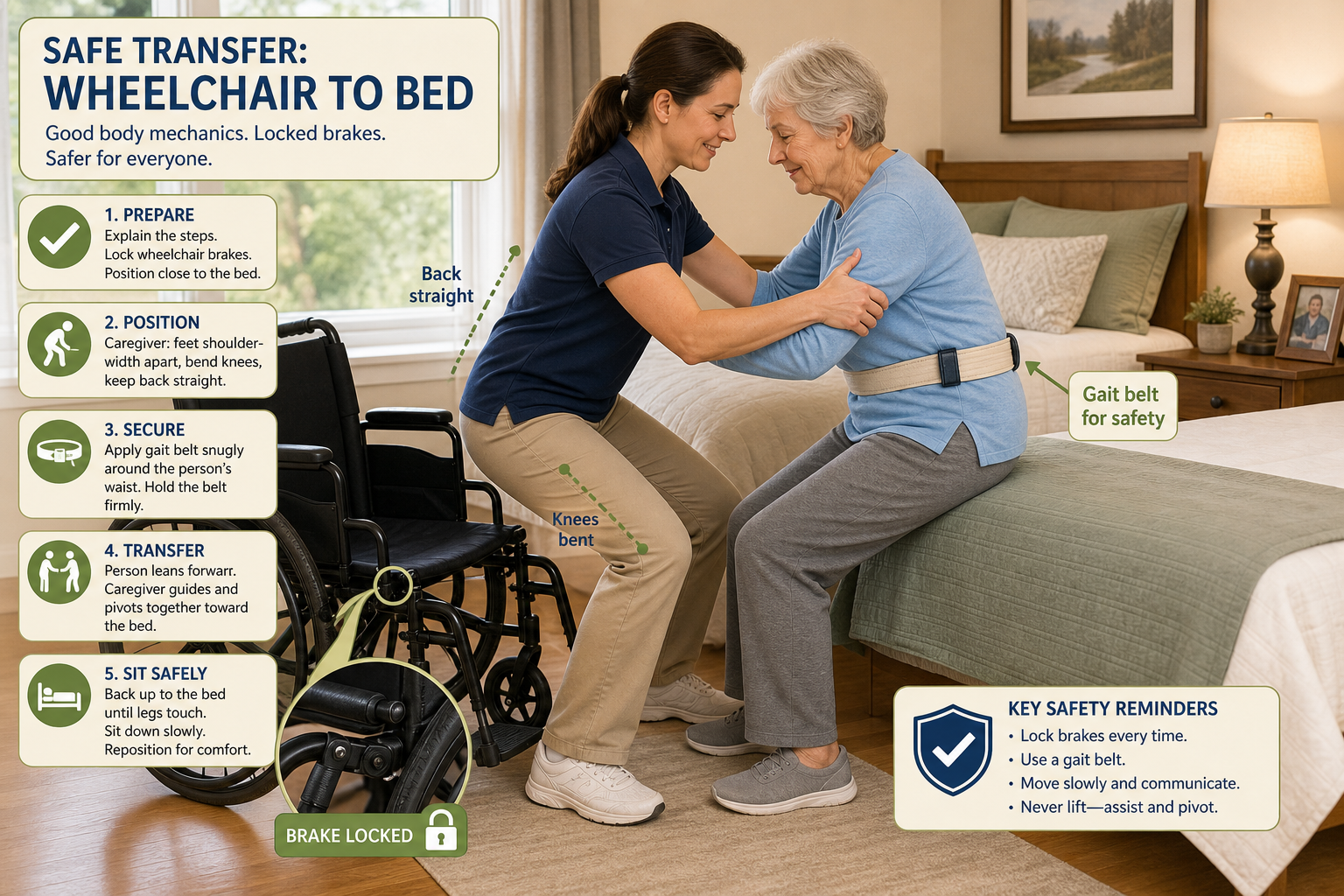
Step-by-Step Safe Transfer Protocol
- Lock both brakes before anything else. This is the single most important step. Both wheel locks must be fully engaged before the wheelchair user begins any movement. Make it a verbal habit: say "brakes locked" out loud before each transfer.
- Position the wheelchair correctly. Place the wheelchair at a 30–45 degree angle to the destination surface (bed, toilet, car seat). This reduces the distance and rotation required, lowering the risk of a fall mid-transfer.
- Remove footrests or swing them out of the way. Footrests left in place are a tripping and catching hazard during the transfer movement.
- Use a gait belt when assistance is needed. A gait belt gives the caregiver a secure grip point at the person's waist, reducing the risk of grabbing clothing or an arm — both of which can cause injury to both parties.
- Apply correct caregiver body mechanics throughout. Bend at the knees, not the waist. Keep your back straight. Push from your core and legs. Never twist your spine while bearing weight. These mechanics protect your back and shoulders — caregiver musculoskeletal injuries from improper transfer technique are common and preventable.
- Guide, don't lift, when possible. Encourage the wheelchair user to participate in the movement as much as their ability allows. Full lifts increase injury risk for both parties.
- Confirm stability before releasing. Once the person is on the destination surface, confirm they are stable and balanced before stepping back.
Car Transfers: A Distinct Sub-Scenario
Car transfers involve a lower destination surface, an unstable vehicle seat, and an outdoor or parking environment where the wheelchair may be on an uneven surface. Additional precautions apply:
- Park on the flattest surface available to prevent the wheelchair from rolling.
- Lock brakes before the car door is opened and keep them locked throughout the transfer.
- Position the wheelchair as close to the car seat as the door opening allows to minimize the transfer distance.
- Use a transfer board if the height difference between the wheelchair seat and car seat makes a standing pivot transfer difficult.
- Protect the wheelchair user's head when lowering them into the car seat — this is a common point of injury.
Room-by-Room Home Hazard Audit for Wheelchair Users
A 2025 systematic review of home modification studies found that only 10% of U.S. homes are adequately designed for aging populations. Mobility and accessibility improvements — threshold removal, doorway widening, ramp installation — and bathroom safety enhancements appeared in 100% of the reviewed studies, reflecting how consistently these areas fail wheelchair users. The following audit covers the highest-priority areas in your home.
| Room / Area | Wheelchair-Specific Hazard | What to Address |
|---|---|---|
| Bathroom | Insufficient transfer space; no grab bars; high thresholds; slippery floors | 60-inch turning radius; grab bars at toilet and shower; curbless or roll-in shower; non-slip flooring; threshold ¼ inch or less |
| Bedroom | Bed too high or low for transfer; no clear transfer zone; poor nighttime lighting | Bed height matching wheelchair seat height; 36-inch clear zone on transfer side; nightstand lighting reachable from bed |
| Kitchen | Counters too high for seated use; inaccessible controls; cabinets out of reach | Knee clearance under work surfaces; front-positioned appliance controls; frequently used items within seated reach |
| Hallways | Doorways too narrow; sharp turns; rugs and transitions | Minimum 32–36 inch clear doorway width; smooth floor transitions; no loose rugs or raised thresholds |
| Entry / Exterior | Steps without ramp; steep ramp slope; uneven outdoor surfaces | Zero-step entry or properly sloped ramp; firm, level outdoor surface to the entry; adequate outdoor lighting |
Bathroom: The Highest-Risk Room
Bathroom falls are the most frequently documented location for wheelchair-related injuries across multiple studies. The combination of wet surfaces, tight spaces, and the need to transfer to and from the toilet and shower creates a concentrated hazard profile.
- Turning radius: A manual wheelchair requires a minimum 60-inch turning radius to maneuver safely. Measure your bathroom before assuming it's adequate.
- Shower access: A curbless or roll-in shower with at least 36 inches of width eliminates the step-over hazard and allows wheelchair or shower chair access. A standard tub with a high side is a significant transfer risk.
- Grab bars: Install grab bars at the toilet (side and rear) and inside the shower. Towel bars are not load-bearing substitutes.
- Flooring: Non-slip flooring or non-slip mats secured at all edges reduce the risk of the wheelchair sliding during transfers.
- Threshold: Door thresholds should be ¼ inch or less. Higher thresholds catch wheelchair front casters and can cause sudden stops or tip-forwards.
Bedroom: Transfer Zone and Nighttime Safety
- Bed height: The bed surface should be approximately the same height as the wheelchair seat to allow a level or slightly downhill transfer. Beds that are too high or too low increase the physical effort and fall risk.
- Transfer zone clearance: Maintain a minimum 36-inch clear zone on the transfer side of the bed. This space cannot be occupied by furniture, cords, or stored items.
- Nighttime lighting: Poor lighting was present in 25.9% of observed wheelchair falls in the JAMDA video analysis. A motion-activated night light along the path from bed to bathroom significantly reduces nighttime transfer risk.
- Floor path: The path between the bed, doorway, and bathroom must be clear of rugs, cords, and furniture corners. Wheelchair casters catch on any raised edge.
Kitchen, Hallways, and Entry
According to CareFor's wheelchair safety guidance, doorways should be 32–36 inches wide with adequate floor space near doors to maneuver a wheelchair. Thresholds should be ¼ inch or less. These minimums apply to every doorway the wheelchair user needs to pass through independently.
- Kitchen counter height: Standard counters (36 inches) are above comfortable seated working height. A section of counter at 28–32 inches with knee clearance underneath allows seated food preparation.
- Appliance controls: Stove controls at the front of the range and front-loading appliances eliminate the need to reach across hot surfaces or over obstacles.
- Hallway width: A minimum 36-inch hallway width allows wheelchair passage. Narrower hallways require the user to navigate with arms extended and risk catching knuckles on door frames.
- Ramp slope: A ramp slope of 1:12 (one inch of rise for every 12 inches of run) is the standard for wheelchair accessibility. Steeper slopes require significant upper-body strength or caregiver assistance and increase tip-backward risk.
- Outdoor surface condition: Cracked pavement, gravel, and uneven surfaces are wheelchair hazards. The path from the entry to where transportation arrives should be firm, level, and well-lit.
Pressure Injury Prevention: The Silent Risk
Pressure injuries — sometimes called pressure sores or bedsores — are one of the most serious and preventable complications of wheelchair use. Unlike falls, they develop gradually and silently. A caregiver who is vigilant about transfer safety may be entirely unaware that a pressure injury is forming under clothing.
Pressure injuries occur when sustained weight on a bony prominence — the tailbone, sit bones, heels, shoulder blades — reduces blood flow to the skin and underlying tissue. For wheelchair users, the sit bones and tailbone are the primary sites of concern.
Repositioning: The Foundation of Prevention
Clinical guidelines consistently recommend repositioning every 30–60 minutes to relieve sustained pressure. This is a general interval based on established clinical standards; the appropriate schedule for any individual depends on their diagnosis, skin condition, and activity level. Consult the wheelchair user's physician or occupational therapist for a personalized repositioning schedule.
Repositioning doesn't always mean a full transfer. A small weight shift — leaning to one side, briefly lifting the body with the armrests, or tilting the wheelchair back — is sufficient to restore blood flow to compressed tissue. Building these micro-movements into a regular routine is more sustainable than relying on full repositioning every hour.
Cushion Selection and Skin Inspection
- Pressure-relieving cushions: Standard foam cushions provide minimal pressure redistribution. Pressure-relieving cushion categories include air-cell, gel, and contoured foam designs. The right choice depends on the individual's weight, sitting posture, and activity level — an occupational therapist or seating specialist can recommend the appropriate category.
- Daily skin inspection: Inspect the skin over bony prominences every day, ideally at bath or dressing time. Use a mirror or ask for assistance to check areas that are difficult to see.
- Early warning signs: Persistent redness that does not fade within 30 minutes of pressure relief, warmth, swelling, or any skin breakdown are early-stage pressure injury signs. These require prompt attention — do not wait for an open wound to develop before contacting a healthcare provider.
- Moisture management: Skin that is consistently moist from incontinence or perspiration is significantly more vulnerable to pressure injury. Breathable cushion covers and moisture-wicking clothing reduce this risk.
Wheelchair Equipment Inspection and Maintenance
Equipment failure is a direct injury risk. A brake that doesn't hold, a footrest that collapses, or a tire that goes flat during a transfer can cause a fall just as surely as an unlocked brake. Given that 44–57% of wheelchair users experience a breakdown within six months, a structured inspection routine is not optional maintenance — it is injury prevention.
| Inspection Frequency | What to Check | What to Look For |
|---|---|---|
| Daily | Wheel locks (brakes) | Both brakes engage fully and hold the wheelchair stationary when applied |
| Daily | Footrests | Secure attachment; no wobble; swing-away mechanism functions smoothly |
| Daily | Tire condition (manual) | No visible flat; consistent firmness across both tires |
| Daily | Seating stability | Cushion is properly positioned; no shifting or compression that changes seat height |
| Weekly | Frame integrity | No cracks, bends, or loose welds; all bolts and fasteners tight |
| Weekly | Armrests | Secure attachment; height adjustment mechanism holds position if adjustable |
| Weekly | Cushion condition | No significant compression, tearing, or loss of pressure-relief properties |
| Weekly | Tire pressure (if pneumatic) | Inflate to manufacturer specification; consistent pressure in both tires |
| Annually | Full professional service | Comprehensive inspection and adjustment by a wheelchair maintenance specialist |
The MSKTC recommends a complete professional service by a wheelchair maintenance expert once a year. Many wheelchair repair and durable medical equipment (DME) suppliers offer this service. For power wheelchair users, battery health is a critical annual check — a battery that fails unexpectedly can strand the user or prevent a timely transfer.
When to Request an Occupational Therapist Home Assessment
A caregiver walkthrough of the home using a checklist is a useful starting point. An occupational therapist (OT) home assessment is a different order of magnitude.
Research published in PMC found that OT-led environmental assessments identified significantly more hazards than assessments conducted by non-OT assessors — particularly in pathways, entrances, and stairs. In a randomized clinical trial, OT-led interventions reduced falls by 39% compared to control groups, while interventions by non-OT assessors showed no significant fall reduction. A separate systematic review of home modification studies found that home modifications led by occupational therapists reduced weekly care hours by 42% in one study — a meaningful reduction in caregiver burden.
An OT home assessment for a wheelchair user goes beyond hazard identification. It evaluates the match between the person's specific functional abilities and the home environment, recommends modifications calibrated to their actual transfer technique and mobility pattern, and can identify equipment adjustments — seat height, armrest position, footrest angle — that reduce injury risk during daily routines.
When an Assessment Is Most Valuable
- When a senior first begins using a wheelchair at home — before injury patterns are established.
- After a fall, near-miss transfer failure, or new pressure injury.
- When a significant functional change occurs — new diagnosis, surgery, or change in strength or cognition.
- Before undertaking home modifications, to ensure planned changes address the actual hazard profile.
- When caregivers are experiencing back or shoulder pain from transfers — a sign that technique or equipment needs adjustment.
How to Access an OT Home Assessment
- Request a referral from the wheelchair user's primary care physician. A physician referral is typically required for Medicare coverage.
- Medicare coverage: OT home assessments are potentially covered by Medicare when medically necessary. Coverage rules are subject to policy cycles. Verify current coverage with Medicare or a Medicare counselor before scheduling.
- Home health agencies: If the wheelchair user is already receiving home health services, ask whether an OT home assessment is included in the current plan of care.
Quick-Reference Wheelchair Safety Checklist
Use this checklist as a regular reference or post it where transfers happen most often. Each item is a concrete, observable action — not a general principle.
Transfers
- Both wheel locks are engaged and confirmed before every transfer — no exceptions.
- Footrests are swung away or removed before the transfer begins.
- Wheelchair is positioned at a 30–45 degree angle to the destination surface.
- Gait belt is used when caregiver assistance is required.
- Caregiver bends at the knees, keeps back straight, and pushes from the core — no spinal twisting under load.
- The wheelchair user participates in the movement as much as ability allows.
- Stability is confirmed before the caregiver releases.
Home Environment
- Bathroom has a minimum 60-inch turning radius and a curbless or roll-in shower.
- Grab bars are installed at the toilet and inside the shower or tub area.
- All floor thresholds are ¼ inch or less.
- Doorways used by the wheelchair are 32–36 inches wide.
- Bed height matches wheelchair seat height for level transfers.
- A 36-inch clear transfer zone is maintained on the transfer side of the bed.
- Motion-activated lighting covers the nighttime path from bed to bathroom.
- All floor paths are clear of rugs, cords, and furniture corners.
- Entry ramp slope is 1:12 or less, with a firm, level outdoor surface.
Pressure Injury Prevention
- Weight shift or repositioning occurs at least every 30–60 minutes (confirm individualized schedule with physician or OT).
- A pressure-relieving cushion appropriate to the user's needs is in place and in good condition.
- Skin over bony prominences is inspected daily.
- Any persistent redness, warmth, or skin breakdown is reported to a healthcare provider promptly.
Equipment Maintenance
- Daily: Brakes hold the wheelchair fully stationary when engaged.
- Daily: Footrests are secure and swing-away mechanism functions correctly.
- Daily: Tires have consistent firmness (no visible flat).
- Daily: Cushion is properly positioned and not significantly compressed.
- Weekly: Frame shows no cracks, bends, or loose fasteners.
- Weekly: Armrests are secure and hold position.
- Weekly: Cushion shows no tearing or significant loss of pressure-relief properties.
- Annually: Complete professional service by a wheelchair maintenance specialist.
Questions to bring to a clinician or OT
This is not medical, legal, or a family's final decision — only a framework. Bring these questions to a clinician, occupational therapist, or your local Area Agency on Aging.
Find Local HelpRelated reading
Noticed something outdated or inaccurate on this page? Flag a correction. We review every report against CDC, NIA, and AARP HomeFit guidance before updating a page.