
When Is It Time for Senior Care? A Proactive Checklist for Recognizing the Signs and Choosing the Right Option
Last reviewed: — Review date is particularly important for Medicare coverage, device specifications, and clinical guidance, which change frequently.
Why Waiting Until a Crisis Is Costly
The decision to begin senior care rarely arrives on a schedule. For most families, it arrives in the form of a fall, a hospitalization, a missed utility payment, or a call from a concerned neighbor. According to U.S. News, 60% of families report that difficulty with daily tasks is the primary trigger that finally pushes them to start looking at care options. By that point, the decision window has already narrowed — and the emotional and financial stakes are at their highest.
The cost of reactive decision-making extends beyond the immediate crisis. Families who scramble to find placement often pay higher rates, choose facilities that are not the best fit, or commit to care arrangements that drain savings faster than necessary. Meanwhile, the unpaid labor that families provide is staggering: family caregivers contribute an estimated $873 billion in unpaid care annually, according to data from A Place for Mom cited by Choice Mutual. Caregivers who live with their care recipients spend over 37 hours per week on caregiving duties — essentially a second full-time job.
The good news is that the warning signs are almost always visible well before a crisis, if you know where to look. The framework that follows organizes those signs into four clear domains, giving you a structured way to observe, document, and act — on your timeline, not the emergency room's.
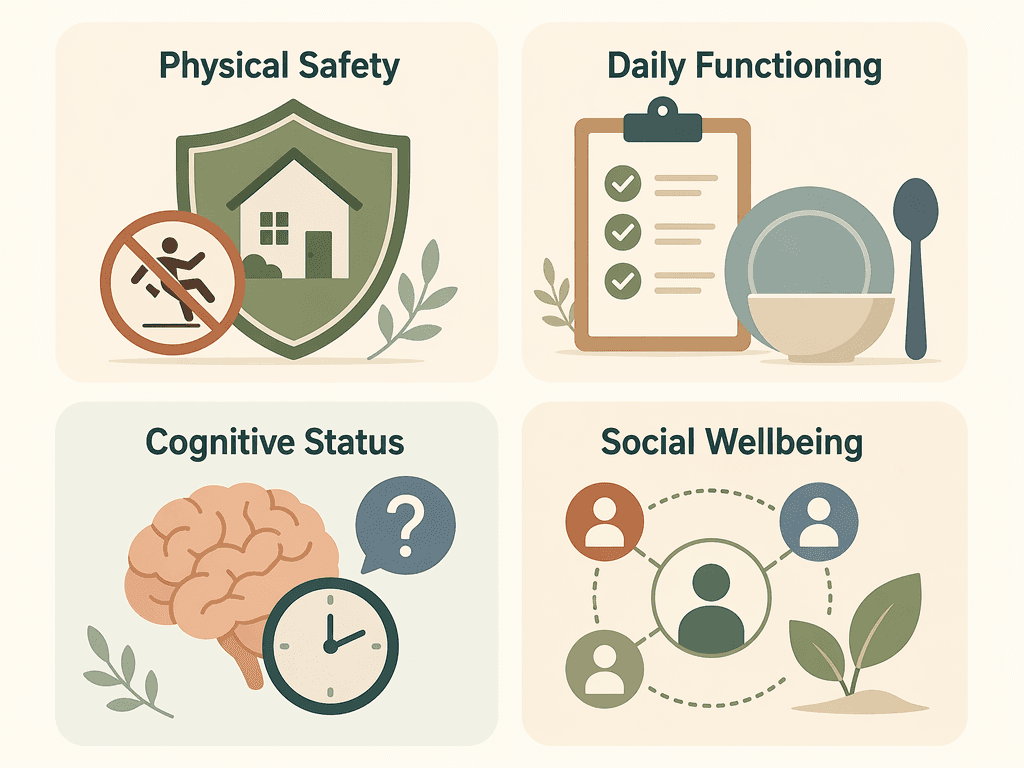
The Four-Domain Early-Warning Checklist
Rather than relying on a single dramatic event, this checklist asks you to track changes across four domains over a period of weeks or months. A pattern of small changes in multiple domains is a stronger signal than any single warning sign.
Domain 1: Physical Safety
Physical safety concerns are often the first visible signal. Look for:
- Unexplained bruises, scrapes, or injuries that suggest unreported falls
- Burn marks on clothing or appliances, indicating stove or oven accidents
- Unsafe driving — new dents on the car, traffic violations, or getting lost on familiar routes
- Difficulty navigating stairs, getting in and out of chairs, or walking without support
- Nearly 80% of older adults say they would need bathroom modifications like grab bars to age safely at home (AARP, cited by Choice Mutual)
Domain 2: Daily Functioning
This domain captures the practical tasks of independent living. Changes here are often the most concrete and easiest to document. Look for:
- Missed meals or a refrigerator full of expired food
- Unpaid bills, overdue notices, or unusual credit card activity
- Unwashed laundry, dirty dishes piling up, or a noticeably unkempt home
- Missed medication doses, double-dosing, or empty pill bottles that should still be full
- Difficulty using the phone, managing mail, or keeping appointments
Domain 3: Cognitive Status
Cognitive changes can be subtle and gradual. They are often dismissed as "just getting older," but a pattern of change warrants attention. Look for:
- Repeating the same question or story within a short conversation
- Confusion about time, place, or familiar people
- Poor judgment — giving money to telemarketers, leaving the stove on, wandering outside at odd hours
- Difficulty following a conversation, movie plot, or set of instructions
- Getting lost in previously familiar neighborhoods
Domain 4: Social Wellbeing
Social withdrawal is one of the most overlooked warning signs. It can be a response to embarrassment about declining abilities, or a symptom of depression. Look for:
- Declining participation in hobbies, religious services, or social groups
- Withdrawal from phone calls or visits with family and friends
- Neglected personal hygiene — unwashed hair, unchanged clothes, strong body odor
- Hoarding behaviors or extreme disorganization in the home
- 77% of older adults who live alone maintain weekly contact with family, friends, or neighbors (Choice Mutual); a drop in this contact is a red flag
How to Assess ADLs and IADLs: The Standard Clinical Framework
Once you have identified patterns of concern, the next step is to conduct a more formal assessment using the standard clinical framework that healthcare professionals use: Activities of Daily Living (ADLs) and Instrumental Activities of Daily Living (IADLs). This framework provides a common language for describing what a person can and cannot do independently, and it directly informs which type of care is appropriate.
The Six Activities of Daily Living (ADLs)
ADLs are the fundamental self-care tasks that a person must be able to perform to live independently. Difficulty with one or more ADLs typically signals the need for hands-on personal care assistance.
| ADL | What to Observe | What It Suggests |
|---|---|---|
| Bathing | Difficulty getting in/out of tub or shower; fear of bathing; visible body odor | May need bathing assistance or bathroom safety modifications |
| Dressing | Difficulty buttoning, zipping, or choosing appropriate clothing; wearing same clothes repeatedly | May need help with dressing or wardrobe simplification |
| Toileting | Accidents, difficulty getting on/off toilet, incontinence episodes | May need toileting assistance, raised toilet seat, or incontinence products |
| Transferring | Difficulty getting out of bed or a chair; using furniture for support; near-falls | May need a transfer aid, walker, or physical therapy |
| Continence | Frequent accidents, hiding soiled laundry, avoiding fluids to prevent accidents | May need incontinence assessment and management plan |
| Feeding | Difficulty using utensils, choking, skipping meals, significant weight loss | May need meal preparation assistance or feeding support |
Read the Full Guide
FAQs provide a concise answer. For comprehensive coverage, see these related guides.
- The True Cost of Assisted Care in 2026: What Families Actually Pay and How to Afford It
A comprehensive guide for adult children navigating the sticker shock of assisted living, memory care, and home care costs in 2026. Learn what families actually pay across care types and states, and discover a step-by-step payment playbook combining private funds, insurance, and public benefits.
- Medication Management Technology for Family Caregivers: From Simple Apps to Smart Dispensers
Family caregivers managing a loved one's medications now have technology options beyond the pill organizer—from pharmacy blister packs and mobile apps to smart dispensers that alert you to missed doses. This guide helps you choose the right tool based on your situation, with evidence on adherence and cost.
- Short-Term Care for Elderly: A Respite Guide for Caregivers Facing Burnout
This guide helps spousal and adult child caregivers recognize when burnout is approaching, understand the emotional barriers to seeking help, and find practical, affordable short-term care options to sustain their caregiving journey.
Comments
Join the discussion with an anonymous comment.