
Senior Care Options: A Practical 3-Step Decision Framework for Families Facing a Crisis
When a parent needs care urgently, families often make rushed decisions that don't match the actual level of need. This guide provides a replicable, crisis-ready framework — assess ADL/IADL needs, match to the right care tier, and evaluate facilities using objective criteria — all executable within a single week.

The Crisis That Changes Everything
The call comes at 6:47 PM on a Tuesday. Your father fell in the bathroom and couldn't get up. A neighbor found him four hours later. Or maybe it's a hospital discharge planner telling you your mother can't go home safely after her hip replacement. Or a frantic call from a sibling who found your parent wandering the neighborhood at 2 AM.
If you are reading this, you are likely in one of those moments. The ground has shifted. You need to make a decision about senior care — and you need to make it fast.
You are not alone in being unprepared. Nearly 70% of Americans over 65 will need some form of long-term care, yet the vast majority of families have never discussed preferences or options before a crisis hits. In the absence of a plan, families default to whatever is available fastest — the facility the hospital discharge planner recommends, the one nearest to a sibling's house, or the one with a room available today. These rushed decisions often lead to a mismatch between the level of care provided and the level of care actually needed, resulting in unnecessary costs, premature transitions, and deep regret.
This guide provides a replicable, three-step framework designed to be executed within a single week. It will help you:
- Assess what your parent actually needs using a standardized ADL/IADL checklist
- Match that assessment to the right care tier — not the one that sounds best, but the one that fits
- Evaluate specific facilities using objective criteria that most families never think to ask about
Step 1: Assess What Your Parent Actually Needs — The ADL/IADL Checklist
Before you can choose a care option, you need a clear picture of what your parent can and cannot do independently. Most families overestimate or underestimate functional ability because they have not systematically observed every domain. The standardized framework for this is the Activities of Daily Living (ADLs) and Instrumental Activities of Daily Living (IADLs).
ADLs are the fundamental self-care tasks that a person must be able to perform to live independently. IADLs are more complex tasks that require higher cognitive function and organizational ability. Deficits in IADLs often appear years before ADL deficits become apparent — which is why this assessment can catch needs that families have not yet recognized.
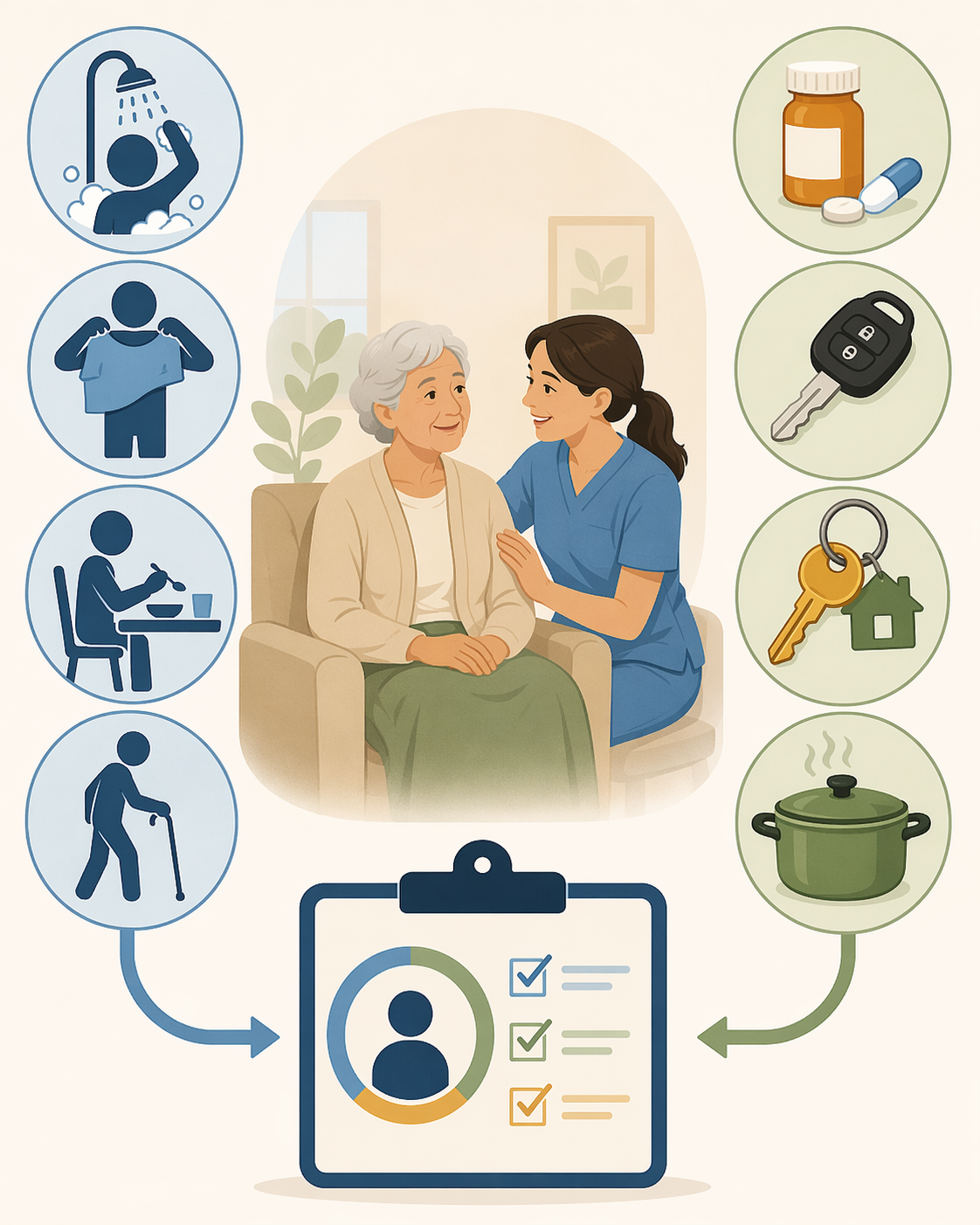
The ADL Checklist
For each activity, rate your parent as: Independent (no help needed), Needs Supervision (verbal cueing or standby assistance), Needs Physical Help (hands-on assistance), or Dependent (cannot perform at all).
| Activity | Independent | Needs Supervision | Needs Physical Help | Dependent |
|---|---|---|---|---|
| Bathing (getting in/out of tub or shower, washing all body parts) | ||||
| Dressing (selecting clothes, putting them on, fastening buttons/zippers) | ||||
| Eating (getting food to mouth, chewing, swallowing — not cooking) | ||||
| Toileting (getting to and from the toilet, cleaning self, managing clothing) | ||||
| Transferring (getting in/out of bed or chair, standing from seated position) | ||||
| Continence (controlling bladder and bowel function, managing incontinence products) |
The IADL Checklist
| Activity | Independent | Needs Some Help | Cannot Do |
|---|---|---|---|
| Medication management (taking correct doses at correct times, refilling prescriptions) | |||
| Transportation (driving safely, using public transit, arranging rides) | |||
| Financial management (paying bills, tracking accounts, avoiding scams) | |||
| Meal preparation (planning, shopping, cooking, storing food safely) | |||
| Housekeeping (cleaning, laundry, maintaining a safe home environment) | |||
| Telephone use (dialing numbers, answering calls, using a smartphone) |
How to Score the Assessment
Add up the scores from both checklists. The total will guide you to the appropriate care tier in Step 2.
| Total Score | Interpretation |
|---|---|
| 0–3 | Minimal assistance needed. Likely safe with occasional check-ins or light home care. |
| 4–8 | Moderate assistance needed. May need regular home care, adult day services, or assisted living. |
| 9–15 | Significant assistance needed. Assisted living, memory care, or skilled nursing likely appropriate. |
| 16+ | High-dependency care needed. Skilled nursing or 24/7 home care is likely necessary. |
Step 2: Match the Score to the Right Care Level
Once you have a score, the next step is to match it to the appropriate care tier. The table below maps score ranges to the most common care options. Read across the row that matches your total score to see which options are worth investigating.
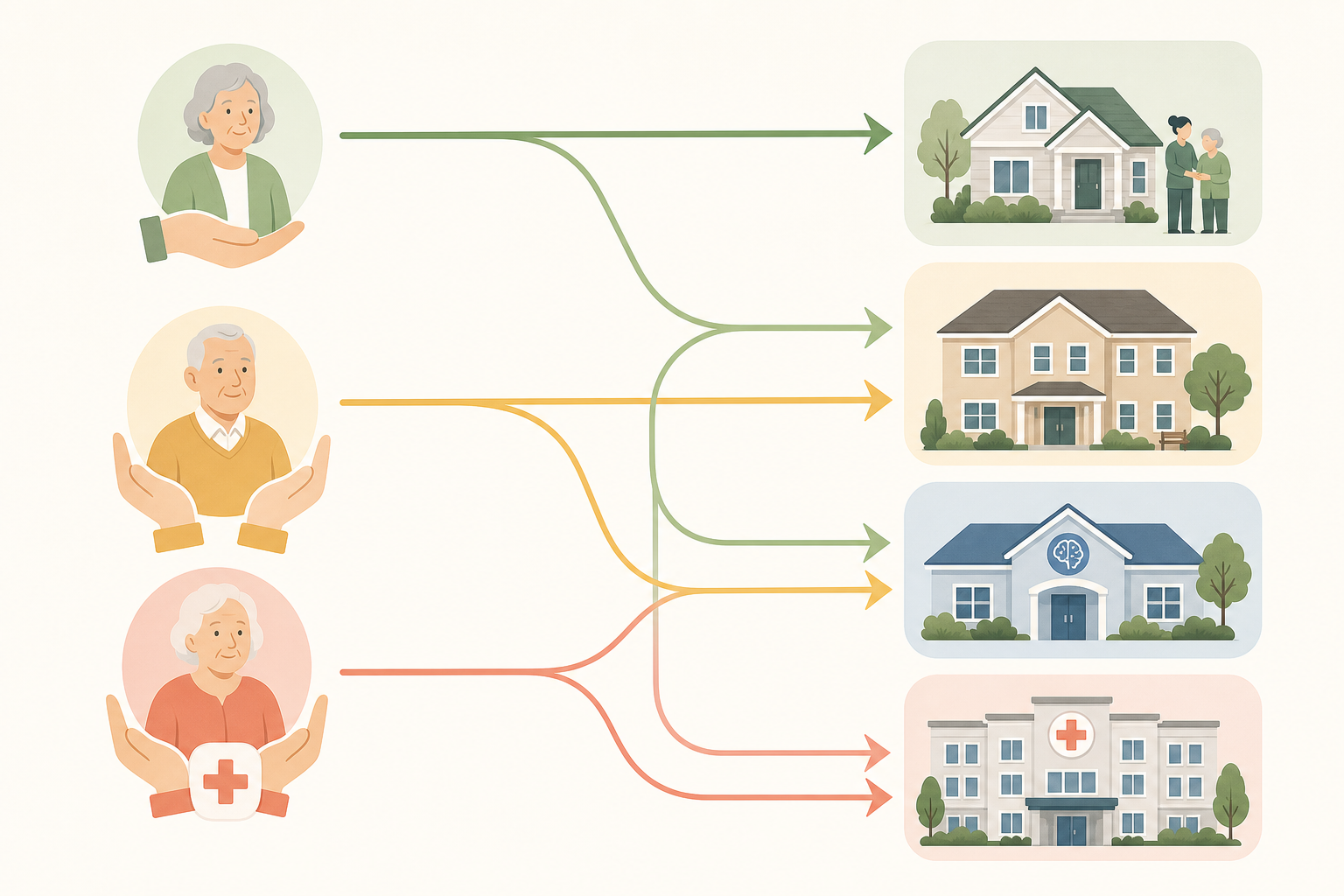
| Score Range | Recommended Care Options | Key Features | Typical Resident Profile |
|---|---|---|---|
| 0–3 | Independent Living, Light Home Care (4–8 hrs/week) | Apartment or cottage, meals optional, social activities, no on-site caregivers | Active, mobile, cognitively intact, needs minimal assistance |
| 4–8 | Home Care (8–40 hrs/week), Adult Day Services, Assisted Living | Help with 1–2 ADLs, medication management, meals, 24-hour staff, social programs | Needs regular assistance but can still participate in activities |
| 9–15 | Assisted Living (higher acuity), Memory Care, Skilled Nursing (short-term) | Help with 3–4 ADLs, dementia programming (if memory care), 24/7 nursing (if skilled nursing) | Significant functional decline, possible cognitive impairment, needs substantial daily help |
| 16+ | Skilled Nursing Facility (long-term), 24/7 Home Care (with aides) | 24/7 skilled nursing care, rehabilitation services, full assistance with all ADLs | High dependency, complex medical needs, likely bed-bound or requiring total care |
Understanding Each Care Option
Here is a brief description of each option to help you narrow your list to 2–3 viable choices before you start touring.
- Independent Living: For active seniors who need minimal or no assistance. Typically includes an apartment, some meals, and social activities. No on-site caregivers. Costs around $3,200–$3,523/month (LTCFEDS, U.S. News).
- Home Care: A nonmedical caregiver comes to the home to help with ADLs, IADLs, or companionship. Median hourly cost is $35/hour (CareScout). At 44 hours/week, this reaches $80,080/year — often more expensive than assisted living.
- Adult Day Services: A structured program during daytime hours (typically 8 AM–6 PM) that provides social activities, meals, and some personal care. Average cost is $95 per eight-hour day (U.S. News). Good for working caregivers.
- Assisted Living: Private apartments with 24-hour staff, help with up to 2 ADLs, medication management, meals, and social activities. National median cost is $5,419/month (A Place for Mom 2026), ranging from ~$4,000 to ~$11,000 depending on location and level of care.
- Memory Care: A specialized assisted living unit for people with Alzheimer's or other dementias. Secure environment, specially trained staff, structured programming. Costs 20–30% more than standard assisted living — average $6,690–$7,645/month (A Place for Mom, U.S. News).
- Skilled Nursing Facility (Nursing Home): 24/7 skilled nursing care for people with complex medical needs or high dependency. Semi-private room $9,581/month, private $10,798/month (CareScout 2025). Medicare covers the first 100 days after a qualifying hospital stay but does not cover long-term custodial care.
- Continuing Care Retirement Community (CCRC): A campus that offers independent living, assisted living, and skilled nursing all in one location. Requires a large entrance fee ($100,000–$1 million+) plus monthly fees ($3,000–$6,000+). Best for those who can afford the upfront cost and want to age in place.
Step 3: Evaluate Facilities Using an Objective Tour Checklist
Once you have identified 2–3 viable care options, the next step is to evaluate specific facilities. This is where most families make their biggest mistake: they tour a facility, like the look of the lobby and the friendliness of the tour guide, and make a decision based on gut feel. The NIA and the Alzheimer's Association both emphasize that objective criteria — staffing ratios, turnover rates, inspection history, and discharge policies — are far more predictive of quality than first impressions.
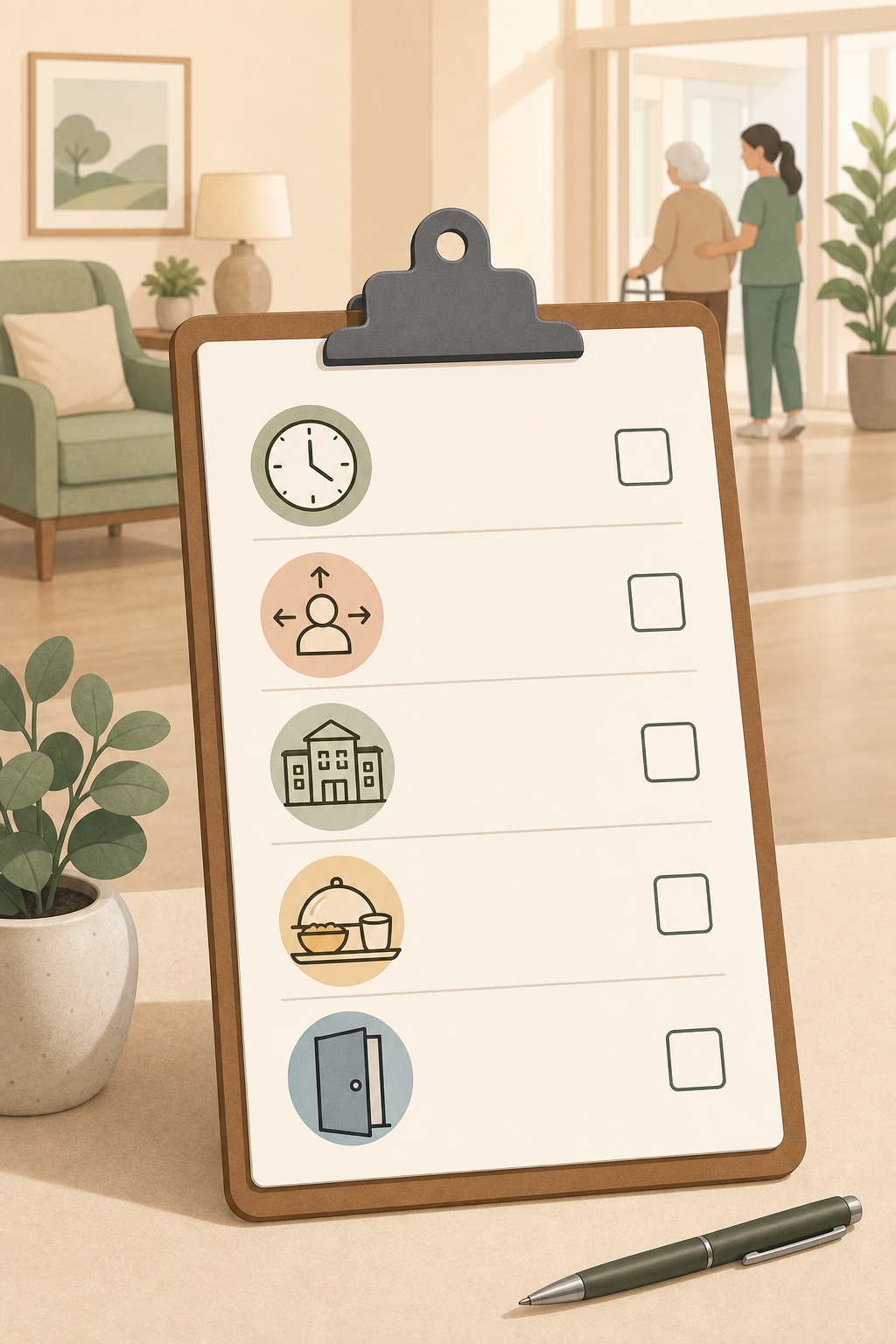
The Tour Checklist
Print this checklist and bring it to every tour. Take notes during the visit, not after. If a staff member cannot answer a question, ask to speak with the director of nursing or the executive director.
| Category | Question to Ask | Why It Matters |
|---|---|---|
| Staffing | What is the staff-to-resident ratio during the day? Overnight? | Low ratios mean residents wait longer for help with toileting, meals, and call lights. |
| Staffing | What is the annual staff turnover rate? How long has the average caregiver worked here? | High turnover is one of the strongest predictors of poor care quality. The NIA recommends asking this directly. |
| Staffing | What training do staff receive for dementia care (if memory care)? | Specialized training is essential for managing behaviors like wandering, sundowning, and agitation. |
| Care | How often does a physician or nurse practitioner visit? Is there a medical director on site? | Regular medical oversight reduces hospital readmissions and ensures timely intervention. |
| Care | What is the process for handling a medical emergency? How are families notified? | Clear protocols prevent delays in care and keep families informed. |
| Activities | What activities are offered daily? Are they appropriate for the cognitive level of residents? | Engagement is a key predictor of quality of life. Look for structured, varied activities, not just bingo. |
| Safety | Is the facility secure? Is there a wander-prevention system (for memory care)? | Wandering is a leading cause of injury and death in dementia patients. Secure outdoor space is essential. |
| Safety | What is the fall rate per 1,000 resident days? How does it compare to the state average? | Facilities with high fall rates may have inadequate staffing or environmental hazards. |
| Food | Can we observe a meal? Are residents given choices? Is assistance available for those who need it? | Mealtime is a key indicator of dignity and quality of life. Observe whether staff interact respectfully. |
| Inspection | When was the last state inspection? Can we see the report? Were there any deficiencies? | State inspection reports are public records. Deficiencies in staffing, infection control, or resident safety are red flags. |
| Discharge | Under what circumstances can a resident be discharged? How much notice is given? | Some facilities discharge residents who need more care than they can provide, leaving families scrambling. |
| Cost | What is included in the base monthly fee? What services are extra (e.g., medication management, incontinence care, transportation)? | Unexpected add-on costs can increase the monthly bill by 20–40%. |
The Unannounced Follow-Up Visit
The single most important evaluation strategy recommended by the NIA and the Alzheimer's Association is the unannounced follow-up visit. After your scheduled tour, return to the facility at a different time of day — ideally during a meal or in the evening. Do not call ahead. Observe:
- Are residents engaged in activities or sitting alone in hallways?
- Are call lights answered promptly?
- Do staff members interact with residents warmly and respectfully?
- Is the facility clean and odor-free?
- Are residents who need help eating actually receiving assistance?
The Cost Reality Check: What Each Option Really Costs
Cost is often the most stressful part of the decision — and the area where families have the most misconceptions. The table below compares monthly costs across the options identified in Step 2. Use it to build a realistic budget.
| Care Option | Monthly Cost (Median) | Annual Cost (Estimated) | Source & Year |
|---|---|---|---|
| Independent Living | $3,200–$3,523 | $38,400–$42,276 | LTCFEDS 2024, U.S. News 2026 |
| Home Care (44 hrs/week) | $6,160 | $80,080 | CareScout 2025 ($35/hr) |
| Adult Day Services | $2,090 (22 days/month) | $25,080 | U.S. News 2026 ($95/day) |
| Assisted Living | $5,419 | $65,028 | A Place for Mom 2026 |
| Memory Care | $6,690–$7,645 | $80,280–$91,740 | A Place for Mom 2026, U.S. News 2026 |
| Nursing Home (Semi-Private) | $9,581 | $114,972 | CareScout 2025 |
| Nursing Home (Private) | $10,798 | $129,576 | CareScout 2025 |
| CCRC (Entrance Fee + Monthly) | $100k–$1M+ entry + $3,000–$6,000+/mo | Varies widely | NIA 2023, Senioridy 2026 |
A few important caveats about these figures:
- Cost data comes from multiple sources (CareScout, A Place for Mom, U.S. News, Genworth, Alzheimer's Association) with different methodologies and survey periods. Figures may not be directly comparable across sources.
- Assisted living costs have been rising about 5% per year. In 2024, the median cost surged by 10% to $70,800 annually (New LifeStyles).
- Home care at 44 hours/week is often more expensive than assisted living — a fact many families discover only after they have already hired a caregiver.
- Medicaid eligibility rules and waiver programs vary significantly by state. Consult your state Medicaid office or an elder law attorney for personalized guidance.
How to Have the Conversation: Scripts for Talking to Your Parent and Siblings
The hardest part of this process is often not the assessment or the tours — it is the conversation. Telling a parent they can no longer live independently, or convincing siblings to share the responsibility, is emotionally charged. The language you use matters enormously.
Talking to Your Parent
Center the conversation on safety, dignity, and collaboration — not on what they cannot do anymore. Avoid language that sounds like you are taking over.
| Do Say | Don't Say |
|---|---|
| "Mom, I'm worried about you living alone after your fall. Can we talk about what would make you feel safer?" | "You can't live alone anymore. It's not safe." |
| "I've been reading about some options that might help you stay independent longer. Would you be open to looking at them together?" | "I've already found a place for you. You're moving next week." |
| "Let's make a list of what's important to you — what you want in a living situation — and see what options match." | "This is what's best for you. You just need to accept it." |
| "I know this is hard. I'm not trying to take away your independence — I'm trying to help you keep as much of it as possible." | "If you don't agree, I can't keep helping you. You're on your own." |
Talking to Siblings
Sibling disagreements about care are common and can derail the decision-making process. Use a structured approach to keep the conversation productive.
- Start with data, not opinions. Share the ADL/IADL assessment results and the decision matrix. Let the facts guide the discussion.
- Acknowledge different perspectives. "I know you live farther away and don't see Mom every day. Let me share what I've been observing."
- Assign roles based on capacity, not guilt. "I can handle the tours and the paperwork. Can you help with the financial research?"
- Set a decision deadline. "Let's agree to have a decision by Sunday night. If we can't agree, we'll go with the option that has the highest safety rating."
- If disagreements persist, involve a neutral third party — a geriatric care manager, a social worker, or a trusted family friend.
Your One-Week Action Plan
This framework is designed to be executable within a single week. Here is a day-by-day timeline to keep you on track.
| Day | Tasks | Key Actions |
|---|---|---|
| Day 1–2 | Complete the ADL/IADL assessment | Observe your parent across all domains. Score the assessment. Share results with a primary care provider or occupational therapist for validation. |
| Day 3 | Match score to care levels and research options | Use the decision matrix to identify 2–3 viable care tiers. Research facilities in your area using Medicare Care Compare and the Eldercare Locator (800-677-1116). |
| Day 4–5 | Schedule and conduct tours using the checklist | Tour 2–3 facilities. Bring the printed checklist. Schedule unannounced follow-up visits for a different time of day. |
| Day 6 | Review costs and contracts | Compare monthly costs, included services, and add-on fees. Review the contract with a focus on discharge policies, fee increases, and refundability of entrance fees. |
| Day 7 | Make the decision and begin transition | Involve your parent in the final decision if possible. Notify the chosen facility. Begin the move-in process. Cancel or pause home services as needed. |
Resources to Help You Move Forward
You do not have to navigate this alone. The following resources provide independent, authoritative information and support.
- Medicare Care Compare Tool: Compare nursing homes, home health agencies, and hospitals on quality measures, staffing, and inspection results. Available at medicare.gov/care-compare.
- Eldercare Locator: A public service of the U.S. Administration on Aging that connects families to local aging resources. Call 800-677-1116 or visit eldercare.acl.gov.
- State Inspection Databases: Every state maintains public records of nursing home and assisted living facility inspections. Search your state's health department website for inspection reports.
- Area Agencies on Aging (AAA): Local organizations that provide information, counseling, and referrals for senior services. Find your local AAA through the Eldercare Locator.
- Alzheimer's Association Community Resource Finder: A searchable database of dementia-specific resources, including memory care facilities, support groups, and home care agencies. Available at alz.org.
- LongTermCare.gov: A federal resource that explains long-term care options, costs, and how to plan. Includes state-specific Medicaid information.
If your parent needs short-term rehabilitation after a hospitalization before a long-term care decision can be made, the Short-Term Care for Elderly: A Complete Guide to Options, Costs, and Medicare Coverage in 2026 guide explains how Medicare covers short-term skilled nursing and what to expect during the transition.
For a broader overview of caregiving support, the Compass for Caregiving guide provides a comprehensive orientation for families who need to understand the full landscape of caregiving resources.
Related reading
Noticed something outdated or inaccurate on this page? Flag a correction. We review every report against CDC, NIA, and AARP HomeFit guidance before updating a page.
Part of the Fall Prevention section.