
Clinical term
What Hospital Strikes Mean for Elderly Parents
Last verified 2026-08-01
A strike is happening at your parent’s hospital. The first practical answer is this: if the hospital has not directly canceled your parent’s appointment, procedure, treatment, or admission plan, assume it is still on while you confirm by phone. Do not keep an older adult away from emergency care because of a strike notice.
The clearest public rule comes from NHS England, which tells patients affected by industrial action to attend planned appointments unless the NHS contacts them to rearrange, says postponed elective care will be rebooked as a priority, and says inpatients should be told by ward staff how their care will be affected.[1] That is UK-specific guidance, not a rule for U.S. hospitals. Still, it is the safest caregiver default when no direct cancellation has arrived: go unless told otherwise, and actively confirm anything routine.

Start with your parent’s situation
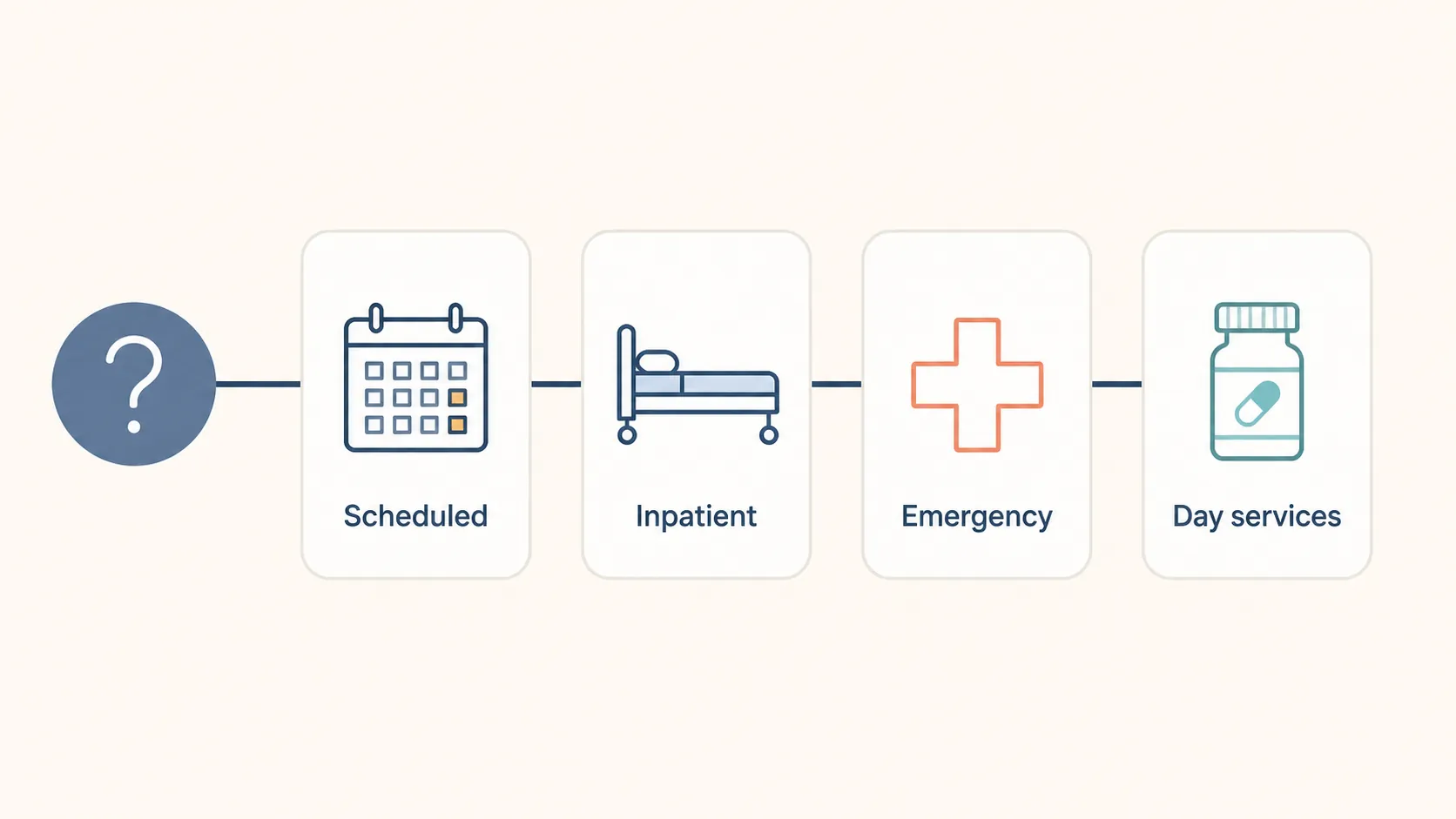
| If your parent... | What to assume and confirm |
|---|---|
| Has scheduled surgery or a procedure | This is the kind of care most likely to be postponed. Confirm the status, the arrival time, and what to do about pre-op instructions if the plan changes. |
| Is already admitted | They do not simply leave because a strike begins. Ask the ward what staffing, therapy, tests, discharge timing, and family communication will look like today. |
| Needs emergency or urgent care | Go. Emergency departments continue to handle urgent and emergency needs, even when other hospital services are disrupted. |
| Depends on rehab, dialysis, infusions, chemo, imaging, lab work, or hospital pharmacy pickup | Phone-confirm every visit. These are the appointments where a missed message can become a missed treatment, medication gap, or transport problem. |
If your parent has scheduled surgery or a procedure
Scheduled and elective care is where caregivers should expect the most uncertainty. Hospitals may keep some procedures, postpone others, and move patients around the calendar depending on staffing, urgency, operating-room coverage, anesthesia availability, and bed capacity. A public strike notice alone does not tell you which category your parent is in.
During the October 2023 Kaiser Permanente strike, NBC News reported patients describing postponed surgeries, delayed medical procedures, and canceled chemotherapy or infusion sessions.[2] Those reports do not prove what will happen at every hospital, but they show the kinds of care that can land on a family calendar with very little emotional margin.
If your parent’s surgery is tomorrow morning and nobody has called, do not assume it is canceled. Call the surgeon’s office, the hospital’s pre-op line, or the number on the procedure instructions. If you reach voicemail, leave a message that includes the patient’s name, date of birth, procedure date, your callback number, and the exact question: “Should we still arrive at the scheduled time?”
If the answer is “postponed,” the next question is not only “when.” Ask what postponed means for the pieces you are holding: whether the hospital will call with a new date, whether the surgeon’s office or central scheduling handles rebooking, whether the same pre-op instructions still apply, and whether the medication, fasting, transportation, interpreter, mobility-aid, or caregiver-arrival plan needs to be reset. These are questions to ask the clinical team, not instructions to improvise at home.
In the UK, NHS England tells patients that appointments and operations should be rebooked as a priority if they are postponed because of industrial action.[1] U.S. hospitals do not operate under one national patient-facing strike script, so the practical U.S. version is more manual: get the name of the person or department responsible for rebooking, ask when you should hear back, and write down the time of the call.
If your parent is already admitted
An admitted parent is not discharged simply because a strike starts. The hospital still has responsibility for inpatient care. What may change is the pace and coordination around tests, therapy, routine updates, discharge planning, and who answers family questions.
NHS England’s public guidance says inpatients should be informed by ward staff about how their care will be affected during industrial action.[1] Again, that is UK-specific. But it points to the right place to ask in any hospital: the ward, unit, or floor caring for your parent today. Central phone lines may know the strike status; the bedside team knows what changed for this patient.
For older adults, the questions should be basic and persistent. Who is helping your parent get out of bed safely? Are meals, fluids, toileting, medications, and pain control on schedule? Has anyone explained whether therapy, imaging, lab work, or discharge teaching is delayed? If discharge is being discussed, who has reviewed the medication list, mobility limits, follow-up appointments, equipment, and transportation plan?
That is not because strikes have been proven to cause a specific elderly-parent outcome. The evidence is narrower. Patient-safety literature shows that frail older hospital patients face recognizable risks, including delirium, falls, medication problems, and functional decline.[3] A separate study cited in that safety discussion found that hospitalized older adults spent more than 80% of their time in bed and less than one hour per day walking.[3] Those risks matter on any hospital day; a disruption makes it more important for family to ask what is still happening and what has been deferred.
If you are packing for or checking on an inpatient stay, use a short written list rather than memory. The site’s hospital emergency safety checklist for elderly patients can help organize medications, glasses, hearing aids, mobility devices, delirium-prevention basics, and discharge questions.
If your parent needs the emergency department
Do not let a strike notice talk you out of emergency care. If your parent has chest pain, stroke symptoms, severe shortness of breath, a serious fall, uncontrolled bleeding, sudden confusion, signs of sepsis, or another urgent change, treat it as urgent. Call emergency services or go to the emergency department according to the situation.
NHS England’s public guidance tells people to use emergency services as normal during industrial action, including calling 999 in a life-threatening emergency.[1] The phone number is UK-specific, but the caregiver principle is not: strike-related disruption is not a reason to delay emergency evaluation.
What may change is waiting, routing, or staffing pressure. Bring the medication list, allergies, baseline cognition and mobility notes, hearing aids, glasses, phone charger, and the name of the person who can answer history questions. If your parent is frail, confused, or at fall risk, say that plainly at triage and again when staff change.
Falls deserve particular attention because hospital falls are treated by the Centers for Medicare & Medicaid Services as a “never event,” meaning a serious, preventable patient-safety event.[3] If your parent is admitted after the ER visit, keep the fall-risk conversation going on the ward. The same hospital emergency safety checklist is useful once the emergency visit becomes an inpatient stay.
If your parent depends on day services
Day services are the part of a strike that can look small on a hospital operations chart and enormous in a family kitchen. Rehab, dialysis, infusions, chemotherapy, wound care, imaging, lab work, anticoagulation clinic visits, and hospital pharmacy pickups often depend on transportation, timing, fasting or medication routines, and a parent’s limited stamina.
This is the branch where “I guess they would have called” is most dangerous. Call before you drive. If the service is open, confirm the exact location, arrival time, expected wait, and whether the parent should bring food, water, medications, mobility equipment, or a support person. If it is canceled, ask who is rescheduling it, whether the ordering clinician needs to be notified, and what symptoms or missed-dose concerns should trigger a call back.
The disruption is not theoretical. NBC News reported Kaiser patients saying chemotherapy and infusion sessions were canceled during the October 2023 strike.[2] LAist, writing ahead of a Kaiser nurse strike in October 2025, reported that Kaiser said hospitals and emergency departments would remain open, some appointments could be rescheduled, and affected patients would be contacted.[4] CalMatters later reported that a Kaiser strike had entered a fourth week in February 2026 and described disrupted care as the walkout continued.[5]
Those Kaiser reports are not a universal map of U.S. hospital strikes. They do show the pattern caregivers should prepare for: the hospital may have contingency plans, but your parent’s actual appointment still needs a direct confirmation. In the U.S., no single national patient-facing guidance was found that tells every hospital patient what to do during a strike.
There is one older-adult-specific strike detail worth using carefully. A 2022 review of morbidity and health care use during health care worker strikes reported a historical account from a 1971 UK ambulance strike: nearly 10% of elderly day-hospital patients failed to return for treatment after the strike ended.[6] That is old, indirect evidence from a different health system and a different kind of strike. It does not prove what will happen to your parent. It does explain why day-program disruption deserves more attention than it usually gets.
What “the hospital has a plan” does and does not mean
Hospitals often prepare for strikes before the first picket line appears. LAist reported Kaiser saying it had contingency plans before an October 2025 nurse strike and that patients whose appointments were affected would be contacted.[4] That kind of planning matters. It may keep emergency departments open, prioritize urgent cases, bring in replacement staff, or move appointments.
But a plan is not the same as a clean message reaching your phone. An older parent may miss a voicemail, ignore an unfamiliar number, delete a portal alert, or misunderstand whether “clinic closed” applies to their infusion suite. Adult children often find out last, after the ride is booked and the medication schedule has already been adjusted.
That is why the caregiver job during a strike is not to interpret labor news. It is to verify the care event in front of you: date, time, location, status, transportation, medication questions for the clinical team, and who calls next if something changes.
If discharge is coming during or after a strike
Discharge is where hospital disruption can quietly move into the home. A parent may leave with new medications, a walker, wound instructions, home health orders, delayed therapy, or a follow-up appointment that was supposed to be scheduled before they left. If staffing pressure has made the day feel rushed, slow the discharge conversation down.
Before leaving, ask for the medication list, diagnosis, warning signs, follow-up appointments, activity limits, equipment plan, and the number to call if symptoms change. If home safety is now part of the recovery plan, the aging-in-place checklist can help prioritize modifications by cost and fall risk. If the hospital episode followed a fall, use the 30-minute family safety walkthrough once your parent is home.
Same-day confirmation script
Call the number tied to the actual care, not only the hospital’s main switchboard. For surgery, call pre-op or the surgeon’s office. For an inpatient, call the ward or unit. For infusion, dialysis, rehab, imaging, labs, or pharmacy, call that department directly. Start with: “My parent is scheduled for care today or tomorrow, and I’m calling because of the strike notice. Has this appointment or service changed?”
If it is still on, confirm the time, location, entrance, expected delays, whether a caregiver can stay, and whether anything about arrival instructions has changed. If it is postponed, ask who is rebooking, when you should expect the new date, what to do if nobody calls, and whether the ordering clinician needs to review any medication, symptom, or timing concern while you wait.
Write down the date and time of the call, the name or department of the person you spoke with, and the exact instruction. If your parent uses a patient portal, check it after the call, but do not rely on the portal alone when the appointment is close.
Last verified: August 1, 2026. This article is for caregiver planning and general information, not medical advice. For clinical decisions, medication changes, symptoms, fasting instructions, or whether a delay is safe for your parent, contact the treating clinician or emergency services. Credentialed clinical review is expected for this topic before publication.
References
- Information for the public on industrial action, NHS England, updated June 2026.
- Surgery, medical procedures are delayed amid Kaiser strike, patients say, NBC News.
- Patient Safety for Frail Older Patients, AHRQ PSNet.
- Kaiser nurses plan to strike tomorrow. Here’s how it will affect patients, LAist, October 2025.
- Kaiser strike enters fourth week as nurses say patient care is disrupted, CalMatters, February 2026.
- The impact of healthcare worker strikes on patient morbidity: A systematic review and meta-analysis, PMC, 2022.
Browse more in the Glossary.