
STEADI: Intervene
A Hospital Emergency Safety Checklist for Elderly Patients
Follow a single emergency visit through four safety windows: what to pack and document before arrival, what to watch for in the emergency department, how to prevent falls and delirium on the inpatient ward, and what to verify at discharge. Each checklist shows family caregivers what to ask, check, and record to reduce medication errors, hospital falls, and post-discharge falls.
In a hospital emergency, the hard part is not usually knowing that safety matters. It is remembering what to put in whose hand while an older parent or spouse is being moved from a waiting chair to triage, from triage to a bed, from one shift to another, and finally back through the front door at home.
This hospital emergency safety checklist for elderly patients follows one visit through four safety windows: before arrival, the emergency department, an inpatient stay if the person is admitted, and discharge. If you came here looking for a general emergency-preparedness kit, that matters too; the narrower job here is hospital-visit safety—what to ask, verify, and write down so medication errors, falls, delirium, and discharge gaps are less likely to hide in ordinary handoffs.
Use this as a caregiver checklist, not as a substitute for medical advice. The safest version of family advocacy is not overruling the care team. It is making sure the details only you may know—baseline memory, usual walking ability, hearing aids, home setup, medication changes—are visible to the people making decisions.
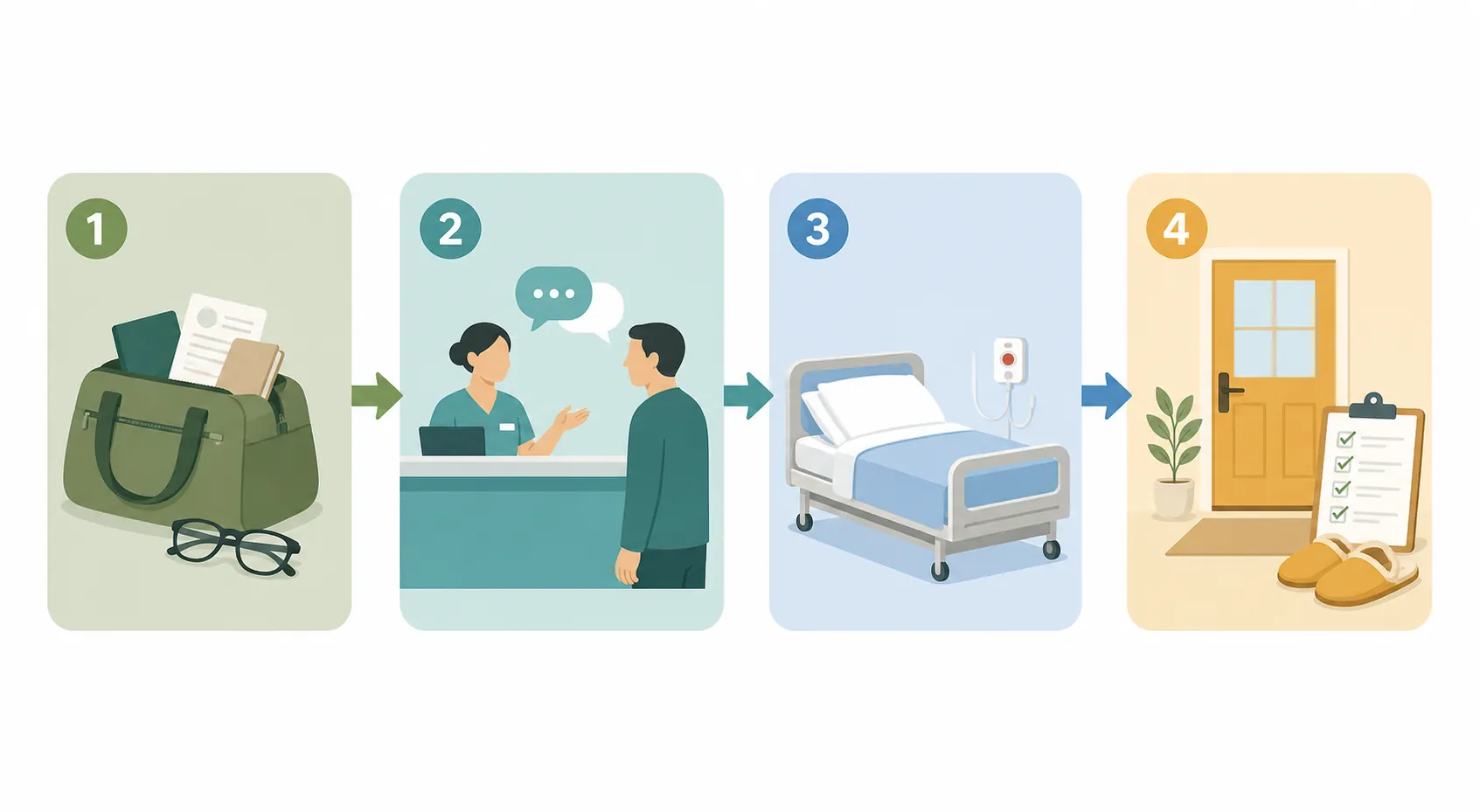
| Safety window | What can go wrong quietly | What the caregiver should make visible |
|---|---|---|
| Before arrival | Medication history is copied from memory; hearing aids, glasses, dentures, or directives are left behind. | Written medication list, ID and insurance copies, advance directives, sensory aids, phone charger, non-slip footwear. |
| Emergency department | Triage focuses on the urgent complaint while baseline confusion, mobility limits, or fall risk remain unclear. | Why today is different, usual mental status, walking and toileting needs, sensory aids, allergies, medications, caregiver contact. |
| Inpatient stay | Falls, delirium, and medication changes accumulate across shifts. | Call bell access, assisted toileting, glasses and hearing aids, nighttime orientation, sudden confusion, daily medication review. |
| Discharge | The paperwork says “ready,” but the caregiver does not know what changed or what to do at home. | Written plan for life at home, medications, warning signs, test results, follow-up, caregiver training, and home fall hazards. |
Before arrival: put the memory work on paper
The best hospital go bag is not a suitcase. It is a way to keep the same facts from being re-created under stress. AARP’s hospital packing guidance includes ID and insurance copies, a written medication list with doses, over-the-counter medicines and supplements, glasses, dentures, hearing aids, a phone charger, and non-slip footwear; it also recommends writing key patient needs on the room whiteboard so every shift sees them [1].
- Medication list: name of each prescription, dose, timing, reason if known, recent changes, allergies or bad reactions, pharmacy name, and all over-the-counter medicines, vitamins, sleep aids, pain relievers, and supplements.
- Documents: photo ID, insurance cards, advance directive, health care proxy or durable power of attorney if available, and a short list of major diagnoses, surgeries, and implanted devices.
- Sensory and communication items: glasses, hearing aids with batteries or charger, dentures, a written note if the person reads lips or hears better on one side, and any communication board or translation need.
- Mobility and fall-prevention items: cane or walker if safe to transport, non-slip footwear, and a note about whether the person normally walks alone, needs help standing, or gets up often to use the bathroom.
- Caregiver contacts: the main family caregiver’s name, phone number, relationship, and who should receive discharge instructions.
- Baseline note: one or two sentences about the person’s normal memory, speech, mood, and mobility, such as “Usually knows the date and manages breakfast independently” or “Uses a walker and needs help getting to the bathroom at night.”
That last baseline note is easy to skip because it feels informal. It is often the note that helps later. “Seems confused” means one thing if the person has advanced dementia and another if they were balancing a checkbook yesterday. “Weak” means one thing if they normally use a wheelchair and another if they usually climb three porch steps with a cane.
If there is time before leaving, take photos of the medication bottles and the advance directive. Do not rely on memory for doses. Do not assume the hospital can see every medication from every pharmacy. And if the older adult is leaving home without glasses, hearing aids, or dentures, write that down and tell triage; sensory loss can make a frightened, sick person look more confused than they are.
In the emergency department: make the hidden baseline part of triage
Emergency departments are built to sort urgency fast. That is appropriate; chest pain, stroke symptoms, breathing trouble, sepsis, fracture, and severe pain cannot wait for a leisurely life history. Geriatric emergency care guidance from the American College of Emergency Physicians recognizes the need for ED processes that account for older adults’ medication complexity, frailty, function, and transitions of care, because those needs can be missed in a standard acuity-driven workflow [2][3].
The caregiver’s job in the ED is to put the missing context into the record early, then keep it from disappearing when the patient moves rooms or shifts change.
| At triage or the first bedside handoff | Say or ask plainly |
|---|---|
| Why today is different | “This is new for her. Yesterday she was walking to the kitchen; today she cannot stand without help.” |
| Baseline mental status | “At home he normally knows the day, recognizes family, and follows a conversation. Today he is mixing up names.” |
| Mobility status | “She uses a walker, has fallen before, and should not walk to the bathroom alone.” |
| Sensory aids | “His hearing aids are in this case. Please note that he needs them before instructions or consent conversations.” |
| Medication list | “This is the current list with doses, over-the-counter medicines, and supplements. Please use this for medication reconciliation.” |
| Caregiver contact | “Please put my name and number in the chart as the family caregiver and discharge contact.” |
If the patient is moved before you finish explaining, repeat the essentials to the next person. It is not rude to say, “I want to make sure this is in the chart.” It is better than assuming the first sentence you said at the desk followed the patient to the next bay.
Medication reconciliation starts before admission
Medication reconciliation sounds like a hospital task, and it is. But the raw material often comes from family: the pill organizer, the pharmacy printout, the bottle that was stopped last week, the supplement the patient does not call a “medicine.” Hand over the written list and ask, “Which medications are being continued, held, changed, or newly started today?”
If the older adult cannot answer reliably, say so. If they answer confidently but are often wrong about doses, say that too. The point is not to embarrass anyone. It is to stop a guess from becoming the active medication history.
Fall risk begins in the ED, not after the room assignment
An older adult who has been lying on a stretcher, missed meals, taken pain medicine, or received IV fluids may not be safe to stand even if they walked into the hospital. Ask before helping them up. Ask where the call bell is. Ask whether they should have assistance to the bathroom. If they need glasses, a walker, hearing aids, or non-slip footwear to move safely, say that before the first bathroom trip, not after the near fall.
If admitted: watch the ordinary moments

The inpatient room can look calmer than the ED, but a different set of risks begins there. AHRQ’s patient safety review estimates that U.S. hospitals have roughly 700,000 to 1 million patient falls each year, and about one in four hospital falls causes injury [4]. That is not a reason to panic every time an older adult shifts in bed. It is a reason to treat call bells, toileting help, footwear, lighting, and mobility instructions as actual safety equipment.
Make fall precautions visible at the bedside
- Ask what the fall-risk plan is: Can the patient get up alone, or should they call every time?
- Check the call bell before you leave the room. Place it in the hand the person can actually use.
- Ask how toileting will work, especially overnight. Many falls happen around urgent, ordinary bathroom trips.
- Keep glasses, hearing aids, dentures, water if allowed, and the walker or cane where staff can see the patient needs them.
- Ask whether non-slip socks or footwear should be worn when standing.
- Use the room whiteboard for short, practical facts: “Needs hearing aids before instructions,” “Uses walker,” “Do not walk to bathroom alone,” or “Daughter Maria is discharge contact.” AARP specifically recommends using the whiteboard to make key patient needs visible across shifts [1].
A family member does not need to design the fall-prevention plan. But someone should be able to answer, “What should happen if he needs the bathroom at 2 a.m.?” If the answer is vague, ask the nurse to clarify it in plain language.
Sudden confusion is not just “being tired”
Delirium often first appears during a hospital stay, and HealthInAging, from the American Geriatrics Society, notes that family members are usually the first to notice sudden confusion, memory loss, or mood changes in an older adult [5]. That matters because the family may be the only people in the room who know what “normal” looked like the day before.
- Tell staff if confusion is new, worse, or coming and going.
- Describe the baseline, not only the symptom: “She normally recognizes all grandchildren and reads the newspaper. Today she thinks she is at work.”
- Mention sudden sleepiness, agitation, hallucinations, paranoia, or a personality change.
- Ask whether pain, infection, dehydration, medication changes, poor sleep, missing glasses, or missing hearing aids could be contributing.
- Help orient the patient if staff approves: glasses on, hearing aids in, clock visible, familiar voice, calm reminders of where they are and why.
Do not wait until rounds if the change is sharp. Use ordinary language: “This is not his usual memory,” “She is suddenly seeing things that are not there,” or “He was calm this morning and now he is frightened and trying to climb out of bed.” Those observations are clinical clues, even when they come from a tired daughter in a hallway.
Review medication changes once a day
During an admission, medicines may be started, stopped, substituted, or held for good medical reasons. The danger is not that change happens. The danger is that no one outside the chart understands which changes are temporary, which will continue at home, and which older home medicines should not be restarted without checking.
- Ask: “What medicines changed today?”
- Ask: “Were any home medicines held, and should they stay held after discharge?”
- Ask: “Are any new medicines increasing sleepiness, dizziness, urination, or confusion?”
- Write down medication names instead of relying on “the new blood pressure one” or “the nighttime pill.”
- If the patient uses more than one pharmacy or sees several specialists, say that clearly before discharge planning begins.
Discharge: the final safety gate
Discharge is not just the end of the hospital stay. It is the handoff from a building full of call bells, nurses, medication scanners, and grab bars to a home where the bathroom is down the hall, the bedroom rug curls at the corner, and the caregiver may be learning a medical task for the first time.
AHRQ’s IDEAL discharge planning materials organize the discharge conversation around five areas families should understand before leaving: life at home, medications, warning signs, test results, and follow-up appointments [6]. Treat those five areas as a verification frame, not paperwork to skim in the parking lot.
| IDEAL area | Do not leave until this is clear |
|---|---|
| Life at home | What the patient can do alone, what needs supervision, what equipment is needed, and whether stairs, bathing, toileting, meals, or nighttime walking are unsafe right now. |
| Medications | Which medicines are new, stopped, changed, or continued; what each is for; when to take it; and whether the old pill organizer should be emptied and rebuilt. |
| Warning signs | Which symptoms mean call the doctor, which mean urgent care, and which mean 911. |
| Test results | Which results are back, which are pending, who will review pending results, and how the family will be contacted. |
| Follow-up appointments | Who needs to be seen, how soon, whether the appointment is already scheduled, and what to bring. |
Put the caregiver in the discharge plan before the wheelchair arrives
Under CARE Act laws in most states, hospitals must record the family caregiver’s name, notify that caregiver of discharge, and provide instruction on medical tasks the caregiver will need to perform at home, according to the Family Caregiver Alliance’s discharge planning guide [7]. The exact requirements vary by state, but the practical request is the same: “Please list me as the caregiver, notify me before discharge, and train me on any care tasks I am expected to do.”
Training means more than hearing the words once. If you are expected to manage wound care, injections, oxygen, mobility transfers, a new walker, a catheter, diet restrictions, or a complicated medication schedule, ask to see it, do it back if appropriate, and receive written instructions. If you cannot safely perform the task, say that before the patient leaves.
Rebuild the medication list before the first dose at home
The discharge medication list should become the new active list. Compare it with the pre-arrival list you brought. Circle anything new. Cross out anything stopped. Mark dose changes. Ask specifically whether the older adult should restart medicines that were held in the hospital. If a specialist, primary care clinician, or pharmacist needs to resolve a conflict, write down who is responsible and when they will be contacted.
- Ask for the first dose timing: “When is the next dose due at home?”
- Ask about side effects that could affect falls or confusion, especially dizziness, sleepiness, low blood pressure symptoms, urgent urination, or stomach upset.
- Ask what to do if a dose is missed.
- Ask whether any over-the-counter medicines or supplements should be stopped until follow-up.
- Before using the old pill box, empty it and refill it from the discharge list, not from memory.
Check the house before the older adult walks back in
CDC STEADI notes that older adults who have had a hospital stay are more likely to fall in the first month after discharge [8]. The safest time to look for home hazards is before the patient is standing at the door exhausted, wearing hospital socks, and trying to get to the bathroom.

- Clear the path from the door to the bedroom, bathroom, and favorite chair.
- Remove loose cords, bags, shoes, and throw rugs from the first walking route.
- Put a light within reach of the bed and add night lighting on the route to the bathroom.
- Set out sturdy shoes or non-slip slippers; do not rely on loose socks.
- Place the walker, cane, or other mobility aid where the patient will actually stand up, not across the room.
- Check bathroom access: toilet height, wet floors, bath mats, shower entry, and whether the person needs hands-on help until stronger.
- Put the discharge papers, medication list, and follow-up numbers in one visible place.
This is not the moment for a full home renovation plan. It is the moment to remove the hazards most likely to meet a weak, medicated, sleep-deprived older adult in the first hours home. For a broader recovery handoff after the hospital, use the week-by-week recovery timeline for older adults after hospitalization. If the home itself needs a room-by-room safety review, the same practical pattern used in a room-by-room emergency safety checklist can help you slow down and inspect one space at a time.
Before leaving the hospital, get the plan into writing
A safe discharge plan should answer the questions the caregiver will face that night: Can they walk to the bathroom? Who helps with bathing? Which pill is next? What symptom is dangerous? Who is calling with pending test results? When is the follow-up visit? What task has the caregiver been trained to do?
Leave with the written discharge plan, the updated medication list, the warning signs, the follow-up schedule, and the caregiver instructions. Then check the home path before the older adult returns. Families cannot control every outcome in a hospital emergency, but they can keep the preventable details from being left vague.
References
- What to Bring to a Hospital Stay, AARP
- Geriatric Emergency Department Guidelines, American College of Emergency Physicians
- Geriatric Emergency Department Guidelines 2.0, PMC
- Falls, AHRQ PSNet
- Tip Sheet: Managing Delirium in Older Adults, HealthInAging.org
- Strategy 4: Care Transitions From Hospital to Home: IDEAL Discharge Planning, Agency for Healthcare Research and Quality
- Hospital Discharge Planning: A Guide for Families and Caregivers, Family Caregiver Alliance
- Inpatient Care, CDC STEADI
Related reading
Noticed something outdated or inaccurate on this page? Flag a correction. We review every report against CDC, NIA, and AARP HomeFit guidance before updating a page.
Part of the Fall Prevention section.