
Glossary entry
How the Medicare Part D Subsidy End Affects Seniors
Last verified 2026-07-30
This is not financial or legal advice. Medicare/Medicaid and benefits rules vary by state and change over time — verify current rules with your state Medicaid office or Area Agency on Aging.
If you are trying to understand how the end of a Medicare Part D subsidy affects seniors, start by sorting the question into two piles. One pile is about stand-alone Part D prescription drug plan premiums after a temporary federal premium-stabilization program ends. The other pile is about low-income beneficiaries losing, or being asked to prove again, their Extra Help status.
Those two things are happening close together. They are not the same thing. They do not affect the same people in the same way. And the next step is different depending on which envelope, plan type, and subsidy status is sitting in front of you.

First, find your category
Before reading another headline about a “Part D subsidy,” check three things: your drug coverage type, whether you receive Extra Help, and whether you received a Loss of Deemed Status notice.
| If this describes you | The subsidy issue most likely involved | What to do next |
|---|---|---|
| You have a stand-alone Medicare Part D prescription drug plan, often called a PDP | The Premium Stabilization Demonstration is ending after calendar year 2026 | Watch your 2027 premium, deductible, formulary, pharmacy network, and total drug cost during Open Enrollment |
| You get drug coverage through a Medicare Advantage plan with drug coverage, often called MA-PD | The premium-stabilization news may affect the broader market, but it is less directly about your plan than it is for stand-alone PDP enrollees | Still check your Annual Notice of Change; broad premium reassurance is not a substitute for reading your own plan details |
| You receive Extra Help, also called the Part D Low-Income Subsidy or LIS | You may be affected by redetermination or loss of automatic, “deemed” Extra Help status | Open every Medicare, Social Security, Medicaid, or state notice and respond if it asks for information |
| You received a Loss of Deemed Status notice | You may no longer be automatically treated as eligible for Extra Help, often because another program’s eligibility changed | Do not assume you are ineligible; consider applying for Extra Help directly |
| You do not receive Extra Help and have not received a notice | Your main issue is likely plan pricing and coverage for 2027, not LIS redetermination | Compare plans during Open Enrollment rather than waiting for an automatic renewal to decide for you |
That sorting step matters because a premium increase and a lost low-income subsidy feel similar in a monthly budget, but they are handled through different doors. A PDP premium problem is mostly an Open Enrollment comparison problem. An Extra Help problem may be a paperwork, eligibility, or reapplication problem.
What is ending for stand-alone Part D plans
CMS says the Part D Premium Stabilization Demonstration ends after calendar year 2026. For 2027, CMS set the Part D base beneficiary premium at $41.33, described as a 6% increase; the standard deductible at $700, a 13.8% increase; and the annual out-of-pocket cap at $2,400, a 14.3% increase.[1]
For people in stand-alone PDPs, the concern is not only the national base premium. The plan you actually buy may change its premium, deductible, covered drugs, cost-sharing tiers, preferred pharmacies, or service area. KFF has warned that some stand-alone PDP enrollees could see premium increases of up to $20 per month as the market adjusts.[2]
That does not mean every senior with Part D will see a $20 monthly increase. It means the end of the premium-stabilization program makes plan-by-plan review more important for PDP enrollees, especially if the current plan was kept mainly because the premium looked manageable.
This is also where some public reassurance can mislead if it is read too broadly. Dr. Oz’s statement that most Medicare drug beneficiaries may see no increase or lower premiums is more consistent with the combined market, including Medicare Advantage drug plans, than with the narrower situation of someone enrolled in a stand-alone PDP. A PDP enrollee should judge the 2027 notice in hand, not the average beneficiary in a press statement.
If the premium-stabilization side is the only issue you are trying to understand, the fuller cost breakdown is here: What the Medicare Part D Subsidy Cut Means for Your 2027 Costs. For this article, the more urgent distinction is that this market-wide premium issue is separate from losing Extra Help.
The Extra Help problem is different, and it can be more personal
Extra Help, or LIS, is the subsidy that can reduce Part D premiums, deductibles, and prescription cost sharing for people with limited income and resources. If a person loses that help, the change is not just a market adjustment. It can alter whether a prescription is affordable next month.
KFF reported that LIS enrollment fell from 13.7 million to 13.1 million in 2025, the first decline since 2007.[3] Justice in Aging reported that more than 1.4 million Medicare beneficiaries received Loss of Deemed Status notices in fall 2024.[4] Those numbers point to a practical problem: some people who had been automatically connected to Extra Help were being told that automatic status would not continue unless another basis for eligibility was established.
A Loss of Deemed Status notice does not necessarily mean, “You make too much money for Extra Help.” It means Medicare no longer has the automatic eligibility signal it had before. For many low-income seniors, that signal is tied to Medicaid, Supplemental Security Income, or a Medicare Savings Program. If one of those changes, the automatic Extra Help pathway can break even when the person may still qualify under the Extra Help rules.
This is the notice that should not be placed in the “ignore for now” pile. A person who loses Medicaid-based deemed status may still be able to apply directly for Extra Help. NCOA’s 2026 guidance uses an LIS income threshold of 150% of the federal poverty level, or $23,940 per year for an individual, and notes that this can be broader than many state Medicaid income thresholds.[5]
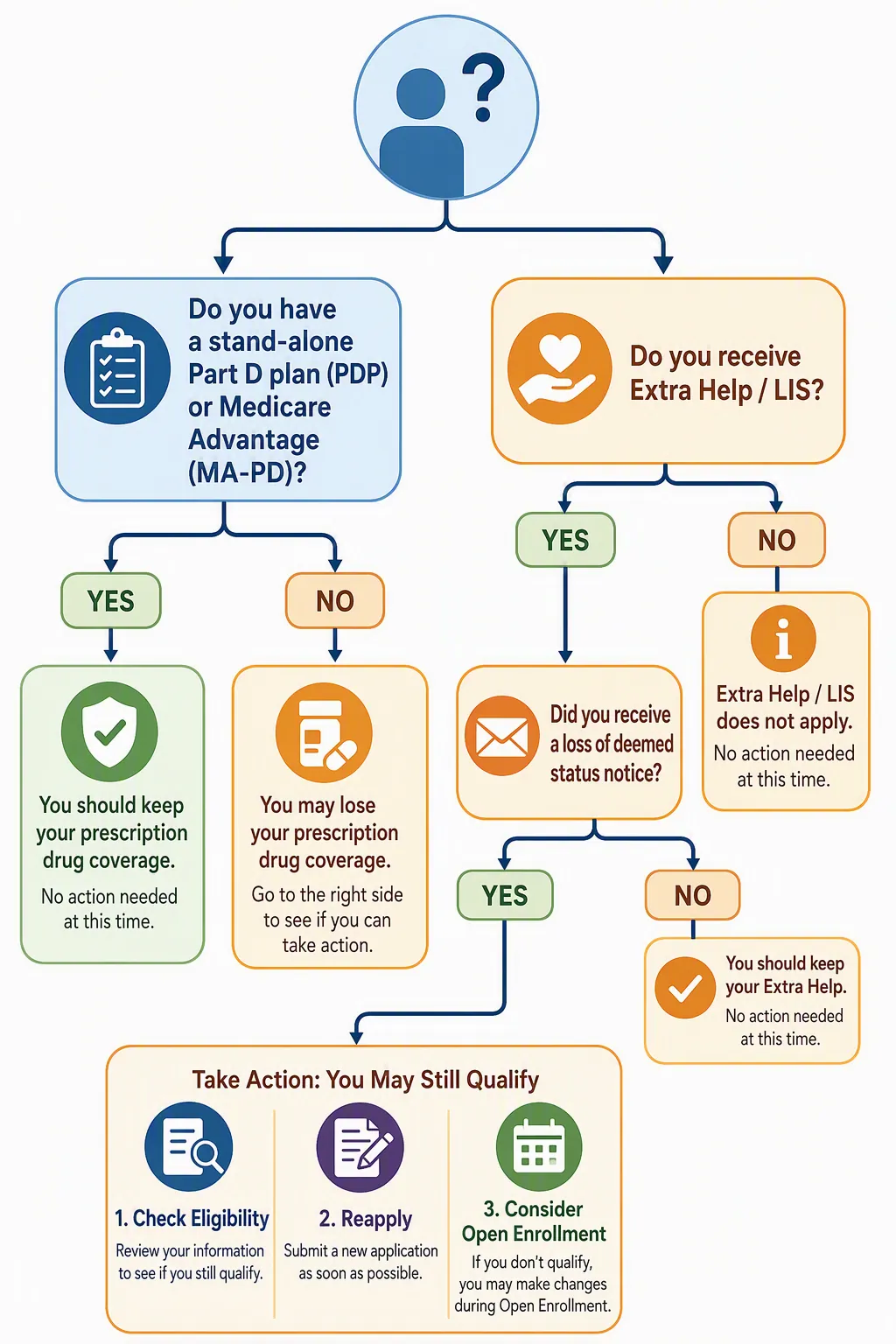
What to do if you received a Loss of Deemed Status notice
- Read the notice for the effective date and whether it says you will lose automatic Extra Help status.
- Do not treat loss of automatic status as a final denial of Extra Help.
- Check whether you still have Medicaid, SSI, or a Medicare Savings Program; if one ended, ask whether it can be renewed or appealed.
- If your income may still fit the Extra Help rules, apply directly instead of waiting for the subsidy to disappear from your drug costs.
- Keep copies of notices, application confirmations, and any plan bills that show a premium or deductible change.
The reason to move quickly is not abstract. A 2025 study in The New England Journal of Medicine found 3.0 additional deaths per 1,000 people within 17 months after subsidy loss among dual-eligible beneficiaries who lost LIS following Medicaid disenrollment.[6]
That finding should be used carefully. It does not prove that the end of the Premium Stabilization Demonstration will cause the same outcome. It applies to a narrower group: dual-eligible beneficiaries who lost LIS after Medicaid disenrollment. But it does show why losing low-income prescription help is not just a billing inconvenience. For vulnerable beneficiaries, a subsidy disruption can become a health-risk event.
Why the headlines feel muddled
Late-July coverage from The New York Times and Bloomberg/Yahoo focused on the CMS announcement that the premium-stabilization demonstration would not continue after 2026. That is legitimate breaking news for the stand-alone PDP market. It is also easy to misunderstand if the reader is already holding a separate Extra Help notice.
The phrase “Part D subsidy” is doing too much work. In one story, it refers to federal payments meant to steady PDP premiums during a transition period. In another kitchen-table problem, it refers to a low-income subsidy attached to a specific person. The first calls for comparing 2027 plans. The second may call for answering a notice, restoring a linked benefit, or reapplying for Extra Help.
What to check now
If you are in a stand-alone PDP, your main job is to review the 2027 plan materials during Open Enrollment. Do not stop at the premium. Check the deductible, your specific medications, the pharmacies you use, and the plan’s total estimated annual cost. A lower premium can still be a worse deal if the plan moved your medication to a higher tier or changed preferred pharmacies.
If you are in an MA-PD plan, broad claims about stable or lower premiums may be more relevant to you than to a PDP enrollee, but they are still not a personal guarantee. Read your Annual Notice of Change for drug costs, provider access, supplemental benefits, and any tradeoffs inside the plan. For broader Medicare Advantage cost context, see What Medicare Advantage Benefit Cuts Mean for Seniors in 2027.
If you receive Extra Help, or recently received a Loss of Deemed Status notice, your main job is not plan shopping first. It is protecting the subsidy if you still qualify. Reapply if appropriate, answer requests for information, and get help from a benefits counselor, local aging agency, SHIP counselor, or trusted nonprofit if the forms are unclear.
If you help a parent or spouse, sort the mail before sorting the news. Put plan-change notices in one pile and Extra Help or Medicaid-related notices in another. The first pile belongs with Open Enrollment comparisons. The second pile may need a faster response because a missed redetermination can turn into a lost subsidy.
For households trying to budget around Open Enrollment, a mid-year review of income, prescriptions, plan notices, and cash flow is useful before the plan comparison rush begins. A practical planning framework is here: 6 Steps for a Mid-Year Financial Checkup for Seniors.
The useful question is not simply whether a Medicare Part D subsidy is ending. It is which subsidy, for which person, through which plan or notice. Once that is clear, the next step is much smaller: compare your PDP, read your MA-PD changes, or protect your Extra Help eligibility before the pharmacy counter delivers the surprise.
References
- CMS Fact Sheet, Centers for Medicare & Medicaid Services, July 28, 2026, link
- The Uncertain Future of Medicare's Stand-Alone Prescription Drug Plan Market and Why It Matters, KFF, link
- Key Facts About Medicare Part D Enrollment, Premiums, and Cost Sharing in 2025, KFF, link
- Loss of Deemed Status notices, Justice in Aging, link
- LIS income limit and reapplication guidance, National Council on Aging, link
- Subsidy Loss and Mortality after Medicaid Disenrollment, The New England Journal of Medicine, May 2025, link
Browse more in the Glossary.