
Clinical term
Could a New Cholesterol Drug Increase Fall Risk for Seniors?
Last verified 2026-07-29
Last verified: July 29, 2026. Lipfendra, also called enlicitide, is a new FDA-approved cholesterol drug for adults, including seniors, who need additional LDL cholesterol lowering. It is the first FDA-approved oral PCSK9 inhibitor and is taken once daily, which matters for families who have been trying to avoid another injection in an already crowded medication routine.[1][2]
The short home-safety answer: dizziness was reported in 9% of Lipfendra patients in the CORALreef HeFH trial, compared with 4% on placebo, so an older adult who already has balance problems, takes blood pressure medicine, gets dehydrated easily, or has had a recent near-fall deserves a specific fall-risk conversation before starting it.[3] That is not a reason to panic, and it is not a reason to stop a cholesterol medication without the prescriber. It is a reason to watch the first days and weeks with more structure than “call us if anything changes.”
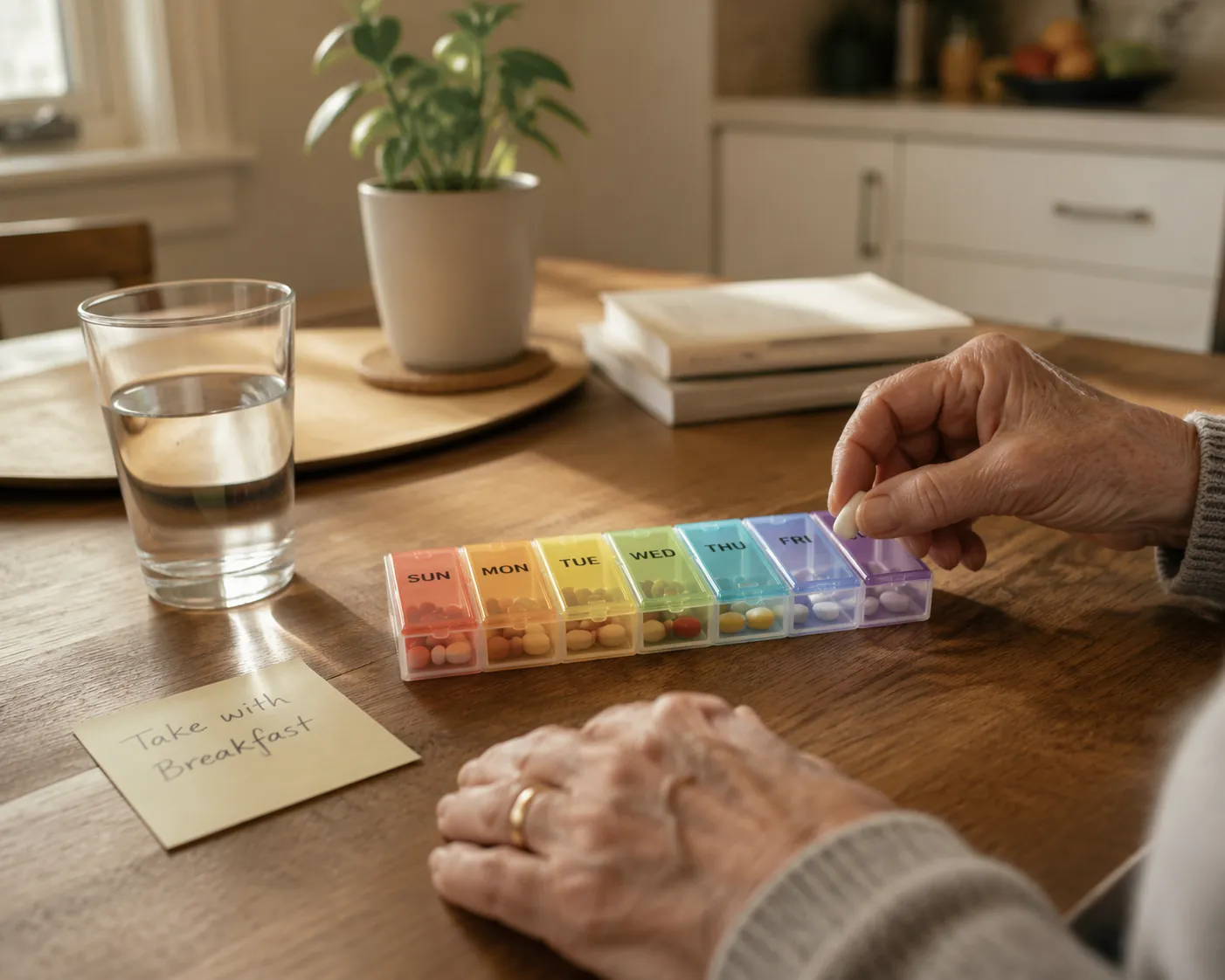
Could Lipfendra increase fall risk in seniors?
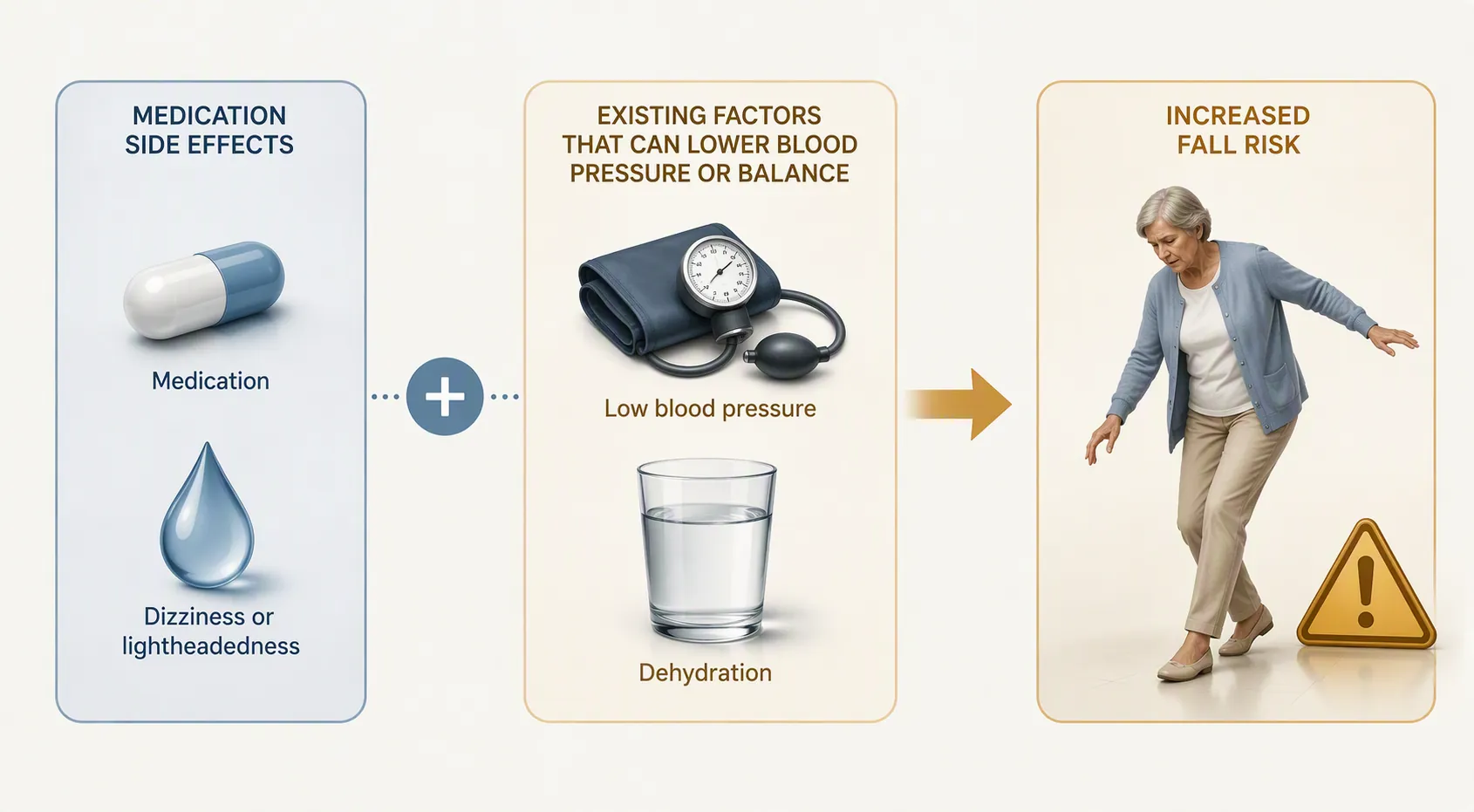
Possibly for some people, but the label does not prove a broad senior fall-risk outcome. The dizziness number is the practical signal: in one 303-participant trial of patients with heterozygous familial hypercholesterolemia, dizziness occurred more often with Lipfendra than with placebo.[3] Dizziness is not the same as a documented fall, but at home it can be the step before a fall: standing up from bed, turning toward the bathroom, reaching for the counter, or rushing because the phone rang.
The FDA label also says no overall differences in safety or effectiveness were observed between patients age 65 and older and younger adults.[3] That sentence matters. It keeps the 9% dizziness figure in proportion. It means the available label data do not show that older adults, as a group, did worse on Lipfendra than younger adults.
But caregivers do not manage “older adults as a group.” They manage one parent with a walker, one parent on two antihypertensives, one parent who drinks too little water, or one parent who says “I’m fine” after grabbing the wall. For that person, dizziness belongs in the starting conversation, not as an afterthought.
What the 9% dizziness number does and does not mean
| Label fact | What it means at home |
|---|---|
| Dizziness occurred in 9% of Lipfendra patients versus 4% on placebo in the CORALreef HeFH trial. | Ask specifically about fall precautions if your parent already has balance issues, low blood pressure symptoms, or recent near-falls. |
| Diarrhea occurred in 7% of Lipfendra patients in the same label safety summary. | Loose stools can contribute to dehydration, which can make lightheadedness or standing dizziness worse. |
| No known clinically meaningful drug interactions are listed. | This is helpful for polypharmacy, but it does not make dizziness irrelevant; it may be related to the drug or to the person’s condition and routine. |
| Lipfendra is taken on an empty stomach, at least 30 minutes before food. | A changed morning routine can lead to skipped doses, double doses, or confusion with other medicines. |
Those label facts come from trial and prescribing information, not from a fall-prevention study. The trial measured adverse reactions such as dizziness and diarrhea; it did not establish that Lipfendra causes falls in seniors, nor did it tell caregivers exactly which bathroom, hallway, heat wave, blood pressure pattern, or hydration problem will matter in real life.[3]
The sensible reading is narrower: dizziness appeared often enough to plan for it, especially in a person who is already vulnerable. That plan should sit alongside the cardiovascular reason the drug was prescribed, not replace it.
Which seniors need the most careful start?
The caregiver should slow down and ask for a clearer monitoring plan if the person starting Lipfendra has any of these fall-risk factors:
- Recent falls, near-falls, wall-grabbing, or new fear of walking alone.
- Known balance problems, neuropathy, Parkinsonism, stroke history, vision changes, or use of a cane or walker.
- Blood pressure medicines, diuretics, or a history of lightheadedness when standing.
- Poor fluid intake, recent diarrhea, vomiting, heat exposure, or kidney-related fluid restrictions that make hydration advice more complicated.
- Medication confusion, memory changes, or a pill schedule that is already difficult to follow.
Blood pressure deserves special attention because a caregiver may see the outcome before anyone sees the cause. A parent stands up, feels lightheaded, pauses at the dresser, and says breakfast can wait. That could be dehydration, an antihypertensive dose, heat, illness, a new medication effect, or several of those at once. If heat or standing dizziness is already part of the picture, the practical mechanics overlap with how extreme heat can trip up seniors’ balance: fluid loss, blood pressure shifts, and slower recovery after standing.
What to ask before the first dose
A good starting conversation is specific. “Is this safe?” usually gets a broad answer. Better questions help the prescriber connect the cholesterol goal to the person who has to get from the bed to the bathroom at 2 a.m.
- “My parent has had dizziness or near-falls before. Should we check sitting and standing blood pressure after starting Lipfendra?”
- “Do any blood pressure medicines, diuretics, or timing changes need review before this starts?”
- “If dizziness starts, what symptoms mean we should call the same day?”
- “If diarrhea happens, when does dehydration become a concern for this patient?”
- “Where should Lipfendra fit in the current pill schedule, given the empty-stomach and 30-minute wait instruction?”
The drug-interaction point is reassuring but not a substitute for this conversation. Lipfendra has no known clinically meaningful drug interactions, which is valuable for older adults with long medication lists.[3] Still, a person can have dizziness from a new medication, dehydration, blood pressure changes, illness, or routine disruption without there being a classic drug-drug interaction.
What to watch during the first days and weeks
Do not rely only on the word “dizzy.” Many older adults will not use it, or they will minimize it. Ask about the behavior around it.
- Pausing after standing, sitting back down, or holding furniture before walking.
- New unsteadiness on the way to the bathroom, kitchen, mailbox, or shower.
- A new refusal to walk without help, even if the person says nothing is wrong.
- Lightheadedness after the morning dose, before breakfast, or after taking blood pressure medicine.
- Loose stools, reduced drinking, dark urine, unusual fatigue, or signs that dehydration may be developing.
- Missed doses, doubled doses, or uncertainty about whether the empty-stomach pill was already taken.
A simple log helps because dizziness reports get blurry fast. Note the date, dose time, meal time, blood pressure medicine time if relevant, dizziness or diarrhea symptoms, fluid intake concerns, and any stumble or near-fall. The goal is not to prove Lipfendra caused the symptom. The goal is to give the prescriber enough detail to adjust safely.
When the empty-stomach rule becomes the safety problem
Lipfendra must be taken on an empty stomach at least 30 minutes before food.[3] On paper, that is a dosing instruction. In a kitchen, it can move the whole morning: coffee waits, breakfast waits, the pill organizer changes, and the person who has taken medicines the same way for years now has one more exception to remember.
That disruption matters because a fall-risk plan can be undone by a medication mix-up. If a parent takes the pill, forgets, and takes it again with the rest of the morning pills, the caregiver now has a different problem. If the parent skips it because breakfast already happened, cholesterol treatment becomes inconsistent. Put the instruction somewhere visible: on the pill organizer, near the coffee maker, or in the shared medication app. If routines are disrupted by travel, illness, storms, or outages, the same medication-management thinking used in a 72-hour power outage plan for medically dependent seniors can help keep dosing instructions from getting lost.
How this compares with statin mobility concerns
It would be too easy to frame this as “new drug risky, older drug safe.” That is not how medication decisions work for many seniors. Statins are familiar, but muscle pain or weakness can also affect mobility in some patients. A person who is avoiding walks because their legs ache has a different kind of fall and independence problem.
Lipfendra’s appeal is real: oral dosing, LDL lowering, and no known clinically meaningful drug interactions are all meaningful in older adults who already manage multiple prescriptions.[2][3] The unfinished part is outcomes. Merck has described CORALreef Outcomes as a trial with more than 14,500 participants that is still evaluating cardiovascular outcomes, so caregivers should not assume that long-term reductions in events such as heart attack, stroke, or death have already been established for Lipfendra.[2]
That leaves a practical trade-off discussion: why this LDL-lowering option is being chosen now, what other therapies were tried or considered, what symptoms would change the plan, and who should be called if mobility changes.
When to call the prescriber
Call promptly if dizziness is new, worsening, tied to standing, or accompanied by a stumble, near-fall, fainting feeling, diarrhea, poor fluid intake, or confusion about dosing. Same-day advice is especially important if the person also takes blood pressure medicine or a diuretic, has kidney or heart failure fluid limits, or lives alone.
If a fall has already happened, treat medication review as part of the immediate response, not something to save for the next routine visit. The first few days after a fall are when caregivers need to document what changed, which medicines were taken, whether dizziness or diarrhea occurred, and whether the home setup needs short-term adjustment. The first 72 hours after a parent falls are the right window to pull the pill list, symptom notes, and blood pressure readings together.
Do not stop Lipfendra on your own unless the prescriber or emergency clinician tells you to. Cholesterol medicines are prescribed because cardiovascular risk matters. The caregiver’s job is to notice the home-safety signals early enough that the clinician can decide whether the answer is monitoring, hydration guidance, timing changes, blood pressure review, or a medication change.
References
- FDA Approves First Oral PCSK9 Inhibitor to Lower LDL Cholesterol in Adults with High Cholesterol. U.S. Food and Drug Administration.
- Merck’s LIPFENDRA™ (enlicitide) is the First and Only Once-Daily Oral PCSK9 Inhibitor Approved by the U.S. FDA. Merck.
- Lipfendra. Drugs.com.
Browse more in the Glossary.