
STEADI: intervene
72-Hour Power Outage Plan for Medically Dependent Seniors
A structured 72-hour plan helps caregivers protect older adults who rely on medical devices during a power outage. Following FEMA and Red Cross guidelines, this guide covers backup power, medication storage, utility registration, and evacuation triggers.
The hard part of power outage preparedness for older adults is not buying a flashlight. It is knowing what happens to an oxygen concentrator, CPAP or BiPAP machine, insulin pump, power wheelchair, stair lift, or refrigerated medication when the outage is no longer a few minutes long.
That distinction matters. A 2026 PLOS Medicine study of 23 million Medicare beneficiaries found that after outages lasting at least 8 hours, cardiovascular hospitalizations were 2.0% higher the next day and respiratory hospitalizations were 2.5% higher the same day. When larger outages affected at least 5% of county customers, same-day respiratory hospitalizations were 6.7% higher. The study used 2018 outage data, so it should be read as a measured baseline, not a guarantee of what any one household will experience now. It still makes the point plainly: for medically vulnerable older adults, an outage can become a health event, not just a home inconvenience. [1]
Planning has not caught up. In a 2026 Iowa study of older adults who had recently experienced power outages, only 42% had a medical care plan. Older adults with COPD were more likely to have one, but the overall gap was still large enough to leave many families improvising after the power is already out. [2]
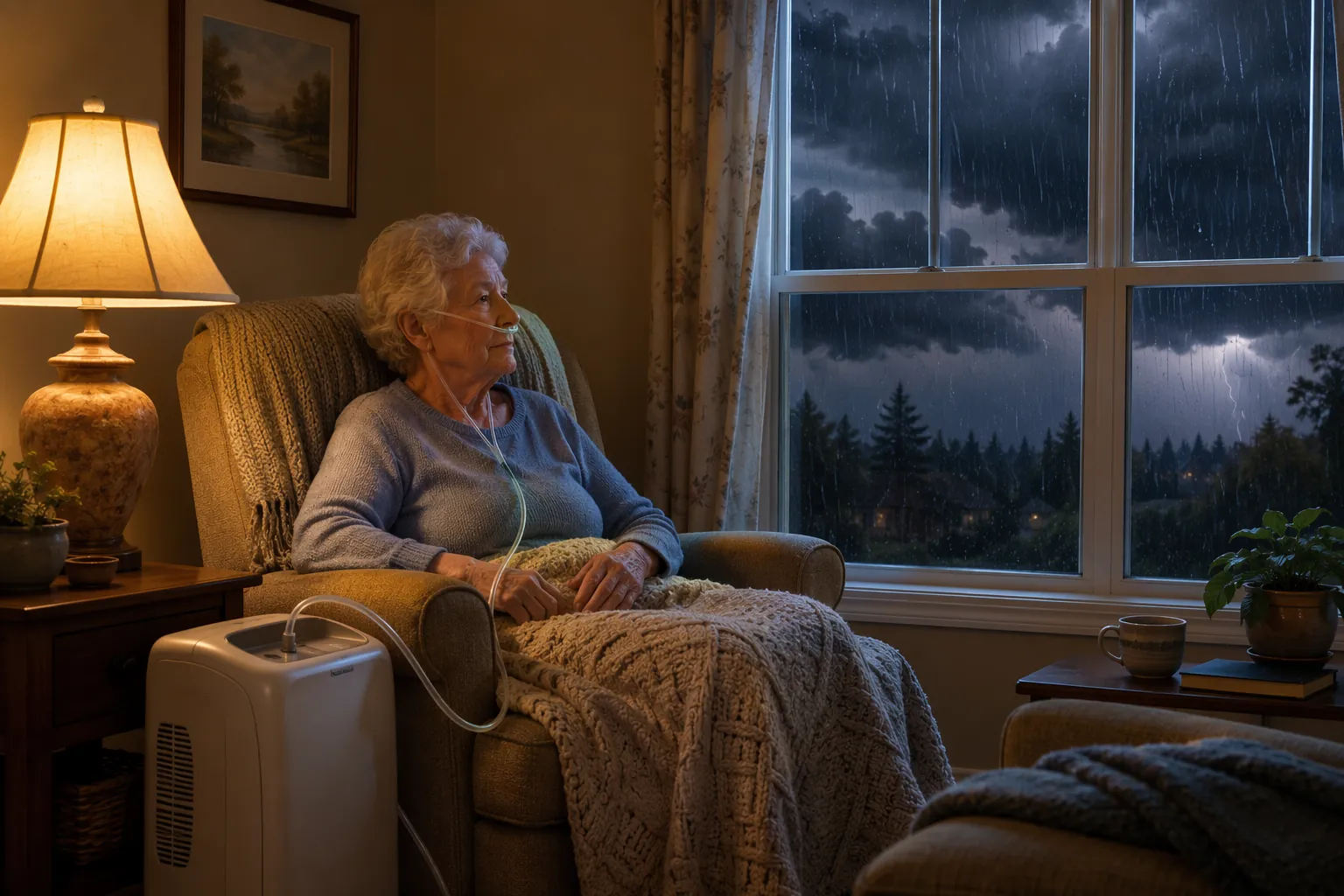
This guide is the medical-device counterpart to a room-by-room power outage fall prevention checklist. Darkness, cords, blocked pathways, and rushing all raise fall risk during an outage. Here, the focus is narrower: keeping electricity-dependent care working for up to 72 hours, and deciding before 9 p.m. who has the authority to say, “We leave now.”
The 72-hour plan has six jobs
A usable plan names the work. It does not say “Dad has oxygen” or “Mom has batteries somewhere.” It records the device, the runtime, the backup, the person responsible, and the condition that changes the plan from staying home to leaving.
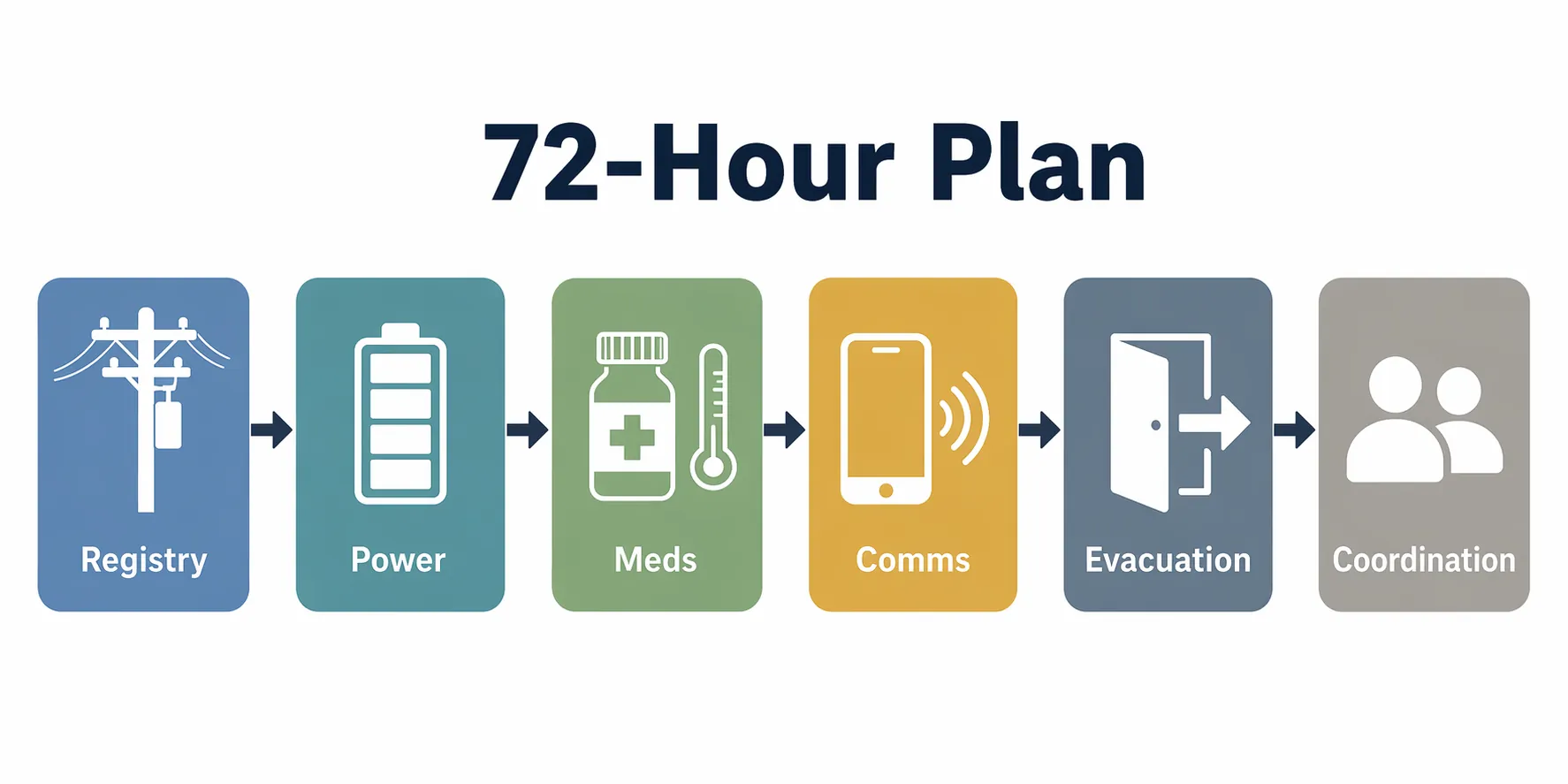
| Domain | What must be decided before the outage | Failure point to avoid |
|---|---|---|
| Utility registry | Which utility to call, what medical equipment to report, and how often to update the account | Assuming registration guarantees rescue or uninterrupted power |
| Backup power inventory | Which device uses which battery, generator, outlet, charger, or manual alternative | Counting a battery without knowing its tested runtime |
| Medication temperature | Which medications need temperature control and when refrigeration becomes unreliable | Opening the refrigerator repeatedly or guessing whether insulin is still usable |
| Communication network | Who receives alerts, who calls the older adult, and what to do if phones fail | Having contact names but no decision-maker |
| Evacuation criteria | The exact conditions that mean leaving is safer than staying | Waiting until the device stops, the home is unsafe, or the caregiver cannot reach the house |
| Caregiver coordination | Who checks equipment, who drives, who calls the utility or clinician, and who is backup | Letting siblings debate during the emergency instead of assigning authority in advance |
Start with the utility, but do not stop there
Call the electric utility before storm season and ask whether it has a medical baseline, life-support, critical care, or priority restoration program. The Red Cross recommends registering life-sustaining medical equipment with the utility for advance warning and priority restoration when available. [3]
The caregiver or older adult should have the account number, service address, equipment type, physician or clinician documentation if required, and an alternate contact ready before calling. Some programs require renewal. Some vary by state, utility, or account status. Some may provide alerts but not priority restoration. None should be treated as a promise that power will return before a battery runs out.
For a regional example of how utility registration fits into storm planning, see severe thunderstorm safety for seniors in Boston. The local names and forms may differ, but the practical test is the same: the utility knows about the equipment, and the family still has a plan if restoration is delayed.
Build the backup power inventory device by device
The safest inventory is boring and specific. It should sit on paper near the equipment and in a shared digital note for caregivers. Each line should answer: what device is this, what power does it need, what backup runs it, how long has that backup actually lasted in a test, and what is the next step when the backup reaches its limit?
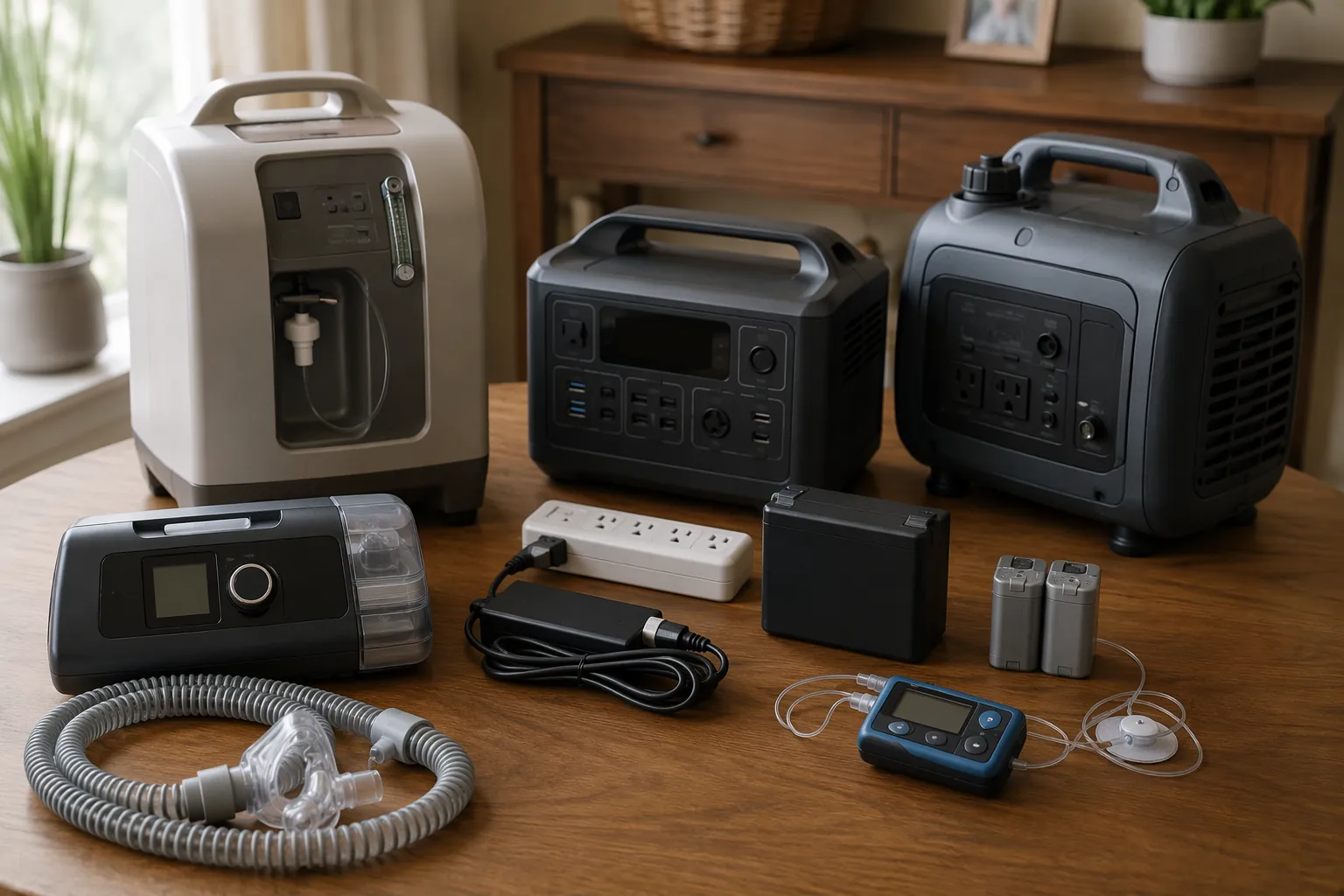
| Device or equipment | Backup question to answer | Planning note |
|---|---|---|
| Oxygen concentrator | How long can the concentrator run on the chosen power source, and is there a clinician-approved oxygen backup? | Do not assume a small battery can run a concentrator through the night. Confirm the device wattage, prescription needs, and backup supply plan. |
| CPAP or BiPAP | Can the device run on a manufacturer-approved battery, and does humidification shorten runtime? | Test the actual setup the older adult uses, not a best-case setting that will not be used during sleep. |
| Insulin pump or glucose-related equipment | Which parts need charging, which use replaceable batteries, and where are spares stored? | Separate medication temperature planning from device charging. Both can fail independently. |
| Power wheelchair or scooter | Is the battery fully charged before forecasted storms, and is there a safe manual mobility plan? | A charged chair does not solve stairs, blocked exits, or an elevator outage. |
| Stair lift | Does the lift have battery backup, and how many trips can it support? | If the bedroom, bathroom, medication, or exit requires stairs, the evacuation trigger may come earlier. |
| Phone, medical alert device, and router | Which chargers, power banks, or landline alternatives keep communication working? | A medical plan can collapse if the only decision-maker cannot be reached. |
Label every battery with the device name, last full charge date, and tested runtime. If the runtime is unknown, write “untested” instead of guessing. That one word changes behavior: it tells the family not to wait until hour 10 to discover the backup only covered part of the night.
Generators need their own rule, written where no one can miss it: never run a generator, grill, camp stove, or similar fuel-burning device indoors, in a garage, or near windows. The CDC identifies carbon monoxide from generators or camp stoves used indoors as a leading cause of outage-related death, and recommends battery-powered or battery-backup carbon monoxide detectors. [4]
The inventory also needs a charging routine. Before a predicted storm, charge the power wheelchair, scooter, phone, portable power stations, power banks, medical alert device, and any manufacturer-approved medical-device batteries. Move chargers and cords out of walking paths. The fall risk from a rushed nighttime charging setup is not separate from the medical plan; it is part of the same outage.
A simple inventory template
| Item | Fill in before the outage |
|---|---|
| Device name | Example: oxygen concentrator, CPAP, power wheelchair, stair lift |
| Medical purpose | Breathing support, sleep breathing support, mobility, medication delivery, communication |
| Normal power source | Wall outlet, rechargeable battery, replaceable batteries |
| Backup source | Manufacturer battery, portable power station, generator, spare battery, manual alternative |
| Tested runtime | Date tested and how long it ran under the real settings used at home |
| Responsible person | Who charges it, checks it, and replaces it |
| Failure action | Call clinician, switch to backup supply, relocate, evacuate, or call emergency services |
Protect medications before the refrigerator becomes a guessing game
Medication planning starts with labels and clinician instructions, not family memory. Insulin is the common example, but it is not the only medication that may have temperature limits. The person making the plan should list every refrigerated or temperature-sensitive medication, where it is stored, the acceptable temperature range on the label, and who to call if it warms, freezes, or is exposed to heat.
CDC emergency guidance based on FDA-labeled insulin storage says opened or unopened insulin vials may be kept at 59°F to 86°F for up to 28 days, but insulin can degrade above 86°F or if it freezes. The same guidance notes that a cooler with ice packs can help for 24 to 48 hours. This is general insulin guidance; individual products can differ, so the medication label and clinician or pharmacist instructions control. [5]
Ready.gov advises that during an outage, a refrigerator keeps food cold for about 4 hours if the door stays closed, and a full freezer maintains temperature for about 48 hours. Those food-safety windows are not a substitute for medication labeling, but they help caregivers understand why repeatedly checking the refrigerator is not harmless. [6]
- Before storms: place medications that may need cooling in one known location, add a thermometer if appropriate, and prepare a small cooler and ice packs.
- During the outage: keep refrigerator and freezer doors closed unless removing what is needed.
- If medication warms, freezes, or looks changed: do not guess; call the pharmacist, clinician, or emergency medical line named in the plan.
- If evacuation is possible: move medications, device supplies, prescriptions, and a printed medication list together, not in separate bags.
Make communication redundant
A contact list is not a communication plan. The plan should state who calls first, who calls second, and who has authority to act if the older adult cannot be reached. It should also include the utility outage number, electric account number, primary care office, relevant specialists, pharmacy, durable medical equipment supplier, oxygen supplier if applicable, local nonemergency number, and emergency services instructions.
Write the plan for low battery and poor signal. If the home internet fails, a Wi-Fi calling setup may fail with it. If the cell phone dies, the medical alert device may become the only channel. If the older adult lives alone, a neighbor who can knock on the door may matter more than a third relative in another state.
| Communication role | Assigned person or number | When used |
|---|---|---|
| Primary check-in caller | When an outage begins or a warning is issued | |
| Backup check-in caller | If the primary caller cannot get through within the agreed time | |
| On-site neighbor or building contact | If phones fail or no one can confirm safety | |
| Medical decision contact | If symptoms change, oxygen backup is uncertain, medication is compromised, or device support fails | |
| Transportation contact | If evacuation criteria are met | |
| Backup decision-maker | If siblings or caregivers disagree, or the primary caregiver cannot be reached |
Set evacuation triggers while everyone is calm
Evacuation is where many family plans fail because the trigger is emotional instead of operational. “If it gets bad” is not a trigger. “If the oxygen concentrator backup has less than two tested hours left and restoration is unknown” is a trigger. The older adult’s preference matters, but the decision should not be invented while a device is already failing.
Set thresholds for the specific household. A parent who can safely sit in one well-lit room with charged communication and no critical powered device has a different risk profile from a parent who needs oxygen, cannot use stairs without a lift, and stores temperature-sensitive medication. Temperature also changes the decision: heat and cold can make a home unsafe before the 72-hour mark, especially when medical conditions limit the body’s ability to cope. For heat-specific planning, use a separate cooling plan such as how to cool seniors without AC and prevent falls during heat waves.
| Trigger category | Leave or escalate when... |
|---|---|
| Breathing support | The oxygen concentrator, CPAP, BiPAP, or related support cannot run as prescribed, backup supply is running low, symptoms worsen, or the clinician’s emergency instructions say to seek care. |
| Backup power | Tested battery or generator-supported runtime will not cover the expected outage, restoration is unknown, or safe generator use is not possible. |
| Medication | Temperature-sensitive medication is exposed outside label instructions, freezes, overheats, or cannot be replaced or verified in time. |
| Mobility | A wheelchair, scooter, stair lift, elevator, or transfer setup fails in a way that blocks bathroom access, bed access, exit, or safe repositioning. |
| Temperature | Indoor conditions become unsafe for the older adult’s medical condition, or the caregiver cannot maintain cooling, warmth, hydration, or monitoring. |
| Communication | The older adult cannot be reached, cannot call for help, or has no working phone, medical alert device, or nearby person who can check in. |
| Caregiver access | The assigned caregiver cannot reach the home because of storm conditions, road closures, flooding, downed lines, or personal safety limits. |
| Falls and home hazards | Darkness, cords, clutter, stairs, or rushing make basic movement unsafe. Use the room-by-room fall checklist for the home setup, then decide whether staying is still realistic. |
The destination should be named before it is needed: a relative’s accessible home, a cooling or warming center that can support the equipment, a medical facility if symptoms require it, or emergency services if transport cannot be handled safely. The plan should also name what goes in the first bag: medications, medication list, chargers, device manuals or model numbers, insurance cards, ID, clinician contacts, spare glasses or hearing-aid supplies, and mobility aids.
Assign the work, not just the concern
Families often have plenty of concern and no chain of command. One person checks the device inventory. One person calls the utility. One person confirms medication storage. One person handles transportation. One person is allowed to make the evacuation decision if the usual caregiver is unreachable.
That does not make the older adult passive. It makes the agreement visible. The older adult should help decide what information is shared, which neighbors may be contacted, where they would be willing to go, and what equipment they refuse to leave behind. But once the trigger is met, the family should not restart the whole argument.
| Time | Caregiver actions |
|---|---|
| Before outage season | Register with the utility if eligible, complete the device inventory, test batteries, write evacuation triggers, and print the plan. |
| When severe weather is forecast | Charge all devices and backups, confirm medication cooling supplies, review transportation, and move cords and equipment out of walkways. |
| At outage start | Record the start time, call or text the older adult, check device status, preserve refrigerator temperature, and report the outage. |
| First 4 hours | Confirm communication, keep refrigerator doors closed, monitor symptoms, and compare actual battery use with the written runtime. |
| 4 to 24 hours | Reassess restoration estimates, medication temperature, indoor temperature, mobility access, and whether evacuation triggers are approaching. |
| 24 to 72 hours | Do not wait for complete failure. If backup power, medication safety, mobility, communication, or caregiver access is uncertain, escalate or relocate. |
The readiness test
A 72-hour plan is real when the caregiver and older adult can answer these questions without searching through drawers:
- What powered medical or mobility devices are used, and what is the tested backup runtime for each one?
- Which backup power source belongs to each device, and who charged or tested it last?
- Which medications are temperature-sensitive, what do their labels require, and who gives instructions if storage is compromised?
- Which utility account is registered or flagged for medical equipment, and what number is used to report an outage?
- What exact conditions mean leaving, calling the clinician, calling emergency services, or moving to a backup location?
- Who is the backup decision-maker if the primary caregiver cannot be reached?
If any answer is missing, that is the next task. Call the utility. Label the battery. Test the CPAP setup without humidification only if the clinician and manufacturer instructions allow it. Check the insulin label. Choose the evacuation trigger. Name the person who decides when two relatives disagree.
References
- Power outages and hospitalizations among Medicare beneficiaries, PLOS Medicine, 2026
- Emergency Preparedness in Older Adults With and Without COPD During Power Outages and Natural Disasters, University of Iowa Internal Medicine, June 22, 2026
- Power Outage Safety, American Red Cross
- What to Do to Protect Yourself During a Power Outage, Centers for Disease Control and Prevention
- Managing Insulin in an Emergency, Centers for Disease Control and Prevention
- Older Adults, Ready.gov
Related reading
Noticed something outdated or inaccurate on this page? Flag a correction. We review every report against CDC, NIA, and AARP HomeFit guidance before updating a page.
Part of the Fall Prevention section.