
Clinical term
What Lyme Treatment and Recovery Look Like for Older Adults
Last verified 2026-07-31
If you or an older parent has just been diagnosed with Lyme disease, the reassuring part should come first: Lyme disease is usually very treatable, especially when treatment starts early. The part that needs more care is the next few weeks at home. Treatment length depends on what Lyme is doing in the body — a skin rash, nerve symptoms, heart involvement, or arthritis are not managed on the same timeline.

Older adults deserve a more concrete roadmap because they show up clearly in recent Lyme data. In CDC surveillance for 2022, incidence among adults ages 75–79 was 38.3 per 100,000, compared with 17.3 per 100,000 during 2017–2019, and CDC authors noted that disseminated illness was proportionally more common in older adults than in younger groups.[1] A separate Medicare claims analysis estimated about seven times as many Lyme diagnoses among adults 65 and older as were captured by surveillance, 123.5 versus 16.6 per 100,000 person-years.[2] That does not prove older adults biologically recover more slowly. It does mean families should pay close attention to the stage, symptoms, and safety risks during recovery.
The treatment roadmap: what is usually prescribed, and for how long
The prescription label and the diagnosing clinician’s instructions are the plan to follow. Dose can change because of kidney function, allergies, drug interactions, anticoagulants, swallowing problems, or other medical history. The table below is the usual treatment-duration framework from the 2020 IDSA-AAN-ACR Lyme guidelines and CDC clinical care guidance, not a substitute for an individualized prescription.[3][4]
| Lyme manifestation | Common antibiotic approach | Usual duration | What this means at home |
|---|---|---|---|
| Early localized Lyme with erythema migrans rash | Oral doxycycline, amoxicillin, or cefuroxime axetil | 10 days of doxycycline, or 14 days of amoxicillin or cefuroxime axetil[3][4] | Many people are treated entirely at home. Improvement may not be immediate in the first few days. |
| Neurologic Lyme disease | Antibiotic choice depends on the specific neurologic problem and clinician assessment | 14–21 days[3][4] | New or worsening neurologic symptoms should not be brushed off as ordinary fatigue. |
| Lyme carditis or other cardiac involvement | Oral or IV antibiotics depending on severity and clinical setting | 14–21 days[3][4] | Palpitations, faintness, or lightheadedness matter because heart involvement can affect steadiness and safety. |
| Lyme arthritis | Oral antibiotics are commonly used first | 28 days[3][4] | Joint swelling and pain may take longer to settle than a rash, and mobility at home may need temporary adjustment. |
For adults, doxycycline is commonly used as a first-line option, while amoxicillin and cefuroxime axetil are effective alternatives in appropriate situations.[5] If an older adult is told not to take doxycycline, that does not automatically mean the treatment is weaker; it may simply reflect the safer choice for that person.
What the first 24–48 hours on antibiotics can feel like
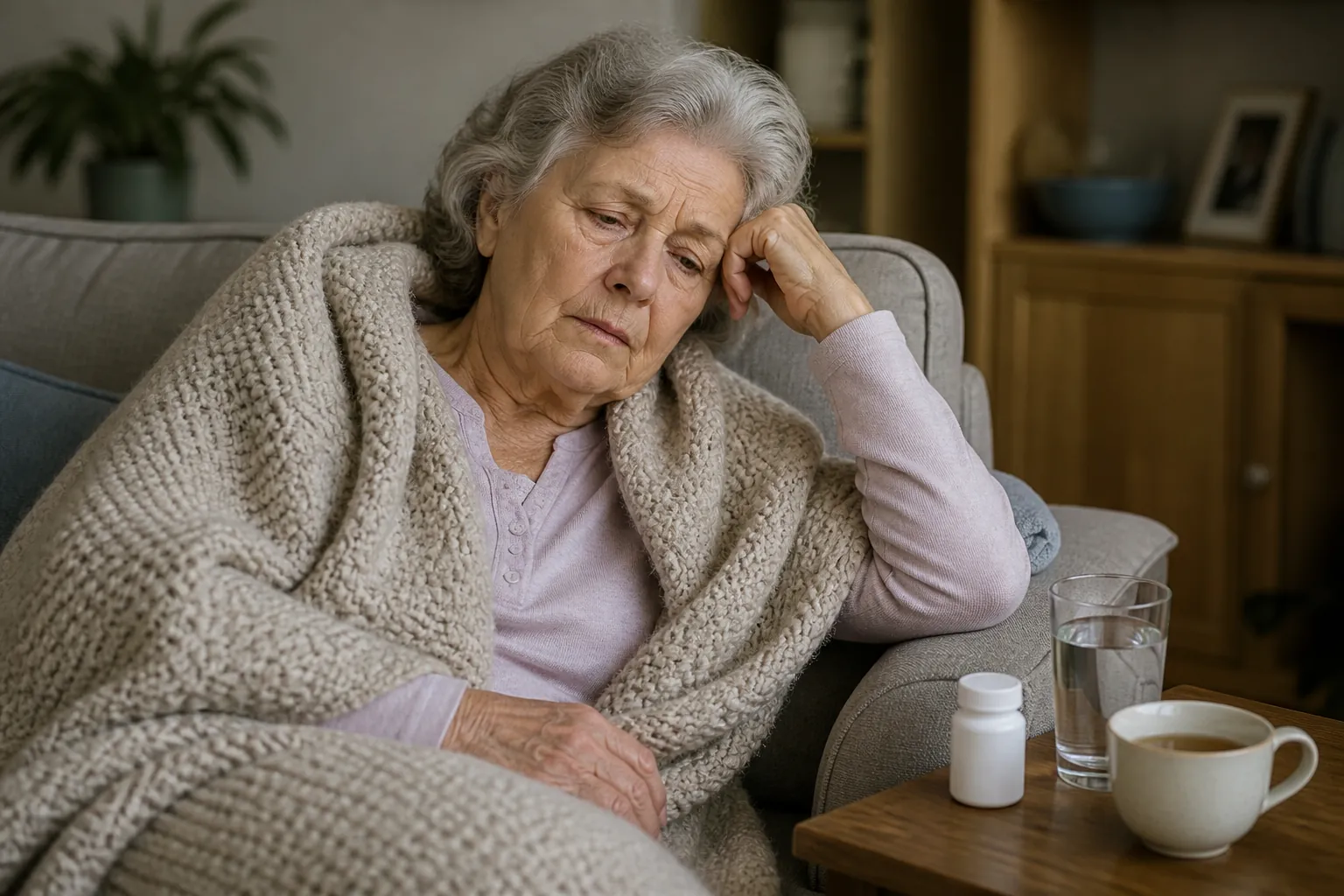
The first bad night after starting antibiotics can be unsettling. Some people feel worse before they feel better: more achy, more tired, chilled, headachy, or generally flu-like. Johns Hopkins and Harvard describe this as a Jarisch-Herxheimer reaction, a temporary worsening that can occur in the first 24–48 hours after antibiotics begin and usually resolves on its own.[5][6]
That reaction is not a reason to quietly stop the antibiotic. It is a reason to watch closely, keep the prescribing office’s number handy, and make the next day easier than usual. The older adult may need meals brought over, a water bottle within reach, help getting to the bathroom at night, and a pause on errands or yard work.
- Take the antibiotic exactly as prescribed unless the clinician tells you to change it.
- Ask the pharmacy or clinician what to do if nausea, diarrhea, sun sensitivity, swallowing trouble, or missed doses become an issue.
- Write down the start date, dose times, temperature, new symptoms, and any dizziness or palpitations. A simple note is often more useful than trying to remember everything during a phone call.
- If the person is unusually weak, have someone nearby for showering, stairs, and nighttime bathroom trips for the first couple of days.
Symptoms that should interrupt the wait-and-see approach
Some symptoms belong in a same-day call to the doctor, not in the “let’s see how tomorrow goes” category. CDC advises seeking medical care for a new rash or fever that appears within several weeks of a tick bite.[7] Mayo Clinic lists stiff neck, confusion, heart palpitations, and lightheadedness among symptoms that can occur with Lyme disease.[8]
For an older adult recovering at home, the practical rule is simple: call promptly for a new rash or fever after a tick bite, stiff neck, confusion, palpitations, or lightheadedness. Palpitations and lightheadedness deserve special respect because they can be cardiac symptoms and can also make a person unsteady on the way to the bathroom, kitchen, or front door.
A caregiver may notice the change before the patient does. A parent who says “I’m just tired” while grabbing the counter, losing their train of thought, or feeling their heart race is giving you useful information. Do not argue about whether it “counts.” Call and describe what changed, when treatment started, which antibiotic is being taken, and whether there has been fever, rash, chest discomfort, faintness, or confusion.
What recovery usually looks like after the antibiotic course
CDC says most people with Lyme disease recover after a 2–4 week course of oral antibiotics, though some symptoms can take longer to go away.[4] Cleveland Clinic notes that in one cited study, about 80% of patients treated early recovered completely.[9] Those are encouraging numbers, but they do not mean everyone wakes up on the last pill day feeling normal.
Early in recovery, the change may be gradual: fever settles, the rash fades, sleep improves, or the person has longer stretches of normal energy. Joint aches, fatigue, and a washed-out feeling may lag behind. If Lyme was diagnosed later, or if neurologic, cardiac, or arthritis symptoms were present, the recovery picture can be less tidy and should stay connected to the treating clinician.
Persistent symptoms are real, but the numbers attached to them vary because studies and agencies define them differently. Harvard’s Lyme materials describe most persistent symptoms as resolving within 6–12 months, while acknowledging that some last longer.[10] That is a different message from “nothing is wrong” and also different from assuming every lingering ache means active infection still needs more antibiotics.
The most useful recovery question is not whether every symptom has vanished by a certain date. It is whether the overall pattern is moving in the right direction, whether any warning signs have appeared, and whether fatigue or dizziness is making home life unsafe.
Treat fatigue and dizziness as fall-risk conditions during recovery
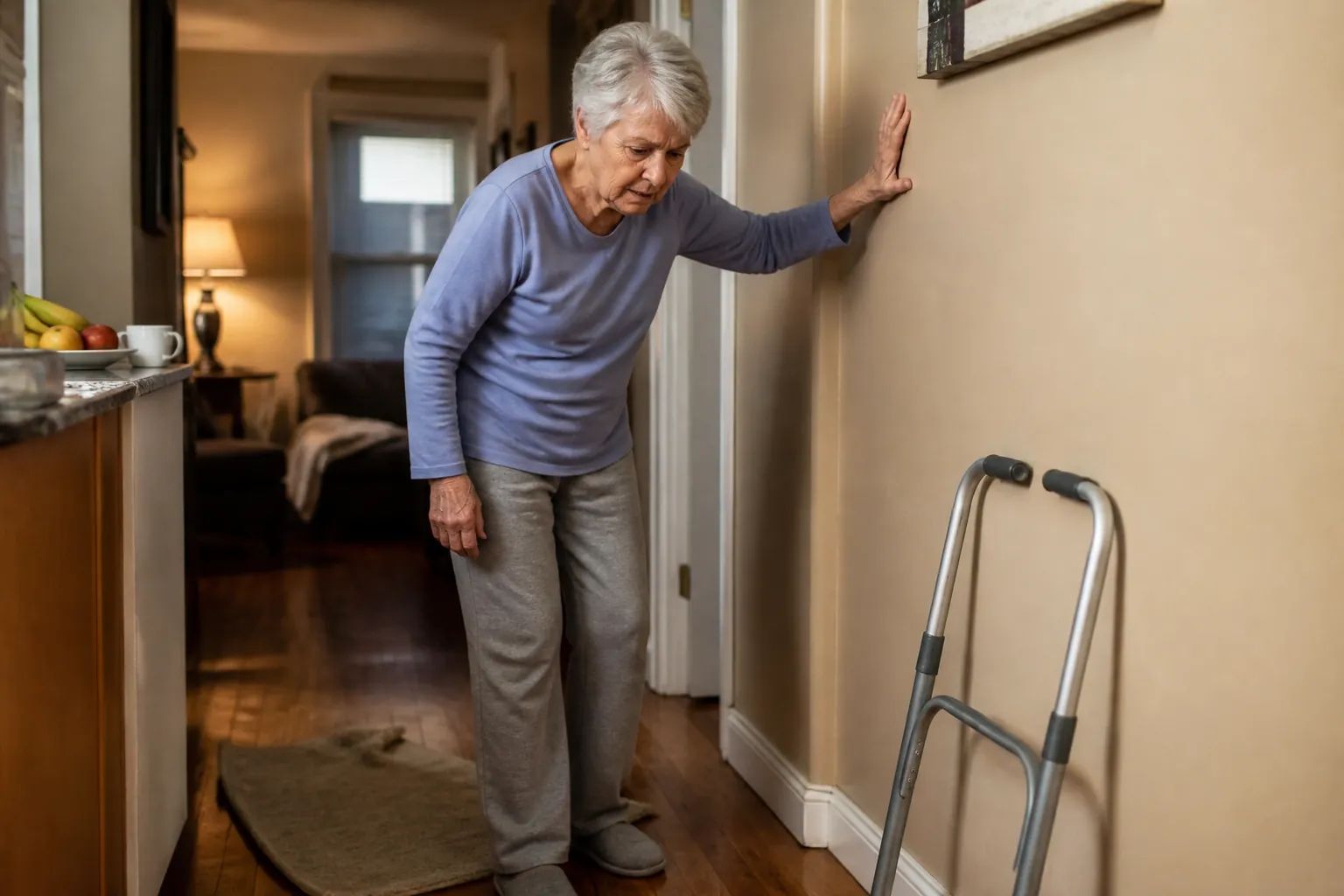
A hallway rug that was harmless last month can become a problem when someone is exhausted, lightheaded, moving more slowly, or getting up at night after poor sleep. Lyme recovery is not only about clearing an infection; it is also about getting through the recovery weeks without a preventable fall.
Start with the walking routes the person actually uses: bed to bathroom, favorite chair to kitchen, entryway to bedroom. Remove loose rugs or secure them well, clear cords and baskets, improve lighting, and put frequently used items at waist-to-shoulder height so the person is not climbing, bending deeply, or rushing.
Bathrooms deserve particular attention during the first treatment days and any stretch of lingering weakness. Use a non-slip bath mat, keep a towel within easy reach, consider a shower chair if standing feels draining, and avoid locking the bathroom door if the person is lightheaded or has been confused. Nighttime matters too: add a clear path, a nightlight, and a plan for calling for help before standing if dizziness hits.
If you need a fuller sweep of the home, use the room-by-room home safety assessment checklist rather than trying to spot hazards from memory. If the bathroom is already a trouble area, the bathroom remodel decision framework can help separate quick safety fixes from larger projects.
For the next few weeks, think in smaller margins: sit before standing, stand before walking, pause before stairs, and keep a phone within reach. If palpitations, lightheadedness, confusion, stiff neck, fever, or a new rash enters the picture, the home-safety plan stops being the main issue and the doctor’s office becomes the next step.
References
- Surveillance for Lyme Disease After Implementation of a Revised Case Definition — United States, 2022, CDC MMWR, February 2024.
- Estimating Lyme Disease Diagnoses among Adults Aged ≥65 Years Using Medicare Claims Data, United States, 2016–2019, CDC Emerging Infectious Diseases, September 2024.
- 2020 Guidelines for the Prevention, Diagnosis and Treatment of Lyme Disease, Infectious Diseases Society of America, 2020.
- Clinical Care and Treatment of Lyme Disease, CDC.
- Treatment and Prognosis of Lyme Disease, Johns Hopkins Lyme Disease Research Center.
- Lyme disease treatment, Harvard Lyme Disease Initiative.
- What to Do After a Tick Bite, CDC.
- Lyme disease - Symptoms and causes, Mayo Clinic.
- Lyme Disease, Cleveland Clinic.
- Chronic Symptoms, Harvard Lyme Disease Initiative.
Browse more in the Glossary.