
Room checklist
Bathroom Remodel for Elderly Parents: A Phased Decision Framework for Adult Children
A practical, staged approach to remodeling a parent's bathroom — starting with immediate fall-hazard fixes under $500, then mid-range upgrades, and deferring structural changes until needed. Built on evidence that 40% of older adults with repeated falls still have no bathroom modifications.
Why Most Bathroom Remodels Start Too Big — and Why That’s a Problem
If you are an adult child helping a parent age in place, the bathroom is the room that keeps you up at night. It is the smallest room in the house and the most dangerous. According to the CDC, roughly 235,000 Americans over 65 visit emergency rooms each year because of bathroom-related falls. To put that in perspective, that is more than 640 people every single day — and those are just the injuries serious enough to warrant an ER visit.
The instinct when you hear those numbers is to think, "We need a full renovation." A curbless shower. New flooring. A wider door. The whole thing. But here is the problem with that instinct: it leads to paralysis. A comprehensive bathroom remodel for aging in place typically runs between $8,000 and $25,000, and many families cannot or will not write that check all at once. So nothing gets done.
The data backs this up. A 2021 study published in the Journal of the American Geriatrics Society, using Medicare Current Beneficiary Survey (MCBS) data from 2016, found that among older adults who had experienced repeated falls — two or more — approximately 40.2% had no bathroom modifications at all. That represents roughly 1.9 million Medicare beneficiaries who have fallen multiple times and still lack basic safety features like grab bars or non-slip surfaces.
The core insight is simple: cost is the primary barrier, and the all-at-once renovation model is the reason. A staged, phased approach — starting with the highest-risk fall hazards first — changes the math entirely. You can address the most dangerous problems this weekend for under $500, build on that with mid-range upgrades over the next few months, and defer structural changes until your parent's mobility actually demands them.
This is not a compromise. It is a strategy. Research cited by the Journal of the American Geriatrics Society shows that home modifications reduce fall rates by 26% and fall-related injuries by 33%. The question is not whether modifications work — it is how to get them into homes that need them. The phased framework below is designed to do exactly that.
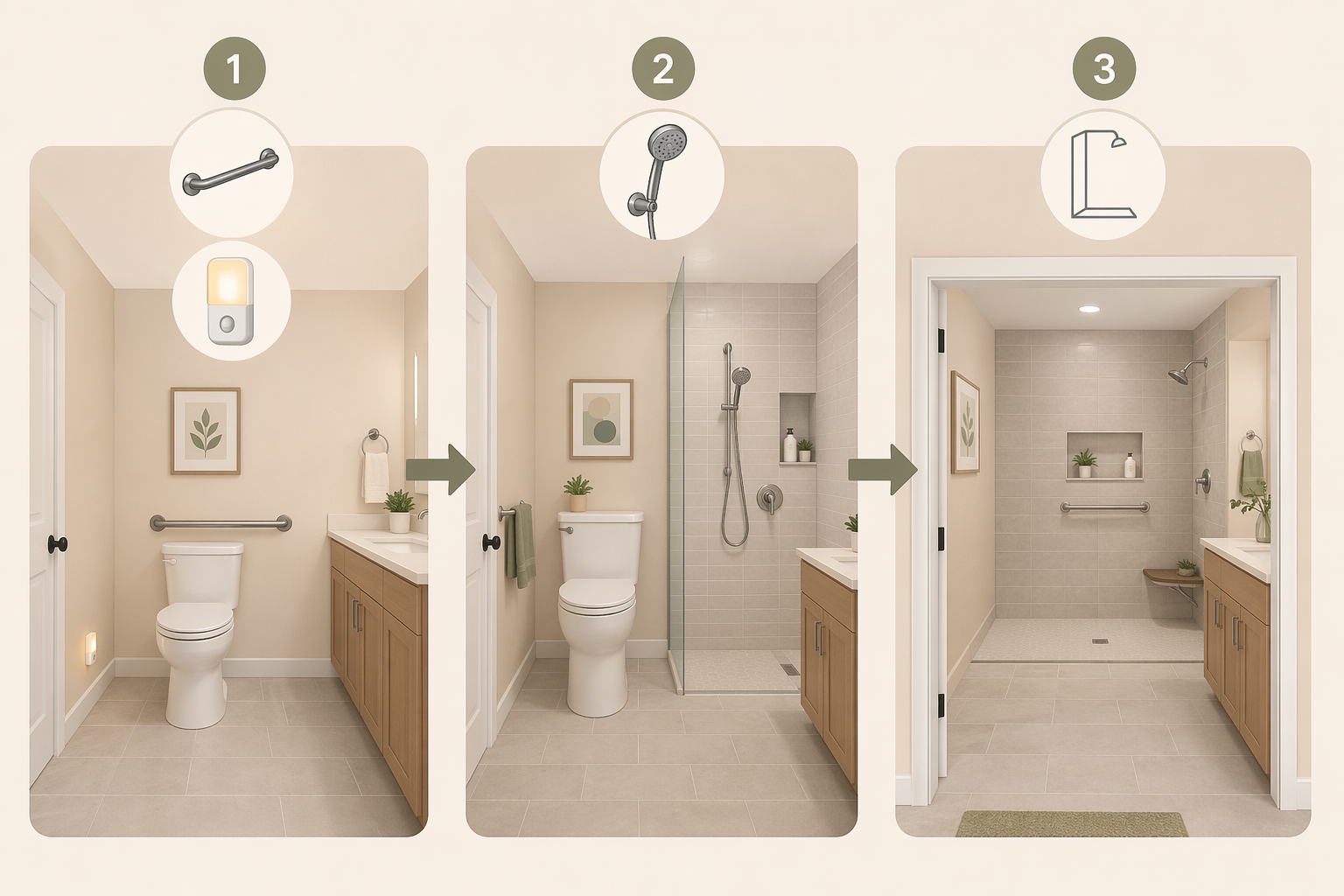
Phase 1: Immediate Fall-Hazard Fixes (Under $500)
Phase 1 is about one thing: eliminating the most common bathroom fall triggers with modifications you can install in a single weekend. No contractor. No permit. No decision fatigue. These are the changes that should be in place before you even begin thinking about a full remodel.
The National Institute on Aging recommends mounting grab bars near toilets and on both the inside and outside of the tub and shower. This is the single most impactful modification you can make. A set of two grab bars — one vertical near the shower entry, one horizontal beside the toilet — costs between $85 and $300 installed, depending on whether you hire a handyman or do it yourself. If you DIY, use a stud finder and make sure the bars are anchored into wall studs or blocking, not just into tile.
| Modification | Cost Range | Installation Time | Risk Addressed |
|---|---|---|---|
| Grab bars (2 bars, installed) | $85–$300 | 1–2 hours | Loss of balance during transfer |
| Non-slip mats or adhesive strips | $15–$50 | 15 minutes | Wet floor slip |
| Automatic night light (motion-sensor) | $10–$30 | 5 minutes | Nighttime disorientation |
| Lever-style faucet handles | $25–$80 | 30 minutes | Difficulty gripping round knobs |
| Remove loose bath mats and rugs | $0 | 5 minutes | Trip hazard |
Non-slip surfaces are the next priority. Place adhesive strips or a non-slip mat inside the tub or shower. The UCLA Health system notes that an estimated 80% of falls in the home occur in the bathroom, and wet, slick surfaces are the primary culprit. A $20 set of adhesive strips can eliminate that risk entirely.
Lighting is often overlooked but critical. Many older adults get up to use the bathroom at night, and the transition from a dark bedroom to a bright bathroom — or a dim bathroom with no light at all — is a fall waiting to happen. A motion-sensor night light plugged into a bathroom outlet costs under $20 and ensures the path is always visible. The NIA specifically recommends leaving a light on at night or using an automatic night light.
Finally, swap out round knob faucet handles for lever-style handles if your parent has arthritis or reduced grip strength. This is a $25–$80 change that makes a meaningful difference in daily independence — and it takes about 30 minutes with a basic wrench.
Phase 2: Mid-Range Upgrades for Daily Safety and Comfort ($1,000–$3,000)
Once the immediate hazards are addressed, Phase 2 focuses on making the bathroom easier and safer to use every single day. These are upgrades that improve independence — reducing the need for assistance with transfers, bathing, and toileting — without requiring structural demolition.
| Upgrade | Cost Range | Key Specification | Benefit |
|---|---|---|---|
| Comfort-height toilet | $200–$500 | Seat height 17–19 inches | Easier sit-to-stand transfer |
| Handheld showerhead with slide bar | $50–$150 | Adjustable height bracket | Seated showering capability |
| Shower bench or transfer bench | $80–$200 | Weight capacity 250–400 lbs | Reduces standing time in shower |
| Anti-scald valve (pressure-balancing) | $100–$300 | Set max temp to 120°F | Prevents burn injuries |
| Raised toilet seat (temporary) | $30–$60 | Adds 2–4 inches | Immediate transfer help |
The comfort-height toilet is the anchor upgrade of this phase. Standard toilets have a seat height of about 15 inches. A comfort-height model — also called "right-height" — sits at 17 to 19 inches, which is roughly the same height as a standard chair. This reduces the distance a person has to lower themselves and, more importantly, the distance they have to stand back up. For someone with weak legs, hip arthritis, or general balance issues, those two to four inches make the difference between an independent transfer and a call for help.
A handheld showerhead mounted on a slide bar is another high-impact upgrade. It allows your parent to shower while seated on a bench, directing water exactly where it is needed without having to twist or reach. Combined with a shower bench or transfer bench — which costs $80 to $200 — this setup eliminates the need to stand on a wet surface for the duration of a shower.
The anti-scald valve is an invisible but essential safety feature. Older adults have thinner skin and slower reaction times, making them more vulnerable to burn injuries from water that is too hot. A pressure-balancing valve maintains a consistent water temperature even when a toilet is flushed or a washing machine cycles, preventing sudden temperature spikes. Set the maximum temperature to 120°F.
If you are not ready to replace the toilet, a raised toilet seat — which adds 2 to 4 inches to the existing seat — is a $30 to $60 temporary solution. It is not as stable as a comfort-height toilet, but it can serve as a bridge while you plan the larger upgrade.
Phase 3: Structural Changes for Long-Term Accessibility ($5,000–$25,000)
Phase 3 is where the renovation becomes a renovation. These are structural changes that require a contractor, permits, and a meaningful budget. They are also the changes that make the bathroom fully accessible for someone with significant mobility limitations — including wheelchair use, walker navigation, or the need for caregiver assistance during bathing.
The most important decision in this phase is whether to install a curbless walk-in shower or a walk-in tub. Each serves a different mobility profile, and the choice should be driven by your parent's current and projected functional ability — not by aesthetics or contractor preference.
| Modification | Cost Range | Best For | Key Consideration |
|---|---|---|---|
| Curbless walk-in shower | $3,000–$15,000 | Wheelchair users, walker users, those with poor balance | Requires sloping the floor; may need structural work |
| Walk-in tub | $2,000–$20,000 | Those who can transfer with minimal aid, prefer soaking | Longer entry/exit; water sits until drained |
| Widened doorway (min 32") | $300–$2,500 | Wheelchair or walker clearance | 36 inches preferred for wheelchair access |
| Full non-slip flooring (DCOF 0.60+) | $3–$22/sq ft | All users | Must meet slip-resistance standard for wet areas |
| Tub-to-shower conversion | $3,000–$8,000 | Replacing a tub with a more accessible shower | Less expensive than full curbless shower |
A curbless walk-in shower — also called a zero-threshold shower — has no step to enter. The floor slopes gently toward the drain, allowing a wheelchair to roll directly in or a person with a walker to step in without lifting their feet over a barrier. The cost ranges from $3,000 to $15,000 depending on whether the existing floor can be sloped without major structural work. For a full bathroom remodel that includes a curbless shower, the total can reach $8,500 to $20,000 or more.
A walk-in tub has a low threshold — typically a few inches — and a watertight door. The user opens the door, steps in, closes it, and fills the tub. These are suitable for people who can transfer with minimal assistance and who value the ability to soak. However, the entry and exit process is slower than a shower, and the user must wait for the tub to drain before opening the door. The UDS Foundation notes that proper installation is critical for walk-in tubs, as a poorly sealed door can lead to leaks and water damage.
Doorway width is another structural consideration. The minimum recommended width for a bathroom door is 32 inches, and 36 inches is preferred for wheelchair access. Widening a doorway costs $300 to $2,500 depending on whether the wall is load-bearing. If you are planning a Phase 3 remodel, widen the door at the same time — doing it later means paying for demolition and reconstruction twice.
Flooring matters more than most people realize. Standard bathroom tile can be dangerously slippery when wet. The industry standard for slip resistance in wet areas is a Dynamic Coefficient of Friction (DCOF) rating of 0.60 or higher. Non-slip flooring costs $3 to $22 per square foot, with an average of about $13 per square foot installed. This is not the place to cut corners.
Decision Matrix: When to Stop vs. Continue Remodeling
Not every family needs Phase 3. Some parents will age safely with just Phase 1 and Phase 2 modifications. Others will need the full structural renovation. The decision comes down to three questions: current mobility, fall history, and long-term housing plan.
| Question | If Yes → | If No → |
|---|---|---|
| Can they transfer independently (toilet, shower) without assistance? | Phase 1 + Phase 2 may be sufficient | Plan for Phase 3 structural changes |
| Have they had 2+ falls in the past 12 months? | Prioritize Phase 1 immediately; evaluate Phase 3 | Phase 1 + Phase 2 may be sufficient |
| Is this their long-term home (5+ years)? | Phase 3 is a worthwhile investment | Focus on Phases 1 and 2; avoid structural investment |
| Do they use a walker or wheelchair? | Phase 3 is likely necessary (curbless shower, widened door) | Phase 1 + Phase 2 may be sufficient |
| Is a caregiver assisting with bathing? | Plan for Phase 3 (transfer space, roll-in shower) | Phase 2 upgrades (handheld shower, bench) may suffice |
If your parent can transfer independently, has not had a recent fall, and plans to stay in the home for the long term, Phase 1 and Phase 2 are likely sufficient. Install grab bars, add a comfort-height toilet, and set up a handheld shower with a bench. Reassess every six months or after any change in mobility.
If your parent has had multiple falls, uses a walker or wheelchair, or requires caregiver assistance for bathing, Phase 3 is not optional — it is the difference between aging in place safely and moving to a facility. The cost is significant, but so is the alternative.
The ROI Math: How a Mid-Range Remodel Pays for Itself
The most common objection to a bathroom remodel is cost. But the math changes when you compare the cost of a remodel to the cost of not doing it — specifically, the cost of a fall-related injury or the cost of moving to assisted living.
| Scenario | Cost | Timeframe |
|---|---|---|
| Mid-range bathroom remodel (Phases 1–2) | $7,000–$13,000 | One-time cost |
| Assisted living (national median) | $4,500+/month | Monthly recurring |
| Fall-related ER visit (average) | $3,000–$5,000 | Per incident |
| Hip fracture hospitalization (average) | $30,000–$40,000 | Per incident |
A mid-range bathroom remodel — covering Phases 1 and 2, plus a curbless shower conversion — typically costs $7,000 to $13,000. The national median cost for assisted living is over $4,500 per month. That means the remodel pays for itself in under six months of avoided assisted living costs. Even if your parent is not considering assisted living today, the comparison illustrates the scale of the financial decision.
The health ROI is equally compelling. Research published in the Journal of the American Geriatrics Society found that home modifications reduce fall rates by 26% and fall-related injuries by 33%. Given that falls are the leading cause of fatal and non-fatal injuries among older adults — with about 3 million ER visits and 1 million hospitalizations per year — a 33% reduction in injuries represents a massive avoided cost in both human and financial terms.
There is also a real estate ROI to consider. A mid-range bathroom remodel has an average return on investment of 58.9%, according to the KBF Design Center. While aging-in-place modifications are not primarily about resale value, the fact that they do not destroy value — and may even add it — removes one more objection.
Financing Options and Assistance Programs
The cost of a bathroom remodel is real, but it is not an all-or-nothing proposition. Several federal, state, and nonprofit programs exist specifically to help older adults and their families pay for home modifications. The key is knowing which programs exist and whether your parent qualifies.
| Program | Maximum Benefit | Eligibility | Best For |
|---|---|---|---|
| VA Specially Adapted Housing (SAH) Grant | Up to $117,014 (2026) | Veterans with service-connected disabilities | Major structural modifications |
| VA Home Improvement and Structural Alterations (HISA) | $6,800 (service-connected), $2,000 (non-service) | Veterans enrolled in VA healthcare | Grab bars, ramps, bathroom modifications |
| USDA Section 504 Grant | Up to $10,000 | Low-income rural seniors aged 62+ | Smaller modifications and repairs |
| USDA Section 504 Loan | Up to $40,000 | Low-income rural seniors aged 62+ | Larger structural changes |
| HUD Title I Property Improvement Loan | Up to $25,000 | Homeowners with equity | Any home improvement |
| Medicaid HCBS Waivers | Varies by state ($5,000–$15,000 typical) | Medicaid-eligible, need-based | Modifications that prevent institutionalization |
| Rebuilding Together | Free repairs (no set max) | Low-income seniors, veterans | Small to moderate repairs and modifications |
For veterans, the VA Specially Adapted Housing (SAH) grant is the most generous option, providing up to $117,014 in 2026 for adaptive housing modifications. The HISA grant is smaller — up to $6,800 for service-connected disabilities and $2,000 for non-service-connected — but it can be used specifically for grab bars, ramps, and bathroom alterations. Both require enrollment in VA healthcare and a clinical determination of need.
For low-income rural seniors aged 62 and older, the USDA Section 504 program offers grants up to $10,000 and loans up to $40,000 for home repairs and modifications. This is one of the least-known but most valuable programs for families in rural areas.
Medicaid Home and Community-Based Services (HCBS) waivers vary significantly by state, but many cover home modifications when they are deemed necessary to prevent institutionalization. Typical state caps range from $5,000 to $15,000. Contact your local Area Agency on Aging to find out what is available in your state.
Nonprofit organizations like Rebuilding Together provide free home repairs and modifications to eligible low-income seniors and veterans. Availability varies by location, and waitlists can be long, but the cost is zero.
For a deeper comparison of home repair programs, see our guide on Habitat for Humanity aging-in-place programs versus other senior home repair options.
Putting It All Together: Your Phased Action Plan
The difference between a bathroom that is dangerous and one that is safe is not a single $15,000 renovation. It is a sequence of decisions, each made at the right time, based on your parent's actual needs. Here is your action plan.
- This weekend: Install grab bars near the toilet and shower. Add non-slip strips to the tub floor. Plug in a motion-sensor night light. Remove all loose bath mats and rugs. Total cost: under $200. Total time: 2 hours.
- This month: Replace the toilet with a comfort-height model (17–19 inches). Install a handheld showerhead on a slide bar. Add a shower bench. Install an anti-scald valve if the faucet does not already have one. Total cost: $500–$1,200.
- This year: Assess whether Phase 3 is needed. Use the decision matrix above. If yes, get three quotes from CAPS-certified contractors. Explore funding options — VA grants, USDA loans, Medicaid waivers. Budget for a curbless shower, widened doorway, and non-slip flooring. Total cost: $5,000–$25,000.
- Ongoing: Reassess every six months or after any change in mobility, a new diagnosis, or a fall. The right phase for today may not be the right phase next year.
The 40.2% statistic — the share of older adults with repeated falls who have no bathroom modifications — is not a judgment. It is a signal that the current approach is not working. The all-at-once renovation model asks families to make a single, overwhelming decision. The phased model asks them to make one small decision at a time, starting with the most important one.
For a broader view of home modification costs across all rooms, see our room-by-room budget tiers guide. And if you are considering hiring a professional, our CAPS specialist cost guide can help you budget for contractor fees.
Related reading
Need a professional assessment?
Find a CAPS-credentialed professional or local aging services through our outbound resource list — we never name or rank individual contractors.
Find Local HelpNoticed something outdated or inaccurate on this page? Flag a correction. We review every report against CDC, NIA, and AARP HomeFit guidance before updating a page.