
Room checklist
The Room-by-Room Home Safety Assessment Checklist for Your Aging Parent
This structured checklist helps adult children assess their aging parent's home room by room, identify red-flag hazards, and learn how to discuss sensitive modifications without damaging the relationship.
Start at the front door with two jobs in mind: notice what could cause harm, and protect the relationship enough that your parent will still want to talk after the walkthrough. An aging in place checklist is useful only if it helps you sort what matters without turning an ordinary visit into a home inspection.

Bring a notebook or print the scorecard in this article. Walk the house in the order your parent actually uses it: entry, living areas, kitchen, bathroom, bedroom, stairs, laundry, garage, and outdoor paths. Mark hazards as you see them, but do not narrate every discovery out loud. A curled bathmat, a dim hallway bulb, and mail stacked on a stair landing may all be real problems; listing them one by one while your parent follows behind you can make the whole exercise feel like evidence gathering.
The urgency is real. Falls are the leading cause of injury for adults 65 and older, with 36 million falls reported annually in the United States.[1] Bathrooms deserve special attention because injury rates around tubs and toilets increase with age, and they are often the room where pride, privacy, and practical risk collide.[1] The point is not to make every possible modification this week. It is to find the few changes that reduce the most danger while your parent can still participate in the decision.
How to Use the Checklist Without Starting a Fight
Before you walk through the house, agree on the reason for the visit in language that does not accuse your parent of failing. Try: “I know you want to stay here. I want that too. Can I look for a few things that would make that easier and safer?” That is different from, “This house is dangerous,” even if both sentences come from worry.
Use three marks as you go:
- Fix now: a low-cost or obvious hazard that can be handled quickly, such as loose clutter on stairs, poor lighting, or a slippery rug.
- Plan next: a change that needs agreement, shopping, measuring, or a contractor, such as grab bars, doorway changes, railings, or a bathroom remodel.
- Call for help: anything involving repeated falls, major mobility changes, unsafe transfers, structural work, or disagreement about what the home can safely support.
If you want a deeper room-by-room renovation reference after the assessment, use the aging-in-place room-by-room guide. For this first pass, stay focused on observation, triage, and the first conversation.
Printable Home Safety Scorecard
Print this table or recreate it on one sheet. Score each area from 0 to 3, then add notes. A score is not a diagnosis; it is a way to decide what deserves attention first.
| Score | Meaning | What to do |
|---|---|---|
| 0 | No obvious issue during this visit | Leave it alone unless your parent reports difficulty |
| 1 | Minor nuisance or early warning | Watch it, ask about it, or make a simple improvement |
| 2 | Likely fall, burn, access, or transfer risk | Plan a fix and discuss timing with your parent |
| 3 | Immediate red flag or repeated problem | Fix now or call a qualified professional |
| Area | What to check | Red flags | Score |
|---|---|---|---|
| Entry and front path | Lighting, steps, railings, threshold, weather mats, door hardware | No railing, uneven path, loose mat, high threshold, poor night lighting | 0–3 |
| Living room | Walkways, rugs, cords, furniture height, favorite chair, phone access | Narrow paths, unstable furniture, cords across walking route, chair too low to rise from safely | 0–3 |
| Kitchen | Frequently used items, floor traction, lighting, stove use, reach height | Climbing to reach items, slippery floor, poor task lighting, burned pans, heavy items stored high | 0–3 |
| Bathroom | Tub or shower entry, toilet transfers, towel bars, bathmats, night lighting, medication clutter | Towel bar used for support, no grab bar where needed, slippery tub, poor lighting, difficulty standing from toilet | 0–3 |
| Bedroom | Path to bathroom, bed height, lamp access, nightstand clutter, footwear | Dark nighttime route, loose rugs, no reachable light, bed too high or low | 0–3 |
| Stairs and hallway | Handrails, landing clutter, tread condition, contrast, lighting, hallway width | One missing rail, mail or shoes on stairs, dim bulbs, loose carpet, narrow or blocked hall | 0–3 |
| Laundry, basement, garage | Steps, carrying route, lighting, floor condition, storage | Carrying baskets on stairs, oil or water on floor, poor lighting, heavy items stored overhead | 0–3 |
| Outdoor areas | Driveway, mailbox route, trash route, winter or rain hazards, seating | Uneven pavement, no place to rest, poor drainage, unsafe route to mailbox or bins | 0–3 |
When you finish, circle no more than three first actions. If everything is urgent, nothing is. Choose the hazards most likely to cause a fall, block daily routines, or make your parent avoid part of the home.
Entry, Front Path, and Doorways
The front entry tells you how much the house asks of your parent before they are even inside. Watch for the small sequence: getting out of the car, carrying keys or bags, stepping over a threshold, opening the door, and finding a light switch. A person can manage each piece on a good day and still be at risk when rain, darkness, fatigue, or a rushed delivery interrupts the routine.
Check whether mats lie flat, railings are present and steady, steps are visible at night, and the threshold catches a shoe or walker. If a ramp is already in place or being considered, the NAHB CAPS remodeling checklist uses a 1:12 ramp slope ratio as a practical specification worth confirming with a qualified installer.[2]
Doorway width matters when a parent uses, or may soon need, a walker or wheelchair. NAHB CAPS standards call for at least 32 inches of clear doorway width, hallways at least 36 inches wide, and clear turn spaces of at least 5 feet by 5 feet.[2] You do not need to redesign the house while standing in the foyer, but you should write down where a walker would scrape, stall, or force a sideways turn.
Living Areas: The Hazards Everyone Learns to Step Around
In the living room, look less at decor and more at routes. Can your parent move from the favorite chair to the bathroom, kitchen, phone, and front door without stepping over cords, turning sharply around furniture, or crossing a rug that bunches at the edge? A family member who visits once a week may see clutter; a parent who lives there may see a system that has worked for years.
Notice the chair your parent actually uses. If it is too low, too soft, or placed far from a stable surface, standing up becomes a transfer problem disguised as a furniture preference. Do not start by replacing it. Ask, “Is this still easy to get out of, or is it getting annoying?” The word “annoying” often opens more doors than “unsafe.”
Common quick fixes include taping down or removing loose cords, improving lamp placement, clearing one main walking path, and moving frequently used items within easy reach. If a rug is sentimental, try a conversation about securing it first. If it still curls or slides, it belongs in the “plan next” column rather than the “we will pretend not to see it” column.
Kitchen: Reach, Heat, and Routines
The kitchen assessment is partly about falls and partly about the workarounds that creep in when strength, balance, or vision changes. Look for step stools, heavy pans stored high, dim counter lighting, slippery flooring, and signs that your parent avoids cooking because the process has become too tiring.
Move everyday items to shoulder-to-waist height if your parent agrees. That change can feel small, but it removes the need to climb, stretch, or carry a heavy object from above eye level. If you notice scorched pans, spoiled food, or confusion with appliances, treat that as more than a home modification issue. It may be time to involve a clinician or care manager rather than solving the kitchen with better storage alone.
Bathroom: Do Not Wait for the Second Fall
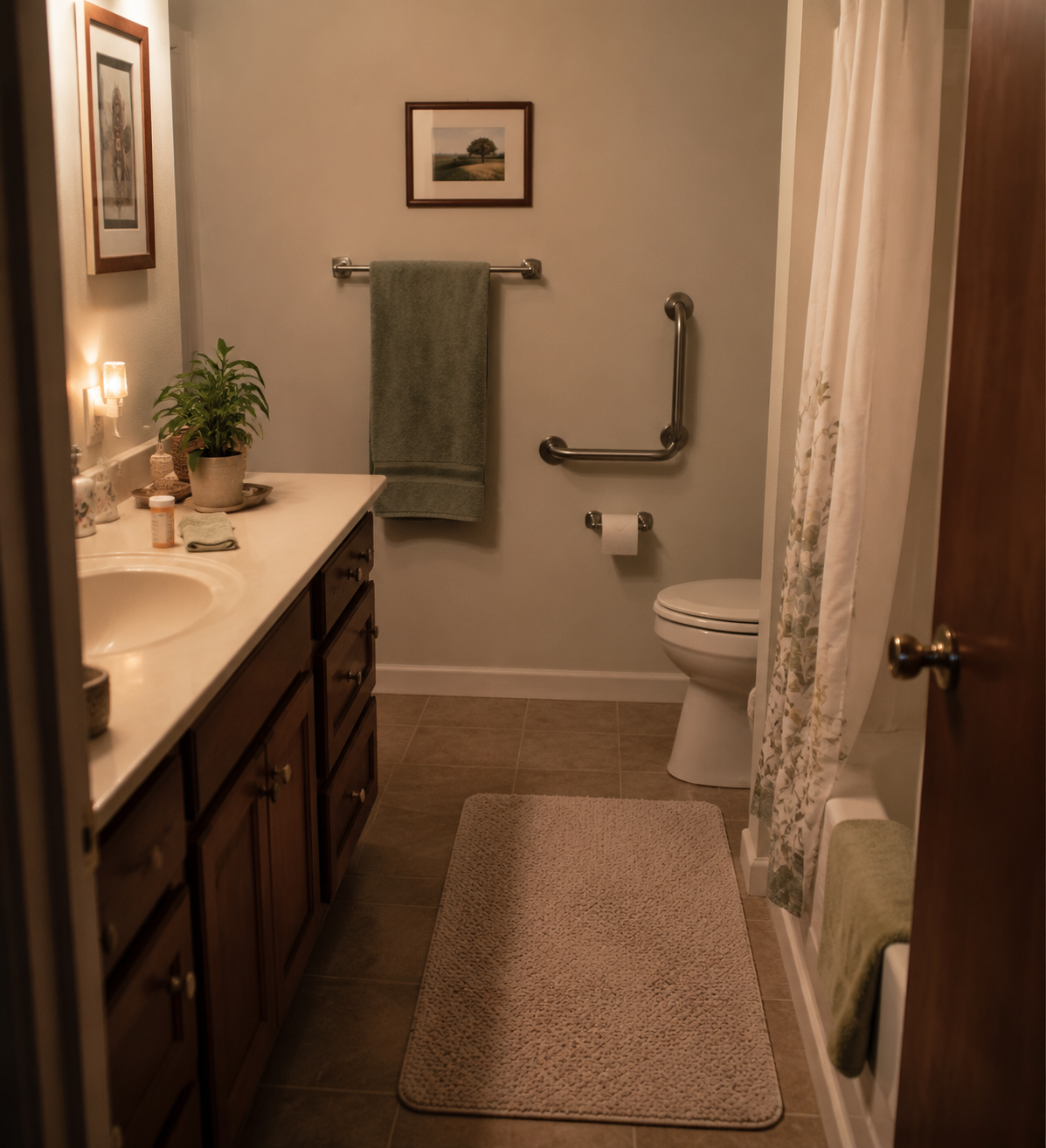
The bathroom is where a polite checklist has to become more specific. Wet surfaces, stepping over a tub wall, turning in a tight space, reaching for a towel bar, and standing from the toilet all combine in a room where people least want an audience. That is why bathroom changes need both urgency and tact.
Start with what your parent already does. Is there a towel bar placed exactly where a hand reaches during a tub transfer? Is a bathmat non-slip on both sides, or only soft? Is there a nightlight for the path from bed to toilet? Does your parent brace against the sink, shower door, or towel bar to stand? These details matter because they reveal where the body is already asking for support.
Grab bars are the classic hard conversation for a reason. They can sound like a declaration that someone is old. They also address a gap families postpone: 42% of older adults who could benefit from grab bars do not have them in their homes, according to a JAMA Internal Medicine study cited by ElderLife Financial.[3]
Do not suggest a grab bar as punishment for a fall. Suggest it as equipment that makes the bathroom less demanding. Try: “I noticed the towel bar is where your hand naturally goes. A real grab bar in that spot would look cleaner and hold weight safely.” If your parent cares about appearance, show finishes that match the bathroom. If they care about independence, say plainly that the goal is to make bathing easier without anyone hovering.
Installation is not the place to improvise. Grab bars should be anchored into wall studs and support 250 to 300 pounds under NAHB CAPS specifications cited by ElderLife Financial.[3] A suction bar may feel reassuring in the package, but it should not be treated as a substitute for a properly installed support where a person may put real weight during a slip.
Mark the bathroom as a red flag if your parent has trouble stepping into the tub, uses a towel bar or sink for balance, cannot rise from the toilet without strain, avoids bathing, or has fallen or nearly fallen there. For deeper planning after this first assessment, use a dedicated senior bathroom remodel guide rather than trying to decide on tubs, showers, flooring, and contractors in one emotional conversation.
Bedroom and Nighttime Path
The bedroom assessment is really a nighttime assessment. Stand where your parent gets out of bed and imagine the route to the bathroom at 2 a.m. Is the lamp reachable before standing? Are slippers stable? Is the path clear enough for a walker if one becomes necessary? Is the bed height helping or making the first movement of the day harder?
This is one of the easiest places to make improvements without a big declaration. Add or reposition nightlights, clear the floor beside the bed, remove loose rugs, and make sure glasses, phone, water, and medications are reachable without twisting. If your parent is getting up frequently at night, write it down, but do not treat the house as the only cause. That observation may belong in a medical conversation too.
Stairs, Hallways, and the Places Things Pile Up
Stairs collect all the compromises: mail set down “just for now,” laundry carried with both hands, a loose strip of carpet, one dim bulb that technically works, a railing on only one side. Do not just look at the staircase. Watch the job the staircase is being asked to do.
Red flags include missing or loose handrails, objects stored on steps or landings, poor contrast at stair edges, uneven treads, loose carpet, and lighting that leaves shadows. A hallway can be a problem even when it is clear if it is too narrow for a mobility device or blocked by furniture. NAHB CAPS standards use at least 36 inches for hallway width and 5 feet by 5 feet for clear turning space, which gives you a practical measuring point when access is becoming tight.[2]
If stairs are becoming a daily barrier, separate the safety issue from the symbol. A stair lift, first-floor bedroom setup, or second railing can sound like surrender if introduced abruptly. Try: “Which trip is hardest now: laundry, bedtime, or getting out to appointments?” The answer tells you whether the first change should be storage, a new routine, better rails, or a larger access plan.
Laundry, Basement, Garage, and Outdoor Routes
These areas often look secondary until you ask what your parent carries through them. Laundry baskets, trash bags, groceries, tools, pet food, and winter gear change the risk of a route. A dry garage floor with good lighting is one thing; the same garage with oil spots, storage bins, and a step into the house is another.
Check the path to the mailbox, trash bins, car, basement freezer, laundry machines, and outdoor seating. If your parent has started leaving chores undone, ask whether the task is unpleasant, tiring, painful, or scary. The solution may be a railing or light; it may also be moving laundry upstairs, changing delivery routines, or asking someone else to handle a seasonal task.
Turn Observations Into Priorities
After the walkthrough, do not hand your parent a full defect list. Sit with your notes and sort them into three groups. The first group is simple: remove the stack from the stairs, replace a burned-out bulb, move the daily coffee mug to a lower shelf. The second group needs agreement: grab bars, railings, furniture changes, a shower chair, or a new routine for laundry. The third group needs outside judgment: repeated falls, major bathroom access problems, structural changes, or mobility needs that are changing quickly.
If money is part of the hesitation, be careful with old cost figures. Published ranges for items such as grab bar installation or stair lifts can become outdated quickly, and the research available for this article points to source-dependent estimates rather than a stable national price. Use current local quotes and funding resources before budgeting, and review options in a home modification costs and funding guide if the first fixes are likely to become a larger project.
A useful first action plan might look like this:
| Priority | Example | Who decides |
|---|---|---|
| This week | Clear stairs, improve night lighting, remove a loose rug | Parent and family can usually decide together |
| This month | Install grab bars, add a second railing, adjust furniture layout | Parent chooses timing and style; family helps arrange |
| Professional review | Unsafe transfers, doorway access problems, repeated falls, major bathroom changes | Occupational therapist, Area Agency on Aging, or CAPS-certified contractor |
For help deciding which changes come first, use this resource on prioritizing aging-in-place modifications after you have the marked-up checklist. Prioritizing is easier when the house has already told you where daily life is snagging.
When a Family Checklist Is Not Enough
A family walkthrough is good at finding visible hazards. It is weaker at judging transfers, balance, cognition, fatigue, vision, medication effects, and whether a modification fits the way your parent actually moves. A home assessment by an occupational therapist can identify hazards families overlook, including the fit between a person’s abilities and the home environment.[4]
Call for professional help if your parent has had repeated falls or near-falls, cannot bathe safely, struggles to get on or off the toilet, has new walker or wheelchair needs, avoids stairs, or needs structural changes. An occupational therapist can evaluate function and daily routines. A local Area Agency on Aging may be able to connect families with home safety evaluations or community supports. A CAPS-certified contractor is the better fit when the issue has moved into remodeling, doorway changes, ramps, bathroom reconstruction, or other construction decisions.
Those are different kinds of help. CDC STEADI’s “Check for Safety” brochure is a fall-prevention walkthrough tool.[5] AARP HomeFit is a broader room-by-room planning guide.[6] NAHB CAPS standards help translate access and remodeling needs into construction specifications.[2] None of them replaces a clinician’s judgment when your parent’s body, balance, or cognition is changing.
If the project reaches remodeling scale, use a CAPS-certified specialist hiring guide before requesting bids. The family member who notices the problem should not have to become the construction expert too.
How to Bring Up the First Changes
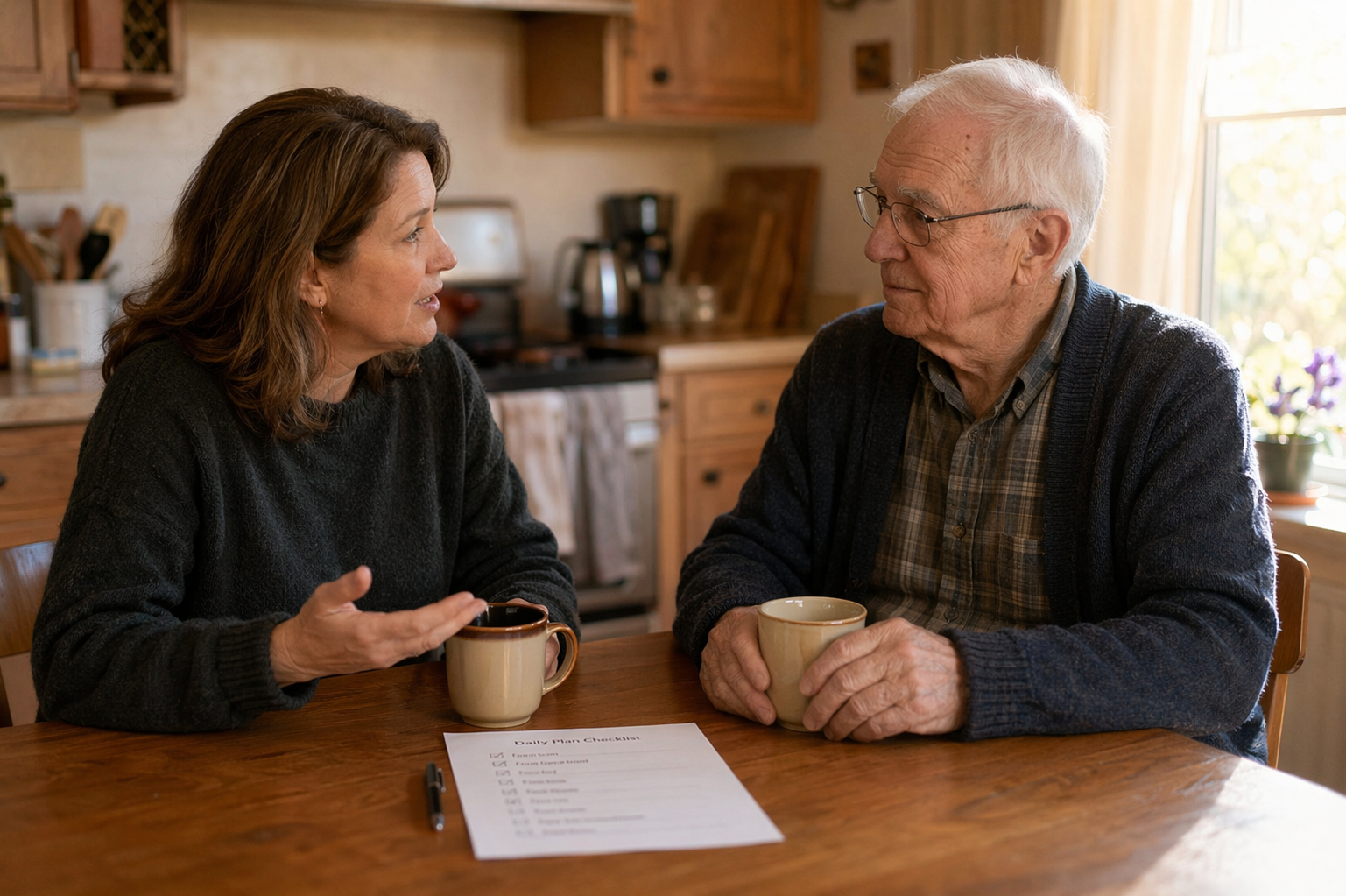
The conversation usually goes better after the walkthrough, not during every stop on the tour. Sit down later, preferably when nobody is tired or embarrassed, and start with the shared goal: staying at home with fewer close calls. Then offer choices instead of a verdict.
| Hard topic | Instead of saying | Try saying |
|---|---|---|
| Grab bars | You need grab bars before you fall again. | Your hand already goes to that spot. Would you rather choose a grab bar that matches the room than have me worry about that towel bar? |
| Stairs | You cannot keep using these stairs. | Which stair trip feels most tiring now? Let’s fix the hardest part first. |
| Bathroom changes | This bathroom is unsafe. | Bathing should not feel like a balance test. What would make it easier without changing more than we need to? |
| Clutter | You have too much stuff in the way. | Can we clear one main path so you do not have to think about your footing every time? |
| Professional help | We need someone to come assess you. | I want a second set of eyes on the house so we do not guess or overdo it. |
If your parent resists, listen for what is underneath the no. It may be money, appearance, fear of losing control, embarrassment, or a belief that accepting one change means surrendering the whole house. The answer is not to bury them in fall statistics. Pick one practical improvement and leave room for them to choose how it happens.
A marked-up checklist should leave you with three things: one or two quick fixes, one planning conversation, and one threshold for calling help if the problem is bigger than the family can judge. That is enough for a first visit. A good assessment protects safety, but it also protects cooperation, because cooperation is what makes the second and third changes possible.
References
- Aging in Place: What To Know, Cleveland Clinic
- Aging-In-Place Remodeling Checklist, NAHB
- Budgeting and Prioritizing Home Modifications for Aging in Place, ElderLife Financial, January 2026
- Is Your Aging Parent Safe at Home?, Seniors At Home / JFCS
- Check for Safety, CDC STEADI
- Your Home Checklist for Aging in Place, AARP
Related reading
Need a professional assessment?
Find a CAPS-credentialed professional or local aging services through our outbound resource list — we never name or rank individual contractors.
Find Local HelpNoticed something outdated or inaccurate on this page? Flag a correction. We review every report against CDC, NIA, and AARP HomeFit guidance before updating a page.