
Glossary entry
What Seniors Should Know About Part D Premium Changes
Last verified 2026-08-04
This is not financial or legal advice. Medicare/Medicaid and benefits rules vary by state and change over time — verify current rules with your state Medicaid office or Area Agency on Aging.
If the average Medicare Part D premium went down in 2026, why might your drug coverage still feel more expensive? Because the average premium is only one moving part. CMS projected the average stand-alone Part D prescription drug plan total premium at $34.50 for 2026, down from $38.31 in 2025 and $41.63 in 2024. CMS also projected the average Part D premium in Medicare Advantage plans to fall from $13.32 to $11.50. Those declines are real, but they do not tell you what happens after your own drug list, deductible, coinsurance, pharmacy, and plan choice enter the picture. [1]

Last verified: August 4, 2026. This article is general Medicare education, not medical, legal, or financial advice. Private insurers set individual Part D plan premiums and cost-sharing within Medicare rules, so your own plan documents control. Reviewed for Medicare accuracy by the site's credentialed Medicare reviewer.
The average premium fell, but the bill did not shrink in one clean line
A lower average premium can sit right beside a higher household cost. That is the part many premium headlines skip. A plan can lower or hold the monthly premium while raising the deductible, moving a drug to a more expensive tier, charging coinsurance instead of a flat copay, narrowing preferred pharmacies, or adding utilization management such as prior authorization or step therapy.
KFF separately calculated an average stand-alone Part D premium of $36 for 2026, down from $39. That is close to CMS’s $34.50 projection, but it is not the same number; CMS published a projected average, while KFF computed its own average from plan and enrollment data. Treat them as two different measurements pointing in the same general direction, not as interchangeable figures to blend together. [2][3]
| What the headline may say | What the enrollee still has to check |
|---|---|
| Average stand-alone Part D premium projected at $34.50 in 2026, down from $38.31 in 2025 | Your own plan premium, because individual plans can move differently from the national average [1] |
| KFF computed a separate 2026 average of $36, down from $39 | Which methodology is being used, instead of mixing CMS and KFF figures as if they were the same number [2][3] |
| Premiums looked more stable than many people expected | Whether the plan used a higher deductible, coinsurance, tier changes, or pharmacy-network changes to shift cost elsewhere |
| Fewer stand-alone PDP choices were available nationally | Whether the plan you used before still exists in your area and still covers your drugs well [3] |
The 2026 premium headline also had support behind it. CMS pointed to the Part D Premium Stabilization Demonstration and its 2026 bid process, including the use of bid authority to address excessive increases, as part of the explanation for premium stability. Those factors help explain the public average. They do not make any one person’s plan cheap. [4]
Where the cost moved in 2026
The deductible is the first place to look. For 2026, the Medicare Part D maximum deductible rose to $615, up from $590. A person who takes only low-cost generics may barely notice that. A person whose brand-name drug is subject to the deductible may feel it in January. [5]
The change was especially visible inside Medicare Advantage drug coverage. KFF found that the share of Medicare Advantage prescription drug plan enrollees in plans charging a drug deductible rose from 23% in 2024 to 82% in 2026. That does not mean every MA-PD enrollee paid more. It means far more people were exposed to a deductible structure before the plan started paying for certain drugs. [3]
Stand-alone Part D plan choice also narrowed. KFF reported that the number of stand-alone prescription drug plans fell from 464 to 360, a 22% drop. Fewer choices can simplify the screen in Medicare Plan Finder, but it can also mean a familiar low-premium option disappears or a household has fewer good matches for a specific medication list. [3]
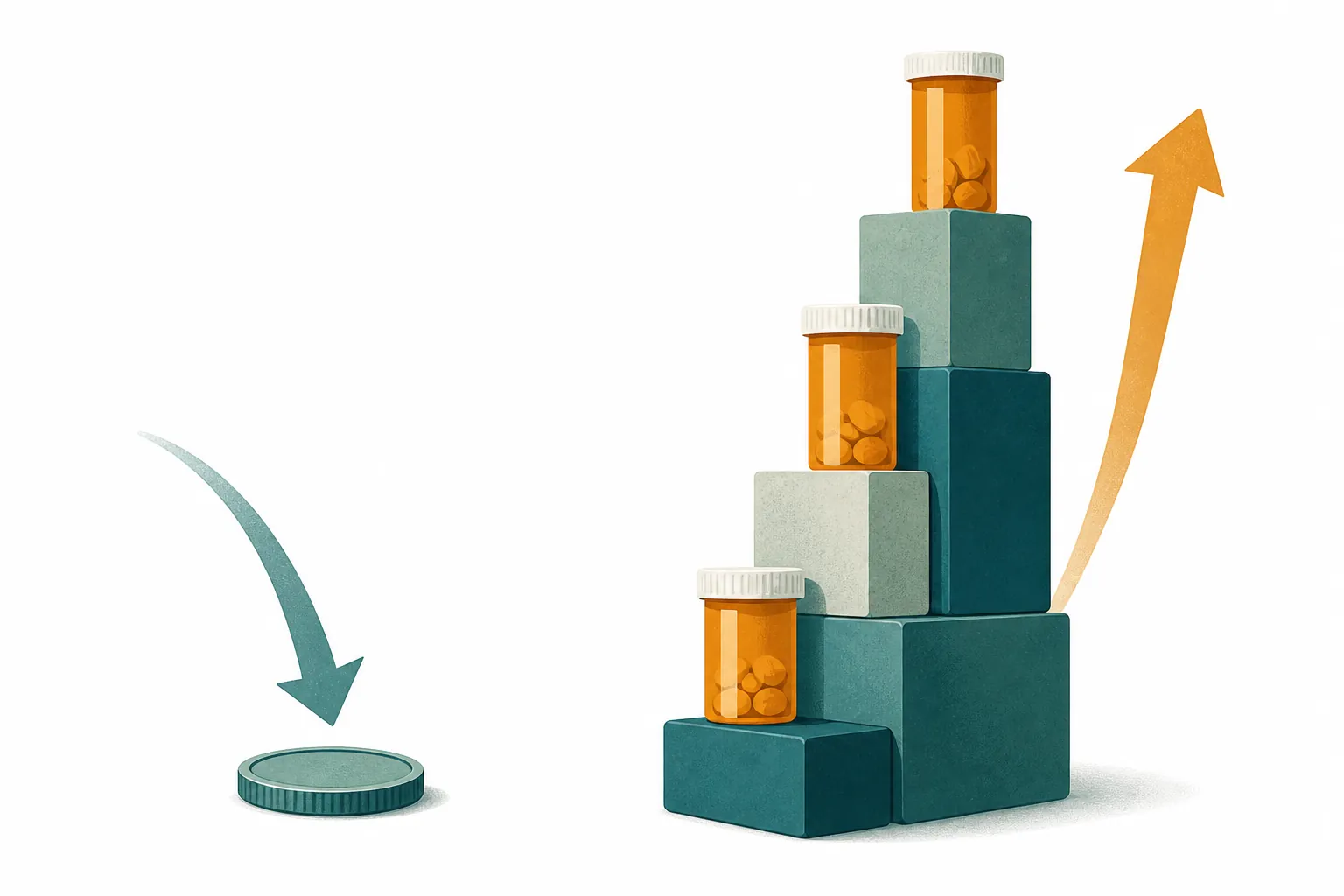
Cost sharing matters just as much as the premium. KFF’s Part D snapshot describes a market in which formularies, tiers, utilization management, and the use of coinsurance shape what people pay at the pharmacy. Coinsurance is easy to underestimate because it is a percentage, not a clean dollar amount. If a drug is expensive, 25% coinsurance can be a very different experience from a $25 copay. [6]
A simple hypothetical shows the trap. One plan may charge a lower monthly premium but place a person’s main medication on a coinsurance tier after a deductible. Another plan may charge a higher premium but use a flat copay for that same drug at a preferred pharmacy. Without entering the actual drug, dose, quantity, and pharmacy, the cheaper premium plan only looks cheaper.
Do not use 2026 averages to make a 2027 decision
The 2026 numbers are useful because they teach the reading habit. They are not a shortcut for choosing 2027 coverage. As of August 4, 2026, the regular opportunity to change 2026 drug coverage has already passed unless someone qualifies for a Special Enrollment Period. The next regular decision window is the October 15–December 7, 2026 open enrollment period for coverage that starts in 2027.
September 2026 is the update trigger. When 2027 plan landscape information becomes available, the right question will not be whether the national average sounds better or worse. The question will be whether your drugs, pharmacy, deductible exposure, and total yearly cost still work in the plan you are considering.
If you want the broader 2027 premium context, read the site’s separate guide to how 2027 Part D changes may affect seniors. If your main concern is whether a cheaper premium can still cost more, the same total-cost idea is covered in the guide on switching Part D plans for 2027.
The comparison that matters: total yearly cost
For open enrollment, start with one written medication list. Include every prescription drug, dose, quantity, and how often it is filled. Then compare plans around that list, not around the lowest premium on the first screen.
- Monthly premium: the amount you pay whether or not you fill a prescription.
- Deductible: the amount you may pay before the plan starts covering certain drugs; the 2026 maximum deductible is $615. [5]
- Formulary status: whether each drug is covered at all, and whether it sits on a preferred generic, non-preferred, specialty, or other higher-cost tier.
- Copay versus coinsurance: a flat dollar amount is easier to predict than a percentage of the drug’s negotiated price.
- Pharmacy network: the same plan can price a drug differently at a preferred pharmacy, standard in-network pharmacy, mail-order pharmacy, or out-of-network pharmacy.
- Utilization management: prior authorization, quantity limits, or step therapy can affect access even when a drug is technically covered. [6]
Medicare Plan Finder is useful here because it estimates yearly drug and premium costs after you enter your medications and pharmacy. The estimate is not a promise that nothing will change during the year, but it is far better than comparing premiums by eye.
The 2026 out-of-pocket cap is another piece of the calculation. In 2026, the Part D out-of-pocket cap is $2,100, and covered Part D drugs have $0 cost sharing after a person reaches that cap. That helps people with very high drug costs, but it does not erase premiums, deductibles before the cap, drugs not covered by the plan, or costs outside Part D. [5][7]
Two charges that can override a good-looking plan comparison
Some people pay more for Part D no matter which plan they pick because of IRMAA, the income-related monthly adjustment amount. For 2026, Social Security lists Part D IRMAA surcharges from $14.50 to $91.00 per month for people above $109,000 in modified adjusted gross income for single filers or $218,000 for joint filers. This surcharge is separate from the plan’s own premium. [8]
The late-enrollment penalty can also follow someone for as long as they have Medicare drug coverage. Medicare calculates the penalty as 1% of the national base beneficiary premium for each full uncovered month after a gap of 63 or more days without Part D or creditable drug coverage; for 2026, the base beneficiary premium is $38.99. [5]
Extra Help, Medicare Savings Programs, Medicaid, and state pharmaceutical assistance programs can change the calculation substantially. Eligibility rules and benefit amounts can vary by state or program, so people who may qualify should confirm with SHIP, Medicaid, or the program itself before assuming the sticker premium is the real cost.
A practical open-enrollment posture
When the 2027 plan information is available, do not begin with the plan that has the lowest premium. Begin with the plan that covers the actual medication list at the lowest estimated yearly cost, using the pharmacy the person is willing and able to use.
- Use Medicare Plan Finder with the current drug list, doses, quantities, and pharmacies.
- Call 1-800-MEDICARE if the online comparison is unclear or if a plan detail needs confirmation.
- Contact SHIP for free, unbiased state-specific counseling, especially when Extra Help, Medicaid, or a Medicare Savings Program may be involved.
- Check the plan’s formulary and pharmacy network before December 7, 2026, not after the first expensive refill in January.
The 2026 average premium decline was real. The household bill still lives in the plan details: deductible, formulary tier, coinsurance, pharmacy network, penalties, surcharges, and the exact drugs on the kitchen table.
References
- Medicare Advantage and Medicare Prescription Drug Programs Expected to Remain Stable in 2026 — CMS, Sept. 26, 2025
- Medicare Part D Premiums Are Decreasing for Many Stand-Alone Drug Plans in a Number of States in 2026 — KFF
- Medicare Part D Enrollment, Premiums, and Cost Sharing in 2026 — KFF
- 2026 Medicare Part D Bid Information and Part D Premium Stabilization Demonstration Parameters — CMS
- How much does Medicare drug coverage cost? — Medicare.gov
- A Current Snapshot of the Medicare Part D Prescription Drug Benefit — KFF
- What You Will Pay in Out-of-Pocket Medicare Costs in 2026 — NCOA
- Benefits Planner: Retirement | Medicare Premiums — Social Security Administration
Browse more in the Glossary.