
Glossary entry
How Much More Will Seniors Pay for Part D in 2027?
Last verified 2026-07-30
This is not financial or legal advice. Medicare/Medicaid and benefits rules vary by state and change over time — verify current rules with your state Medicaid office or Area Agency on Aging.
Last verified: July 30, 2026.
If you are asking how much more you will pay each month for Medicare Part D in 2027, the honest answer starts with your plan type. The same national Part D change can feel small in one household and painful in another.
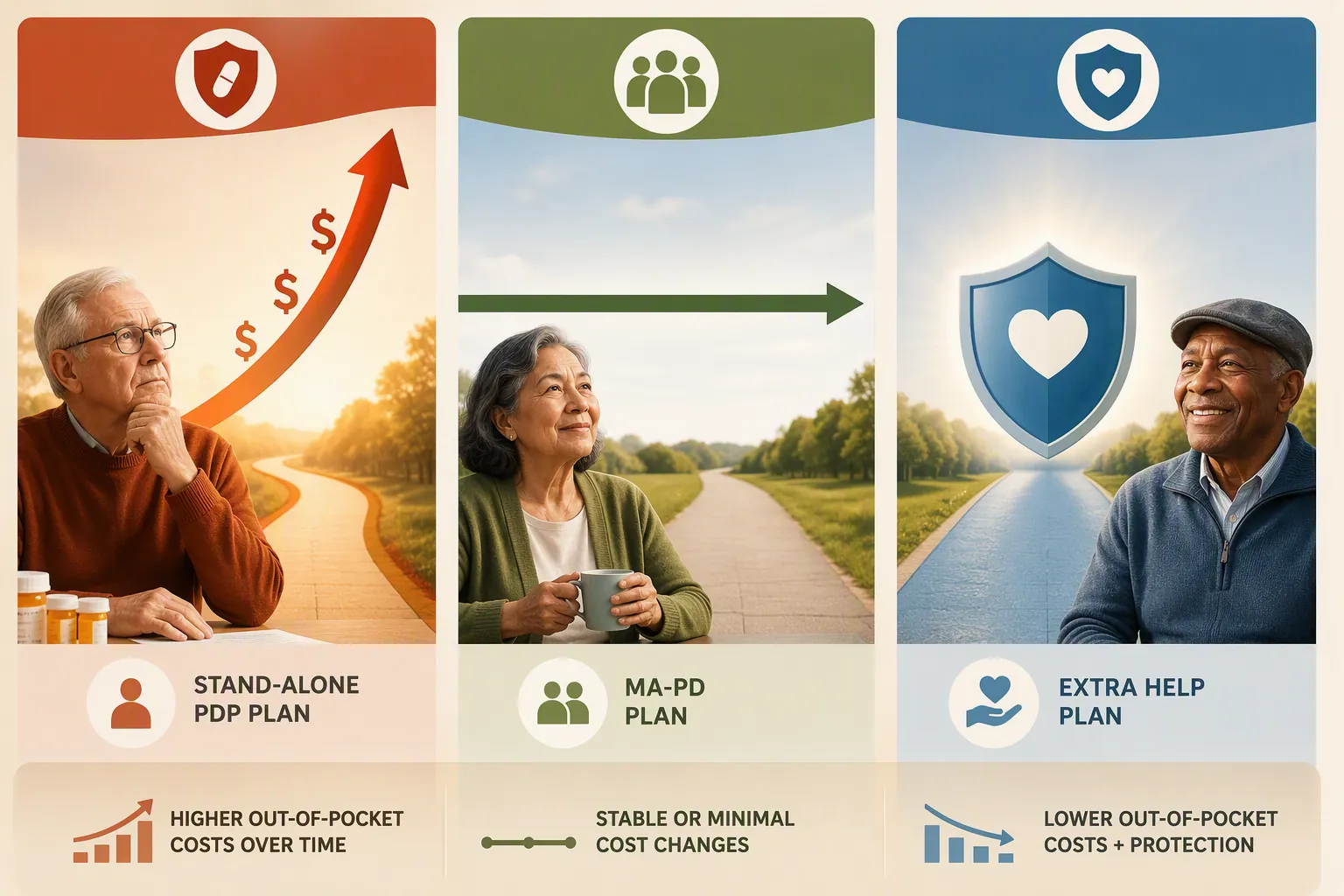
- If you have a stand-alone Part D prescription drug plan, or PDP, you are the most likely to see a noticeable monthly increase.
- If your drug coverage is built into a Medicare Advantage prescription drug plan, or MA-PD, you may be more insulated, but you still need to check your plan’s 2027 premium, formulary, and pharmacy network.
- If you receive Extra Help, also called the Part D Low-Income Subsidy, the premium and deductible rules are much more protective.
The confirmed 2027 Part D numbers
CMS has confirmed several national Part D figures for 2027. These are real numbers, but they are not all the numbers a household needs before choosing a plan.
| 2027 Part D figure | What changed | What it means for seniors |
|---|---|---|
| Base beneficiary premium: $41.33 per month | Up from $38.99 in 2026, the maximum 6% increase allowed under the Inflation Reduction Act | This is the national base figure, not necessarily your plan’s actual premium. [1] |
| Standard deductible: $700 | Up 13.8% from $615 | Some enrollees may pay more before plan cost-sharing begins, depending on the plan and drugs used. [1] |
| Annual out-of-pocket cap: $2,400 | Up 14.3% from $2,100 | After reaching the cap, beneficiaries pay $0 for covered Part D drugs for the rest of the year. [1] |
That first number, $41.33, is the one most likely to be misunderstood. It explains the national base beneficiary premium. It does not tell you what your plan will charge in January.
Why the 6% base premium increase is not your actual bill
The base premium rose by $2.34 a month, from $38.99 to $41.33. On paper, that is the 6% increase. In a kitchen-table budget, though, a senior does not pay “the base premium.” A senior pays the premium charged by a specific plan in a specific county, after that plan’s pricing, benefits, subsidies, and, for Medicare Advantage plans, possible rebate dollars are taken into account.
That distinction matters most for stand-alone PDP enrollees because a temporary program that held down some PDP premiums is ending. The Premium Stabilization Demonstration reduced stand-alone PDP premiums by up to $15 per month in 2025 and up to $10 per month in 2026, and it ends after 2026. [2][3]
That is why “Part D is going up 6%” is too tidy. The 6% cap applies to the base beneficiary premium. The end of the stabilization demonstration can affect what a PDP enrollee actually sees on the monthly bill.
Stand-alone PDP enrollees: the group most likely to feel the increase
A stand-alone PDP is the separate drug plan many people buy when they have Original Medicare, often with a Medigap policy. If that is your setup, the 2027 Medicare Part D premium increase could be more than the $2.34 base-premium change.
KFF estimates that the end of the stabilization demonstration could mean premium increases of up to $20 a month for some stand-alone PDP enrollees. ABC News, reporting on CMS’s decision to end the program, reported the CMS administrator’s expectation that most enrollees would see increases under $10 a month. [2][3]
Those two estimates are not the same, and neither should be treated as your final number. They mark the range of uncertainty before plan-level premiums and benefits are available for 2027 shopping. A careful reader should hear both messages at once: not every PDP enrollee will see a $20 monthly jump, but some PDP enrollees may see an increase large enough to matter in a fixed-income budget.
KFF’s current comparison helps explain why PDP enrollees are more exposed: stand-alone PDP enrollees currently pay about $36 per month on average, while MA-PD enrollees pay about $8 per month on average for drug coverage, with Medicare Advantage rebates helping hold down many MA-PD drug premiums. [2]
For a PDP enrollee, the practical January question is not only “What is the premium?” It is: what happens when the premium, deductible, drug list, tier placement, prior authorization rules, and preferred pharmacies are all put together?
- A plan with a higher premium may still be cheaper for someone whose medications are covered on better tiers.
- A plan with a low premium may cost more if it has a $700 deductible and places a regular medication on a costly tier.
- A pharmacy that was preferred in 2026 may not be preferred in 2027.
- A drug that was covered in 2026 may need fresh review if the 2027 formulary changes.
That is especially important for people who have stayed in the same PDP for years. Loyalty to a drug plan is not the same as protection from a price change. If you want the shorter version of what is changing, this related guide on what the Medicare Part D subsidy cut means for 2027 costs may help separate the base premium increase from the subsidy ending.
MA-PD enrollees: often more insulated, not excused from checking
If your prescription drug coverage is part of a Medicare Advantage plan, the Part D premium increase may not show up in the same way. Many MA-PD plans use rebate dollars to reduce or offset the drug premium, which is one reason average MA-PD drug premiums are much lower than stand-alone PDP premiums. [2]
That does not mean an MA-PD enrollee can ignore the Annual Notice of Change. A plan can keep a low or $0 drug premium while changing other parts of the package: medical copays, prior authorization rules, supplemental benefits, drug tiers, or pharmacy networks. The broader Medicare Advantage benefit picture is separate from this Part D premium question; if that is your situation, see what Medicare Advantage benefit cuts may mean for seniors in 2027.
For MA-PD enrollees, the right question is less “Will my Part D premium rise by $20?” and more “Did my total plan value change?” That means checking the drug list, the doctors and hospitals, the pharmacy network, and any medical-side cost changes before assuming the drug premium tells the whole story.
Extra Help recipients: the protected bucket
If you receive Extra Help, the 2027 Part D premium story is different. Extra Help generally shields low-income Medicare beneficiaries from Part D premiums and deductibles and limits prescription copays. NCOA lists 2026 Extra Help copays at up to $12.65 for brand-name drugs and $5.10 for generic drugs. [4]
That protection is why Extra Help should not be treated as a footnote. For a senior with limited income, checking Extra Help eligibility may matter more than debating whether the average PDP increase is closer to $10 or $20 a month.
If you already receive Extra Help, still open every Medicare and Social Security notice. If your income, household status, or Medicaid status changed, do not assume the paperwork will sort itself out. If you do not receive Extra Help but your income is limited, this is the year to check eligibility before choosing a 2027 drug plan.
The deductible and out-of-pocket cap matter, but in different ways
The standard Part D deductible rises to $700 in 2027. That does not mean every person will pay $700 before getting any help from a plan. Some plans may apply the deductible differently across drug tiers, and some drugs may have different cost-sharing designs. Medicare.gov describes Part D costs as a combination of premiums, deductibles, copayments or coinsurance, and coverage rules that vary by plan. [5]
The out-of-pocket cap rises to $2,400 in 2027. For people with expensive covered Part D drugs, that cap is still a major protection: after reaching it, beneficiaries pay $0 for covered Part D drugs for the rest of the year. But it is also $300 higher than the 2026 cap, so someone who reaches the cap could have more cost exposure before the $0 phase begins. [1]
The cap applies to covered Part D drugs. It does not make every prescription-related cost disappear, and it does not cap Part B drug costs. For anyone taking high-cost medications, the exact drug, the coverage category, the formulary, and the pharmacy rules still matter.
A few protections still help hold some costs down
Several Inflation Reduction Act Part D protections remain in place for 2027. The insulin copay cap remains $35 per month, ACIP-recommended adult vaccines continue with $0 cost-sharing, and Medicare drug price negotiation expands to 15 drugs for 2027, up from 10 drugs for 2026. [1]
Those protections can be meaningful, especially for people who use insulin or recommended vaccines. They do not erase the need to compare premiums and formularies, because a household’s total drug cost still depends on the drugs used and the plan chosen.
How this may land in a 2027 household budget
A projected Social Security COLA may soften the blow, but it should not be treated as found money yet. Current projections point to about a 3.8% COLA, or roughly $79 per month on an average $2,083 monthly benefit, while projected 2027 Part B figures include a $209.50 monthly premium, a $292 deductible, and a $6.60 Part B premium increase. These figures are projections, not final benefit or premium amounts. [6]
The final COLA is not known until the fall, and final Part B numbers are not the same thing as Part D plan premiums. For a senior on a fixed income, the safer move is to build a small 2027 worksheet that includes Social Security, Part B, Part D or MA-PD premiums, regular prescriptions, and any expected deductible exposure. For a broader budgeting pass, see this mid-year financial checkup for seniors.
What to do during open enrollment
Do not choose a 2027 plan from the national base premium alone. Use it as a warning light, not as your final bill.
- Identify your bucket first: stand-alone PDP, MA-PD, or Extra Help. If you have Original Medicare plus a separate drug plan, you are usually in the stand-alone PDP bucket. If your drug coverage is inside your Medicare Advantage plan, you are in the MA-PD bucket.
- Wait for the 2027 plan details before judging the dollar impact. The confirmed $41.33 base premium and $700 deductible are not enough to tell you what your own plan will cost.
- Compare total annual cost, not just the monthly premium. Include 12 months of premiums, likely deductible exposure, expected copays or coinsurance, and whether you are likely to reach the $2,400 cap.
- Check every regular medication against the 2027 formulary. Look at whether the drug is covered, its tier, any prior authorization or step therapy rules, and whether there is a lower-cost alternative your prescriber would consider.
- Check the pharmacy network. A plan can look affordable until the preferred pharmacy changes or your usual pharmacy becomes more expensive.
- If your income is limited, check Extra Help eligibility before assuming you must absorb the premium or deductible increase.
- Revisit the household budget before 2027 starts. A $10 or $20 monthly increase is not abstract when it competes with groceries, utilities, transportation, or over-the-counter health supplies.
For stand-alone PDP enrollees, especially those outside large metro areas with fewer convenient pharmacy choices, the plan comparison step is not optional. Rural seniors who rely on a small number of pharmacies may also want to read about how the Medicare drug subsidy ending may affect rural seniors.
The most useful first move is simple: pull out your current plan card and your medication list. Once the 2027 plan details are available, compare the plan you have against alternatives before letting it renew automatically.
References
- Medicare Part D 2027 National Average Monthly Bid Amount Information. CMS, July 28, 2026.
- The Uncertain Future of Medicare’s Stand-Alone Prescription Drug Plan Market and Why It Matters. KFF.
- Trump administration to end Medicare Part D subsidy program in 2027. ABC News.
- Understanding Medicare Part D Low Income Subsidy (LIS) / Extra Help. NCOA.
- Costs for Medicare drug coverage. Medicare.gov.
- Medicare 2027: How Much Premiums Are Set to Rise. Kiplinger.
Browse more in the Glossary.