
Glossary entry
12 warning signs your parent's power of attorney is being abused
Last verified 2026-07-29
This is not financial or legal advice. Medicare/Medicaid and benefits rules vary by state and change over time — verify current rules with your state Medicaid office or Area Agency on Aging.
Last verified: July 29, 2026. This article is educational information, not legal, financial, or tax advice. Power of attorney laws, accounting rights, revocation rules, damages, guardianship, and conservatorship procedures vary by state. If you suspect abuse, talk with an elder law attorney licensed in your state or contact the appropriate protective-services agency.
Power of attorney theft warning signs for elderly parents usually do not arrive as one dramatic confession. They show up as clusters: a utility bill that should have been paid, ATM withdrawals when your parent rarely leaves home, an agent who suddenly treats bank statements like private property, and a parent who looks embarrassed because they cannot explain where their own money went.
That gray feeling matters. Elder financial exploitation losses in the U.S. have been estimated at $28.3 billion a year, and only about 1 in 44 cases is reported, according to statistics summarized by SeniorLiving.org from AARP and DOJ-related data.[1] These figures describe elder financial exploitation broadly, not power of attorney theft alone, but they explain why families so often sit with suspicion for months before anyone names it.
The uncomfortable part is that the suspected person is often familiar. SeniorLiving.org reports that family members steal roughly twice as much as strangers and that the average loss per older victim is about $120,000, while noting that averages can be pulled upward by large-loss cases.[1] AARP’s analysis, as summarized in the same source, attributed 72% of financial losses to someone the older adult knew.[1] That does not mean every sibling, step-parent, niece, caregiver, or longtime helper is suspect. It means closeness is not a reason to stop looking at records.

A power of attorney gives an agent authority to act for the principal, often an aging parent, within the powers granted by the document. That agent generally owes fiduciary duties, including acting in the parent’s best interests and not using the parent’s assets for personal gain.[2] The problem is that POA documents are commonly private arrangements rather than court-supervised roles; the American Bar Association has been cited for the concern that they are generally not subject to routine court or third-party oversight.[3]
So the practical question is not, “Can I prove theft today?” It is, “Am I seeing repeated, documentable patterns that justify asking for records, getting advice, or reporting concern?” One odd purchase may have an innocent explanation. Several irregularities plus secrecy deserve attention.
The 12 warning signs to look for
1. Unexplained withdrawals or transfers
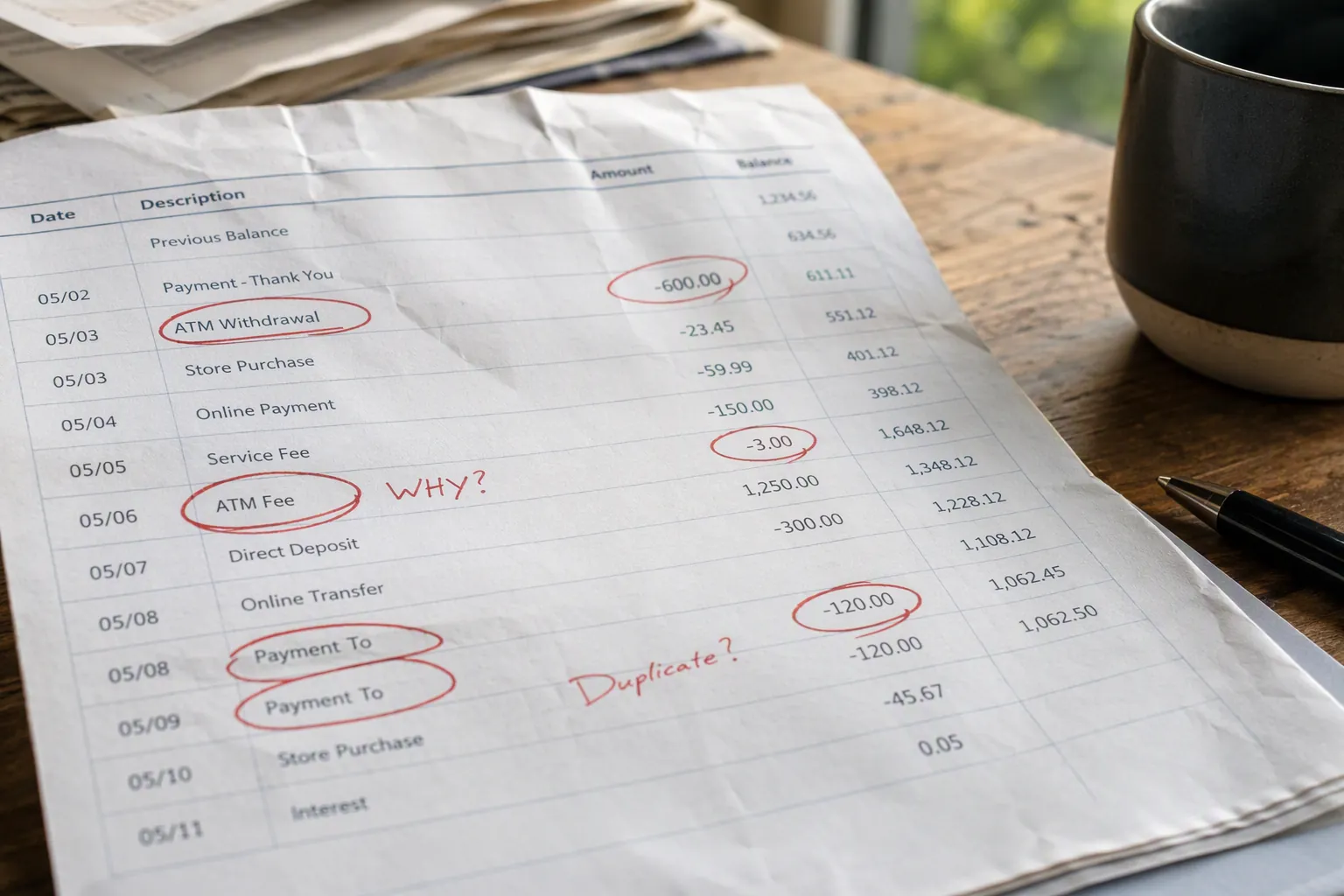
Start with the bank statements, not the family story. Look for cash withdrawals your parent cannot explain, transfers to the agent or the agent’s household, checks made out to “cash,” repeated electronic payments to unfamiliar accounts, or new payment apps tied to your parent’s checking account.
The pattern matters more than a single line item. A one-time cash withdrawal may have paid a contractor, reimbursed groceries, or covered a legitimate care expense. A series of withdrawals that increase after the agent takes over finances, especially when receipts are missing, is different. Make a simple timeline: date, amount, account, who had access, what explanation was given, and whether the explanation matches your parent’s needs.
2. Bills go unpaid even though your parent has enough money
Unpaid essentials are one of the clearest household-level warning signs because they show a consequence, not just a suspicion. Watch for shutoff notices, late mortgage or rent warnings, unpaid property taxes, lapsed insurance, pharmacy calls about declined payments, collection letters, or caregivers who have not been paid despite money being available.
This sign becomes stronger when the agent controls bill payment and cannot give a consistent explanation. Some older adults have complicated mail, autopay failures, or confusion after a hospitalization. But if accounts show adequate deposits while basic bills are neglected, ask where the money went before assuming it was simple disorganization.
3. ATM activity does not match your parent’s mobility or habits
ATM withdrawals deserve special scrutiny when a parent is homebound, no longer drives, lives in a facility, has limited mobility, or has not carried a debit card for years. Look at the location, time, and frequency. A withdrawal near the agent’s workplace, near the agent’s home, or during a time your parent was in the hospital may be more meaningful than the dollar amount alone.
Ask a careful, non-accusing question first: “Did you ask anyone to get cash for you last week?” If your parent says yes, ask what it was for and whether any cash came back. If your parent says no or seems frightened to answer, preserve the statement and keep looking for repeats.
4. The agent pays themselves twice, pays themselves without records, or mixes money
Family caregiving often involves legitimate reimbursement. A daughter may buy incontinence supplies, a nephew may pay a plumber, or a sibling may front money for prescriptions. The warning sign is not reimbursement itself. It is payment without documentation, duplicate payments, rounded “care” checks with no agreement, or the agent using your parent’s account as if it were shared household income.
Look for the same receipt being reimbursed twice, checks to the agent on the same day as cash withdrawals, credit card charges for the agent’s personal expenses, or transfers labeled vaguely as “help,” “expenses,” or “Mom.” A fiduciary role generally requires the agent to act for the principal’s benefit, not to treat access as permission to self-deal.[2]
5. The agent refuses to share statements or becomes defensive about ordinary questions
Secrecy is often the sign that turns worry into action. Be alert when the agent says bank statements are “none of your business,” changes online passwords, moves mail to a different address, blocks siblings from speaking with financial institutions, or insists that asking for receipts means you are attacking them.
Some agents are overwhelmed and poorly organized. Some are exhausted caregivers who feel judged. Still, a person handling another adult’s money should be able to explain major transactions, provide basic records, and separate their own inconvenience from the parent’s right to financial safety. Smith Strong, PLC states that about 1 in 3 power of attorney abuse cases involves a family member as the perpetrator, which is one reason familiar status should not end the inquiry.[4]
6. Your parent is increasingly isolated from family, friends, or professionals
Isolation can be physical, emotional, or informational. The agent may answer every call, hover during visits, cancel appointments, tell relatives your parent is “too tired” to talk, discourage private conversations, or make themselves the only route to doctors, bankers, lawyers, and mail.
Isolation does not prove theft. Older adults do withdraw because of illness, grief, hearing loss, depression, or fatigue. The concern rises when isolation appears alongside financial irregularities or when your parent seems coached, anxious, or unable to speak freely. If you are also seeing changes in memory, judgment, or vulnerability, it may help to review the signs of declining capacity in Is It Time to Step In? 5 Signals of Declining Capacity.

7. Your parent seems confused about their own finances
A parent may say, “I thought I had more than that,” “I don’t know who pays the bills now,” or “I’m not allowed to look at that account.” They may be unable to explain why a CD was cashed out, why a credit card balance rose, or why they no longer receive mail from the bank.
Confusion by itself is not proof that someone is stealing. Cognitive decline, medication changes, illness, and normal delegation can all affect what a parent remembers. The National Council on Aging reports that about 47% of elder abuse incidents overall involve family member perpetrators, citing National Center on Elder Abuse data, and also notes that dementia can increase vulnerability to abuse.[5] That makes confusion a reason to slow down, document, and verify rather than dismiss the concern as “just aging.”
8. Valuable items, cards, checks, or documents go missing
Missing property can be easy to minimize because no one wants to accuse a relative over jewelry, coins, tools, collectibles, cash envelopes, or a checkbook. But personal property is often the first thing families notice before they can access formal financial records.
Look for gaps: a safe that used to contain documents is empty, a debit card disappears and reappears, blank checks are missing from the middle of a checkbook, a vehicle title cannot be found, or sentimental jewelry is suddenly “being held” by the agent. Write down what is missing, when it was last seen, who had access, and what explanation was given. Avoid exaggerating the list; accuracy helps if you later need legal advice or a protective-services report.
9. Signatures, checks, or forms do not look right
Forged or questionable signatures may appear on checks, beneficiary forms, account-change documents, vehicle transfers, deeds, loan documents, or handwritten “permission” notes. The warning sign is stronger when the signature appears during a period when your parent was hospitalized, cognitively impaired, physically unable to write, or unaware that the document existed.
Do not mark a signature as forged because it looks shaky. Many older adults’ handwriting changes because of tremor, stroke, arthritis, vision loss, or weakness. Instead, compare dates, witnesses, notarization, capacity concerns, and whether the transaction benefited the parent or the agent. If a document changed ownership or access to money, get legal guidance before confronting the suspected person.
10. Estate documents, beneficiaries, or account ownership change suddenly
A sudden change to a will, trust, deed, beneficiary designation, joint account, payable-on-death account, or life insurance policy deserves attention when it benefits the agent or cuts out people your parent had consistently included. The concern is sharper if the change happened after a diagnosis, hospitalization, bereavement, move, or increased dependence on the agent.
A parent with capacity can change their estate plan, including in ways other relatives dislike. The warning sign is pressure, secrecy, confusion, or a change that does not fit the parent’s long-stated wishes. If the concern involves a trust or estate document, the next question may become whether a family member interfered with your parent’s plan; Can You Sue a Family Member for Tampering With Mom’s Trust? explains that related path.
11. The agent’s lifestyle changes without a clear source of money
Lifestyle changes are sensitive because families often know too much and too little at the same time. A new car, home renovation, debt payoff, vacation, luxury purchases, or sudden ability to cover expenses may have nothing to do with your parent. The question is whether the timing overlaps with new access to your parent’s accounts and whether records show transfers, cash withdrawals, or payments benefiting the agent.
Avoid treating jealousy or family history as evidence. Tie the concern to documents: payments from your parent’s account to the agent’s credit card, checks to contractors working on the agent’s home, bank transfers shortly before large purchases, or caregiver “salary” payments with no written agreement. Power of attorney access has been described by some elder-law commentators as dangerous when treated like a “license to steal,” but the useful work is still specific record-gathering, not name-calling.[6]
12. The agent keeps using the POA after your parent dies
A power of attorney generally ends at the principal’s death. After that, authority usually shifts to the executor, personal representative, trustee, or another legally authorized person, depending on the asset and estate plan. If the agent keeps withdrawing money, writing checks, using debit cards, selling property, or moving funds after death, treat it as urgent.
There may be legitimate final expenses, but they should be handled through the proper post-death authority and records. Preserve statements, screenshots, check images, receipts, and notices. If estate documents are involved, speak with a probate or elder law attorney in the relevant state before warning the person you suspect.
A quick way to sort concern from a pattern
| What you see | Why it matters | What to preserve |
|---|---|---|
| One unfamiliar charge | May be an error, purchase, or reimbursement | Statement page and any receipt or explanation |
| Repeated withdrawals plus missing receipts | Suggests money is leaving without a clear parent-related purpose | Monthly statements, check images, ATM locations, written explanations |
| Unpaid bills despite adequate deposits | Shows your parent may be harmed even while assets exist | Bills, shutoff notices, account balances, payment history |
| Agent blocks access to records | Secrecy makes ordinary verification impossible | Texts, emails, call notes, mailed notices, password-change alerts |
| Financial changes plus isolation | Raises concern that your parent cannot speak freely or verify decisions | Visit notes, appointment cancellations, witness names, communication records |
This is also where broader financial-safety work fits. If you are trying to separate POA misuse from outside fraud, see Protect your elderly parents from common financial scams. If your family is still planning and trying to understand what a POA does alongside other documents, start with Start incapacity planning with these 5 essential documents.
What to do if several signs appear together
When several warning signs line up, resist the urge to solve everything in one family confrontation. The first job is to keep your parent safe and preserve the records that show what changed.
- Save financial records: bank statements, credit card statements, check images, bills, shutoff notices, receipts, emails, texts, account alerts, and screenshots. Keep copies somewhere the suspected agent cannot access.
- Write a dated timeline: when the POA began, when the agent took over bills, when each suspicious transaction occurred, what your parent said, and who witnessed relevant conversations.
- Avoid tipping off the suspected agent before getting advice if your parent’s safety, housing, care, or financial evidence could be at risk.
- Contact an elder law attorney licensed in your state about accounting demands, revocation, bank notices, guardianship or conservatorship, civil claims, or other remedies that may apply. Nolo notes that some states allow enhanced damages for elder financial abuse, but the rules are state-specific.[2]
- If your parent may be in immediate danger or unable to protect themselves, contact Adult Protective Services, law enforcement, or emergency services as appropriate. The Eldercare Locator and the National Adult Protective Services Association can help route you to local agencies.
Smith Strong also identifies guardianship or conservatorship as one possible court path when an older adult can no longer protect themselves and a POA is being misused, but that is a serious state-law remedy, not a casual family shortcut.[4]
The point is not to accuse a family member on instinct. It is to stop explaining away repeated, observable warning signs until the money is gone, the bills are unpaid, and your parent has fewer choices than they should have had.
References
- Elder Abuse Statistics for 2026, SeniorLiving.org, Nov 2025.
- Protecting Seniors from Fraudulent POAs and Financial Abuse, Nolo, updated Jan 2026.
- Power of Attorney Abuse: What Is It and Why Seniors Are at Risk, Nursing Home Abuse Center.
- Power of Attorney Abuse and How to Stop It, Smith Strong, PLC.
- Get the Facts on Elder Abuse, NCOA.
- Power of Attorney Abuse in North Carolina, Carolina Family Estate Planning.
Browse more in the Glossary.