
Glossary entry
How seniors can lower electric bills without risking their health
Last verified 2026-07-30
This is not financial or legal advice. Medicare/Medicaid and benefits rules vary by state and change over time — verify current rules with your state Medicaid office or Area Agency on Aging.
During rate hikes, seniors can often save money on electricity bills without making the home unsafe, but the order matters. Keep the home cool enough, warm enough, and bright enough first. Then remove waste: heat coming through windows, air leaking around doors, old bulbs, standby power, and appliance habits that run up the bill without adding comfort. For many households, a combined plan like that can make a meaningful difference; the goal is not the lowest possible bill, but the lowest safe bill.
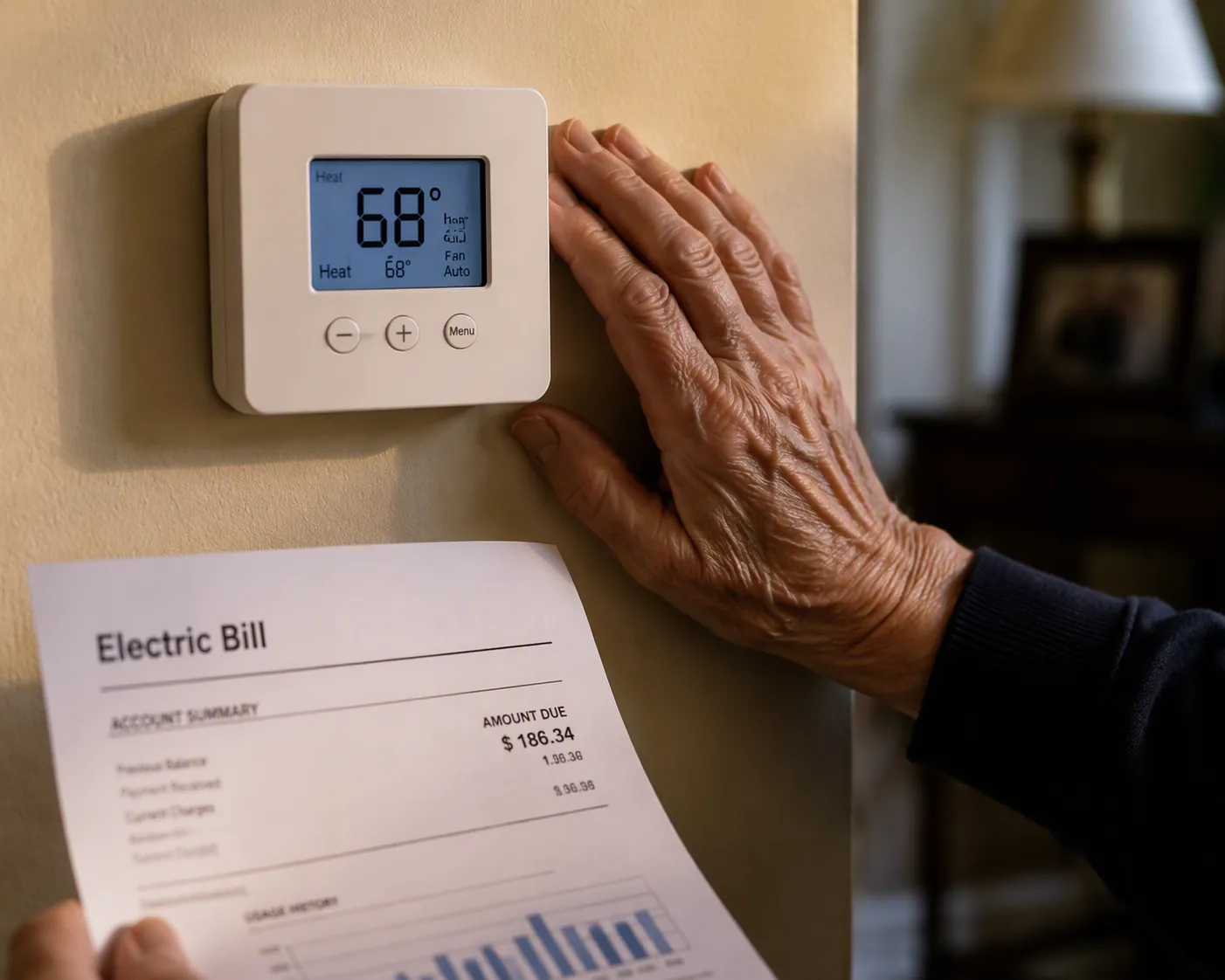
That distinction is important in Q3 2026 because electricity pressure is not imaginary. Utility Dive has reported that rate hikes are outpacing inflation, and AARP’s 2025 polling found that 63% of adults age 50 and older had seen utility bill increases, while 83% were worried about future increases.[1][2] A University of Maryland study published in PNAS found that households headed by adults age 60 and older spent 12.7% of income on energy, rising to 16.9% for the lowest-income senior households.[3]
The danger is what happens after the frightening bill arrives. An older adult may decide to leave the air conditioner off longer, sit in a dim room to avoid turning on lights, or postpone asking for help because “we’ll be fine” feels more dignified than admitting the budget no longer works. Heat risk is not a minor discomfort issue: Yale and CDC-linked reporting has noted that heat-related deaths have risen 50% since 2000, with about three-quarters occurring among people over 65.[4] The CDC also warns that electric fans should not be relied on as the only cooling strategy when temperatures are above 90°F.[5]
Separate unsafe cutbacks from waste
A useful electricity plan starts by sorting every possible action into one of three buckets. This keeps a cost-saving discussion from quietly becoming a health risk.
| Decision | Safe approach | What to avoid |
|---|---|---|
| Cooling | Use air conditioning, shade, ventilation, and assistance programs to keep indoor heat from becoming dangerous. | Do not rely on a fan alone during extreme heat, especially above 90°F. |
| Lighting | Replace inefficient bulbs with LEDs and keep stairs, bathrooms, kitchens, and hallways well lit. | Do not remove bulbs or keep walking paths dark to save a few dollars. |
| Heating | Seal leaks, use weatherstripping, and seek bill help before the home becomes too cold. | Do not use unsafe alternative heat sources or crowd space heaters into risky locations. |
| Appliances and electronics | Unplug standby loads and run appliances strategically. | Do not unplug medical equipment, refrigeration, mobility-device chargers, or safety devices. |
| Bills | Apply for LIHEAP, weatherization, and utility hardship programs early. | Do not wait until the shutoff notice or a health emergency. |
The practical savings target belongs to the whole bundle, not to a single trick. A senior household may be able to lower electricity costs by roughly 10–30% through combined no-cost habits, low-cost fixes under $50, and assistance programs, but that should be treated as an achievable range, not a guaranteed discount. The actual result depends on the home, climate, rate structure, appliance age, health needs, and whether the household qualifies for help.
The no-cost and under-$50 bundle that matters first
The best early steps are the ones that do not require a contractor, a long application wait, or a senior to tolerate unsafe temperatures. They also work better together. Curtains help the air conditioner. Weatherstripping helps both heating and cooling. LEDs protect safe lighting while reducing wattage. Power strips cut electricity that no one is using.
Block heat before paying to remove it
In hot weather, start with windows. Close drapes or curtains on sun-facing windows during the hottest part of the day, especially in rooms where the older adult spends the afternoon. The Department of Energy says medium-colored draperies with white-plastic backings can reduce heat gains by 33% when closed during hot weather.[6] That does not mean curtains replace air conditioning. It means the air conditioner has less heat to fight.
This is a particularly good fix when the household cannot afford major window replacement. Existing drapes, blackout curtains, reflective shades, or even carefully used temporary coverings can reduce afternoon heat gain. The safety test is simple: the room should become more comfortable and easier to cool, not darker in a way that increases fall risk. If a hallway or stair landing becomes dim, add an efficient bulb or night light rather than leaving the path shadowed.
Seal the obvious leaks
Weatherstripping is not glamorous, which is why it is easy to ignore. It is also one of the rare fixes that can be cheap, visible, and useful in both summer and winter. AARP has described weatherstripping as a low-cost improvement that can save 10–20% on energy bills, with materials often costing under $30.[7]
The best places to check first are not mysterious: the front door, back door, door to the garage, window edges, and any place where daylight, dust, or a draft comes through. A caregiver can help by walking the home with the older adult rather than taking over. Point to the draft, choose the product together, and keep the fix reversible when possible. The goal is to make the home easier to heat or cool without making the senior feel as if the house is being “corrected” around them.
Change the bulbs, not the safe lighting
Lighting is where bad frugality shows up quickly. A dark bathroom at 2 a.m. is not an acceptable energy strategy. Replace high-use incandescent bulbs with ENERGY STAR-certified LEDs instead. ENERGY STAR estimates that the average household can save about $225 per year by replacing incandescent lighting with LED lighting.[8]
Prioritize the fixtures that stay on longest or protect movement: kitchen, bathroom, bedroom, hallway, stairway, porch, and any lamp used for reading medication labels. A brighter, efficient bulb is usually a better answer than reminding someone to “turn that off” every time they move through the home. Motion-sensor night lights can also be useful in hallways and bathrooms, as long as they are reliable and placed where the light actually reaches the walking path.
Cut standby power without unplugging care
Standby power is the electricity used by devices that look off but are still drawing power. Lawrence Berkeley National Laboratory has found that standby power can account for up to 10% of home energy use.[9] In a senior household, the easiest targets are usually guest-room electronics, old televisions, cable boxes not in active use, chargers left in outlets, printers, and small kitchen appliances with clocks or indicator lights.
Use a power strip where several nonessential devices live together, such as a television, DVD player, and game console used by visiting grandchildren. Then one switch turns off the group. Do not unplug medical equipment, oxygen concentrators, CPAP machines, refrigerated medications, emergency alert systems, phones, mobility-device chargers, routers needed for monitoring devices, or anything the person depends on for safety. If there is any doubt, leave it plugged in and look for savings elsewhere.
Use the thermostat carefully, not heroically
Thermostat changes can save money, but generic advice to “raise the thermostat” or “lower the heat” is incomplete for older adults. A safer version is to avoid overcooling or overheating unused rooms while keeping occupied areas safe. In summer, close curtains, reduce oven use, and run ceiling fans only as a comfort supplement when conditions are safe. If the room is hot and the temperature is above 90°F, a fan alone is not enough protection.[5]
Adult children should be cautious with smart thermostats, too. A remote setting that looks reasonable on an app may feel very different to an 86-year-old sitting near a sunny window or recovering from illness. If a thermostat schedule is used, the older adult should know how to override it easily. A paper note next to the thermostat can be kinder than another app login.
For a broader fixed-income plan, it may help to place utility increases next to Social Security and housing costs rather than treating the electric bill as a personal failure. CareWise Guide’s explanation of why the 2026 Social Security COLA is lower than expected can help frame that conversation, especially when utility costs are rising faster than the monthly check feels able to absorb.
Assistance programs are not extras
Once the safe, low-cost fixes are underway, the next step is not to wait and hope the next bill is smaller. Federal, state, local, and utility assistance programs exist because energy is a health and housing need, not a luxury. USA.gov directs households to energy assistance resources, including LIHEAP, weatherization help, and utility support options.[10]
LIHEAP can help with bills, but the details are local
The Low Income Home Energy Assistance Program, usually called LIHEAP, helps eligible households with home energy costs. For FY2026, HHS and NEADA materials identify LIHEAP funding at $4.045 billion and describe the program as serving about 6 million households.[11] That reach is large, but it does not mean benefits are automatic or identical everywhere.
Eligibility, benefit amounts, emergency rules, cooling assistance, heating assistance, and application windows vary by state. The safest next step is to check the older adult’s state through the LIHEAP Clearinghouse, then call the state or local administering agency before a shutoff notice arrives. If an adult child is helping, have the senior present for the call whenever possible. Assistance feels less like a loss of control when the older adult is still the person answering questions and making decisions.
It is worth applying even if the household is unsure. Some seniors assume they will not qualify because they own a home, have a small retirement account, or have “never taken help.” Those assumptions may be wrong, and the consequence of not asking can be a hotter room, a colder room, or a skipped medication because money had to move to the utility bill.
Weatherization can lower the bill at the source
The Weatherization Assistance Program, or WAP, is different from a one-time bill credit. It can provide free home energy upgrades for eligible households, and older adults are among the priority groups identified in program materials from NCOA and the Department of Energy.[12][13] Depending on the home and local program, weatherization may address insulation, air sealing, heating and cooling efficiency, and other energy-related improvements.
This matters because some seniors cannot solve high bills with behavior alone. A leaky home, failing cooling system, or poor insulation can punish a careful person every month. Weatherization is slower than changing light bulbs, but it can remove the burden that no amount of thermostat guilt can fix.
If the household is already thinking about aging in place, energy costs belong in the same conversation as grab bars, transportation, property taxes, and care support. A planning tool such as an aging-in-place budget calculator can make the electric bill visible as a recurring safety cost rather than an annoying side expense.
What to do this week
A good first week does not require solving the whole house. It should reduce waste, protect safety, and start any assistance process that may take time.
- Read the last two electric bills together and identify whether the problem is usage, the rate, a past-due balance, or all three.
- Close sun-facing drapes during hot afternoon hours, but keep walking paths and bathrooms well lit.
- Replace the highest-use incandescent bulbs with LEDs first, especially in safety-critical areas.
- Install weatherstripping on the draftiest door or window before buying larger upgrades.
- Put nonessential entertainment electronics on a power strip, while leaving medical, safety, refrigeration, and communication devices alone.
- Check LIHEAP eligibility and application timing through the state program, even if the household is unsure it qualifies.
- Ask the local agency or utility about weatherization, senior discounts, hardship funds, budget billing, and shutoff protections.
The right conversation is not “Can you use less?” It is “What electricity are we paying for that is not keeping you safe or comfortable?” Cut that first. Then apply for help before the home becomes too hot, too cold, or too dark. Seniors can lower electric bills during rate hikes, but the bill is only improved if the person living behind it is still protected.
References
- Electricity Rates Are Rising Faster Than Inflation — Utility Dive, 2026
- AARP Utility Bill Poll — AARP, 2025
- Energy Insecurity among Older Adults — Proceedings of the National Academy of Sciences
- Heat-related deaths are increasing in the U.S. — Yale Climate Connections
- Heat and Older Adults — Centers for Disease Control and Prevention
- Energy Efficient Window Attachments — U.S. Department of Energy
- Weather Stripping Can Save You Money — AARP
- Light Bulbs — ENERGY STAR
- Standby Power — Lawrence Berkeley National Laboratory
- Help with utility bills — USA.gov
- LIHEAP Funding and Program Status — National Energy Assistance Directors Association, FY2026
- Weatherization Assistance Program — National Council on Aging
- Weatherization Assistance Program — U.S. Department of Energy
Browse more in the Glossary.