
Glossary entry
Use a VOO Retire Early Calculator for Aging-in-Place Budgets
Last verified 2026-07-30
This is not financial or legal advice. Medicare/Medicaid and benefits rules vary by state and change over time — verify current rules with your state Medicaid office or Area Agency on Aging.
Most families do not discover the aging-in-place budget in an ETF chart. They find it when a parent’s house needs grab bars, a safer bathroom, a ramp, a stair lift, or paid help at home. A retire early calculator using VOO can still be useful, because it turns a Vanguard S&P 500 ETF-based portfolio into one clean question: how much might this portfolio support each year in retirement?
That gap is not theoretical. In a 2025 University of Michigan poll, 84% of adults 65 and older said they planned to age in place, yet up to 80% had not made home modifications that would help them do it safely.[1] The calculator matters because “staying home” eventually becomes a spending line, not just a preference.

What a VOO retire early calculator actually tells you
A VOO retire early calculator usually starts with a portfolio balance, contribution rate, expected return, retirement age, and withdrawal rule. It then translates the portfolio into an estimated annual spending amount. For aging-in-place planning, that annual spending amount is the useful output—not the exciting chart line.
VOO is often used in these calculators because it is a low-cost S&P 500 ETF. Secondary aggregator data lists VOO’s expense ratio at 0.03%, assets under management around $1.6 trillion, and dividend yield around 1.1%; VOO.us also offers a retirement calculator that compares a dividends-only approach with a 4% total-withdrawal approach.[2] Slickcharts shows VOO’s 2016–2026 compound annual growth rate at about 12.45%.[3]
Those VOO figures are useful for understanding what assumptions may be inside a calculator, but they should not be treated as a promise. The VOO data cited here comes from secondary aggregators rather than Vanguard’s official ETF page, and a strong 2016–2026 return period does not remove the risk of retiring into a bad market. For a care budget, conservative assumptions are not pessimism; they are how you avoid promising a safer home that the portfolio cannot keep funding.
Step 1: Convert the portfolio into a safe annual spending number
The calculator’s first job is to turn a portfolio balance into annual spending. If the portfolio is $1,000,000, a 4% withdrawal rate produces $40,000 in the first year before later inflation adjustments. But the rate you choose depends on the retirement horizon.
| Withdrawal rate | What it means on $1,000,000 | Best use |
|---|---|---|
| 4% | $40,000 per year | A common rule of thumb tied to a 30-year retirement framework; borderline if the retirement could run much longer. |
| 3.9% | $39,000 per year | Morningstar’s 2026 starting safe withdrawal rate for a 30-year retirement, assuming a 30%–50% equity allocation and 90% success probability.[4] |
| 3.5% | $35,000 per year | The upper end of Big ERN-style guidance for longer 40–60 year horizons.[5] |
| 3.25% | $32,500 per year | The more conservative end of Big ERN-style guidance for longer 40–60 year horizons.[5] |
For many aging-in-place plans, the realistic horizon is not just “until retirement starts.” A parent who retires in the mid-60s may need the house and care budget to hold up for 25 to 35 years. Someone using FIRE math in their 40s or 50s may be looking at a much longer horizon. That is where the difference between 4%, 3.9%, and 3.25% becomes expensive.
The original 4% rule is often discussed as if it were a timeless law, but it was built around a 30-year maximum retirement window. Big ERN’s safe withdrawal rate matrix treats longer 40–60 year horizons more cautiously, with rates around 3.25%–3.5% rather than 4%.[5] Morningstar’s 3.9% estimate is also specifically framed around a 30-year retirement, a 30%–50% equity allocation, and a 90% success probability—not a guarantee that a stock-heavy early retirement will cover every late-life care need.[4]
This matters most in the first five years of retirement. If the market falls early and the retiree is also withdrawing money for a bathroom remodel, roof repair, or aide hours, the portfolio can be forced to sell more shares when prices are down. A calculator that assumes a smooth average return can hide that sequence-of-returns risk.
A quick way to choose the rate
- Use 3.9% as a starting point only if the planning period is roughly 30 years and the portfolio mix is reasonably close to Morningstar’s assumptions.
- Use 3.25%–3.5% when the retirement could run 40 years or more, or when the family wants a more conservative stress test.
- Treat 4% as a comparison number, not the default answer, especially if retiring early or expecting large home-safety expenses in the first decade.
- Run the calculator more than once: once with the optimistic number, once with the cautious number, and once with a bad first-five-years assumption if the calculator allows it.
Step 2: Map the annual withdrawal to actual aging-in-place costs
Once the calculator gives an annual spending number, separate it into ordinary living expenses and aging-in-place expenses. The mistake is to say, “The portfolio supports $48,000 a year,” and then forget that $48,000 has to cover groceries, insurance, property taxes, utilities, transportation, medical out-of-pocket costs, home maintenance, and the changes that make the house safer.
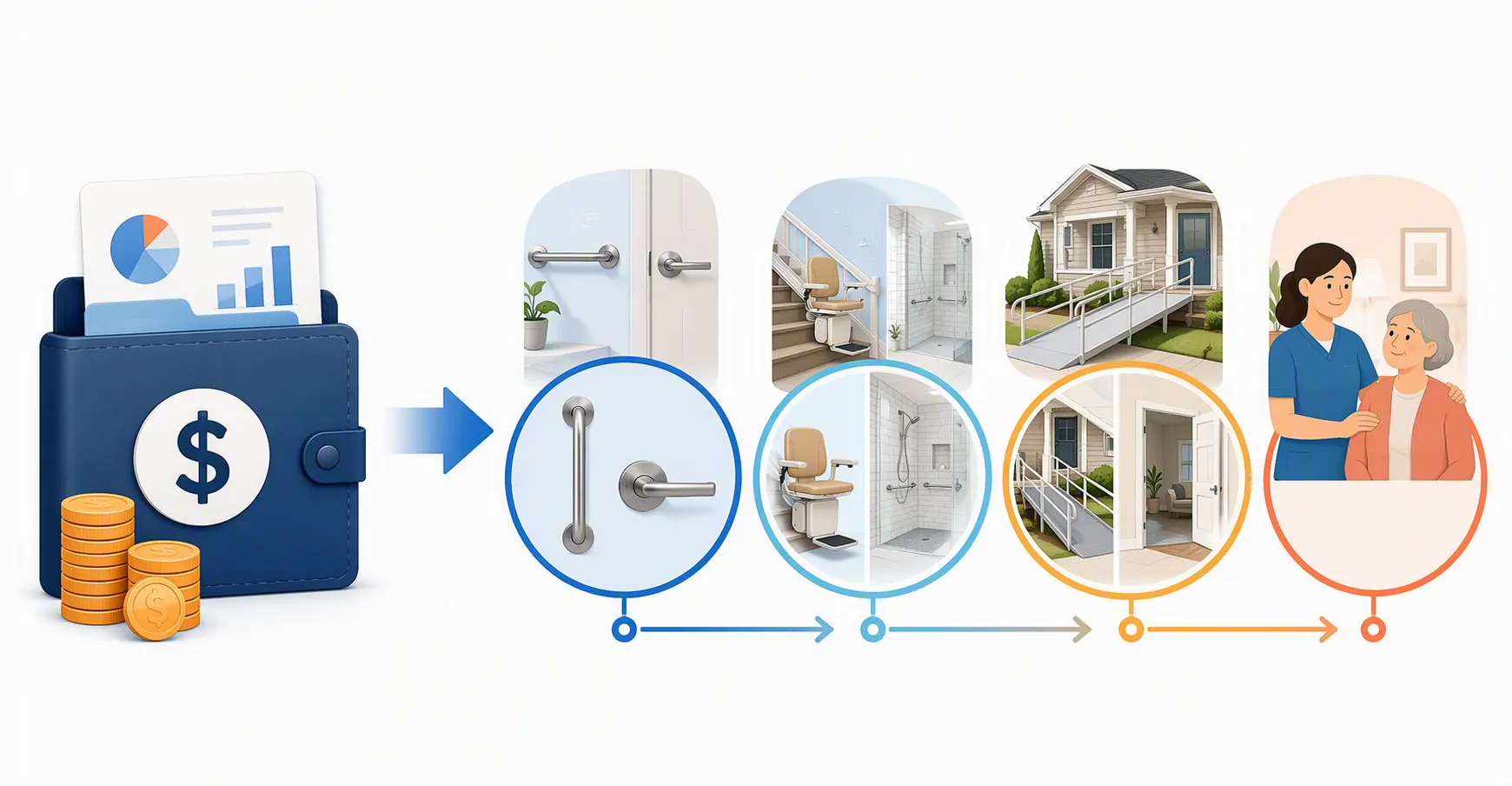
| Cost category | Typical items | Published cost ranges |
|---|---|---|
| Low-cost safety upgrades | Grab bars, lever handles, lighting, non-slip changes | Grab bars can range from $25 to $500 each, depending on product and installation.[6] |
| Mid-range modifications | Stair lift, safer shower, bathroom changes | Stair lifts are commonly cited around $2,500–$12,000; bathroom modifications can run $6,000–$15,000 or more.[6][7] |
| Structural access work | Entry ramp, widened doorway, larger remodel | Entryway ramps are cited around $875–$1,750; larger structural renovations can reach $10,000–$50,000 or more.[6][8] |
| In-home aide support | Help with bathing, dressing, meal preparation, supervision, respite | In-home aide costs are commonly discussed in the $4,000–$8,000+ per month range.[8] |
These are national cost ranges, not contractor bids. Region, home age, permitting, labor availability, whether plumbing or electrical work is involved, and whether the work must happen quickly after a fall can all change the final price. A $500 grab bar conversation is not the same as a $15,000 bathroom conversation, and neither is the same as paying for aide hours every month.
A simple care-budget test
Use the calculator output as a ceiling, then work backward. Suppose a hypothetical parent’s VOO-based retirement calculation supports $39,000 per year using a 3.9% withdrawal rate. If ordinary expenses already require $34,000, only $5,000 remains for home-safety work, repairs, transportation gaps, and care support. That could cover some low-cost changes, but it will not comfortably absorb a stair lift, major bathroom modification, and several months of paid aide help in the same year.
Now change the rate. The same $1,000,000 portfolio at 3.25% supports $32,500 in first-year spending. If ordinary expenses are still $34,000, the plan is already underfunded before a contractor enters the house. That is the kind of result worth finding in a calculator, because it gives the family time to adjust before the hallway, bathroom, or front steps become an emergency.
Step 3: Run what-if scenarios before the house forces the decision
A good retire early calculator is less useful as a one-time answer than as a testing tool. Change the retirement age, withdrawal rate, expected return, and care-cost reserve. Then look at what happens to the annual amount available for home access and support.
Earlier retirement versus working longer
The Motley Fool ran a VOO example in which retiring at 60 with $1.2 million would produce about $48,000 per year under a 4% rule. In the same case study, working five more years while contributing $2,000 per month grew the projected portfolio to about $1.6 million, supporting about $64,000 per year under the same 4% rule.[9]
That example should not be read as a forecast for every investor. It does show the household-budget consequence of time: the extra working years may create more room for care costs, and they may also shorten the number of years the portfolio has to support withdrawals. For an adult child helping a parent, the same logic can apply to delayed Social Security claiming, part-time work, downsizing, or postponing discretionary spending—not because any one move is painless, but because the accessible-house budget has to come from somewhere.
Dividends-only versus total withdrawal
Some calculators, including VOO.us, compare living only on dividends with using a total-return withdrawal rule such as 4%.[2] The distinction matters for home care. With a dividend yield around 1.1%, a $1,000,000 VOO position would produce about $11,000 in annual dividends before taxes. That may help with routine expenses, but it is unlikely to cover ordinary living costs plus meaningful aging-in-place work by itself.[2]
A total-withdrawal approach can provide more spendable cash, but it also means selling shares or drawing from the portfolio during some years. That is why the withdrawal rate and the first-five-years risk matter. Paying for a ramp after a market decline is not emotionally or financially the same as paying for it after a strong year.
One-time remodel versus recurring aide hours
Home modifications often feel expensive because the invoice is visible. Paid care can be harder to plan for because the cost repeats. A $12,000 stair lift may be painful once; $4,000 to $8,000 or more per month for in-home aide support can change the entire retirement withdrawal plan.[7][8]
When testing the calculator, create separate lines for one-time projects and recurring care. A cautious version of the plan might reserve cash for near-term modifications so the portfolio is not forced to sell during a downturn, while using the safe withdrawal amount for ongoing expenses. The exact structure belongs in a personalized financial plan, but the categories should be separated before the family decides that the retirement number “looks fine.”
Step 4: Decide what to do if the calculator shows a gap
If the safe annual spending number does not cover both normal expenses and realistic home-safety costs, the answer is not to pretend VOO will repeat its best decade. The practical choices are narrower and more uncomfortable:
- Lower the withdrawal rate and reduce discretionary spending.
- Delay retirement or increase contributions if the older adult is still working.
- Create a separate cash reserve for near-term safety modifications.
- Prioritize fall-risk items first: bathroom safety, entry access, lighting, flooring hazards, and stair use.
- Look for grants, loans, nonprofit help, or local assistance before using long-term portfolio money for every project.
- Compare the cost of a major remodel with assisted living if the house requires extensive work and paid care is already likely.
CareWise Guide has next-step resources for each of those situations. If Medicare will not cover the modification, start with 7 Funding Sources for Home Modifications When Medicare Won't Pay. For a broader list of assistance options, use Where to Find Money for an Aging-in-Place Remodel: Grants, Loans, and Assistance Programs (2026).
If the money is available but the project is complicated, read How to Choose an Aging-in-Place Contractor and Avoid Costly Mistakes. If the calculator shows that the family needs outside help, review the Habitat for Humanity Aging in Place Program: A Complete Guide. And if the required remodel plus monthly care would consume too much of the portfolio, compare the numbers in Aging in Place Remodel Cost vs. Assisted Living: A Complete Decision Guide.
The number to take seriously
A retire early calculator using VOO is helpful when it produces a number the family is willing to test against real invoices. The portfolio balance is only the first input. The safer question is: after choosing a withdrawal rate that matches the retirement horizon, how much annual spending remains for the home changes and care hours that keep someone safely at home?
This article is for educational planning only and is not financial advice. Withdrawal rates, taxes, asset allocation, Social Security timing, long-term care needs, and home equity decisions are personal. Before making retirement or investment decisions, consult a licensed financial advisor who can model your full situation.
References
- University of Michigan 2025 poll on aging in place, University of Michigan, 2025
- VOO Retirement Calculator, VOO.us
- VOO Annual Returns by Year, Slickcharts
- What's a Safe Retirement Withdrawal Rate for 2026?, Morningstar
- Safe Withdrawal Rate Calculator & 2026 Matrix, InvestingFIRE
- How Much Do Home Modifications Cost for Aging in Place?, ElderLife Financial
- How Much Do Stair Lifts Cost in 2025?, NCOA
- How Much Should You Spend on Aging in Place?, Schmocker Financial
- I Ran the Numbers on Retiring 5 Years Early With VOO, The Motley Fool, 2026-07-24
Browse more in the Glossary.