
Clinical term
Signs of Depression in Elderly Parents That Aren't Sadness
Last verified 2026-08-04
Yes: an elderly parent can be depressed without seeming sad. The signs of depression in elderly parents often show up as fatigue, stomach trouble, pain, poor sleep, appetite change, irritability, withdrawal, slower movement, foggy thinking, or a shrinking daily routine. The Centers for Disease Control and Prevention lists sadness or hopelessness as possible symptoms, but it also includes loss of interest, sleep and appetite changes, low energy, irritability, concentration trouble, and thoughts of suicide or self-harm.[1] Clinical guidance on late-life depression also emphasizes that older adults may present with fatigue, aches, gastrointestinal complaints, appetite or weight loss, poor hygiene, flat affect, slumped posture, and frequent medical visits rather than saying, “I feel depressed.”[2]
The working rule is simple, but it is not a home diagnosis: if a change lasts around two weeks, affects daily function, or raises safety concerns, it deserves professional assessment. The National Council on Aging and Brown University Health both describe the two-week frame and use two plain screening questions as a starting point: has the person felt down or depressed, and has the person lost interest or pleasure in usual activities?[3][4] Those questions can open a conversation. They cannot decide the diagnosis.
Treat suicidal talk, talk of self-harm, or a specific plan as urgent. In the U.S., call or text 988 for the Suicide & Crisis Lifeline, call 911, or go to the nearest emergency department if there is immediate danger. Older adults have higher rates of death by suicide, and a parent who says they are a burden, wants to die, or has no reason to live should not be left alone while everyone waits to see if it passes.[1]
What makes late-life depression easy to miss
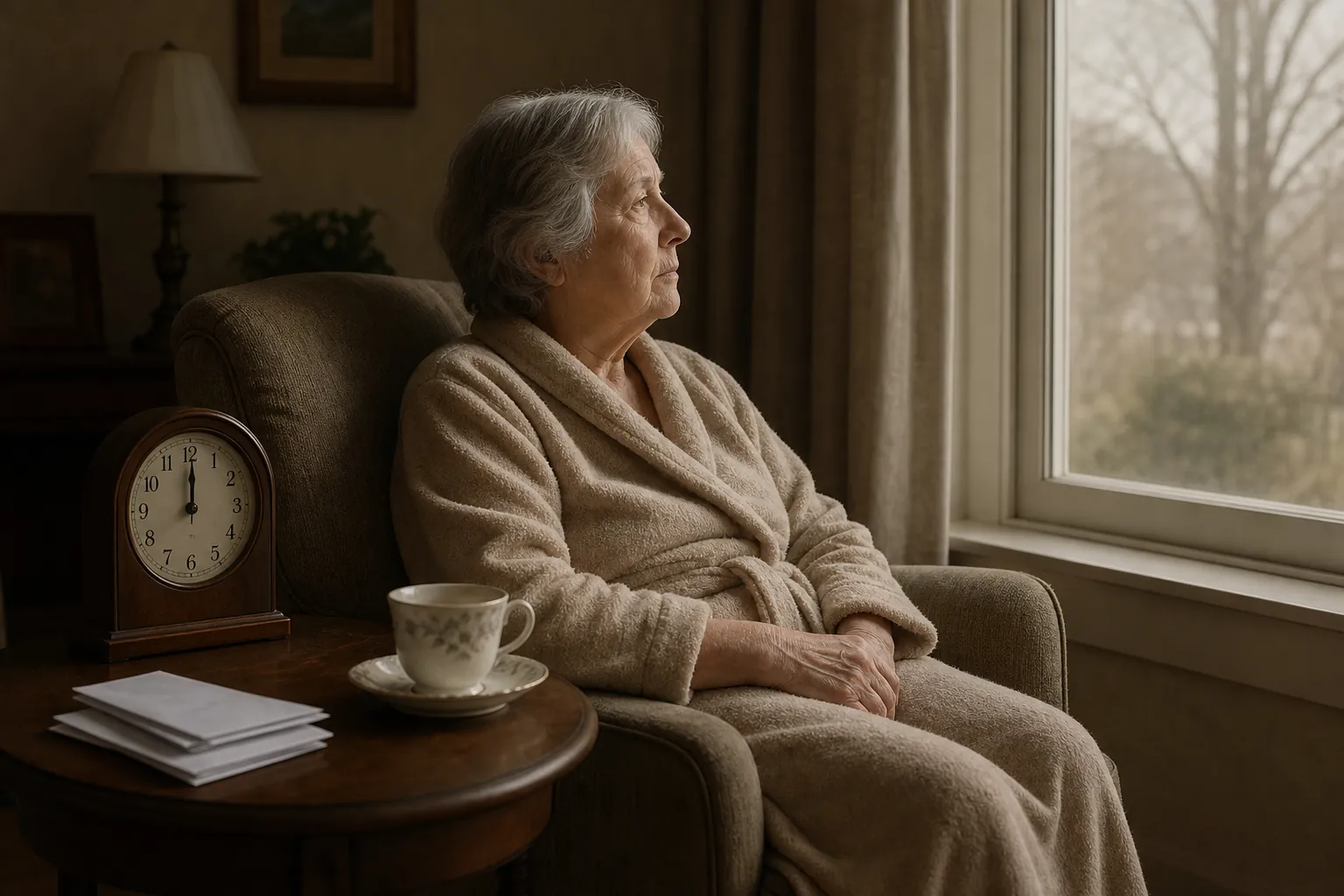
Families are often looking for tears. What they get instead is an unopened stack of mail, the same robe at noon, a parent who no longer wants visitors, or another appointment for vague stomach pain. That mismatch is where depression hides.
Depression is not a normal part of aging. It is also not rare enough to dismiss. The CDC estimates that about 4% of adults age 70 and older have depression, while NCOA summarizes CDC-cited estimates of major depression as 1% to 5% among community-dwelling older adults, 11.5% among hospitalized older adults, and 13.5% among older adults receiving home health care.[1][3] Those numbers vary because the populations and definitions vary. The practical point is narrower and more useful: when an older parent’s daily life noticeably contracts, “they’re just getting old” is not an adequate explanation.
11 signs of depression in elderly parents that may not look like sadness
1. They stop enjoying familiar things
This may be quieter than refusing every invitation. A parent still sits through church, a card game, a grandchild’s visit, or a favorite show, but the pleasure is gone. They do not talk about it afterward. They say, “It was fine,” and move on. They may keep the calendar empty because “it’s too much trouble,” not because they are openly sad.
Families misread this as normal slowing down because older adults do give up some activities for real reasons: pain, vision changes, driving limits, hearing loss, fatigue, grief, or cost. The difference is the narrowing. If the parent is losing interest across several parts of life—not just one activity that became physically difficult—write down what stopped, when it stopped, and what they say when invited.
A useful next step is to ask one low-pressure question: “Are you still enjoying the things that used to feel good to you?” If the answer is no, vague, or unusually irritated, include that when you call the primary-care office.
2. Fatigue, aches, or stomach complaints become the main story
Depression in an older parent may arrive as “I’m tired,” “my stomach is off,” “my back hurts,” or “I just don’t feel right.” The complaints may be real, repeated, and distressing. They may also move around: headache one week, bowel trouble the next, heavy limbs after that. Guidance on recognizing late-life depression specifically notes that older adults may present with fatigue, pain, gastrointestinal symptoms, appetite change, and weight loss rather than depressed mood.[2]
This is one of the places where families should resist two opposite mistakes. Do not wave away the symptoms as “just depression.” Pain, constipation, medication side effects, dehydration, infection, thyroid problems, anemia, heart disease, and other medical conditions can change mood and energy. But do not let repeated “normal” test results end the conversation either. If the body complaints keep bringing your parent to the doctor while life at home keeps shrinking, ask directly whether depression screening is appropriate.
Before the visit, make a short symptom timeline: complaint, date it started, what changed at home, new medications, missed meals, sleep changes, and any falls. A clinician can use that better than a general report that “Mom just isn’t herself.”
3. Sleep changes start to reshape the day
Some depressed older adults sleep far more than they used to. Others wake at 3 a.m., nap in a chair all afternoon, or complain that they were “up all night” but cannot explain why. Sleep changes are part of the CDC’s symptom list for depression.[1]
The home evidence matters: curtains still closed late in the morning, breakfast untouched, skipped medications because they woke too late, dozing through calls, or anxiety that spikes at night. Ordinary aging can change sleep, but a new sleep pattern that drags meals, hygiene, appointments, or safety along with it is more concerning.
Track sleep for one week if you can: bedtime, wake time, naps, nighttime wandering, alcohol use, caffeine, pain, and whether they seem rested. Bring the notes rather than trying to reconstruct the pattern in the exam room.
4. Eating changes, weight change, or “nothing tastes good” appear
Depression can change appetite and weight.[1] At home, that may look like spoiled groceries, the same crackers for dinner, a refrigerator full of food from family that was never opened, or a parent who says cooking is “not worth it.” Some older adults eat more, especially sweets or simple foods, but the more common family alarm is weight loss or a sudden lack of interest in meals.
Families often explain this away because appetite can change with dental problems, taste changes, medications, grief, loneliness, or difficulty shopping. Those are not competing explanations; they are reasons to get a fuller assessment. A parent who is eating poorly may become weaker, more constipated, more dizzy, and less able to move safely around the house.
The next step is practical: check the kitchen. Look for expired food, missing staples, uneaten delivered meals, alcohol use, and whether meal preparation has become too demanding. Tell the clinician what you saw, not just that appetite is “bad.”
5. Irritability replaces sadness
An older parent may sound sharp, impatient, suspicious, or impossible to please. They may snap at offers of help, end calls quickly, complain about small inconveniences, or seem offended by ordinary questions. Irritability is included among depression symptoms by the CDC.[1]
This sign is easy to miss because family history gets in the way. If a parent has always been blunt, adult children may assume nothing medical is happening. If the parent used to be gentle, the change may be blamed on “getting mean with age.” What matters is the shift from their baseline and what comes with it: less patience, fewer calls, more refusals, less bathing, worse sleep, or repeated complaints of not feeling well.
Do not argue about whether they are being rude. Try: “You seem more on edge lately, and I’m worried something is making life harder.” Then name one or two specific changes. Specifics lower defensiveness and help the doctor later.
6. They withdraw, cancel, or become emotionally flat
Withdrawal may look like silence more than sadness. The parent no longer answers the phone, lets calls go to voicemail, stops returning texts, cancels lunch, or sits through visits with little expression. Clinicians may notice flat affect, slumped posture, poor hygiene, and frequent healthcare use in older adults with depression.[2]
Loneliness, hearing loss, transportation problems, grief, and mobility limits can all lead to withdrawal. That is why the question is not “Is this depression or something else?” The better question is “What changed, and what support or assessment is needed?” A parent who stopped going out because stairs hurt needs help. A parent who stopped going out because nothing feels worth doing also needs help. Often both are true.
Start with one low-demand visit or call at a predictable time. If they refuse, note the refusal without turning it into a family trial. A pattern of cancellations is information.
7. Hygiene, mail, bills, or medications begin to slide
Depression often becomes visible in maintenance tasks. The robe stays on all day. Laundry piles up. The pill organizer is half full on Friday. The mailbox is stuffed. Bills are unopened. The house is not dirty in a dramatic way; it is just neglected in places your parent used to manage.
Families may call this laziness, stubbornness, or aging. It may also be pain, vision loss, cognitive impairment, medication confusion, financial fear, or fatigue. The functional impact is the important part. When self-care and household care slip together, the parent’s health risks rise even if no one has named the mood problem yet.
Take photographs only if your parent would not feel shamed by that; otherwise, write down concrete examples. “Three unpaid utility bills on the table” is more useful than “the house is a mess.” Bring the medication bottles or an updated medication list to the appointment.
8. Movement slows, posture changes, or everything takes effort
Depression can show up in the body’s pace. Your parent may walk more slowly, sit slumped, speak less, take longer to answer, or seem weighed down by ordinary tasks. This can be mistaken for frailty because it looks physical. Sometimes it is physical. Sometimes depression is part of what is making the body seem so heavy.
The normal-aging contrast is not speed; many older adults move more slowly than they did at 50. The concern is a noticeable change from the parent’s usual pace, especially when it arrives with poor sleep, reduced appetite, canceled activities, or low energy. Slumped posture and low energy are among the observable cues and symptoms described in late-life depression guidance.[1][2]
Ask what feels hard now: getting out of bed, bathing, walking to the mailbox, cooking, standing from a chair. That answer helps separate pain, weakness, fear of falling, and loss of motivation—without forcing you to decide which one is “the real cause.”
9. They seem foggy, forgetful, or unable to concentrate
This is where families get scared, and reasonably so. Depression can affect concentration, decision-making, processing speed, and memory. NCOA notes that cognitive deficits are estimated in 20% to 50% of older adults with depression.[3] A parent may repeat questions, lose track of bills, stare at a form without completing it, or say, “I can’t think.”
Do not use this sign to reassure yourself that it is “just depression.” Families cannot reliably separate depression, dementia, medication effects, delirium, grief, sleep deprivation, and medical illness at the kitchen table. Depression can mimic cognitive decline, worsen existing cognitive problems, or live alongside dementia. The safest path is assessment.
If you are comparing what you see with dementia warning signs, use that only to organize observations. A guide such as 10 signs of cognitive decline in an aging parent’s home can help you notice patterns, but it should not become a private diagnosis. Bring examples: missed payments, repeated medication errors, getting lost, new confusion, or trouble following familiar recipes.
10. They talk about being a burden, death, or having no purpose
Some comments sound passive: “You’d be better off without me,” “I’m no use anymore,” “I’m ready to be done,” or “There’s no point.” Do not dismiss these as dramatic, religious, generational, or attention-seeking. Thoughts of suicide or self-harm are part of the CDC’s depression symptom list, and a specific self-harm plan is an emergency.[1]
Ask directly and calmly: “Are you thinking about hurting yourself?” This does not plant the idea. It gives you information. If they say yes, mention a method, have access to lethal means, or cannot agree to stay safe, call 988, 911, or emergency services. Stay with them or arrange for another responsible person to stay until help is in place.
11. New falls, near-falls, or fear of walking appear
A fall may seem far from depression, but mood and mobility are connected. A clinical review describes depression as an independent risk factor for falls in older adults and emphasizes the complex interplay among depression, falls, fear of falling, activity restriction, and functional decline.[5]
At home, this may look like furniture-walking, avoiding the shower, refusing stairs, staying in one chair all day, or saying they are “too tired” to go out. Sometimes the fall came first and fear followed. Sometimes depression reduced activity, which weakened balance and confidence. Sometimes medications, blood pressure changes, vision, pain, or dementia are involved. The point is not to choose one cause; it is to treat a new fall or mobility decline as a medical and home-safety signal.
After any new fall, near-fall, or sudden mobility decline, ask for a fall-risk review and a medication review. If dementia or emotional distress is already part of the picture, the mood-and-fall connection is worth reading alongside dementia emotional challenges and fall risk.
Depression, dementia, grief, and frailty overlap more than families want them to

The hard part is that the same home evidence can point in several directions. A parent who stops cooking may be depressed, developing dementia, afraid of falling, grieving, unable to stand long enough at the stove, or confused by a new medication. A parent who repeats questions may be anxious, sleep-deprived, depressed, cognitively impaired, or medically ill.
Clinicians do not always treat these as cleanly separate boxes either. MultiCare notes that depression and dementia can look alike in aging parents and encourages medical evaluation rather than guessing at home.[6] The practical sequence many families hear is: assess for depression and medical contributors, treat what is treatable, then reassess cognition. That does not mean cognitive symptoms are harmless. It means untreated depression can cloud the picture.
Grief deserves similar care. After a death or major loss, sadness, disrupted sleep, reduced appetite, and withdrawal may be understandable. But when symptoms persist around two weeks or more, deepen, include hopelessness or self-harm thoughts, or impair basic function, professional assessment is appropriate rather than assuming grief explains everything.[3][4]
What to do when you notice the pattern

Start with a conversation that does not put your parent on trial. Penn State Health suggests leading with concern, such as, “I’ve noticed you don’t seem like yourself lately. I’m worried about you,” and normalizing depression as a medical condition rather than a personal failing.[7] MultiCare similarly emphasizes approaching the parent with care rather than blame.[6]
Then describe what you have seen. Not “You’re depressed.” Try: “You’ve canceled bridge three times, you’re sleeping until noon, and the mail is piling up.” Or: “You’ve had stomach complaints for a month, but the tests didn’t explain why you’re barely eating.” The more concrete you are, the less the conversation depends on whether your parent accepts the word depression.
- Ask about mood and enjoyment: “Have you felt down?” and “Are you still enjoying the things you usually enjoy?”
- Ask about safety: “Have you thought about hurting yourself?”
- Ask what feels hardest right now: getting up, eating, bathing, walking, sleeping, thinking clearly, or being around people.
- Ask permission to help schedule a primary-care, geriatric, or mental-health appointment.
At the appointment, bring a medication list, recent changes, your notes, and any safety concerns. Penn State Health describes a medical visit for late-life depression as including attention to medication effects, vitamin B12, thyroid problems, depression screening, cognitive testing when needed, counseling such as cognitive behavioral therapy, and cautious medication prescribing in older adults using the geriatric principle of “start low and go slow.”[7]
If your parent refuses help the first time, that is not the end of the road. Revisit it gently. Offer a smaller step: a routine checkup, a medication review, a visit for sleep, or a conversation with a trusted clinician. Depression can make initiative feel impossible, so “call me when you’re ready” may be too much. A specific offer—“I can drive you Tuesday morning”—is kinder and more useful.
Also notice what this worry is doing to you. Watching a parent fade, snap, fall, refuse food, or deny anything is wrong can wear down even a steady caregiver. If your own sleep, patience, health appointments, or work are starting to give way, use caregiver support early rather than waiting for collapse; resources on matching caregiver burnout symptoms to respite options can help you name what kind of relief you need.
The safest handoff is this: recognize the pattern, treat urgent risk as urgent, describe observable changes, ask for professional assessment, and do not let depression disappear under the label of normal aging. If cognition is part of the concern, take it seriously—but expect depression and medical contributors to be assessed and addressed before anyone assumes the first explanation is the final one.
References
- Depression and Aging, Centers for Disease Control and Prevention.
- Recognizing Depression in the Elderly: Practical Guidance and Challenges for Clinical Management, Neuropsychiatric Disease and Treatment.
- How Common is Depression in Older Adults?, National Council on Aging.
- Spotting Depression in Older Adults, Brown University Health.
- The Complex Interplay of Depression and Falls in Older Adults, American Journal of Geriatric Psychiatry.
- Depression or dementia? How to know the signs and care for aging parents, MultiCare.
- The Medical Minute: How can I help my aging parent with depression?, Penn State Health, June 2026.
Browse more in the Glossary.