
Caregiver decision guide
Dementia Emotional Challenges Directly Raise Fall Risk
Learn how dementia-related emotional challenges like agitation, sundowning, and wandering directly increase fall and injury risk at home, and get practical steps to prevent emergencies by addressing emotional triggers as safety interventions.
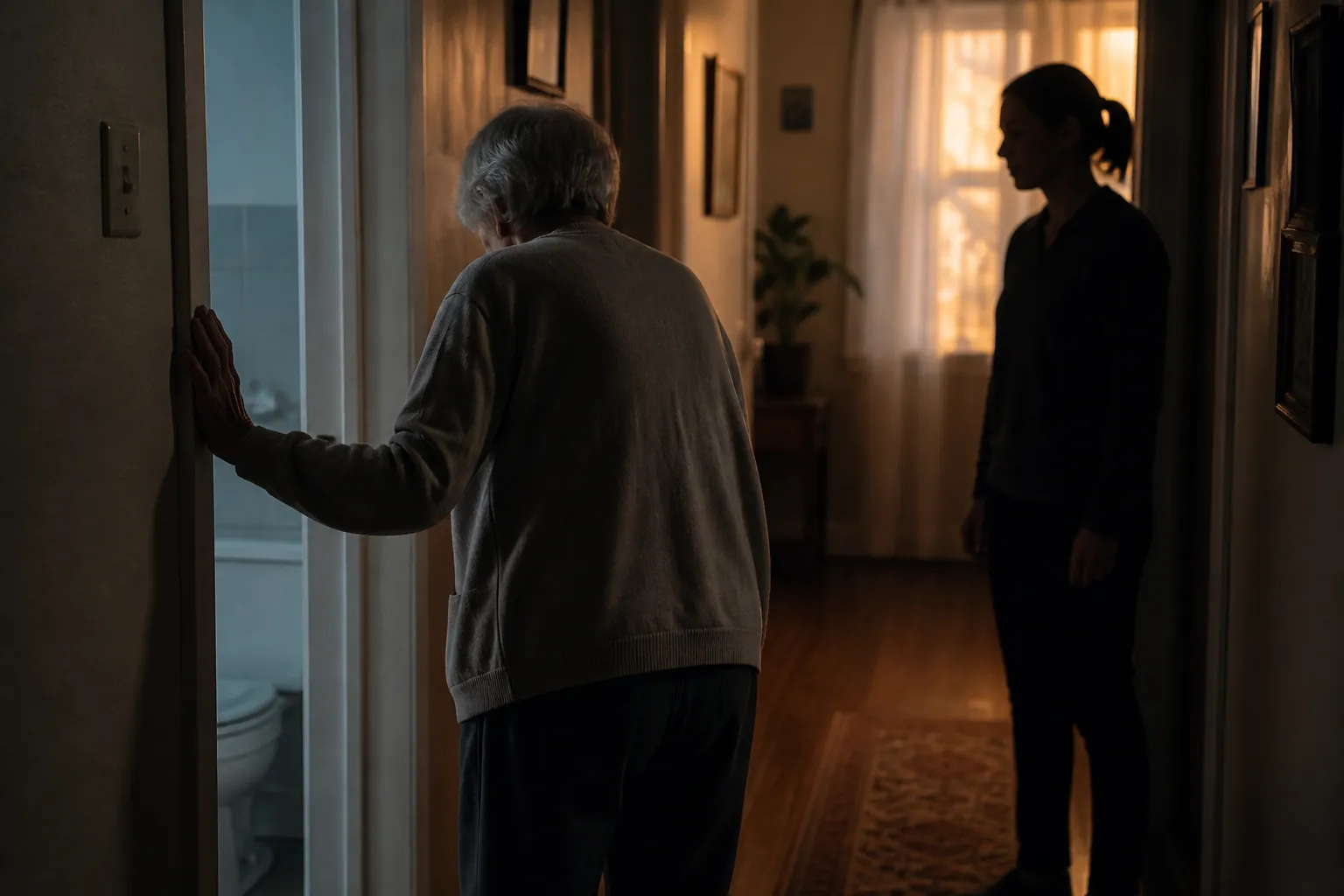
The moment that changes the caregiving math is usually ordinary. A parent refuses to stand up from the toilet. Or insists at 5:40 p.m. that she has to “go home.” Or pulls away from the shower because the water, the mirror, the undressing, or the noise suddenly feels threatening. At that point, the emotional challenge is no longer separate from fall prevention. The fear, confusion, anger, or refusal changes how the body moves next.
That is the practical answer to how to support a parent with dementia emotional challenges: treat the emotion as safety information. Not every upset moment is an emergency. But agitation, sundowning, wandering, aggression, and care refusal each create a different physical risk pattern at home. The safer response is not just kinder; it often reduces rushing, grabbing, wet-floor transfers, dark hallway trips, and door exits.
The behavior tells you where the fall risk is
Dementia behaviors are often grouped together as “challenging,” which is emotionally accurate but not very useful when someone is halfway out of a chair. A refusal to bathe, a late-day burst of confusion, and an angry shove do not create the same danger. They ask for different spacing, lighting, timing, and help.
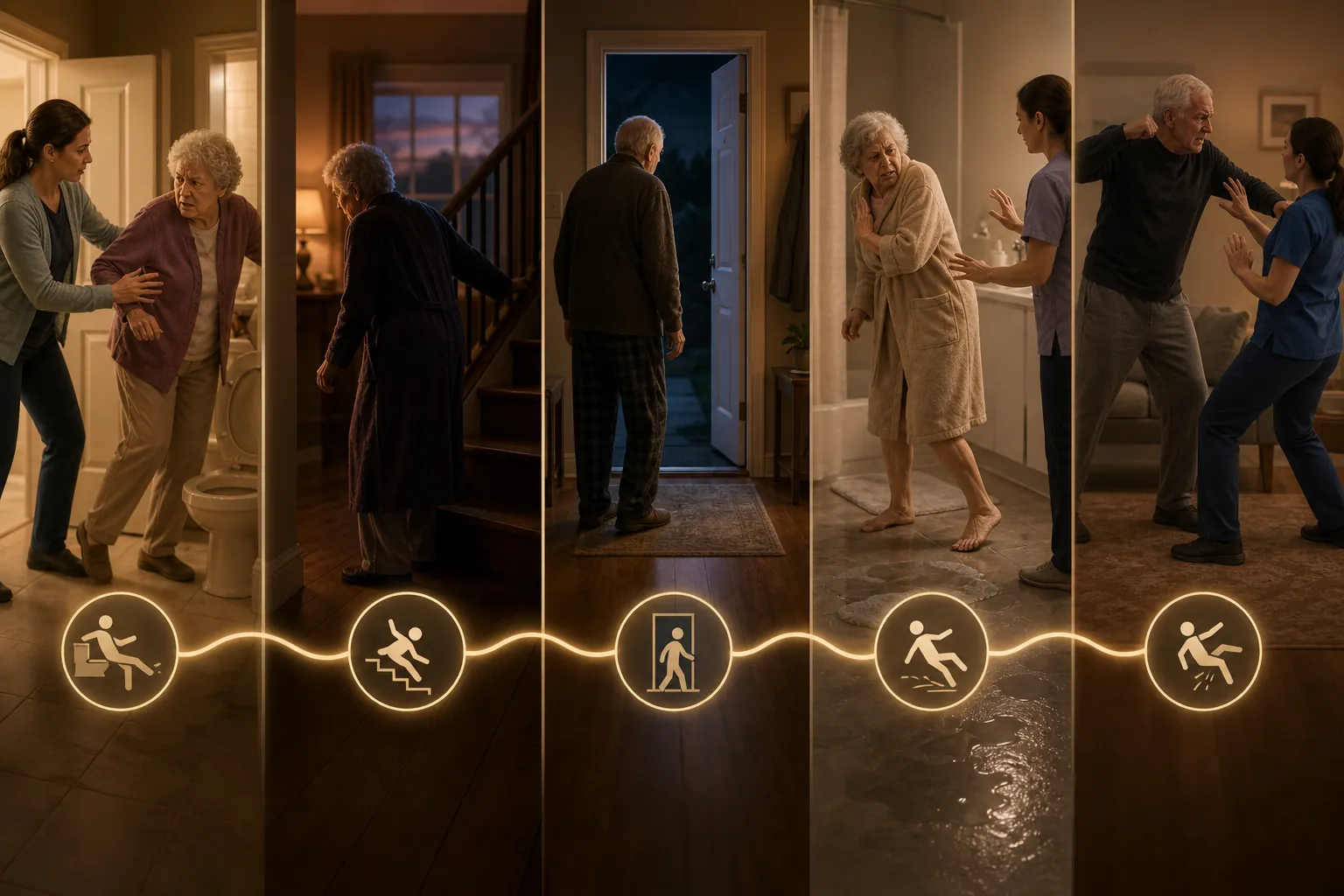
| What you see | Where the physical risk usually appears | First safety move |
|---|---|---|
| Agitation during toileting, dressing, or transfers | Rushing, pulling, grabbing furniture or the caregiver, losing balance while half-standing | Pause the task, lower the demand, stabilize the environment before trying again |
| Sundowning or late-day confusion | Dark hallways, shadows, bathroom trips, stairs, disoriented walking | Turn lights on before sunset and simplify the evening route |
| Wandering or “I need to go home” | Doors, steps, uneven ground, traffic, darkness, weather | Block the unsafe exit path without cornering the person, redirect to a seated or well-lit activity |
| Bathing or dressing refusal | Wet floors, slippery transfers, twisting, exposed skin increasing embarrassment and panic | Switch to a lower-risk version of the task, such as a towel bath or familiar dressing routine |
| Aggression or threatening movement | Close-contact injury to the caregiver or parent, falls during restraint or blocking | Step back, create space, remove hazards, and call for help if safety is unstable |
This is why a basic home-safety checklist is necessary but incomplete. Grab bars, better lighting, dry floors, and clear walkways matter. But if the parent becomes frightened by the bathroom at the exact time a transfer is needed, the risk is not only the bathroom. It is the emotion plus the movement.
Agitation turns routine transfers into rushed transfers
Agitation during toileting, bathing, dressing, or getting out of a chair changes the pace. A caregiver starts hurrying because the parent is upset. The parent reaches for the towel bar instead of the grab bar. Someone pulls before both feet are planted. A hip is still twisted. A walker is two inches too far away. That is how an emotional episode becomes a fall mechanism.
The safer move is often to stop trying to complete the task for a minute. That can feel wrong when the parent is half-dressed or the bathroom is cold. But a rushed transfer is usually more dangerous than a delayed one. Put the walker close, move the bathmat, dry the floor, warm the towel, reduce extra voices, and restart with one instruction rather than a stream of corrections.
Sundowning makes familiar space less familiar
Sundowning is commonly described as restlessness, confusion, agitation, or distress that worsens later in the day. Family Caregiver Alliance links late-day behavior changes with factors such as fatigue, disrupted sleep-wake rhythms, and environmental changes including shadows and lower light.[1]
In the house, that means the hallway that was fine at noon may not be fine at dusk. The bathroom doorway looks different. A dark window reflects like a person. A patterned rug becomes a patch of unclear ground. The parent who could walk to the kitchen at breakfast may hesitate, drift, or move too quickly late in the day.
Lights should go on before sunset, not after the parent is already unsettled. Evening routines should get quieter, not busier. Caffeine and sugar later in the day are worth reducing when they seem to feed restlessness. A predictable late-day activity, even a simple folded-towel task or familiar music in a well-lit room, can be a safety measure because it reduces wandering movement through shadowy spaces.[1]
Wandering adds doors, steps, weather, and darkness
When a parent says “I need to go home,” correcting the address rarely solves the safety problem. The felt need may be real even when the facts are wrong. The danger is the route: the exterior door, porch step, driveway slope, uneven sidewalk, night air, or traffic. Wandering and exit-seeking deserve a different level of attention because the fall risk can leave the controlled space of the home.
The Alzheimer’s Association advises preparing for wandering risk with practical steps such as identifying the most likely times of day, keeping routines structured, and making the home safer against unsafe exits.[2] For caregivers deciding whether an outing is still reasonable when late-day confusion or exit-seeking is active, a more specific risk check belongs in the plan; our dementia outing decision guide can help frame that decision.
Bathing and dressing refusal is often fear, not stubbornness
Bathing refusal can look like defiance from the doorway. Up close, it is often fear, embarrassment, cold, pain, loss of control, or confusion about what is being asked. Family Caregiver Alliance recommends preserving familiar bathing routines when possible, considering towel baths, and never leaving a person with dementia unattended in the bath or shower.[3]
That advice is not just about dignity, though dignity matters. It is also fall prevention. A frightened person may twist away on a wet floor, sit before the chair is behind them, grab the shower curtain, or step over a tub edge without enough balance. If the shower is the dangerous part today, the safer care plan may be a towel bath at the sink, clean clothes, dry feet, and another attempt later.
In the next few minutes, lower the trigger before you move the body
During an emotional episode, the order matters. If the caregiver tries to move the parent first, the parent may resist harder. If the caregiver lowers the trigger first, the next physical action is often safer. This does not mean giving up on hygiene, medication, toileting, or sleep. It means the safest path to the task may be indirect.
- Reduce the trigger: lower noise, stop correcting, cover the mirror if it frightens the parent, warm the room, close the door for privacy, or remove extra people from the space.
- Reduce movement risk: dry the floor, bring the walker close, turn on lights, clear the route, lock unsafe exits if needed, and avoid stairs during the unsettled period.
- Simplify the next action: ask for one small movement, such as “sit here,” “hold this rail,” or “put this arm in,” rather than explaining the whole task.
- Decide if the situation has crossed into danger: call for help if there is physical aggression, an attempted unsafe exit, a fall, chest pain, severe distress, sudden confusion, or a behavior change that may reflect illness or medication effects.
Validation-based communication fits here because it gives the caregiver something safer to say while the body is still at risk. Naomi Feil developed validation therapy between 1963 and 1980 as an approach that focuses on acknowledging the feelings of older adults with cognitive impairment rather than arguing them back to factual accuracy.[4] It is not a guarantee that a parent will calm down. It is a first move that reduces the chance of turning fear into a tug-of-war.
If a parent says, “I have to go home,” the safety response is not, “You are home. We’ve lived here for years.” A safer response may be, “You want to feel safe at home. Let’s sit by the lamp while I get your sweater.” The belief is not corrected. The feeling is named. The next movement is seated, lit, and slower.
If a parent refuses the shower, the safer response may be, “This feels too cold and too much right now. We can wash your face and hands here.” Then the caregiver swaps the transfer into the tub for a towel, a chair, and dry floor contact. Emotional support has changed the fall exposure.
Harvard Health’s 2026 guidance on coping with dementia-related behavior changes similarly emphasizes patience, reassurance, avoiding confrontation, and adjusting expectations during difficult moments.[5] The useful part at home is not a perfect script. It is the habit of asking, “What demand can I lower so the next step is physically safer?”
Aggression changes how close you can safely stand
Verbal anger is not automatically an emergency. Families argue. Dementia can remove filters, increase fear, and make ordinary help feel intrusive. But aggression changes the safety plan the moment a caregiver has to get close for toileting, bathing, medication, or a transfer.
The Alzheimer’s Association recommends looking for causes behind aggression, including pain, discomfort, medication effects, environmental stress, or communication difficulty, and responding by staying calm, giving space, and avoiding restraint unless immediate safety requires emergency help.[6] That last part matters. Holding, blocking, or wrestling with a frightened adult can injure both people.
Step back before the episode becomes physical. Keep your body between the parent and a soft, safer direction if you can do that without cornering them, but do not trap them in a bathroom or narrow hallway. Move sharp objects, canes being swung, unstable chairs, and loose rugs if you can do it without escalating the scene. If there is immediate danger, call 911 and say clearly that the person has dementia, is confused, and may not understand instructions.
After aggression, the follow-up is clinical as well as practical. A sudden change in behavior can come from pain, infection, constipation, dehydration, sleep loss, medication changes, or another medical issue. The home safety plan should not try to explain away a sharp behavior change as “just dementia.”
Caregiver stress is part of the risk environment
The numbers are not the main point, but they explain why good caregivers miss cues. The Alzheimer’s Association reports that 59% of dementia caregivers describe their emotional stress as high or very high.[7] Caregiver Action Network reports that depression affects about 40% of dementia caregivers, compared with an estimated 5% to 17% among non-caregivers, citing the Center for Mental Health and Aging.[8] Those figures should be read as gravity-setting context, not as a diagnosis of any individual caregiver.
Stress becomes a safety issue when it changes timing. A tired caregiver rushes the last transfer. A depressed caregiver may stop noticing that the parent always paces after dinner. An overwhelmed caregiver may argue because there is no energy left to redirect. None of that is a character failure. It is what happens when one person is expected to be the memory, the lighting system, the transfer aide, the medication monitor, and the emotional shock absorber.
A 2024 study of 78 dementia caregivers examined emotional suppression and caregiver well-being, adding to the evidence that how caregivers manage emotion is not a minor side issue.[9] But in the home, the practical question remains simple: if the caregiver is too depleted to slow down, notice the trigger, or wait out a refusal, the fall-prevention plan is underpowered.
When to bring in outside help
Some situations need more than a better script. Call the parent’s clinician when behavior changes suddenly, worsens quickly, appears linked to pain or illness, follows a medication change, disrupts sleep severely, or makes bathing, toileting, eating, or mobility unsafe. If you are unsure whether the behavior is part of dementia progression or something else, resources on early Alzheimer’s symptoms and Alzheimer’s warning signs can help you organize what you are seeing before that call.
Use emergency help when there is immediate danger: a fall with injury, a parent leaving the home unsafely, physical aggression that cannot be safely defused, threats with objects, or a caregiver who cannot keep the situation safe. The Alzheimer’s Association also operates a 24/7 Helpline at 800.272.3900 for dementia-related guidance and support.[10]
The useful reframing is this: emotional triggers are not separate from fall risk. The light switch before sunset, the towel bath instead of the unsafe shower, the decision to step back from an outburst, and the call for help before a door exit becomes a search are all dementia emotional support. They are also home safety interventions.
References
- Caregiver’s Guide to Understanding Dementia Behaviors, Family Caregiver Alliance, https://www.caregiver.org/resource/caregivers-guide-understanding-dementia-behaviors/
- Wandering, Alzheimer’s Association, https://www.alz.org/help-support/caregiving/stages-behaviors/wandering
- Bathing, Family Caregiver Alliance, https://www.caregiver.org/resource/bathing/
- Validation Therapy, Validation Training Institute, https://vfvalidation.org/validation-method/
- How to respond to common dementia behaviors, Harvard Health Publishing, April 20, 2026, https://www.health.harvard.edu/mind-and-mood/how-to-respond-to-common-dementia-behaviors
- Aggression and Anger, Alzheimer’s Association, https://www.alz.org/help-support/caregiving/stages-behaviors/agression-anger
- Caregiver Stress, Alzheimer’s Association, https://www.alz.org/help-support/caregiving/caregiver-health/caregiver-stress
- Dementia Caregivers and Depression, Caregiver Action Network, https://www.caregiveraction.org/
- Emotion suppression in caregivers of people with dementia, PMC, 2024, https://pmc.ncbi.nlm.nih.gov/
- 24/7 Helpline, Alzheimer’s Association, https://www.alz.org/help-support/resources/helpline
Questions to bring to a clinician or OT
This is not medical, legal, or a family's final decision — only a framework. Bring these questions to a clinician, occupational therapist, or your local Area Agency on Aging.
Find Local HelpRelated reading
Noticed something outdated or inaccurate on this page? Flag a correction. We review every report against CDC, NIA, and AARP HomeFit guidance before updating a page.