
Clinical term
10 Signs of Cognitive Decline in an Aging Parent's Home
Last verified 2026-08-03
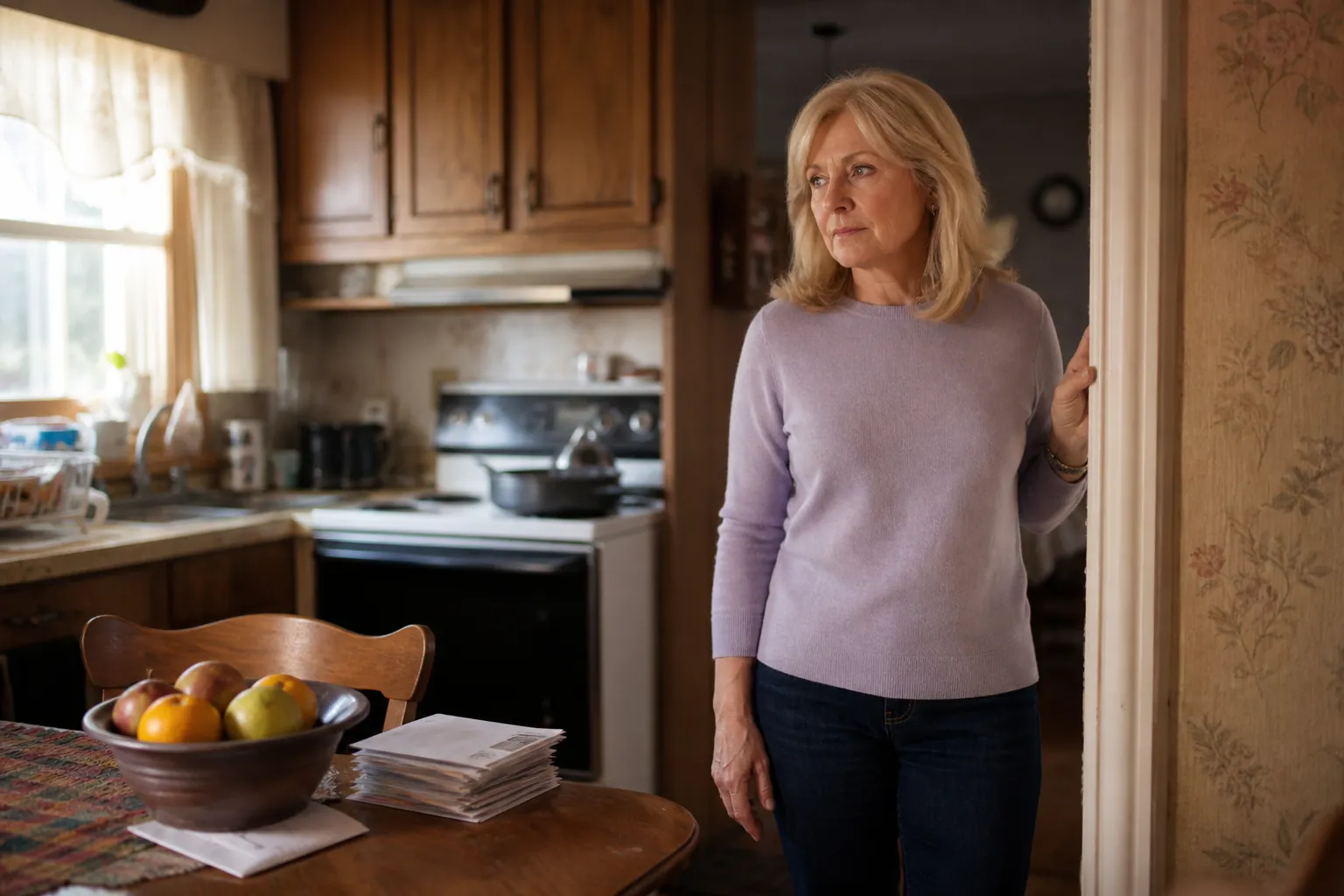
You walk into your parent’s kitchen and notice three small things before anyone says anything: a bill tucked under the fruit bowl, a pan soaking in the sink with a scorched bottom, and two more cans of the same soup lined up behind the ones already in the pantry. None of that, by itself, proves anything. The real question behind the signs of cognitive decline in aging parents is more practical: is this something to monitor, something to make safer today, or something to bring to a clinician?
The 10 signs below are based on the standard warning-sign framework used by the CDC and the Alzheimer’s Association, but translated into what families can actually observe in a home: cooking, mail, medicine, walking routes, conversations, clutter, driving routines, and the little systems that keep a household safe. They are not a diagnosis. Normal aging exists. But repeated changes that affect safety, judgment, movement, or daily function deserve a calmer and earlier response than families often give them. [1][2]
Medical and home-safety note: This article is educational and is not medical advice. It cannot diagnose dementia, Alzheimer’s disease, delirium, medication side effects, depression, vision loss, infection, stroke, or any other condition. If changes are sudden, severe, or paired with weakness, new confusion, chest pain, trouble speaking, a head injury, or repeated falls, seek urgent medical care. Reviewed for home-safety clarity by Elena Morales, RN, BSN, CAPS.
Why a memory checklist also has to be a fall-safety checklist
Families often treat memory changes and fall risk as separate problems. In daily life, they overlap. A parent who forgets the kettle, misreads a stair edge, gets turned around on a familiar route, or stops using a walker correctly is not only having a “thinking” problem. The home is becoming harder to navigate.
A 2021 systematic review in BMC Geriatrics reported that older adults with dementia fall 2 to 3 times more often than cognitively healthy peers, and that 60% to 80% of people with dementia fall each year. Those figures are from the 2021 review, not new 2026 estimates, but they explain why a home walkthrough should pay attention to both cognition and footing. [3]
The timing can also run the other direction: an injurious fall may be an early warning that cognition needs evaluation. A September 30, 2024 JAMA Network Open finding, reported by ALZinfo, found that older adults treated for an injurious fall had a 21% higher risk of receiving a dementia diagnosis in the following year; 10.6% of the fall-treated older adults were diagnosed within a year. That does not mean a fall causes dementia or that every fall predicts it. It does mean a fall plus household changes should not be brushed off as “just clumsy.” [4]
A 2026 Washington University Bursky School of Public Health study adds useful color, with an important caveat: it was a small study of 125 older adults. Its value here is not as a universal rule, but as another reason to treat falls as an early warning signal worth discussing, especially when they appear alongside changes in memory, planning, or judgment. [5]
The issue is common enough that families need a practical way to notice patterns. CDC BRFSS 2022 data report that about 1 in 10 U.S. adults age 45 and older said they had worsening memory loss or confusion in the past year, and about 1 in 4 reported caring for someone with cognitive impairment. Those are self-reported survey figures, not clinical diagnoses, but they show how often households are already living with the question. [6]
The 10 signs, translated into what you can see at home
Use the list as a pattern finder. One forgotten appointment, one misplaced phone, or one repeated story after a tiring day may be ordinary. A repeated change that disrupts cooking, medication, bills, walking, driving, hygiene, appointments, or emergency response belongs in your notes and, when appropriate, in a conversation with a clinician.
1. Memory loss that disrupts daily life
At home, this is not just forgetting a name and remembering it later. It may look like your parent asking the same question several times during one visit, missing familiar appointments even with reminders, repeatedly losing track of whether lunch or medication happened, or relying on sticky notes that no longer seem to help.
- Normal-aging contrast: Occasionally forgetting a name or appointment, then remembering it later, is a typical age-related change in the CDC and Alzheimer’s Association framework. [1][2]
- Safety or next step: Check whether the lapse changes risk. Missed medication, missed meals, a forgotten stove, or a missed medical appointment is more urgent than a repeated story. Start a dated note with examples instead of trying to prove your point in the moment.
2. Difficulty doing familiar household tasks
This sign often shows up in the kitchen, laundry area, bathroom, or car routine before it shows up in conversation. A parent who has cooked for decades may leave a burner on, skip a familiar recipe step, put metal in the microwave, or abandon a half-finished meal because the sequence became too hard to manage. Laundry may be run without detergent. The thermostat may be changed repeatedly because the controls no longer make sense.
Household technology can reveal the same problem. The issue is not that a new phone app is annoying. It is that familiar systems — the coffee maker, pill organizer, remote control, washer, door lock, or bill-pay routine — stop working because the steps no longer stay in order.
- Normal-aging contrast: Occasionally needing help with a microwave setting, a new appliance, or an unfamiliar device is not the same as losing the ability to complete long-familiar tasks. [1][2]
- Safety or next step: Reduce the immediate hazard first. Check stove shutoff habits, remove burned cookware from use, simplify appliance controls where possible, and confirm medication and meal routines. If cleaning routines are failing and clutter is increasing, also review whether tools meant to help — including automatic cleaners — are creating new obstacles; the site’s guide to robot vacuums and fall risk for seniors is useful when household task support and trip hazards overlap.

3. Trouble planning or solving problems
This can look like a household that used to run on a steady rhythm becoming hard to manage. Bills are not just late once; they pile up unopened. A checkbook or online account no longer matches reality. Groceries are bought without a plan, so the refrigerator holds expired food while the pantry fills with duplicates. A parent who used to handle insurance paperwork may now leave forms half completed or make repeated calls because the next step is unclear.
- Normal-aging contrast: Making an occasional mistake while managing finances or household paperwork can happen with age; repeated inability to follow a familiar plan is different. [1][2]
- Safety or next step: Look for consequences: shutoff notices, overdraft warnings, spoiled food, missed refills, or confusion about medical instructions. Offer help around a specific task — “Let’s sort this week’s mail together” — rather than opening with a global accusation.
4. Confusion with time or place
This is one of the signs that can become a safety issue quickly. At home, it may look like your parent dressing for the wrong season, preparing to leave for an appointment on the wrong day, waking from a nap and thinking it is morning, or being unable to explain why they are in the hallway, basement, garage, or yard.
Outside the house, it may show up as getting lost on a familiar walking route, driving to a long-used store and calling because the way home feels unfamiliar, or arriving at a regular destination but not knowing what to do next. Driving concerns should prompt assessment and local guidance, not a one-size-fits-all legal conclusion. State rules, medical reporting requirements, and licensing processes vary.
- Normal-aging contrast: Getting briefly confused about the day of the week and then figuring it out is a typical age-related change in the standard framework. Losing track of where one is or how one got there is more concerning. [1][2]
- Safety or next step: Write down the route, date, and what happened. If the person is leaving home unexpectedly, getting lost, or unable to call for help, treat that as a same-day safety problem. Consider door alerts, neighbor contact, ID information, and a clinician conversation. If wandering or location support is already on the table, read what counts as free GPS tracking for dementia before assuming a phone app solves the whole risk.
5. Visual or spatial problems
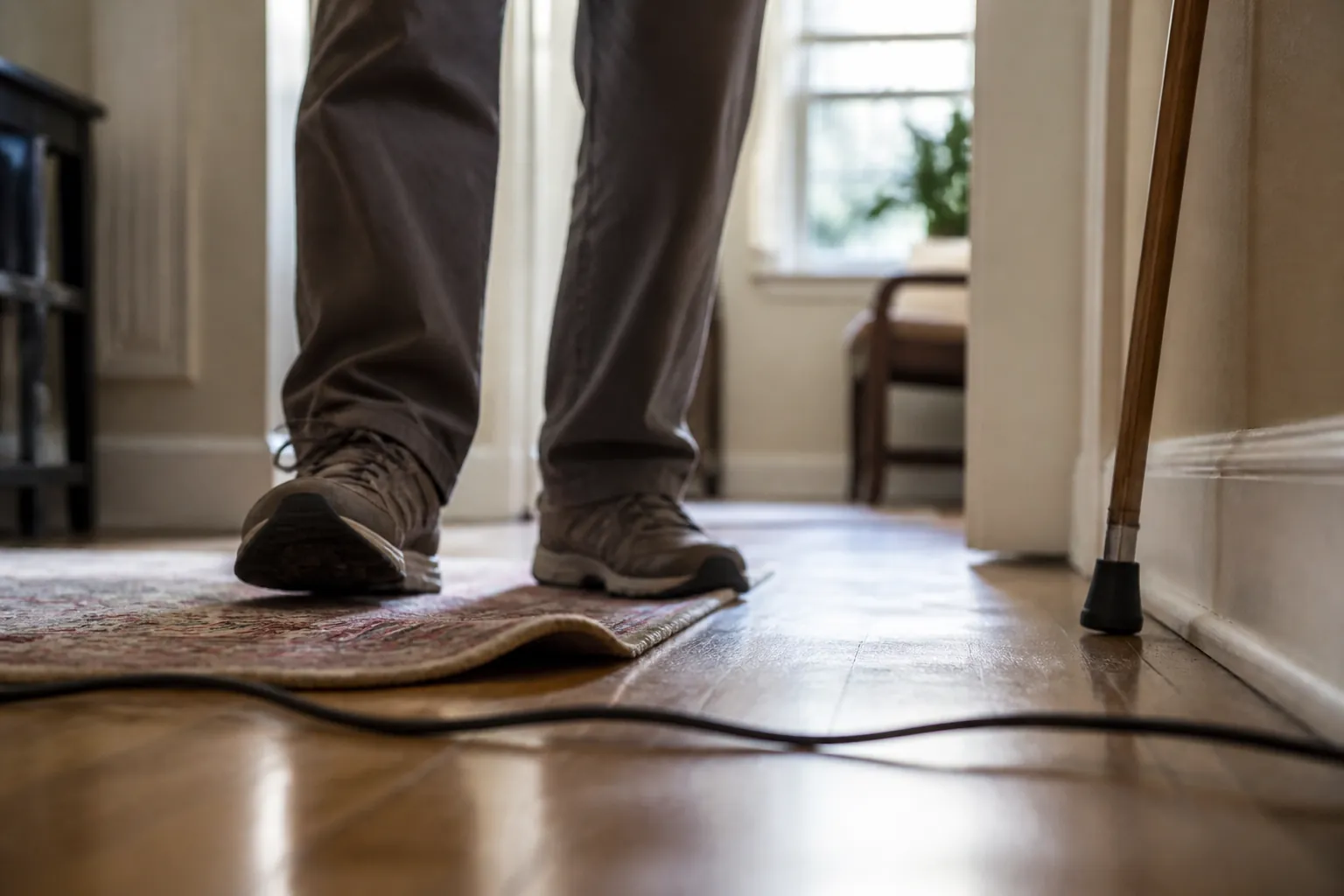
Visual-spatial changes can be mistaken for ordinary clumsiness, especially if your parent jokes about being “unsteady.” Watch how they move through the house. Are they misjudging the edge of a step? Reaching for a chair that is farther away than they think? Hesitating at patterned flooring? Tripping over objects that are visible to everyone else? Pouring beside the glass? Brushing a shoulder against doorframes?
The home hazards are concrete: low-contrast stair edges, curled rugs, cords crossing a walkway, shiny floors, dark hallways, glass tables, clutter near the bed, and bathroom fixtures that look supportive but are not built to hold body weight.
- Normal-aging contrast: Vision changes from cataracts or needing a new glasses prescription can affect daily life and should be checked. The cognitive warning sign is broader difficulty judging distance, contrast, spatial relationships, or movement through familiar space. [1][2]
- Safety or next step: Do not wait for a second fall to remove obvious trip hazards. Clear walking paths, improve lighting, increase contrast at steps, secure or remove rugs, and check bathroom supports. A towel bar is not a safety rail; if the bathroom is part of the concern, use the grab-bar guidance in Can a Towel Bar Be Used as a Grab Bar? to avoid false reassurance.
6. New problems with words in speaking, writing, or following conversation
Word-finding trouble becomes more concerning when it interrupts daily function. Your parent may stop mid-sentence and not recover the thread, call common objects by the wrong name, struggle to explain a problem to a pharmacist or doctor, or write notes that no longer make sense later. The safety issue is communication: can they describe pain, a medication problem, a fall, a scam call, or where they are?
This sign may also look like hearing trouble at first, and hearing should be considered. But also watch for a parent who loses track of a conversation even in a quiet room, cannot follow a familiar TV plot, misses the point of a medical instruction, or agrees to something and then has no usable understanding of what was decided.
- Normal-aging contrast: Sometimes having trouble finding the right word, or missing part of a conversation because of background noise or hearing loss, can be a typical age-related change. Repeatedly losing the ability to follow or join familiar conversation is more concerning. [1][2]
- Safety or next step: Make essential communication easier. Post emergency contacts in large print, confirm that the phone is usable, and keep a current medication list visible. After appointments, ask your parent to explain the plan in their own words. If instructions disappear before they can be used, request written after-visit summaries and permission to join future visits when appropriate.
7. Withdrawal from usual activities
A parent who stops going to church, cards, lunch with friends, the senior center, or a long-standing hobby may be tired, grieving, depressed, in pain, embarrassed by hearing loss, afraid of falling, or struggling cognitively. The reason matters, but the home observation is still important. Withdrawal can hide missed meals, weaker balance, medication errors, and a shrinking circle of people who would notice trouble.
- Normal-aging contrast: Sometimes feeling tired of social obligations or changing routines can happen with age or life circumstances. A repeated withdrawal from usual activities, especially when it hides missed meals, less movement, or fear of falling, deserves closer attention. [1][2]
- Safety or next step: Ask what has become harder, not what is “wrong” with them. If withdrawal followed a fall, fear may be driving the change; the language in Comforting Words for Elderly Parents Scared After a Fall can help keep the conversation supportive instead of corrective.
8. Misplacing things and being unable to retrace steps
Everyone misplaces keys. The concerning pattern is different: important items appear in unusual places, and your parent cannot retrace the steps that would explain it. Keys in the refrigerator, a wallet hidden in a linen closet, medication moved into a kitchen drawer, mail stacked in several rooms, or the phone repeatedly left in places where it cannot be heard all change how safe the home is.
Misplacing things also creates fall risk. A parent may rush through rooms looking for a purse, step over piles created during the search, leave cabinet doors open, or walk outside to check the car without proper shoes or a phone. If suspicion appears — “someone stole it” — the family conversation can become heated fast. Keep the focus on systems, not blame.
- Normal-aging contrast: Misplacing things from time to time and retracing steps to find them is a typical age-related change. Being unable to retrace steps, especially when items are placed in unusual locations, is more concerning. [1][2]
- Safety or next step: Create a landing zone for keys, wallet, glasses, phone, and medication. Clear the search paths where clutter builds. If lost items are paired with leaving home unexpectedly or being unable to call for help, treat it as a wandering and emergency-contact issue, not just a housekeeping issue.
9. Decreased or poor judgment, including money decisions
Judgment changes are often the sign families explain away the longest because they feel personal. At home, look for unpaid bills next to duplicate purchases, unusual charitable donations, repeated repair payments, new susceptibility to phone or email scams, poor hygiene that is out of character, unsafe clothing for the weather, or spoiled food being kept and eaten.
AARP’s dementia warning-sign guidance also flags financial missteps such as trouble counting change, bill problems, and unusual money decisions as changes worth attention. Use that as a reason to look at consequences, not as permission to shame a parent who has managed a household for decades. [7]
- Normal-aging contrast: Making a bad decision once in a while can happen at any age. A repeated shift in judgment, especially when it creates financial, medication, nutrition, driving, or fall risk, is different. [1][2]
- Safety or next step: Quietly gather examples: dates, bills, duplicate purchases, scam messages, medication errors, or spoiled food. If your parent is open to help, set up bill reminders, trusted-contact alerts, pharmacy synchronization, or a shared review of mail. If money loss or exploitation is already happening, seek local professional guidance promptly.
10. Mood or personality change
Mood and personality changes can look like new irritability, suspicion, anxiety, fearfulness, impulsiveness, or anger when routines are interrupted. Do not turn that into a “gotcha” moment. If your parent feels cornered, the next useful conversation may be much harder.
- Normal-aging contrast: Becoming set in a routine or feeling irritated when a preferred routine is disrupted can be a typical age-related change. A marked personality or mood shift deserves closer attention. [1][2]
- Safety or next step: Look for the practical trigger: pain, poor sleep, fear of falling, medication confusion, a schedule change, or a task that has become too hard. Bring repeated changes to a clinician, especially when they appear with memory, judgment, walking, or safety concerns.
When to monitor, when to make safer today, and when to call
A useful home assessment does not end with “yes” or “no.” It sorts what you saw into action levels.
| What you notice | What to do next |
|---|---|
| One mild lapse with no safety consequence, such as briefly forgetting a name and remembering later | Monitor. Do not label it. Write it down only if it repeats or begins affecting daily function. |
| Repeated changes in mail, medication, cooking, appointments, hygiene, money, or conversations | Document specific examples with dates. Look for patterns across routines rather than arguing about one incident. |
| A fall, burn, missed medication, getting lost, unsafe driving episode, scam loss, spoiled food, or inability to call for help | Make the immediate situation safer today and bring the pattern to a clinician or appropriate professional. |
| Sudden confusion, sudden weakness, trouble speaking, head injury, chest pain, or rapid change from baseline | Seek urgent medical care. |
For the clinician, the most useful sentence is not “I think Dad has dementia.” It is specific: “In the past six weeks, he left the stove on twice, missed two medication refills, got lost driving home from the grocery store, and fell in the hallway near a curled rug.” That gives a professional something to evaluate.
If your parent is in cancer treatment, recovering from a stroke, or dealing with another condition that can affect strength, balance, or thinking, the threshold for reporting changes should be lower. The same observation pattern appears in fall-focused care planning, including the site’s guides on falls during chemo for an aging parent and a fall-first stroke recovery checklist.
Before you leave the house, fix what is plainly unsafe: the cord across the hallway, the loose rug, the dark stair edge, the missing emergency numbers, the pill bottles no one can explain, the pan that keeps turning up burned. Then choose one calm next conversation. The point of the 10 signs is not to win an argument over a diagnosis. It is to notice repeated changes early enough that the home, the routine, and the medical evaluation can catch up.
References
- Signs and Symptoms of Alzheimer's, CDC
- 10 Early Signs and Symptoms of Alzheimer's & Dementia, Alzheimer's Association
- Risk factors associated with falls in older adults with dementia: a systematic review, BMC Geriatrics, 2021
- Falls in Older Adults May Presage Dementia Onset, ALZinfo
- Falls signal faster cognitive decline in older adults, Washington University Bursky School of Public Health, 2026
- Cognitive Health Caregiving, CDC
- 15 Early Warning Signs of Dementia and Alzheimer's, AARP
Browse more in the Glossary.