
Room checklist
Bathroom Remodel for Elderly: An Evidence-Based Review of What Actually Reduces Falls
Not all bathroom safety features are equally effective. This evidence-based review for family caregivers examines which modifications — grab bars, non-slip flooring, curbless showers, and lighting — are clinically proven to reduce falls, supported by a 2025 systematic review and RCT data.
What the Research Actually Shows About Bathroom Modifications and Fall Reduction
When a family caregiver begins researching bathroom safety, the information landscape is dense with product recommendations, contractor advice, and well-meaning checklists. But a critical question often goes unasked: which of these modifications are actually proven to reduce falls? A 2025 systematic review of 20 clinical studies, published in PMC, provides the clearest answer yet. The review found that 13 of the 20 studies — 65% — confirmed the effectiveness of home modifications in reducing falls, improving functional independence, and generating cost savings. Bathroom modifications, grab bars, and stair railings emerged as the most impactful interventions.
The evidence hierarchy that emerges from this research is clear: grab bars, non-slip flooring with a Dynamic Coefficient of Friction (DCOF) of 0.60 or higher, curbless shower conversions, and improved lighting produce statistically significant fall reductions. Other commonly marketed features — walk-in tubs, glossy tile, towel bars used as grab bars — lack equivalent supporting evidence or, in some cases, actively increase risk. For families making decisions under emotional and financial pressure, this distinction matters.
Grab Bars: The Most Studied Bathroom Safety Intervention
No single bathroom modification has been studied as rigorously as grab bars. The evidence base includes randomized controlled trials, longitudinal cohort studies, and pre-post intervention designs — collectively making grab bars the gold standard of bathroom fall prevention.
The most frequently cited study is Stark et al. (2017), a randomized clinical trial that found home modifications — including grab bars — led to a 39% reduction in falls in the intervention group compared to the control group. This is not a correlation; it is a controlled experimental finding. Hawkins et al. (2024) reinforced these results with a striking statistic: 79% of older adults reported no falls after receiving grab bars, safety railings, and bathtub cutouts. The same study found that fear of falling, measured by the Falls Efficacy Scale (FES), decreased significantly (T(107)=5.14, p<0.001).
Levine et al. (2021) examined the biomechanics of bathtub exit — one of the most dangerous bathroom maneuvers — and found that grab bar users were 75% more likely to maintain their balance during the transfer. This is not a subtle effect. It is a fourfold improvement in the odds of staying upright during a high-risk activity.
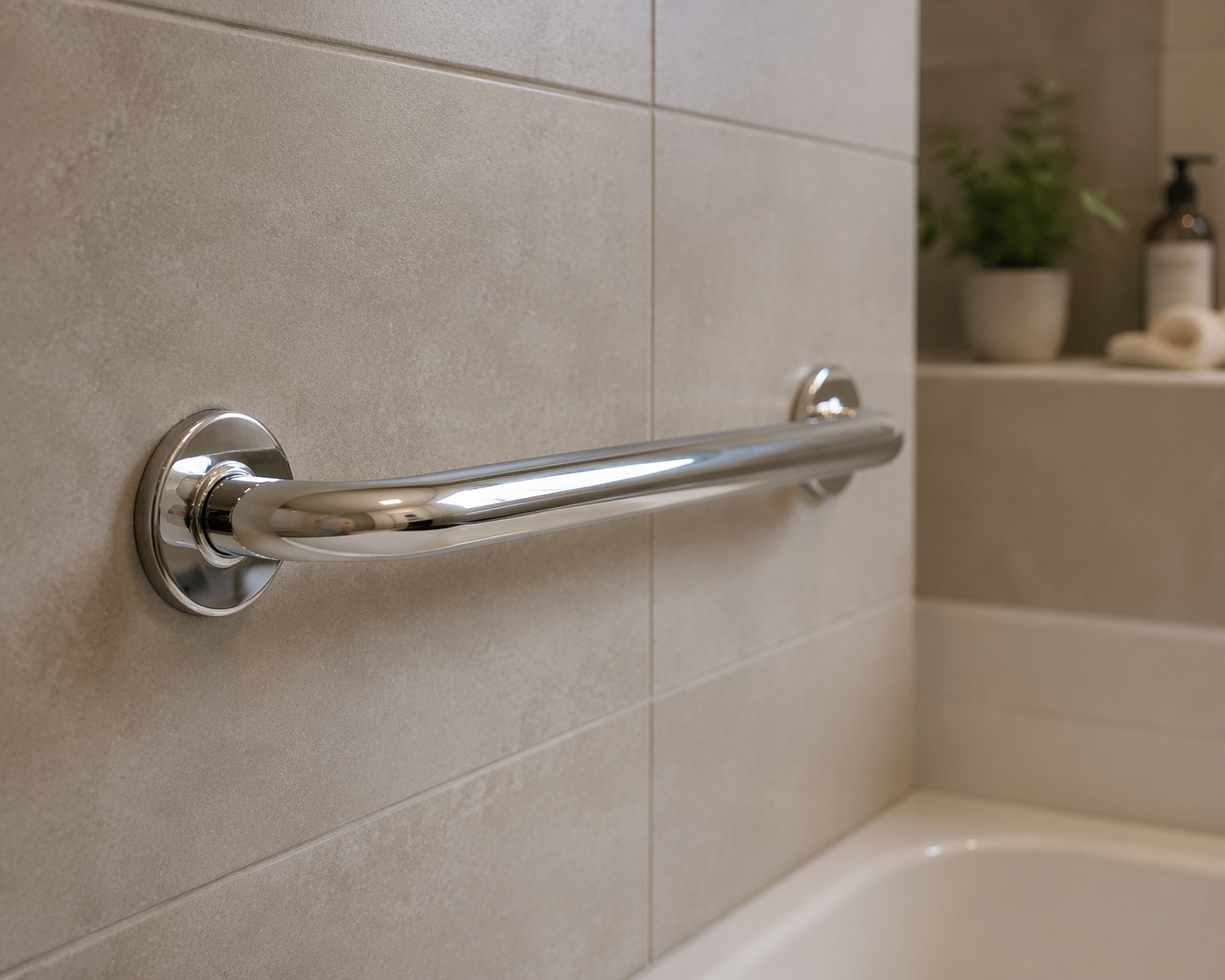
Where to Place Grab Bars for Maximum Impact
Placement matters as much as installation. The evidence supports grab bars in three primary locations:
- Next to the toilet: A horizontal bar on the wall beside the toilet, or a flip-up bar on the open side, assists with sitting down and standing up — a transfer that requires significant lower-body strength.
- At the shower or tub entry: A vertical or angled bar helps with the step-over or step-in motion, which is a common fall point.
- Inside the shower or tub: A horizontal bar on the shower wall provides stability during washing, turning, and exiting.
Non-Slip Flooring: Understanding DCOF Ratings and What the Tile Industry Recommends
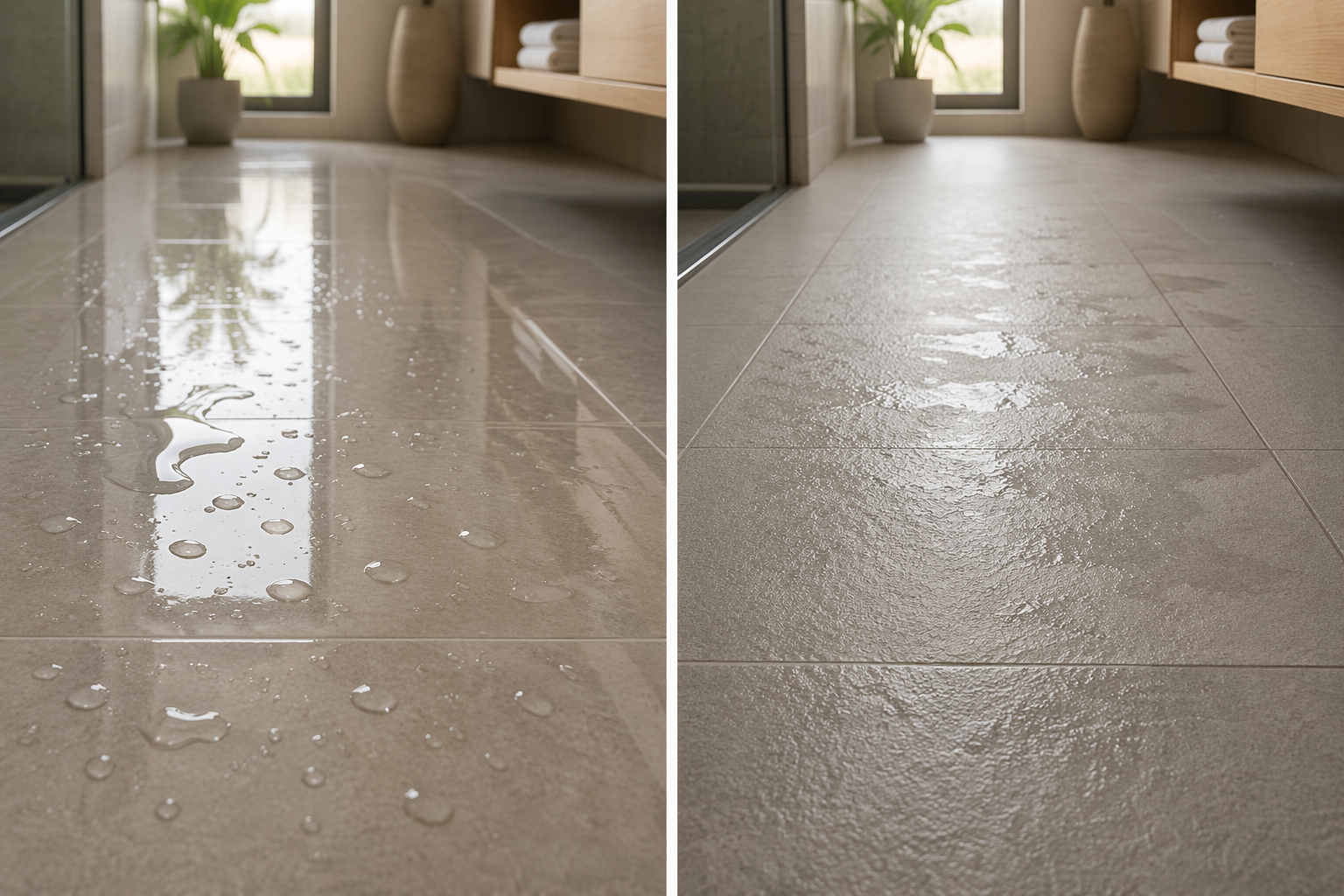
Flooring is the second most impactful bathroom modification, but the technical specifications matter far more than the aesthetic choice. The key metric is the Dynamic Coefficient of Friction (DCOF), which measures how much slip resistance a tile surface provides when wet. The tile industry's revised testing system sets the minimum threshold for commercial wet areas at a DCOF of 0.60 or higher. For residential bathrooms — where the user may be older, unsteady, or using a mobility aid — this same standard should apply.
Glossy polished tile, a popular choice in many bathroom remodels, commonly falls below this threshold. When water hits the surface, the coefficient drops further, creating a genuinely hazardous condition. Matte-textured tile, by contrast, maintains its slip resistance when wet and is the evidence-backed choice for bathroom flooring.
| Flooring Type | Typical DCOF (Wet) | Fall Risk | Recommendation |
|---|---|---|---|
| Glossy polished porcelain | 0.30 – 0.45 | High | Avoid in bathrooms |
| Matte textured porcelain | 0.60 – 0.80 | Low | Recommended |
| Natural stone (honed) | 0.55 – 0.70 | Moderate | Acceptable with sealant |
| Vinyl sheet (textured) | 0.65 – 0.85 | Low | Recommended |
Curbless Showers vs. Walk-In Tubs: What the Evidence Says
When families consider a major bathroom accessibility upgrade, two options dominate the conversation: the curbless (zero-threshold) shower and the walk-in tub. The evidence strongly favors one over the other.
Schorderet et al. (2022) studied individualized home adaptations — including curbless shower conversions — and found that bathroom-related difficulties decreased by 93.4%. Quality of life improved by 9.8%, and fear of falling decreased by 12.5%. These are large, clinically meaningful effects. The curbless shower eliminates the step-over hazard entirely, requires no door to operate, and can accommodate a shower chair or wheeled commode if needed.
Walk-in tubs, by contrast, lack equivalent RCT-level evidence for fall reduction. While they are marketed as safety solutions, they introduce their own risks: the user must step over a threshold (typically 4–6 inches), wait for the tub to fill and drain, and sit in a fixed position that can be difficult to exit quickly in an emergency. The 2025 systematic review did not identify walk-in tubs among the most impactful interventions.
| Feature | Curbless Shower | Walk-In Tub |
|---|---|---|
| Threshold height | 0 inches (flush with floor) | 4–6 inches (step-over required) |
| Entry/exit | Walk in, no door to operate | Must open/close watertight door |
| Evidence for fall reduction | Strong (Schorderet 2022: 93.4% difficulty reduction) | Limited (no equivalent RCT data) |
| Usability with mobility aid | Excellent (wheelchair accessible) | Poor (must transfer from chair) |
| Installation cost range | $3,000 – $15,000 | $2,000 – $20,000 |
Lighting Improvements: An Overlooked but Evidence-Backed Intervention
Lighting is frequently treated as an afterthought in bathroom remodels, but the evidence suggests it deserves more attention. Nighttime bathroom trips are among the most dangerous activities for older adults: the transition from a dark bedroom to a brightly lit bathroom, or from a dim hallway to a dark bathroom, temporarily impairs vision and spatial orientation. Improved ambient lighting, motion-activated night lights, and circadian lighting reduce fall risk by improving visibility during these transitions.
The 2025 systematic review's finding that environmental modifications addressing multiple risk factors produce the greatest fall reduction supports lighting as a complementary intervention. When combined with grab bars and non-slip flooring, lighting improvements create a bathroom environment that is safer at every hour of the day.
Key Lighting Recommendations
- Install a motion-activated night light in the bathroom and along the path from the bedroom. This eliminates the need to fumble for a switch in the dark.
- Use bright, even ambient lighting rather than a single overhead fixture. Shadows and dark corners can hide tripping hazards.
- Consider circadian lighting that shifts color temperature throughout the day — warmer tones in the evening to support sleep, cooler tones during the day for alertness.
- Ensure the shower area is well-lit. A waterproof LED fixture in the shower ceiling eliminates the need to shower in dim light.
What the 2025 Systematic Review Found Across 20 Studies
The 2025 systematic review (PMC11988477) is the most comprehensive analysis of home modification effectiveness currently available. Its findings extend beyond fall reduction to include functional independence and cost savings — making the case for bathroom modifications not just a safety measure but a financial one.
Key findings from the review include:
- Carnemolla et al. (2019): Home modifications reduced weekly care hours by 42%. Informal care (provided by family members) dropped by 46%, and formal care (paid aides) dropped by 16%. This is not just a safety improvement — it is a reduction in the caregiving burden that falls on families.
- Hollinghurst et al. (2022): A longitudinal study of 657,536 older adults found that home adaptations reduced fall-related emergency admissions by 3% per quarter (OR=0.97, p<0.001). At scale, this translates to thousands of avoided hospital visits.
- The review's overall conclusion: bathroom modifications, grab bars, and stair railings are the most impactful interventions. The evidence supports a combined approach — no single modification is a silver bullet.
The Combined Effect: Why Home Modifications Work Best Alongside Exercise
The evidence consistently shows that home modifications produce the greatest fall reduction when combined with exercise interventions. This is not a coincidence — the two approaches address different risk factors. Modifying the environment removes external hazards: slippery floors, missing grab bars, poor lighting. Exercise addresses internal risk factors: reduced balance, muscle weakness, and gait instability.
The CDC's STEADI (Stopping Elderly Accidents, Deaths & Injuries) model formalizes this combined approach. STEADI recommends screening all older adults for fall risk, assessing modifiable risk factors (including home hazards), and intervening with a tailored plan that may include both environmental modifications and balance-strengthening exercises. The bathroom remodel is one part of a larger fall prevention strategy.
What Doesn't Work: Common Bathroom Features That Increase Fall Risk
Understanding what to avoid is as important as knowing what to install. Several common bathroom features are not just ineffective — they actively increase fall risk.
- Glossy floor tile with a DCOF below 0.60: This is the single most common flooring mistake in bathroom remodels. The tile looks beautiful in the showroom but becomes dangerously slippery when wet. Always verify the DCOF rating before purchasing.
- Towel bars used as grab bars: A towel bar is not weight-rated. It will pull out of the wall under the dynamic load of a person losing their balance. This is not a minor risk — it is a fall mechanism.
- Soft bath rugs and mats: These create a tripping hazard. The edge of the rug can catch on a foot or mobility aid, and the rug itself can slide on the tile floor. If a non-slip surface is needed, use a rubber-backed mat that is secured to the floor.
- Round doorknobs: These are difficult to grip for someone with arthritis, reduced hand strength, or fine motor impairment. Lever-style handles are the evidence-backed alternative.
How to Use This Evidence When Working with Contractors and Occupational Therapists
Translating clinical evidence into real-world decisions requires asking the right questions. Contractors and designers may recommend features based on what is popular or profitable, not what is proven. Occupational therapists can conduct individualized home assessments and recommend modifications tailored to a specific person's functional limitations.
Here are the questions you should ask to ensure your bathroom remodel is evidence-based:
- "What is the DCOF rating of the floor tile you are recommending?" If the answer is below 0.60, or if the contractor does not know what DCOF means, that is a red flag.
- "Are these grab bars weight-rated and installed into wall studs or blocking?" The answer should be yes, with a specific weight rating (typically 250–300 pounds).
- "Can you provide a cost breakdown for a curbless shower conversion versus a walk-in tub?" Use the evidence comparison above to evaluate the options.
- "Do you have experience with CAPS (Certified Aging-in-Place Specialist) standards?" A CAPS-certified contractor has specific training in accessible design and is more likely to recommend evidence-based modifications.
- "Can an occupational therapist visit the home before we finalize the design?" An OT assessment can identify specific hazards and functional needs that a general contractor might miss.
The evidence is clear: grab bars, non-slip flooring with a DCOF of 0.60 or higher, curbless shower conversions, and improved lighting are the interventions that actually reduce falls. By focusing your budget on what works — and avoiding what doesn't — you can create a bathroom that is not just safer, but genuinely supportive of aging in place.
Related reading
Need a professional assessment?
Find a CAPS-credentialed professional or local aging services through our outbound resource list — we never name or rank individual contractors.
Find Local HelpNoticed something outdated or inaccurate on this page? Flag a correction. We review every report against CDC, NIA, and AARP HomeFit guidance before updating a page.