
How to Choose Counter Stools for Elderly with Back Pain
Choosing the wrong counter stool can worsen back pain and increase fall risk. This guide walks through the essential ergonomic and safety features — from lumbar support to stable bases — that make a stool safe and comfortable for seniors with chronic back pain.
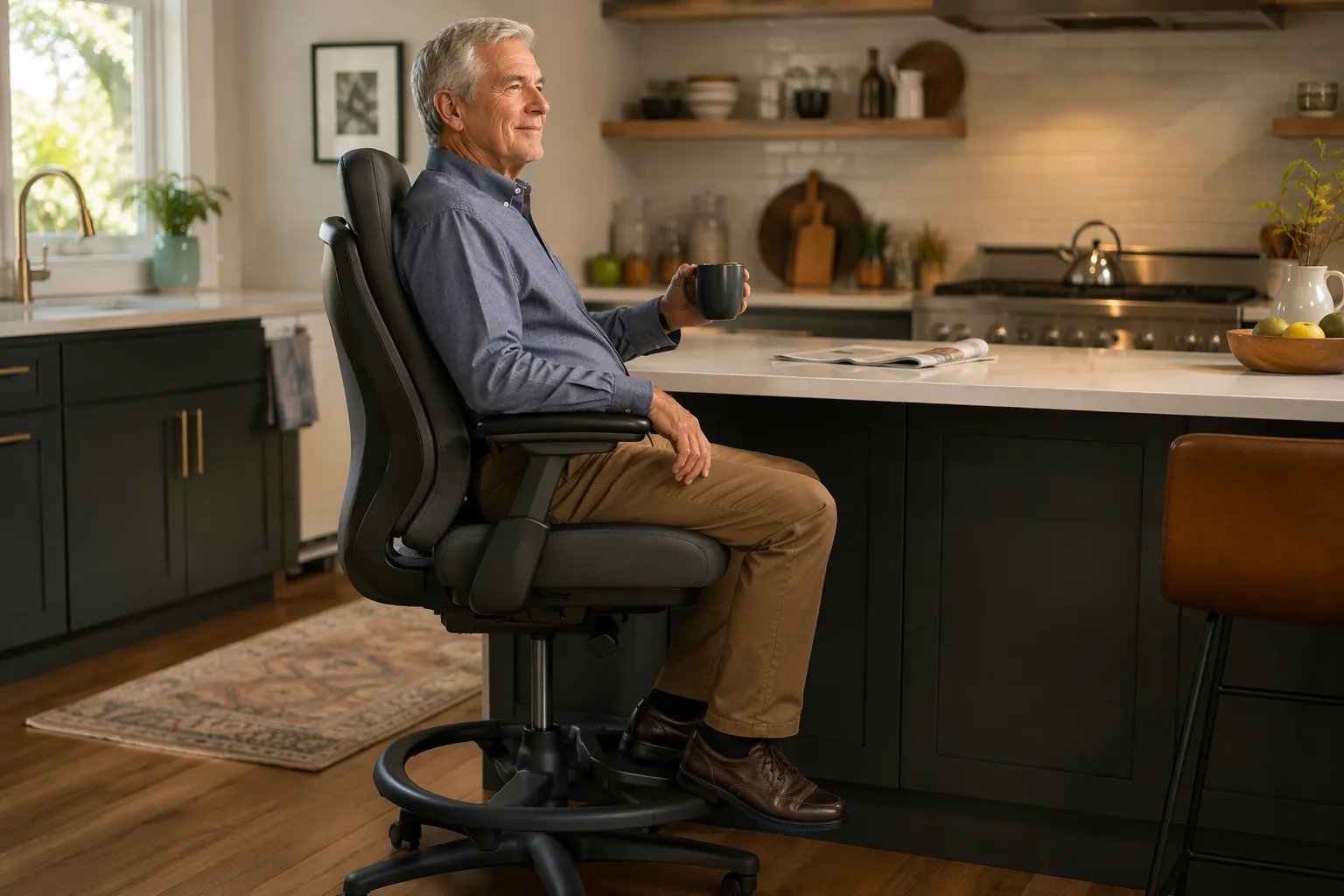
The counter stool usually becomes a problem quietly. An older parent starts sitting at the island because standing through coffee, pill sorting, or chopping vegetables makes the lower back ache. At first, any stool seems better than standing. Then you notice the sideways shift before they sit, the hand gripping the counter edge, the feet dangling, the shoulders rounded over the work surface, or the little pause before they try to stand again.
That is why the best counter stools for elderly users with back pain are not simply the softest stools or the ones that look most at home under the island. This is a small home-modification decision. The stool has to reduce back strain while also making sitting down, staying upright, and standing back up less risky. Kitchen fall-prevention guidance treats the kitchen as a place where independence and hazards sit close together, and seating is part of that safety picture, not just decor [1].
Start With Posture, Not Upholstery
A stool for an older adult with chronic lower-back pain has to answer a physical question first: can the person sit with the spine supported, hips and knees positioned comfortably, feet supported, and arms available for controlled movement? Fabric color can wait. A pretty stool that lets the pelvis slide forward or leaves the feet hanging is asking the back to do work the furniture should be doing.
A useful first screen looks like this:
| Feature | What To Look For | Reject The Stool If |
|---|---|---|
| Back support | Full back with lumbar contouring | Backless, very low back, or a decorative curve that misses the lower spine |
| Seat height | Usually 24–27 inches for counter height, or adjustable when used at more than one surface | The user’s feet dangle or knees are pushed too high |
| Seat depth and width | About 17–19 inches deep and 17–21 inches wide | The seat cuts behind the knees or feels too narrow to shift safely |
| Cushion | Firm, high-density foam that resists bottoming out | Soft padding collapses or memory foam lets the user sink |
| Armrests | Firm arms that extend far enough forward to help with standing | Arms are too short, flimsy, or only decorative |
| Base | Wide four-leg or sled base with non-slip feet | Narrow pedestal, slick feet, or wobble under side pressure |
| Weight capacity | At least 300 lb as a safer target for many households | Capacity is missing, unclear, or too close to the user’s weight |
Those numbers are not a prescription for every body, but they are a better starting point than “comfortable.” Comfortable for a healthy dinner guest and comfortable for an older adult with back pain are not the same standard.
A Full Backrest Should Hold The Lower Spine, Not Just Touch The Shoulder Blades
Backless stools make sense in catalog photos because they tuck neatly away. They make much less sense when someone is sitting longer because standing hurts. Without a backrest, the user has to keep the trunk upright through muscle effort or lean forward onto the counter. For someone with chronic lower-back pain, that often means hunching, bracing, or sliding toward the front edge of the seat.
General bar-stool guidance for long sitting favors full-back stools because they support the spine and can reduce lower-back strain compared with low-back or backless designs [2]. For an older adult, “full back” should mean more than a tall rectangle. The back should meet the lower spine, encourage the pelvis to stay back in the seat, and make upright sitting possible without constant gripping or leaning.
Lumbar contouring matters here. Senior seating ergonomics guidance emphasizes lumbar support and a seat depth that lets the user sit back without pressure behind the knees [3]. Back-pain posture guidance written for other seating categories also points to the same basics: supported lower back, feet flat or supported, and a hip angle around 90–110 degrees [4]. That source discusses another seating category, so it should not be treated as a counter-stool study. The posture principle still transfers well enough to use at the kitchen island.
Check the backrest with the actual user if possible. When they sit all the way back, the lower back should feel met, not abandoned. The shoulder blades should not be the only contact point. If the person has to perch forward to reach the counter, the stool is too deep, too far from the work surface, or shaped wrong for the task.
Be Careful With “Low Back” Stools
A low-back stool can look supportive while doing very little. It may stop the stool from looking bare, but if the support sits below the lumbar curve or only catches the pelvis, it will not help much when the user tires. For a person who sits at the counter because standing hurts, the backrest should support sustained posture, not merely signal that the stool has a back.
Seat Height And Foot Placement Decide Whether The Back Gets A Break
Counter stools and bar stools are not interchangeable. Counter-height stools are commonly around 24–27 inches high, while adjustable designs with ranges such as 21–27 inches can work when the same seat needs to serve a counter and a lower prep surface [5]. The goal is not to hit a fashionable height; it is to let the user sit close enough to the work surface without hiking the shoulders, rounding the back, or dangling the feet.
Dangling feet are a bigger problem than many buying guides admit. Foot support gives the legs somewhere to rest and helps reduce strain during longer sitting; long-sitting stool guidance specifically treats a footrest as important for comfort and support [2]. For an older adult with back pain, unsupported feet can pull the pelvis forward, increase pressure through the thighs, and make standing feel less controlled.
The footrest has to be where the person’s feet actually land. A thin ring tucked too far under the seat may work for a tall adult and fail completely for a shorter one. Before buying, check whether the user can place both feet securely on the floor or footrest while sitting all the way back against the lumbar support. If they have to slide forward to reach the footrest, the stool is solving one problem by creating another.
- Measure from the floor to the underside of the counter before shopping.
- Leave enough clearance for thighs, knees, and easy entry.
- Have the user test whether both feet rest flat or securely supported.
- Reject stools that require perching on the front edge to reach the counter.
This is also where a broader kitchen review helps. If the only available work surface forces awkward sitting, the stool may not be the only problem. A room-by-room pass using a home safety assessment checklist can show whether the kitchen needs a different prep zone, better lighting, clearer pathways, or a safer place to rest.
Seat Depth, Width, And Cushioning Are Where “Soft” Often Betrays You
A seat can feel pleasant for thirty seconds in a store and still be wrong for daily use. For older adults with back pain, the seat has to support posture without trapping the person. Elderly-focused stool guidance gives seat-depth and seat-width ranges around 17–19 inches deep and 17–21 inches wide [5]. Wirecutter’s general stool testing also reports seat depth as a key measurement and notes common weight-capacity ranges in the 250–300 lb area for many stools [6].
Depth is the easy one to get wrong. If the seat is too deep, a shorter user may slide forward to bend the knees, losing the backrest. If it is too shallow, the thighs lack support and the user may feel perched. The right depth lets the person sit back against the lumbar support while leaving space behind the knees.
Width matters for dignity as much as safety. The user should be able to sit without squeezing between arms or edges, shift slightly without feeling unstable, and place both hands on the armrests without twisting. A too-narrow stool can make every transfer feel like threading a needle.
Cushioning deserves the same suspicion. Long-sitting stool guidance favors high-density cushioning because it resists bottoming out better than softer padding [2]. Wirecutter’s stool criteria also pay attention to cushion quality rather than treating padding as automatically comfortable [6]. For this use case, very soft memory foam can be a poor choice if it lets the user sink, tips the pelvis backward, or makes standing harder. Firm support usually ages better than a plush first impression.
Armrests Are Not Decoration If Someone Uses Them To Stand
For an older adult, armrests are often the difference between a controlled stand and a countertop grab. The arms need to be strong enough to accept downward pressure and long enough to help through the actual sit-to-stand motion. Short little side caps may make the stool look complete, but they do not help much if the user’s hands cannot reach them at the moment effort begins.
Senior ergonomics guidance treats sit-stand transition support as part of stable seating design [3]. Elderly-specific counter-stool guidance also calls out armrests as a feature to consider for safer use [5]. The practical test is simple: when the user is seated all the way back, can they place both hands on the arms, lean forward slightly, and push down without the stool shifting, flexing, or feeling like it might tip?
Armrests also need to fit under or around the counter. If the arms are so high that the stool sits too far away, the user may lean forward to work, losing the back support that justified the purchase. If the arms trap the user against the island, transfers become awkward. This is why dimensions on a product page are not enough; the stool has to fit the counter, the body, and the movement.
The Base Should Make Tipping Boringly Unlikely
A stool can have a beautiful backrest and still be a bad choice if the base is narrow, slick, or light enough to skate across the floor. Kitchen seating for an older adult should tolerate small imperfect movements: sitting a little off-center, pushing unevenly on one arm, turning to speak to someone, or shifting weight before standing.
A wide four-leg base or sled base with non-slip rubber feet is the safer direction. Elderly-focused stool guidance specifically identifies non-slip feet and adequate weight capacity as key selection points [5]. That does not mean every four-legged stool is safe, but it does give you a clear rejection rule: wobble, slick feet, and narrow footprints do not belong in this purchase.
Backrests may also help with stability by adding another body contact point, but that claim should be kept in proportion. Chitaliving argues that counter stools with backs can reduce tipping risk because the backrest gives the seated person more support and contact [7]. That is design logic from a furniture company, not a controlled fall-rate study. It is still a reasonable reason to prefer a supportive back over a backless perch, especially when paired with a stable base.
Swivel is the tempting feature here. It can reduce twisting when someone turns to get down, but it can also move before the user is ready. A free-spinning stool with no arms and a narrow pedestal base is asking for more balance than many older adults with back pain can comfortably provide. If swivel is necessary, look for controlled rotation, a stable base, armrests, and a user who can manage the motion consistently.
Weight Capacity Is A Safety Margin, Not A Polite Detail
Weight capacity should be easy to find. If it is missing, vague, or buried, that is not reassuring. General stool reviews commonly show capacities around 250–300 lb, while elderly-specific guidance recommends a 300 lb capacity for senior counter stools [5][6]. Treat 300 lb as a safer minimum target for many households, not as a universal guarantee.
The number also needs a margin. A stool rated exactly at the user’s body weight leaves little room for the extra force that occurs during sitting down, pushing to stand, shifting, or leaning. If the user is near the stated limit, choose a higher-capacity option. Some bariatric seating options go higher, but the key is not chasing the largest number; it is matching capacity, base stability, seat size, and transfer needs.
Capacity does not rescue a bad design. A high-rated stool with slick feet, a narrow base, and no usable arms can still be wrong for someone who struggles with balance or transfers. Read the rating as one inspection point, not as permission to ignore the rest of the stool.
What To Ignore Until The Basics Are Right
It is fine to care what the kitchen looks like. Nobody wants the island to feel like a clinic if it has always been the place where people drink coffee, open mail, and talk while dinner cooks. But style has to wait its turn. For this purchase, the stool earns the right to be attractive only after it has passed support, fit, transfer, and stability checks.
- Do not choose a backless stool because it disappears neatly under the counter.
- Do not choose a stool mainly because the cushion feels soft in the first minute.
- Do not assume a footring is useful until the user’s feet actually reach it.
- Do not treat swivel as automatically senior-friendly.
- Do not accept missing weight-capacity information from a product listing.
This same product-neutral approach is useful beyond stools. If a listing leans hard on lifestyle photos and avoids measurements, load ratings, and stability details, use a senior home-safety product evaluation framework before trusting the claim.
A Practical Buying Sequence
The safest way to shop is not to start with a list of brands. Start with the person, the counter, and the movement that is already difficult.
- Measure the counter height and the available clearance under the overhang.
- Measure the user’s seated needs: whether they need extra width, a shallower seat, or a lower footrest.
- Shortlist only stools with a full supportive back, firm arms, non-slip feet, and published capacity.
- Check whether the feet rest securely while the back stays supported.
- Test the stand-up motion, not just the seated feel.
- Reject anything that wobbles, slides, sinks, spins unexpectedly, or forces bracing on the counter edge.
If the stool is part of a larger aging-in-place plan, it may compete with better lighting, flooring changes, grab bars, threshold fixes, or bathroom safety work. A kitchen stool can be worthwhile, but it should sit inside a prioritized plan rather than absorb attention because it is easy to buy. For that broader view, see how to prioritize home modifications for aging in place and what aging-in-place modifications actually cost and save.
When A Stool Is Not Enough
A better stool can make the kitchen easier to use, but it should not be asked to solve uncontrolled pain, serious balance problems, recent falls, or transfers that are already unsafe. If an older adult has fallen recently, needs help getting on or off seats, becomes dizzy when standing, or braces heavily on furniture, involve an occupational therapist, physical therapist, clinician, or qualified home-safety professional before buying.
The same caution applies if the kitchen is not the only risky room. A stool may help with coffee and food prep, while the bathroom still carries a larger fall hazard. In that case, compare the kitchen plan with higher-risk projects such as a bathroom remodel for elderly safety before spending heavily on seating.
The right counter stool lets the older adult sit with the lower back supported, feet grounded, arms ready for standing, cushioning that does not collapse, and a base that stays put. Measure the counter. Measure the person. Then inspect the stool as if someone you love will use it on a tired morning, before coffee, when balance and patience are both thinner than usual.
References
- 5 Steps How to Prevent Falls in the Kitchen, Fall Prevention Foundation, https://fallpreventionfoundation.org/2026/05/04/5-steps-how-to-prevent-falls-in-the-kitchen-and-stay-independent-easy-guide-for-seniors-16/
- What Is The Most Comfortable Type Of Bar Stool For Long Sittings?, Edward Martin, https://www.edwardmartin.com/blogs/information/what-is-the-most-comfortable-type-of-bar-stool-for-long-sittings
- Senior-Friendly Ergonomics: Prioritizing Stability and Support, Eureka Ergonomics, https://eurekaergonomic.com/blogs/eureka-ergonomic-blog/senior-friendly-ergonomics-stability-support-guide
- Best Sitting Positions for Seniors with Back Pain, Adaptahome, https://adaptahome.co.uk/blog/best-sitting-positions-for-seniors-with-back-pain/
- How to Select the Best Counter Stools for Elderly?, Yumeya Furniture, https://www.yumeyafurniture.com/blog/how-to-select-the-best-counter-stools-for-elderly.html
- Our 8 Favorite Barstools and Counter Stools of 2026, Wirecutter, https://www.nytimes.com/wirecutter/reviews/our-favorite-barstools-and-counter-stools/
- Supported Seating: Why Counter Stools with Backs are Better, Chitaliving, https://chitaliving.com/blogs/blog/why-counter-stools-with-backs-are-better
Related decisions
Suggest a correction
We keep this content strictly product-neutral and reviewed against CDC STEADI, NIA, and AARP HomeFit guidance. If something here looks outdated, unclear, or inaccurate, tell us — this page does not carry open public comments, because it touches medical urgency, cost, or capacity-adjacent decisions where a discussion thread is a trust liability rather than a trust asset.
See the correction process on our editorial standards page →