
Room checklist
Room-by-Room Fire Safety Checklist for Seniors Living Alone
Fire risk climbs sharply with age, and living alone removes the people who would otherwise wake, help, or notice a fire early. This room-by-room checklist delivers the exact numbers that make home fire safety actionable — smoke alarm placement and testing, heat and oxygen clearances, a maintenance calendar, and free local installation and planning resources.
- Room
- whole-home
- Modification type
- smoke alarms, exits, lighting
- Install complexity
- varies; DIY for clearances, professional for electrical/alarms
- Reviewed by
- Editorial Team
Once a smoke alarm sounds, the person inside may have about two minutes to escape.[1] For a senior living alone, the house therefore has to provide what another person may not be there to supply: an alarm that can be perceived from bed, a route that can be used without assistance, and enough separation between ignition sources and anything that can burn.
Safety information and source measurements were last verified August 26, 2026. This checklist supports a home walkthrough; it does not replace a fire-department visit, electrical inspection, equipment-specific instructions, or an individualized assessment of mobility, hearing, vision, or escape ability.
The whole-home walkthrough at a glance
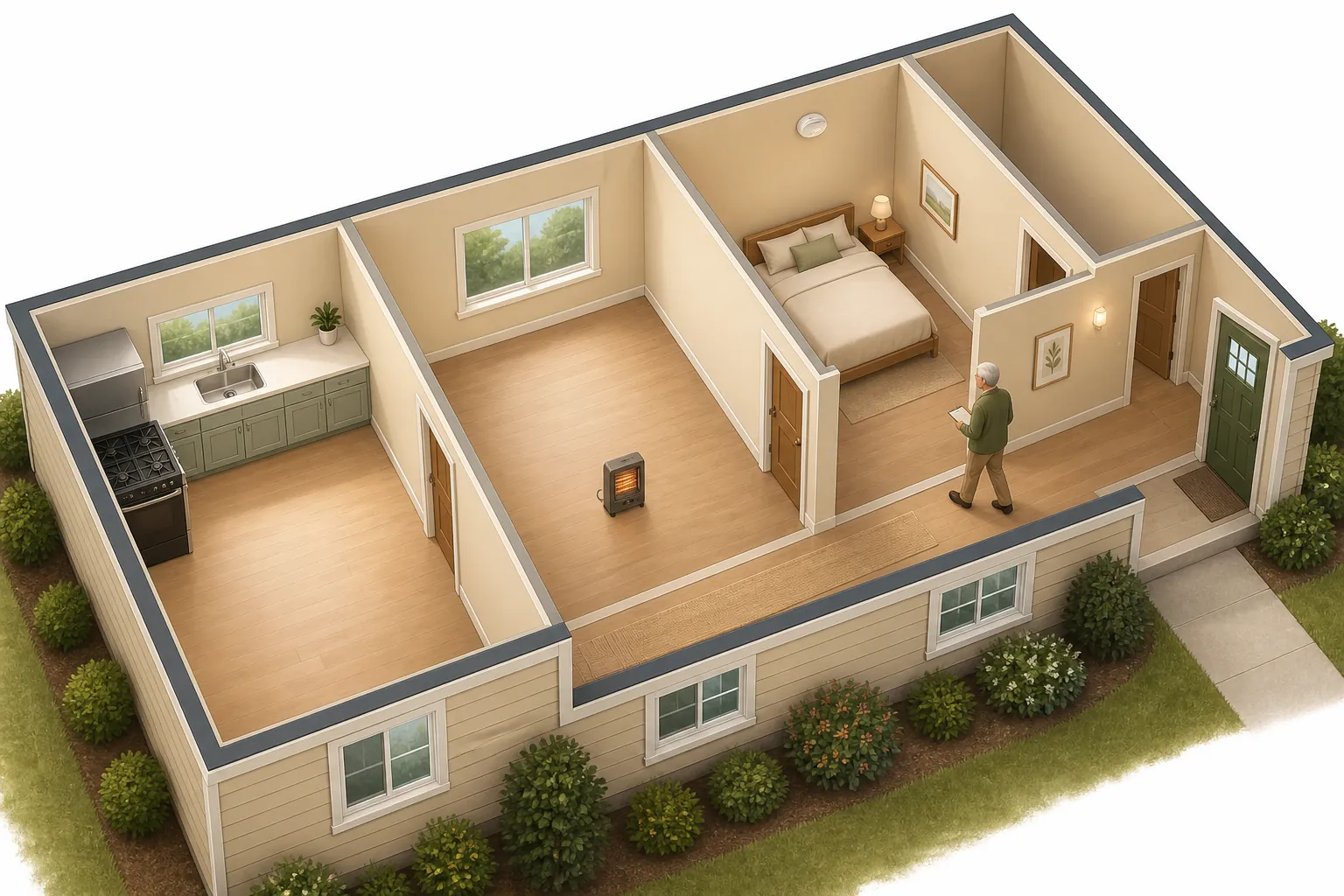
Walk the route in the order below. Mark an item complete only after physically checking it; “we have an alarm somewhere upstairs” is not the same as confirming one inside every bedroom, outside each sleeping area, and on every level.
| Area | Verify | Status / person responsible |
|---|---|---|
| Smoke alarms | Alarm in every bedroom, outside each sleeping area, and on every level; at least 10 feet from cooking appliances; wall units no more than 12 inches below the ceiling; interconnected, tested monthly, and less than 10 years old.[2] | □ Complete □ Fix needed Owner: ______ |
| Sleeping area | Resident can perceive the alarm from bed under usual sleeping conditions; phone, mobility aid, glasses, and a clear route are reachable. | □ Complete □ Fix needed Owner: ______ |
| Kitchen | Cooking area is uncluttered; controls are usable; combustibles are away from burners; resident can remain present and attentive while cooking. | □ Complete □ Fix needed Owner: ______ |
| Heating areas | Space heaters and other heating equipment have at least 3 feet of clearance from anything that can burn.[3] | □ Complete □ Fix needed Owner: ______ |
| Supplemental oxygen | No smoking; equipment is 5 to 10 feet from flames and heat; signs are posted; lotions used around the face are water-based.[4] | □ Complete □ Fix needed Owner: ______ |
| Living areas and bedrooms | Candles, smoking materials, overloaded outlets, damaged cords, and fabric touching heat sources are absent. | □ Complete □ Fix needed Owner: ______ |
| Halls and exits | Paths are clear, doors and windows open without delay, and usable escape routes match the resident’s current mobility. | □ Complete □ Fix needed Owner: ______ |
| Electrical and utility areas | No hot, discolored, loose, sparking, or buzzing outlets; no damaged cords; older wiring concerns go to a licensed electrician; water heater is set no higher than 120°F.[5] | □ Complete □ Fix needed Owner: ______ |
| Escape plan | Resident knows how to leave, where to meet, how to call 911 from outside, and who will provide any assistance that cannot be assumed. | □ Complete □ Fix needed Owner: ______ |
Why these checks deserve urgency
The age gradient is substantial. In the U.S. Fire Administration’s 2014–2023 series, adults 65 and older had 2.5 times the general population’s fire-death risk in 2023, with a rate of 33.0 deaths per million. The risk rose to 3.4 times the general population rate for people 85 and older, the highest risk of any age group in the series.[6]
Alarms remain a critical point of failure. NFPA’s analysis of home fires reported that 59% of home fire deaths occurred where smoke alarms were absent or did not operate: 43% in homes with no alarms and 16% where alarms were present but failed.[7] Separately, USFA’s 2024 estimates identify cooking as the leading cause of residential building fires, accounting for 46.7% of an estimated 343,000 fires.[8] Those findings explain why this audit spends more time on alarm performance and the kitchen than on decorative or low-consequence changes.
Living alone is common: AARP reports that about 24 million U.S. adults age 50 and older—21% of that population—live alone, as do half of adults 75 and older.[9] Those prevalence figures do not prove that living alone independently raises fire-death rates. They do identify a practical planning condition: at some hours, there may be nobody else in the home to hear an alarm, notice smoke, call for help, or assist with escape.
Start with the alarm and escape system
Count and place every alarm
Begin with a floor plan, even if it is only a rough sketch. Mark every bedroom, each separate sleeping area, and every level of the home. Then locate the actual alarms rather than relying on memory.
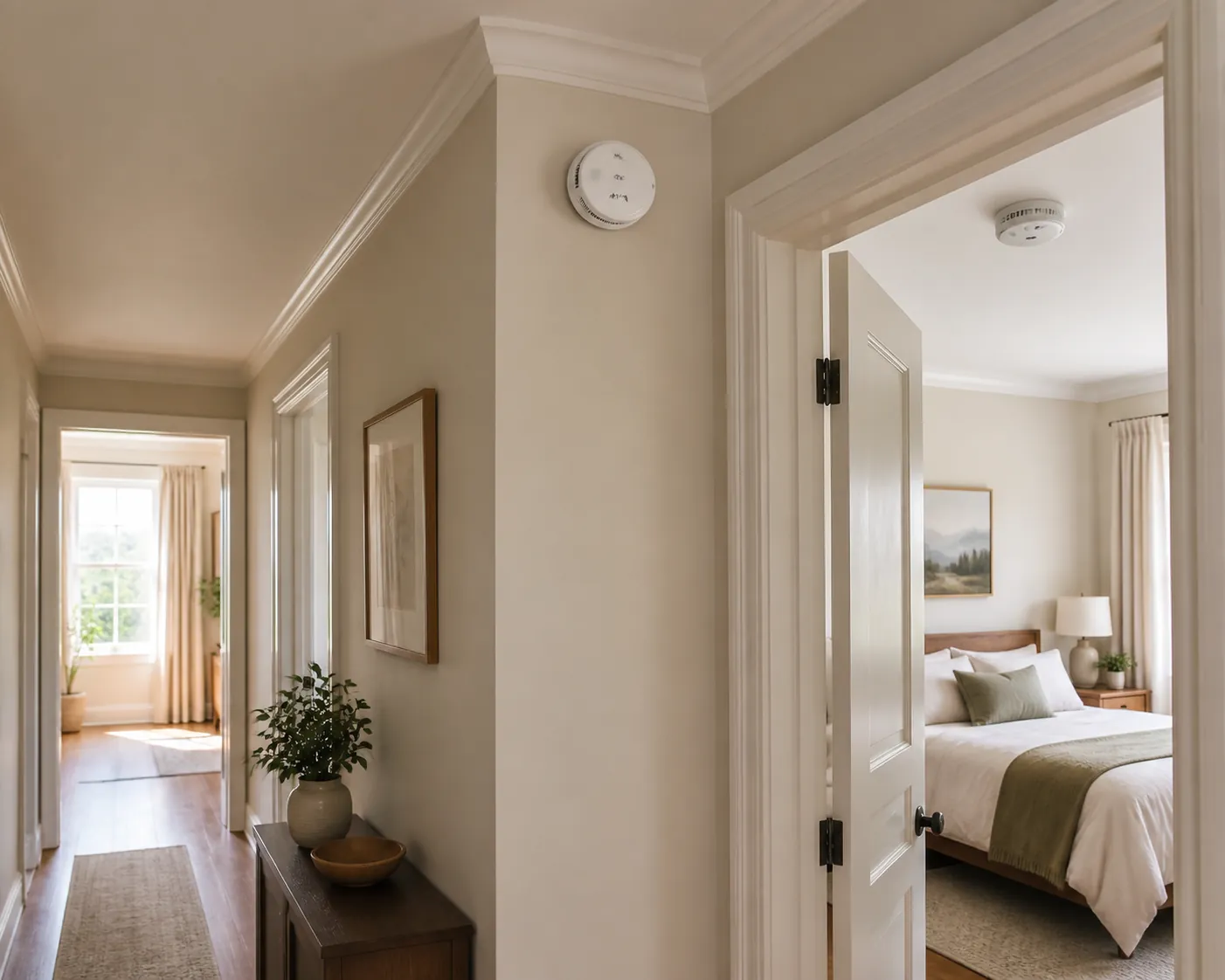
- Inside bedrooms: Confirm that every room used for sleeping has its own smoke alarm.
- Outside sleeping areas: Confirm an alarm in the hall or other space immediately serving each separate sleeping area.
- Every level: Confirm coverage on each story, including the basement.
- Near the kitchen: Measure from the cooking appliance. Install smoke alarms at least 10 feet away to reduce nuisance alarms without leaving the level unprotected.
- Wall-mounted alarms: Measure down from the ceiling. The top of the alarm must be no more than 12 inches below it.
- Interconnection: Activate one alarm and verify that all interconnected units sound. Compatible hardwired or wireless units can provide interconnection; installation must follow the manufacturer’s instructions.
NFPA calls for alarms in all of these locations, monthly testing, interconnection so that one alarm causes the others to sound, and replacement when an alarm is 10 years old.[2] If the date cannot be verified without climbing or removing a ceiling unit, assign that job to someone who can reach it safely.
Test what the resident actually perceives
A monthly button test verifies that an alarm can produce its test signal. The home audit must go one step further: determine whether the person living there notices that signal where it matters.
- Have a helper operate the test button while the resident is in the bedroom, using the door position and hearing aids—or lack of hearing aids—typical during sleep.
- Test interconnected alarms from more than one location. A working hall alarm does not establish that a distant or closed-off bedroom unit is connected.
- Ask the resident to describe what was heard or seen rather than asking only, “Did you hear it?” The signal should be unmistakable, not faint or easily confused with another appliance.
- If the audible signal is inadequate, consult the local fire department or a qualified alarm professional about compatible alerting equipment suited to the resident. Do not assume that turning up a phone notification solves a nighttime warning problem.
No older adult should have to climb a chair or step stool for routine testing. If the test button cannot be reached from the floor with a manufacturer-approved method, put another person’s name and the monthly test date on the schedule. A task without an assigned person is still an open item.
Connect warning time to a usable exit
Stand at the bed and follow the escape route all the way outside. Check it at night as well as during daylight, without staging a rushed or smoke-filled drill. The route has to work with the resident’s current balance, strength, vision, and mobility device—not the abilities they had when the furniture was arranged.
- Remove furniture, cords, rugs, baskets, and stored items that narrow the route.
- Confirm that required doors and windows open without excessive force and that keys are immediately available where permitted.
- Keep a needed cane, walker, glasses, and phone in consistent, reachable locations, while remembering that belongings must not delay escape.
- Identify an alternate exit where the home and the resident’s abilities allow one. Do not count a window as an escape route if the person cannot open it and reach a safe landing.
- For an apartment or an upper-floor room, use the building’s fire plan and professional guidance rather than improvising an escape that requires unsafe climbing.
Follow the ignition hazards through the house
Kitchen
Because cooking accounts for the largest share of residential building fires nationally, inspect the way the kitchen is used, not just whether the stove looks clean.[8] A safe setup still fails if arthritis makes a control difficult to turn off, low vision makes settings unreadable, or the resident regularly leaves the room while a burner is operating.
- Clear paper towels, mail, packaging, dishcloths, curtains, and other combustible material from the stovetop and adjacent heat.
- Do not use the oven or microwave as storage. Someone who cannot see an item inside may turn the appliance on without removing it.
- Check that burner and oven controls are readable, reachable, and easy for the resident to move deliberately to the off position.
- Turn pot handles inward without placing them over another burner. Keep a properly fitting lid nearby while cooking.
- Avoid loose sleeves and clothing that can cross a burner.
- Remain in the kitchen during active stovetop cooking. If attention, medication effects, or fatigue make that unreliable, change the cooking method or arrange assistance rather than relying on memory alone.
- If a pan ignites, prioritize escape and calling 911 from outside. Do not carry a burning pan through the home or pour water onto a grease fire.
Automatic stove shutoff equipment may be worth evaluating when burners are left on, but it is a product category rather than a guaranteed solution. Before choosing a device, ask:
- Is it compatible with the home’s electric, induction, or gas appliance and its controls?
- What condition triggers shutoff, and could ordinary cooking trigger it unnecessarily?
- Can the resident understand and safely reset it?
- What happens during a power or internet outage?
- Does installation require an electrician, gas professional, appliance technician, or permission from a landlord?
- Does it send information to another person, and has the resident agreed to that monitoring?
- Who will test and maintain it after installation?
Living areas and heating equipment
Heating equipment is the second leading cause of fire deaths among older adults, and the clearance rule is specific: keep anything that can burn at least 3 feet from heating equipment.[3] Measure the space instead of estimating it.
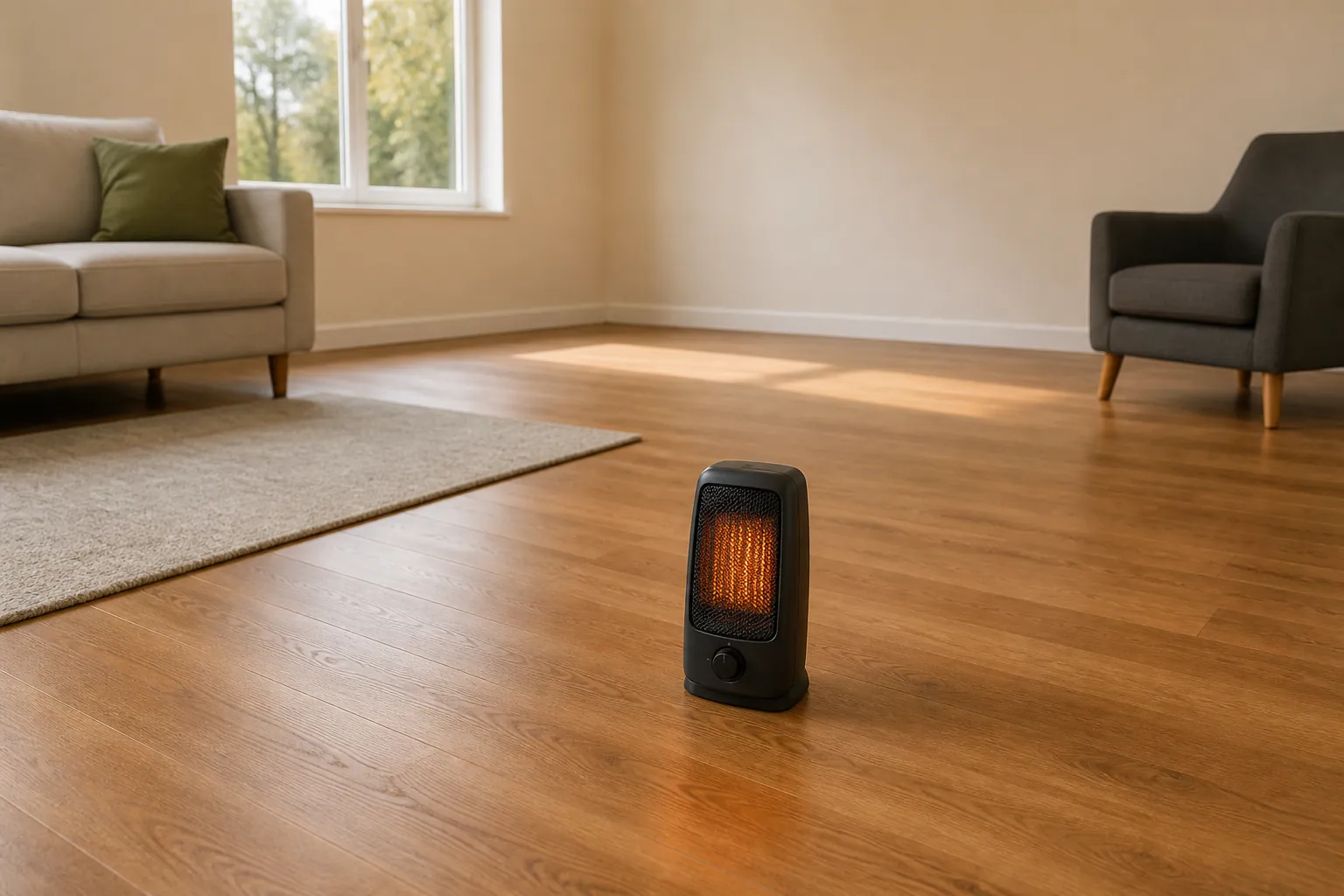
- Measure 3 feet outward from space heaters, fireplaces, stoves, furnaces, and other heating equipment. Remove chairs, blankets, bedding, curtains, newspapers, baskets, and clothing from that zone.
- Do not place a space heater where it narrows an exit route or where someone using a walker or wheelchair must pass close to it.
- Plug a portable heater into a suitable wall outlet as directed by its manufacturer, not into an extension cord or power strip.
- Turn portable heaters off before leaving the room or going to sleep.
- Stop using equipment with a damaged cord, loose plug, unusual odor, scorching, sparking, or repeated shutoffs. Have the equipment and outlet assessed rather than repeatedly resetting them.
- Do not use an oven or stovetop to heat the home.
- Arrange qualified inspection and servicing of fixed heating equipment according to its manufacturer’s instructions and local requirements.
Supplemental oxygen areas
Supplemental oxygen requires its own walkthrough. NCOA advises never smoking around oxygen, keeping oxygen 5 to 10 feet from flames and heat sources, displaying no-smoking signs, and using water-based rather than petroleum-based lotions on the face or upper chest.[4]
- Make the entire home a no-smoking area when oxygen is used or stored. A sign does not compensate for smoking indoors.
- Measure from oxygen equipment to candles, fireplaces, gas burners, space heaters, and other heat or flame sources. Maintain the 5-to-10-foot separation and follow any larger clearance required by the oxygen supplier or local fire authority.
- Post no-smoking and oxygen-in-use signs where visitors and responders can see them, consistent with local guidance.
- Check lotion, lip balm, and similar products used near the face. Replace petroleum-based products with water-based alternatives appropriate for the resident.
- Route tubing so it does not create a fall hazard or obstruct the exit, without pinching or altering equipment.
- Ask the oxygen supplier how cylinders and concentrators must be positioned, secured, ventilated, stored, and handled during a power outage. Follow those equipment-specific instructions.
Bedrooms
The bedroom check joins alarm warning, ignition control, and escape. Sit or lie where the resident sleeps and inspect what can be reached, heard, and navigated from that position.
- Verify the bedroom alarm and its audibility or other perceptible alert under usual sleeping conditions.
- Keep bedding, clothing, upholstered furniture, and curtains outside the 3-foot clearance zone around heating equipment.
- Remove candles and inspect electric blankets, heating pads, chargers, and lamps for damaged cords, scorching, or unsafe placement.
- Do not run cords under rugs, mattresses, bedding, or furniture where damage and heat may go unnoticed.
- Make sure a walker, cane, or wheelchair is positioned for immediate use without blocking the door.
- Check the route with nighttime lighting. Illumination should help the resident move safely without requiring a search for a small switch.
Hallways, stairs, and exterior exits
An exit is not usable merely because a door exists. Open every door and window included in the plan. Follow each route to a safe outdoor location.
- Maintain the full usable width of halls, stairs, landings, and doorways. Relocate packages, shoes, mobility equipment, decorative furniture, and stored supplies.
- Repair loose flooring, unstable rails, and other conditions that could make a rapid exit more dangerous.
- Check that security hardware can be released from inside without searching for a key or completing a confusing sequence, subject to local requirements.
- Make sure exterior paths are passable and that gates can be opened.
- Choose a fixed outdoor meeting place far enough from the building to avoid smoke, heat, and arriving emergency vehicles.
- Keep the street address visible and ensure the resident can state it when calling 911.
Electrical and utility spaces
Montgomery County Fire and Rescue Service notes that homes at least 40 years old are about three times more likely than newer homes to experience an electrical fire.[5] That comparison does not mean every older home needs rewiring. It does mean that recurring symptoms and undocumented alterations deserve an electrician’s attention rather than another adapter or extension cord.
- Look and listen for loose outlets, warm or discolored wall plates, buzzing, crackling, sparking, burning odors, and breakers that trip repeatedly.
- Replace damaged appliance and lamp cords; do not tape over deterioration and return the item to service.
- Remove extension cords used as permanent wiring and power strips connected to other power strips.
- Do not place cords under rugs or across walking routes.
- Keep the electrical panel reachable and labeled. Leave electrical repair and panel work to a qualified electrician.
- Keep combustible storage away from furnaces, water heaters, electrical panels, and other utility equipment, while preserving manufacturer-required service clearance.
- Check dryer lint controls and exhaust components according to the appliance manufacturer’s instructions; arrange service for a damaged, crushed, or obstructed vent.
Set the water heater no higher than 120°F, as recommended in Montgomery County’s older-adult checklist.[5] This is primarily a burn and scalding safeguard, not evidence that the setting prevents residential fires. If the control is inaccessible or unclear, have a plumber or maintenance professional verify the temperature rather than adjusting unfamiliar gas or electrical equipment.
Put recurring checks on the calendar
Testing intervals are useful only when someone is both named and able to perform the work safely. Put the date, result, and responsible person on a paper calendar or another system the resident already uses.
| Timing | Tasks | Record |
|---|---|---|
| Every month | Test every smoke alarm with its test button; confirm interconnected units sound; verify that the resident perceives the warning from the sleeping area; inspect exit routes, heating clearances, oxygen separation, and visible cords or outlets.[2] | Date: ______ Result: ______ Completed by: ______ |
| At least annually | Read the manufacture date on each smoke alarm; review the escape plan from the bedroom and main living area; check contact information; reassess whether doors, windows, and routes match current mobility; arrange required heating, oxygen, electrical, and appliance service. | Date: ______ Work assigned to: ______ |
| At 10 years | Replace each smoke alarm when it reaches 10 years of age. Replace it sooner if required by the manufacturer, if it is damaged, or if it fails testing.[2] | Alarm location: ______ Replace by: ______ |
| After any change | Repeat the relevant walkthrough after a move, fall, hospitalization, medication change affecting alertness, new oxygen use, new heater or cooking appliance, furniture rearrangement, renovation, or change in hearing, vision, or mobility. | Change: ______ Rechecked by: ______ |
Follow the alarm manufacturer’s instructions for battery replacement. Some alarms use replaceable batteries, while others have sealed batteries intended to last for the unit’s service life. A chirp or failed test needs prompt attention regardless of the calendar.
Practice an escape plan the resident can carry out
Write the plan around where the resident spends time: bed, favorite chair, kitchen, bathroom, and any outdoor area. Identify two ways out where usable routes exist, but do not count a staircase, window, or exterior ladder that the person cannot manage safely.[1]
- Start the practice from the bed or chair rather than from the front door.
- Have the resident recognize the alarm, move to the selected exit, open it, and continue to the outdoor meeting place.
- Call 911 only after reaching safety. During practice, say this step aloud instead of placing a test emergency call.
- Stay outside and do not re-enter for people, pets, medication, or possessions.
- Identify who, if anyone, is expected to assist. Confirm that the plan still works when that person is not immediately available.
Do not create fall risk by demanding a high-speed drill. The useful result is discovering that a lock is difficult, a walker catches on a rug, an alarm cannot be heard, or the presumed second exit is unusable. Correct those conditions and repeat the route calmly.
If the resident cannot reliably perceive the alarm or leave without assistance, a family promise to “get there quickly” is not an escape plan. Ask the local fire department and an appropriately qualified health or functional-assessment professional to help develop a plan based on the person’s home, building, mobility, cognition, hearing, and available support.
Assign work the resident cannot safely complete
Finish the walkthrough with a work list containing four fields: the exact problem, the person responsible, the deadline, and how completion will be verified. “Son will look at alarms” is too vague. “Jordan will test all six alarms from floor level and record each result by September 5” can be checked.
| Finding | Appropriate next contact |
|---|---|
| Missing, expired, inaccessible, or inaudible smoke alarms | Local fire department, participating Red Cross program, landlord or property manager, or qualified alarm installer |
| Hot, loose, discolored, sparking, or repeatedly tripping electrical equipment | Licensed electrician; stop using the affected outlet or equipment until assessed |
| Gas odor, damaged fuel-burning equipment, or heating malfunction | Leave the area when necessary and contact 911, the gas utility, or a qualified heating professional as appropriate |
| Supplemental oxygen placement or storage concern | Oxygen supplier and local fire department |
| Door, window, ramp, route, or mobility barrier | Qualified home-modification or functional-assessment professional, landlord where applicable, and local fire department for escape planning |
| Uncertainty about the whole plan | Local fire department’s non-emergency or community-risk-reduction contact |
The American Red Cross Sound the Alarm program is a resource to check for home fire-safety visits and free smoke alarm installation in participating communities.[11] Local fire departments may also offer alarms, installation, home visits, or escape-planning help. Availability, service boundaries, appointment capacity, and eligibility vary, so call or check the local program rather than assuming a service is offered.
Preserving independence does not require the resident to climb, perform electrical work, move oxygen equipment without guidance, or install alarms alone. It requires making each unfinished task visible and giving it to someone qualified to complete it.
References
- Fire Prevention — AARP
- Installing and Maintaining Smoke Alarms — National Fire Protection Association
- Home Fire Safety for Older Adults Safety Awareness Program Toolkit — Electrical Safety Foundation International
- Safety Tips for Using Supplemental Oxygen — National Council on Aging
- Fire Safety Checklist for Older Adults — Montgomery County Fire and Rescue Service
- Older Adult Fire Death and Injury Statistics — U.S. Fire Administration
- Smoke Alarms in US Home Fires — National Fire Protection Association
- U.S. Fire Statistics — U.S. Fire Administration
- Solo Aging — AARP
- Fire Safety for Older Adults — National Fire Protection Association
- Sound the Alarm. Save a Life. — American Red Cross
Related reading
This change typically needs a professional
Find a CAPS-credentialed professional or local aging services through our outbound resource list — we never name or rank individual contractors.
Find Local HelpNoticed something outdated or inaccurate on this page? Flag a correction. We review every report against CDC, NIA, and AARP HomeFit guidance before updating a page.