
Room checklist
Room-by-Room Earthquake Preparedness Tips for Seniors
A room-by-room walkthrough for preparing a senior's home before an earthquake, focused on the hazards most likely to cause injury — unsecured furniture, high shelves, glass, and blocked pathways — and how to fix them in a weekend without a contractor.
- Room
- whole-home
- Modification type
- furniture anchoring, safe storage
- Install complexity
- DIY-friendly; CAPS for structural fixes
- Reviewed by
- CAPS-credentialed professional
Most earthquake preparedness tips for seniors spend a lot of time on kits, contact lists, and documents. Those matter, but they are not where a home visit should start. Start with the tall bookcase beside the recliner, the glass-front cabinet in the dining room, the television balanced above eye level, the lamp on the narrow table, and the hallway a walker barely clears on a normal day.
ShakeOut’s safety guidance makes the practical reason plain: in recent U.S. earthquakes, falling and flying objects such as TVs, lamps, glass, and bookcases have injured far more people than collapsed buildings.[1] For an older adult aging in place, that means earthquake preparation is partly fall prevention with the floor moving underfoot.
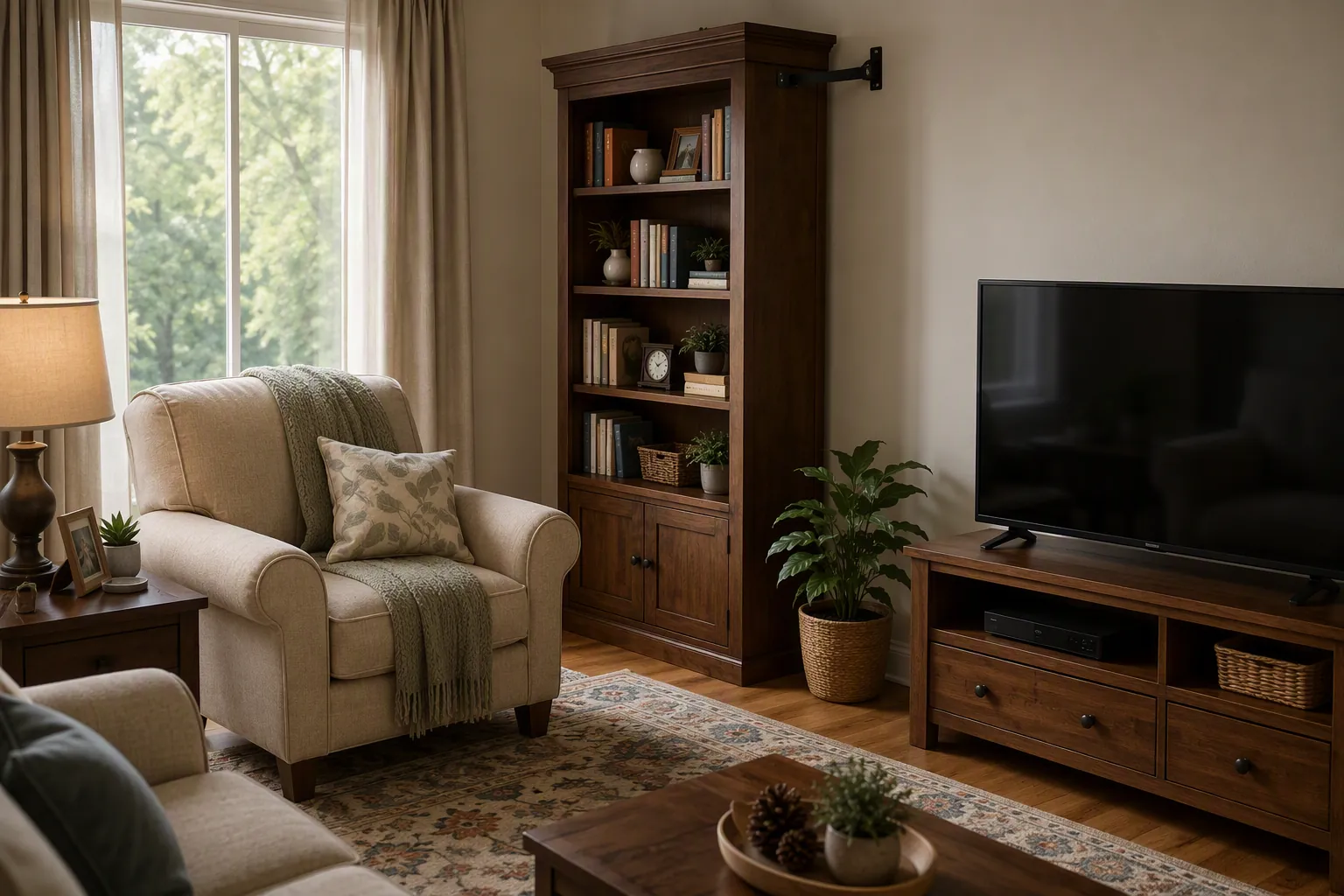
The Illinois emergency planning guide for seniors adds the caveat that changes the whole walkthrough: some older adults may not be agile enough to get under a sturdy table quickly.[2] That is not a failure of the person. It is a warning about the room. If the safe move takes speed, balance, a clear path, and a body that cooperates on command, the better weekend project is to remove the things most likely to fall, slide, shatter, or block the route in the first place.
The weekend pass: look for what can fall, shatter, slide, or block
Walk the home in the order a person actually uses it: where they sleep, where they sit, where they cook, where they bathe, and how they get out. In every room, ask the same plain questions:
- What could fall onto the bed, chair, toilet, shower seat, or main walking path?
- What could slide into the path of a cane, walker, wheelchair, or oxygen tubing?
- What could shatter at foot level?
- What is stored high because “it has always been there” but would be dangerous to reach during cleanup?
- If the power is out and the person is startled, what route still stays open?
This is not a design exercise. It is a hands-on pass. Lower the heavy things. Move the breakables. Clear the doorway. Add latches. Anchor obvious tip hazards. Put an extra cane or walker where it can be reached after the shaking, not in a closet behind the hazard that just fell.
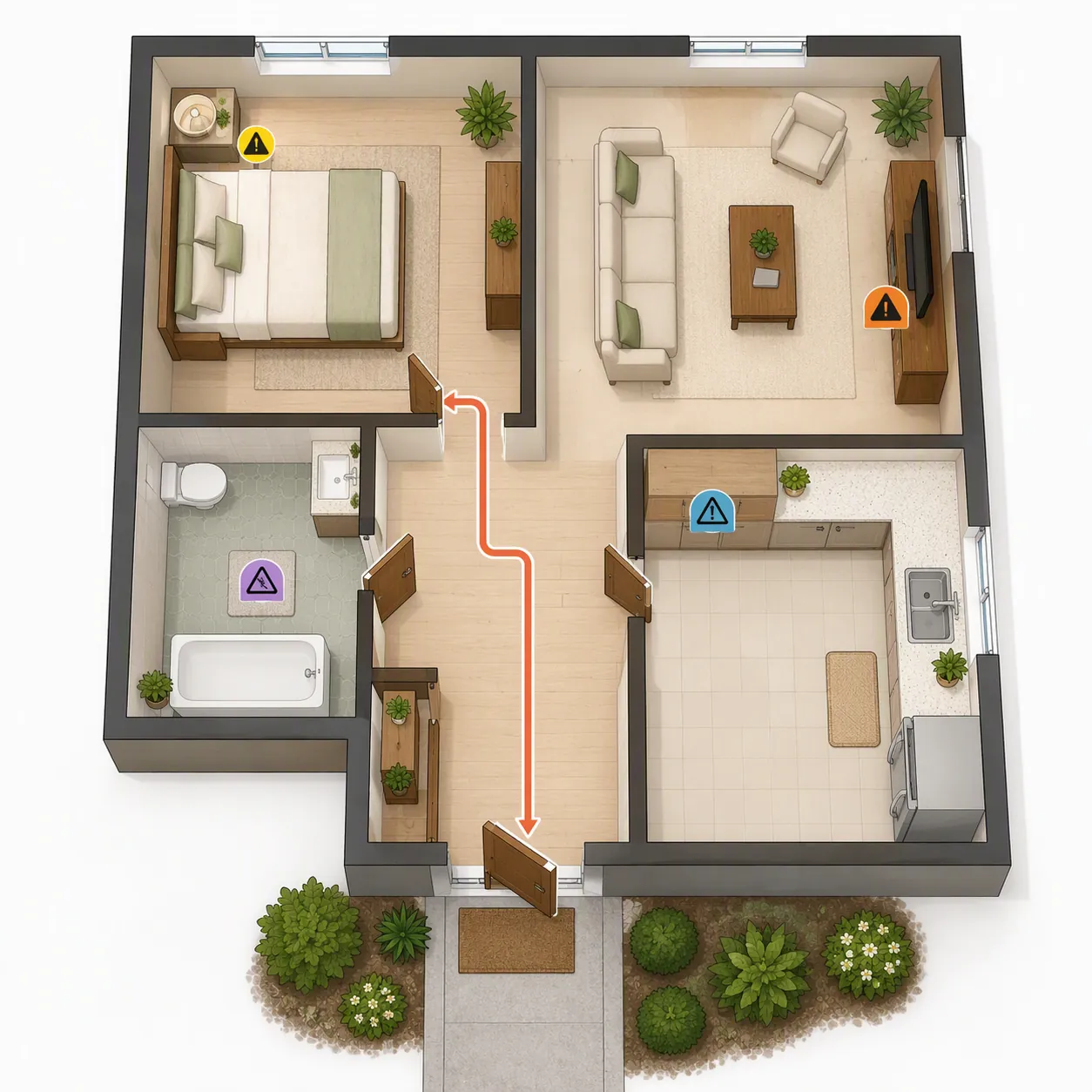
Bedroom: protect the first few seconds after waking
The bedroom deserves the first pass because a quake may happen when the older adult is asleep, barefoot, without glasses, and not fully oriented. The goal is simple: nothing heavy over the bed, nothing glassy beside the first step, and no blocked route to the door.
Move the bed away from windows if the room allows it. The Illinois senior guide specifically advises moving beds away from windows, and it also recommends putting heavy objects on low shelves and keeping doorways, halls, and exits clear.[2] That advice is not fussy. It keeps broken glass away from bare feet and keeps the path open for someone who may need a cane, walker, or steady hand on furniture.
- Remove framed pictures, mirrors, wall shelves, or heavy decor from above the bed.
- Move glass lamps, ceramic pitchers, and breakable keepsakes off the nightstand if they could land where feet go.
- Put a flashlight, glasses, shoes, and a walking aid within reach, but not on a high shelf or across the room.
- Lower heavy blankets, medical supplies, and storage bins from closet shelves to waist-height or lower.
- Check that the bedroom door opens fully and that no hamper, chair, plant stand, or storage basket narrows the exit path.
If there is a tall dresser, wardrobe, freestanding mirror, or bookcase in the room, treat it as a tip hazard. Ready.gov and the Red Cross both tell households to secure bookcases, televisions, wall-hung objects, refrigerators, water heaters, and heavy or breakable items before an earthquake.[3][4] A low, wide dresser with empty wall above it is one kind of problem. A tall dresser beside the bed is another. The second one should be anchored or moved.
The no-contractor work is mostly sorting and relocating. The installation work—anchoring a tall unit into studs, securing a wall-mounted object, or changing built-ins—may belong with someone who knows both home safety and aging-in-place needs. A CAPS-informed home-modification professional is a reasonable choice when the fix needs drilling, blocking, wall repair, or judgment about mobility equipment clearance.
Living room: fix the recliner zone, not just the “pretty” shelves
In many homes, the living room is where the real risk gathers. A favorite chair sits beside a tall bookcase. A lamp is perched on a small table. The television is too high or too loosely placed. A basket, magazine rack, plant stand, or footstool lives in the same strip of floor the walker needs.
Start at the chair where the older adult actually sits. From that seat, look up, beside, and along the first few steps toward the hallway or bathroom. Anything that could hit the person, break underfoot, or trap a mobility aid deserves attention before the decorative shelves across the room.
| Living-room hazard | Weekend fix |
|---|---|
| Tall bookcase or display shelf near a chair | Anchor it to wall studs or move the chair away until it can be secured. |
| Television on a narrow stand or high surface | Place it on a low, sturdy console; secure it if the setup allows. |
| Glass-front cabinet or china cabinet | Add cabinet latches, move heavy contents low, and relocate fragile items away from the main path. |
| Heavy books, speakers, vases, or storage boxes on upper shelves | Move heavy and breakable items to low shelves. |
| Plant stands, baskets, ottomans, cords, or small tables near walking routes | Clear the path wide enough for the person’s actual mobility aid, not an imaginary narrow route. |
The Illinois guide names bookcases, china cabinets, heavy appliances, hanging plants, medical equipment, cabinet latches, low storage for heavy objects, and clear exits as senior-specific earthquake planning items.[2] The important part is that these are also everyday fall-prevention items. A bookcase that tips in a quake is a hazard. A cord or plant stand that catches a walker on an ordinary Tuesday is also a hazard. Removing it helps twice.
If the room has a safe spot, make it usable. A sturdy table can be helpful for people who can reach it quickly, but the Illinois guide’s warning about limited agility matters here.[2] Do not choose a “safe spot” that requires crossing between the bookcase and the TV. If the person’s realistic action is to stay low near a chair and protect the head and neck, then the space around that chair should not be ringed with glass, lamps, and unstable furniture.
Kitchen and dining area: put weight low and latch what can swing open
The kitchen has two problems at once: heavy objects stored high and breakable objects stored behind doors that may fly open. It is also one of the last rooms where people admit the arrangement is unsafe, because every shelf has a history and every cabinet is “where it belongs.”
Start with the cabinets above shoulder height. Cast-iron pans, casserole dishes, large glass bowls, small appliances, bulk pantry items, and stacks of plates should not be stored where they can fall from overhead or require a step stool. Ready.gov and the Red Cross both advise storing heavy and breakable items on low shelves and securing household items that could cause injuries.[3][4]
- Move the heaviest cookware and serving pieces to lower cabinets.
- Keep daily-use dishes at a height the older adult can reach without climbing or stretching.
- Add simple cabinet and drawer latches where doors could swing open and spill glass or cans.
- Remove decorative bottles, ceramic pieces, and glassware from open shelves.
- Keep the floor around the refrigerator, stove, sink, and table free of rolling carts, step stools, pet bowls, and loose rugs.
Some kitchen items are not weekend handyperson work. Ready.gov and the Red Cross include securing refrigerators and water heaters in their earthquake guidance.[3][4] If a refrigerator, range, water heater, or tall pantry unit needs bracing, use qualified help. A bad anchor into weak material can create the feeling of safety without much safety.
In the dining area, look hard at china cabinets and hutches. A glass-front cabinet full of dishes is not just furniture; during shaking, it can become a wall of falling glass and plates. Add latches, move heavy contents to the bottom, and keep the walkway around the table open enough for the person’s actual turning radius.
Bathroom: keep the small room from becoming a trap
Bathrooms are already unforgiving for older adults: hard surfaces, water, tight turns, and few good places to recover balance. During or after a quake, the risks compound if glass jars fall, cabinet doors spill supplies, or a walker cannot clear the doorway because something shifted.
The first fix is to remove breakables from counters, toilet tanks, tub ledges, and wall shelves. Replace glass containers with lighter, nonbreakable ones where possible. Keep shampoo, soap, towels, and incontinence supplies low enough to reach without climbing, but not scattered on the floor.
- Latch vanity doors or medicine cabinets if they tend to swing open.
- Move heavy spare supplies from high bathroom shelves to a lower, closed cabinet.
- Remove freestanding narrow shelves unless they are secured and do not narrow the walking path.
- Keep the route from bed to bathroom clear at night, including space for a walker or cane.
- Check whether grab bars, shower chairs, raised toilet seats, and other supports remain stable if bumped.
If the bathroom already needs grab bars, threshold changes, better lighting, or a safer shower setup, treat the earthquake pass as one more reason to address it. For a broader fall-risk framework, CareWise Guide’s fall-prevention pillars explain why home modification belongs beside strength, medication review, and vision or footwear checks. In this article, the bathroom work stays practical: fewer breakables, clearer turns, and stable supports.
Halls and exits: a clear path counts only if a real walker can use it
A hallway can look clear to a standing adult child and still be too narrow for the person who lives there. Test it with the cane, walker, rollator, wheelchair, oxygen tubing, or laundry basket the older adult actually uses. Then imagine one object has fallen sideways.

The Illinois senior guide specifically says to keep doorways, halls, and exits clear and to keep extra walking aids in multiple rooms.[2] That second instruction is easy to overlook. If the walker is in the bedroom and the person is in the living room when shaking starts, the “plan” depends on crossing the house without the tool they need.
- Move plant stands, small tables, umbrella holders, shoe racks, and decorative baskets out of hallways.
- Remove heavy pictures, mirrors, or shelves from walls above narrow walking paths.
- Keep at least one route from bedroom to bathroom and bedroom to exterior door free of loose rugs and low furniture.
- Place an extra cane or walker where it can be reached from the main sitting area, bedroom, and another frequently used room if the person depends on one.
- Check that exterior doors open fully and are not blocked by furniture, stored boxes, or seasonal items.
This is where families often have to be gently stubborn. A hallway table may be pretty. A row of houseplants may have been there for years. But if a tipped plant stand blocks a rollator after the shaking, the person waiting on the other side pays the price.
Medical equipment, mobility aids, and the rooms that get forgotten
Any room with medical equipment needs its own short pass. The Illinois guide includes anchoring medical equipment among its senior-specific earthquake planning steps.[2] That can mean different things depending on the home: oxygen equipment, a hospital bed, a lift chair, a mobility scooter charger, a CPAP setup, or supplies stacked near a recliner.
Do not bury the useful equipment behind the neat equipment. If a backup cane is behind a stack of storage bins, it is not a backup. If oxygen tubing crosses a path where a cabinet door may spill contents, the path needs correction. If a lift chair is positioned beside an unsecured bookshelf because that is where the outlet is, the outlet did not make a safe plan.
- Keep charging cords routed away from walking paths.
- Place medical supplies in closed, reachable storage instead of on high open shelves.
- Do not store heavy backup supplies above a chair, bed, or toilet.
- Keep mobility aids parked where they do not block exits but can be reached from the person’s usual seat.
- Ask a qualified professional before anchoring or relocating equipment that affects breathing, transfers, electrical safety, or medical routines.
If the family is also deciding who can approve home changes, pay for modifications, or set up emergency monitoring, CareWise Guide’s caregiver decision pathway covers terms such as POA, CAPS, PERS, and caregiver roles. That paperwork can matter, but the room still needs the basket moved out of the walker path.
A fast checklist for the actual Saturday
A polished binder can wait. A two-hour walkthrough is enough to find the obvious dangers; a weekend is often enough to remove many of them. Use the first pass for decisions that do not require tools.
| Do first without a contractor | Set aside for qualified help |
|---|---|
| Move beds away from windows when the room layout allows. | Anchor tall bookcases, dressers, china cabinets, and wall-mounted objects into appropriate structural support. |
| Lower heavy and breakable items from high shelves. | Secure large appliances, refrigerators, water heaters, or complex built-ins. |
| Remove glass, lamps, and decor from fall zones near beds and favorite chairs. | Modify bathrooms, thresholds, grab bars, or doorways when mobility clearance or structural work is involved. |
| Clear halls, doorways, and exits for the person’s real mobility aid. | Relocate medical equipment or electrical setups that affect health or safe transfers. |
| Add simple latches to cabinets and drawers where appropriate. | Evaluate complicated homes with a CAPS professional, occupational therapist, or other qualified home-safety professional. |
After each room, pick one usable safe spot. For some older adults, that may be under a sturdy table if it is close and reachable. For others, the more realistic plan may be staying near a stable interior area, getting low if able, and protecting the head and neck without trying to cross a room full of hazards. The room should not demand agility the person does not have.
What not to let take over this project
Emergency kits, medication supplies, family contact plans, and document folders all have a place. They are simply not the spine of this particular job. If an older adult cannot get from the bed to the bathroom because a cabinet fell into the doorway, the perfect supply bin in the garage is not the first problem.
Insurance also deserves a short, sober mention. Ready.gov notes that standard homeowners and renters policies do not cover earthquake damage.[3] That is worth knowing and discussing with an insurance professional if property loss is a concern. It does not change the weekend work: secure the furniture, lower the weight, latch the cabinets, and clear the route.
For families who need a broader caregiving starting point, a structured 30-day plan for taking care of elderly parents can help sort priorities. For this pass, the priority stays inside the rooms.
Make the daily walking path safer first
A senior’s earthquake plan should not depend on quick reflexes and perfect timing. It should depend on a home where the obvious hazards have already been handled: the tall cabinet secured, the dishes lowered, the hallway cleared, the bed moved away from glass, the extra walking aid placed where a real person can reach it.
If the home is safer to walk through every day, it is also safer to be in when the floor starts moving.
This guide is for educational purposes only and is not medical, legal, financial, engineering, or individualized home-safety advice. Before relying on it for a specific older adult’s home, have the plan reviewed by a qualified occupational therapist, geriatric RN, CAPS professional, or other appropriately qualified local expert.
References
- Drop, Cover, and Hold On — ShakeOut
- Earthquake Preparedness for Seniors — Illinois Emergency Management Agency and Office of Homeland Security
- Earthquakes — Ready.gov
- Earthquake Safety — American Red Cross
Related reading
This change typically needs a professional
Find a CAPS-credentialed professional or local aging services through our outbound resource list — we never name or rank individual contractors.
Find Local HelpNoticed something outdated or inaccurate on this page? Flag a correction. We review every report against CDC, NIA, and AARP HomeFit guidance before updating a page.