Help for Elderly Parents: A Practical Action Plan for When You First Notice Something Isn't Right
Reviewed: 2026-06-30
Help for Elderly Parents: A Practical Action Plan for When You First Notice Something Isn't Right
This article provides a sequenced, five-phase action plan for adult children who have noticed warning signs in an aging parent but are unsure where to start — from assessing the situation objectively to building a coordinated support plan with available resources and funding options.
By Editorial Team
early-stage Alzheimer's
middle-stage Alzheimer's
late-stage Alzheimer's
wandering
sundowning
agitation
repetitive questioning
sleep disturbances
eating refusal
dementia communication
safety planning
hospice and end-of-life
BPSD
The hard part about looking for help for elderly parents is that it usually begins before anyone has a diagnosis, a care plan, or a clear emergency. There is just a pattern you can no longer explain away: food spoiling in the refrigerator, a medication bottle that should be emptier, a bill notice under a stack of mail, a new bruise, a parent who still sounds perfectly capable on the phone but is not keeping daily life together as reliably as before.
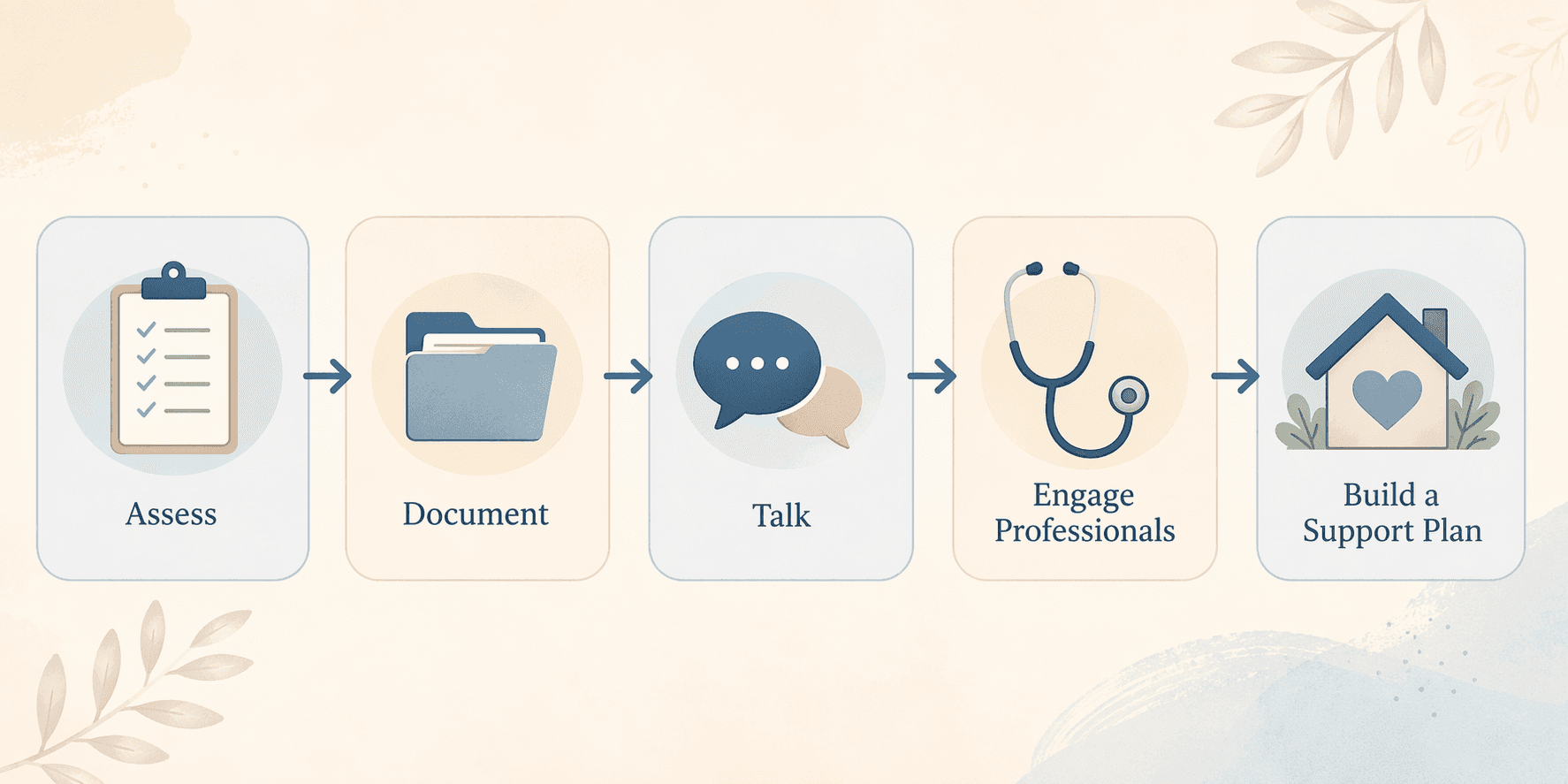
That gap matters. Families often lose weeks or months debating whether they are overreacting. A calmer approach is to stop trying to decide everything at once and move through five phases: assess what has changed, document what you find, talk with your parent, bring in professionals, and build support around the actual problems you observed.
A Five-Phase Plan for the First Few Weeks
This is not a test your parent passes or fails. It is a way to create a shared picture of reality before the family starts arguing from memory, guilt, or whoever happened to visit last.
A working file for doctors, siblings, agencies, and future decisions.
3. Talk
Use specific observations and shared next steps instead of accusations or role-reversal speeches.
A conversation that protects dignity while opening the door to help.
4. Engage professionals
Contact the primary care provider, ask about geriatric assessment, and call local aging resources.
Medical and community entry points instead of guesswork.
5. Build a support plan
Match services and family tasks to the needs you actually found.
A first plan for safety, meals, transportation, medication, supervision, and caregiver capacity.
Phase 1: Assess What Has Actually Changed
Start with observation, not diagnosis. The National Institute on Aging points families toward warning signs in the home environment, personal care, medications, memory and thinking, mobility, eating, mood, and social connection when deciding whether an older adult may need help.[1] That framework is useful because it keeps you from building the whole case around one frightening afternoon or one reassuring phone call.
Look first at activities of daily living: bathing, dressing, using the toilet, transferring from bed or chair, eating, and moving around safely. Then look at instrumental activities of daily living: managing medications, shopping, cooking, paying bills, using transportation, keeping appointments, handling the phone, and maintaining the home. A parent may still be warm, funny, and persuasive while one or two of these systems are quietly breaking down.
One missed bill is not the same as a pile of shutoff notices. One expired yogurt is not the same as a refrigerator full of spoiled food. One stumble is not the same as repeated falls, new bruises, or a parent avoiding stairs. The question is not whether your parent is aging. The question is what changed, how often it is happening, and whether the consequence could become unsafe before the next family visit.
Medication: missed doses, duplicate bottles, old prescriptions mixed with new ones, confusion about timing, or side effects that seem to be affecting balance or alertness.
Food and nutrition: visible weight loss, little fresh food, spoiled groceries, skipped meals, trouble cooking, or loss of interest in eating.
Safety and mobility: falls, bruises, burned cookware, getting lost, unsafe driving, trouble with stairs, or new fear of moving around the house.
Money and appointments: unpaid bills, unusual purchases, missed medical visits, insurance notices, or confusion about banking.
Hygiene and home condition: unwashed clothes, body odor, clutter blocking walkways, pests, spoiled trash, or a home that no longer looks like your parent’s normal standard.
Memory, mood, and connection: repeated stories that feel different from normal forgetfulness, withdrawal, increased suspicion, missed calls, or loss of regular social routines.
If the concern is mainly supervision — wandering, unsafe cooking, repeated falls, or being unable to respond in an emergency — a deeper look at signs your parent needs 24/7 care can help you separate ordinary support from round-the-clock safety needs. If the concern is whether the home itself can still work, compare what you are seeing with the practical markers in when aging in place is no longer viable.
When the Assessment Should Become a Doctor Visit
A doctor visit is justified when the changes are new, worsening, risky, or hard to explain. Sudden confusion, falls, medication problems, weight loss, poor nutrition, changes in hygiene, or a noticeable decline in daily function are not family drama; they are information a clinician needs. The NIA specifically encourages families to notice changes in daily life and seek medical input when concerns arise, rather than trying to determine the cause alone.[1]
Do not soften the facts so much that the appointment becomes useless. “Mom seems a little off” is easy to dismiss. “In the last three weeks, I found two missed cardiology appointments, three medication bottles with conflicting directions, and groceries that had spoiled in the refrigerator” gives the clinician something to evaluate.
Phase 2: Document Before Everyone’s Memory Starts Competing
Documentation is not busywork. It is how you keep the next doctor visit, sibling call, home-care intake, or agency referral from turning into a vague retelling of the same worry. The file can be a binder, a shared folder, or a notebook. The format matters less than whether the right information is in one place.
Current medication list: prescription drugs, over-the-counter medications, supplements, dose instructions, prescribing doctors, pharmacy name, and any bottles that do not match the list.
Provider contacts: primary care provider, specialists, dentist, pharmacy, preferred hospital, and insurance plan contacts.
Recent incidents: falls, missed appointments, unpaid bills, spoiled food, driving concerns, confusion episodes, emergency visits, or neighbors calling with concerns.
Baseline routines: usual meal pattern, transportation, social activities, bill-paying process, medication routine, sleep pattern, and who normally checks in.
Legal and planning documents: health care proxy, durable power of attorney, advance directive, will location, insurance cards, Social Security information, military service records if applicable, and long-term care insurance paperwork.
Write dates when you can. “Found unpaid electric bill on June 12” is more useful than “financial problems.” “Dad fell getting out of the shower on Saturday morning and did not call anyone until evening” is more useful than “fall risk.” You are not building a case against your parent. You are giving everyone a safer way to act on the same facts.
If siblings are involved, share the document early. The sibling who hears a cheerful ten-minute phone call may not understand what you saw in the kitchen, bathroom, or mailbox. A shared record prevents the whole family from voting on impressions.
Phase 3: Talk With Your Parent Without Turning It Into a Trial
Resistance is not automatically denial. It may be embarrassment, fear of losing the car, fear of being moved, fear of becoming a burden, or simple exhaustion from having adult children inspect ordinary life. The Caregiver Action Network describes the emotional strain that can come when adult children begin “parenting” elderly parents, including the tension around changing roles and preserving respect.[2]
Choose one or two specific observations, not the full audit. Sit where you can both leave the conversation with dignity. A useful opening sounds more like: “I noticed the new blood pressure medicine and the old bottle both on the counter, and I’m worried the instructions may be confusing. Can we call the pharmacy together?” It does not need a speech about independence, aging, or “what happens next.”
Lead with concern: “I’m worried because I saw…”
Use observable facts: “The appointment card was for last Tuesday,” not “You never remember anything.”
Offer a small next step: “Can we make one doctor appointment?” or “Can we set up one pharmacy review?”
Preserve choices: “Would you rather I go with you, or would you prefer I write down the concerns for you to bring?”
Avoid making one conversation carry every future decision.
If your parent refuses help but the risk is not immediate, keep documenting and narrow the next request. “Let’s have someone come in for four hours a day” may feel enormous. “Let’s ask the doctor whether the dizziness could be medication-related” is harder to experience as a takeover.
If there is immediate danger — chest pain, signs of stroke, serious injury, unsafe confusion, threats of self-harm, or a parent who cannot be left safely alone — treat it as urgent. This five-phase plan is for the uncertain first weeks, not for replacing emergency care.
Phase 4: Bring in Professionals Before the Family Becomes the Whole System
The first professional call is often the primary care provider. Ask for an appointment that specifically addresses functional changes, falls, medication management, weight loss, memory concerns, mood changes, or safety at home. If your parent agrees, send the written observations before the visit or bring them in a concise one-page version.
Use plain language when you schedule: “We are seeing changes in daily function and safety at home, and we want to know whether a medical issue, medication problem, cognitive change, depression, nutrition problem, or mobility issue could be involved.” That is different from asking the doctor to “prove Mom needs help.”
Ask About a Geriatric Assessment
A geriatric assessment can look more broadly at medical conditions, medications, cognition, mood, mobility, nutrition, daily function, social supports, and safety. The primary care provider may handle this directly or refer to a geriatrician, geriatric clinic, neurologist, physical therapist, occupational therapist, pharmacist, social worker, or other specialist depending on what the assessment shows.
If you are unsure whether to start with the regular doctor or a geriatric specialist, a comparison of a geriatrician versus a primary care provider can help you decide what kind of appointment fits the problem in front of you.
Call the Eldercare Locator
Medical care is only one part of help for elderly parents. For local services, the National Institute on Aging points families to the Eldercare Locator, a public service that can connect callers with their local Area Agency on Aging and other resources. The phone number is 800-677-1116.[3]
This is a practical first call because you do not need to know the name of every program. You can say, “My mother is missing meals and appointments, her medication system is confusing, and I need to know what local supports exist.” The person on the other end can help point you toward the relevant local entry points instead of leaving you to search one service at a time.
If dementia is one concern, say that carefully: “We are seeing memory changes and need evaluation and support,” not “She has dementia” unless there is already a diagnosis. Memory trouble can come from many causes, and the point of professional engagement is to stop guessing.
Phase 5: Build the First Support Plan Around the Problems You Found
A support plan should not begin as a catalog of senior services. It should begin with the facts on your page. If the problem is spoiled food, the plan needs meals and grocery support. If the problem is missed appointments, it needs transportation and scheduling. If the problem is falls, it needs a safety review, mobility evaluation, and possibly supervision. The NIA’s home-services guidance describes common supports such as meal delivery, transportation, home care, adult day care, personal emergency response systems, and help with household tasks for older adults living at home.[3]
Is the barrier shopping, cooking, appetite, memory, money, or swallowing?
Medication confusion
Pharmacy review, pill organizer reset, medication reminders, home health evaluation if eligible
Does the medication list match the bottles in the home?
Missed appointments or unsafe driving
Family ride schedule, local senior transportation, rideshare support, medical transport
Who is responsible for each appointment from scheduling through follow-up?
Falls, bruises, unsafe stairs, fear of bathing
Primary care visit, physical therapy, occupational therapy, home safety changes, personal care help
Has a clinician reviewed fall causes and home risks?
Isolation or daytime supervision needs
Adult day program, senior center, companion care, family check-ins
Is the main need social contact, meals, monitoring, or structured activity?
Caregiver exhaustion
Respite care, shared family schedule, paid help, support group, counseling
What tasks can the caregiver realistically sustain?
For hands-on help at home, it may be useful to compare home help for the elderly with broader elderly home care options. The distinction matters because companion help, personal care, home health, adult day programs, and residential care solve different problems.
Put One Person in Charge of Coordination, Not Everything
In many families, one adult child becomes the coordinator by default. That does not mean that person should become the entire care system. Coordination means keeping the medication list current, tracking appointments, updating siblings, and making sure services do not work at cross-purposes. It should not mean one person absorbs every ride, bill, phone call, emergency, and overnight worry.
Give siblings and relatives jobs that can be verified: Tuesday pharmacy pickup, monthly bill review, Sunday dinner, transportation to cardiology, insurance calls, home maintenance, or one weekend of respite. “Help more” sounds fair and produces resentment. “You handle transportation for the next two appointments” gives the plan a shape.
Check Funding Without Assuming Anything Is Covered
Funding is where families often get stuck, partly because the rules depend on the person’s insurance, income, assets, diagnosis, veteran status, state programs, and the type of care needed. The National Council on Aging identifies several possible entry points families may need to verify, including Medicare-related benefits, some Medicare Advantage supplemental benefits, Medicaid home- and community-based services waivers, VA programs such as the Program of Comprehensive Assistance for Family Caregivers and Aid and Attendance, and the GUIDE model’s respite-related support for eligible people with dementia.[4]
USA.gov also directs families to state Medicaid programs, Veterans Affairs benefits, and other government resources when asking whether a family caregiver can be paid.[5] Treat these as doors to knock on, not promises. Eligibility can change by state, plan, diagnosis, income, service type, and year.
If dementia is diagnosed or strongly suspected, the Alzheimer’s Association has a dementia-specific paying-for-care resource that discusses Medicare, Medicaid, VA benefits, long-term care insurance, and other planning considerations.[6] That resource belongs in the file if memory changes are part of the picture, but the first job is still to get medical evaluation and local support started.
For custodial help — bathing, dressing, supervision, meal preparation, and routine daily support — do not assume Medicare will pay just because the need is serious. A closer look at why Medicare does not usually pay for custodial home care can prevent planning around coverage that may not exist.
Build Caregiver Capacity Into the Plan
A plan that protects your parent while quietly exhausting the coordinator is not stable. Mayo Clinic’s caregiver-stress guidance names common strains such as feeling overwhelmed, sleeping too much or too little, losing interest in activities, becoming irritable, and neglecting one’s own health.[7] Those signs belong in the plan, not in a private pile of guilt.
Write down what you can do, what you cannot do, and what must be covered another way. If you work full time, live far away, have children at home, manage your own health condition, or are already the only reliable person in the family, that is not selfish information. It is a safety fact.
For the next layer of planning, a first-month roadmap such as The Adult Child Caregiver’s First 30 Days can help you turn the first support plan into a routine instead of a series of urgent favors.
What to Do Today
If you are at the kitchen-table stage right now, do not try to solve housing, driving, finances, diagnosis, and family roles before dinner. Pick the next action that reduces uncertainty.
Write down the three most concrete changes you have seen, with dates if possible.
Make a current medication list from the bottles in the home, not from memory.
Schedule a primary care visit or ask about a geriatric assessment if daily function, safety, memory, falls, weight, or medication use has changed.
Call the Eldercare Locator at 800-677-1116 and ask what local aging services fit the needs you observed.
Have one specific conversation with your parent about one specific concern and one next step.
Structured action in the first few weeks will not solve aging, reverse a disease, or guarantee family agreement. It does something more immediate: it turns vague worry into a baseline, a conversation, a professional entry point, and a first support plan that someone can actually follow.



Comments
Join the discussion with an anonymous comment.