
How to Pay for Elderly Home Care: A Practical Funding Guide for Family Caregivers
Most family caregivers are shocked to learn how little Medicare pays for long-term in-home care. This guide walks through the full funding landscape—Medicaid HCBS waivers, VA benefits, state paid leave, and tax breaks—so you can find the help you need without missing critical programs.
Most family caregivers learn how little Medicare covers when they’re standing in a hospital discharge planner’s office. A parent who needs help bathing, dressing, and cooking sits nearby. The planner says: “Medicare will send a nurse for a few weeks, but after that you are on your own.” The shock is real. And it is expensive.
The average out-of-pocket cost for family caregivers is about $7,200 a year — a figure from AARP data cited by NCOA, but based on 2021 spending. With home-care wages climbing, treat that as a floor, not a ceiling. Home care agencies charge $4,000 a month. Assisted living averages $64,200 a year. Memory care can hit $116,800. And 68% of caregivers report financial strain. The question isn’t “Is there help?” It’s “Can you qualify for it?”

What Medicare actually pays for — and what it doesn’t
This is the single most important fact: Medicare covers short-term skilled home health care, not long-term custodial personal care. It will pay for a visiting nurse to change a wound dressing or a physical therapist to help regain strength after a hip replacement. It will not pay for someone to help take a shower, get dressed, or prepare meals once the skilled need ends.
To get any Medicare home health coverage, your parent must be “homebound” — the official definition: leaving home requires considerable effort. The care must come from a Medicare-certified agency. Even then, the home health aide component is part-time, intermittent. The National Institute on Aging is clear: Medicare will not pay for adult day care, personal care, or 24-hour supervision. If your parent needs help with activities of daily living for more than a few weeks, Medicare is not the answer.
If skilled care ends and the need for help continues, read When Medicare Stops Paying for Home Health for what to do next.
First fork: Is your loved one a veteran or surviving spouse?
If yes, this is the most generous funding stream — and the one most families overlook. The VA’s Aid and Attendance Pension benefit and the Program of Comprehensive Assistance for Family Caregivers (PCAFC) can pay for home care, and in some cases pay a family member to provide that care. But do not assume it is quick. Aid & Attendance requires a clinical need for help with ADLs, and the application process can take months. The NCOA cautions that processing delays are common. There’s also Veteran-Directed Care, which gives the veteran a budget to hire their own caregivers — including family members. These programs exist, they can pay real money, but you need to start the paperwork now, not later.
If your parent is not a veteran and not a surviving spouse, move to the next fork.
Second fork: Can you meet the income and asset limits for Medicaid?
Medicaid’s Home and Community Based Services (HCBS) waivers are the largest source of public funding for in-home custodial care. They cover nonmedical help — bathing, dressing, meal prep, housekeeping — exactly what Medicare doesn’t cover. And in many states, self-directed programs let you hire and pay a relative as the caregiver.
Here is the catch: income limits vary enormously by state. As of 2024 data, the range is $914 to $2,742 per month. That is not a typo — the low end is $914 a month, the high end three times that. Some states also have asset limits (typically $2,000 to $10,000). A home and community based services waiver is what you need. To find your state’s actual limits, call the local Area Agency on Aging — they are the most reliable source for current figures.
Third fork: Does your state have paid family leave?
Paid family leave lets you take time off work while receiving partial wage replacement to care for a loved one. As of 2026, only 11 states plus Washington, D.C. have enacted paid family leave laws. Four more — Delaware, Maine, Maryland, Minnesota — will join by the end of 2026. That leaves 35 states with nothing.
If you live in one of the 11+4 states, the benefit typically replaces 50–70% of your wages for 6 to 12 weeks. It’s not enough to live on, but it can cover the gap while you arrange other funding. If you live in the other 35 states, skip this fork entirely.
- States with paid family leave as of 2026: California, Colorado, Connecticut, Delaware (2026), Maine (2026), Maryland (2026), Massachusetts, Minnesota (2026), New Jersey, New York, Oregon, Rhode Island, Washington, plus D.C.
- Typical benefit: partial wage replacement (50–70% of income) for 6–12 weeks.
- Job protection may require employer size thresholds — check your state’s rules.
Fourth fork: Is there a long-term care insurance policy?
Long-term care insurance is rare. Only 21% of adults 65 and older have it (Pew, 2026); among adults 50 and over it’s just 3% (NCOA). Both numbers are low. The point: most people do not have it.
If you do have a policy, check the ADL trigger — most pay when the insured needs help with two or more activities of daily living. Some policies cover home care, adult day care, and respite. Very few pay informal family caregivers directly. If the policy is there, it can help. If not, move on.
Private and tax options: filling the gaps
After public and insurance routes, most families face self-pay. But self-pay can be structured. A personal care agreement — a simple contract between the elder and a family member — lets you pay a relative from the elder’s assets without gift tax complications. It formalizes what you are already doing.
Tax deductions: medical expenses exceeding 7.5% of your adjusted gross income are deductible — but only if you itemize. Example: if your AGI is $60,000, you can deduct medical expenses over $4,500. If you pay $15,000 in home care, you deduct $10,500. That is real money. Also check the Credit for Other Dependents (up to $500) if you provide more than half the support for a qualifying relative.
Other private options include reverse mortgages (for homeowners over 62) and life insurance conversion (selling a policy for cash). Last-resort tools, but they exist.
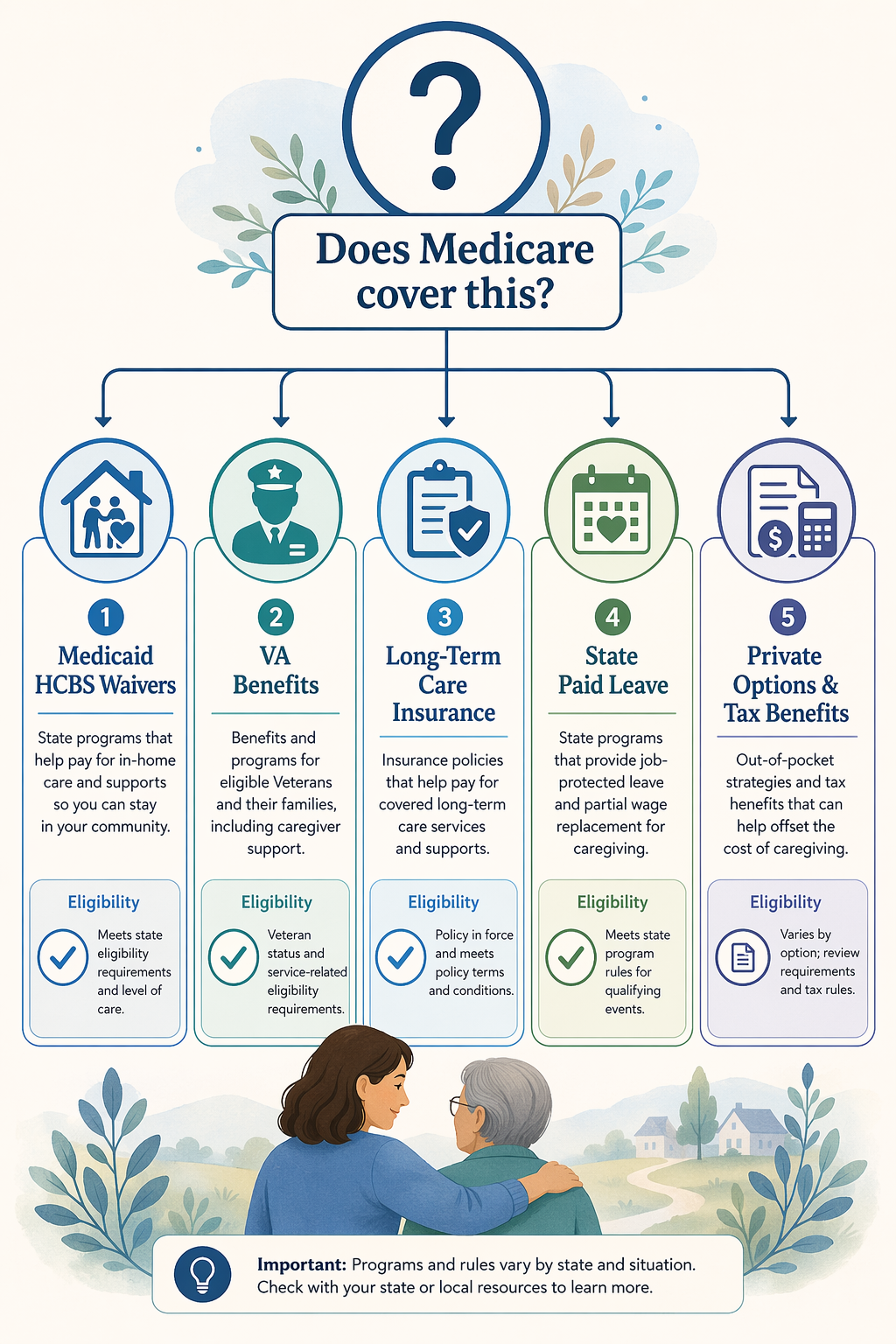
Your five-minute eligibility checklist
Work down this list. Each question is a yes/no gate. If yes, follow that branch. If no, move to the next.
- Is your loved one a veteran or surviving spouse of a veteran? → Check VA Aid & Attendance and PCAFC.
- Does your parent’s income and assets fall under your state’s Medicaid limits? → Contact the Area Agency on Aging for HCBS waiver info.
- Do you live in a state with paid family leave? → Apply for partial wage replacement.
- Does your parent have a long-term care insurance policy? → Review the ADL trigger and coverage.
- Can you structure self-pay with a personal care agreement, and does your tax situation allow itemizing medical expenses? → Use private and tax strategies.
For a broader overview, see Financial Help for Family Caregivers. That article organizes programs by ease of access; this guide is built around the Medicare surprise and eligibility forks. Use them together.
No single program will cover everything. But if you work through these forks systematically, you will likely find at least one paid path you didn’t know existed. Start with the first fork.
Related reading
Noticed something outdated or inaccurate on this page? Flag a correction. We review every report against CDC, NIA, and AARP HomeFit guidance before updating a page.
Part of the Fall Prevention section.