Senior Retirement Homes: A Complete Decision Framework for Family Caregivers
stage guideReviewed: 2026-06-20
Senior Retirement Homes: A Complete Decision Framework for Family Caregivers
This guide helps adult children and family caregivers navigate the confusing landscape of senior housing options. It breaks down five distinct facility types, provides a step-by-step selection process, and includes cost comparisons, payment strategies, and red flags to watch for during tours.
By Editorial Team
assisted living
nursing home
CCRC
memory care
independent living
Making an informed choice together — the goal of this decision framework.
The Terminology Trap: Why 'Senior Retirement Home' Isn't One Thing
When a parent's health crisis hits — a fall, a dementia diagnosis, a sudden functional decline — families often start searching for a "senior retirement home." The problem is that this phrase doesn't describe a single type of facility. It's an umbrella term that covers at least five distinct care environments, each with different costs, staffing, regulations, and resident profiles. Choosing the wrong one can mean paying for care your loved one doesn't need, or — worse — placing them in a setting that cannot safely meet their actual needs.
Consider this: according to the American Health Care Association and National Center for Assisted Living (AHCA/NCAL), 60% of assisted living residents transition to a skilled nursing facility after roughly two years. That statistic suggests that a significant number of families initially choose a care level that turns out to be insufficient. The cost of that mistake is not just financial — it includes the physical and emotional toll of moving an older adult twice within a short period, often during a period of declining health.
This guide exists to help you avoid that outcome. The core thesis is straightforward: match the care environment to the person's current ADL (Activities of Daily Living) needs first, then evaluate facilities using a structured checklist. We'll walk through each of the five facility types, what they cost, how they're regulated, and — most importantly — how to know which one fits your situation.
Quick-Decision Flowchart: Is It Time for a Facility?
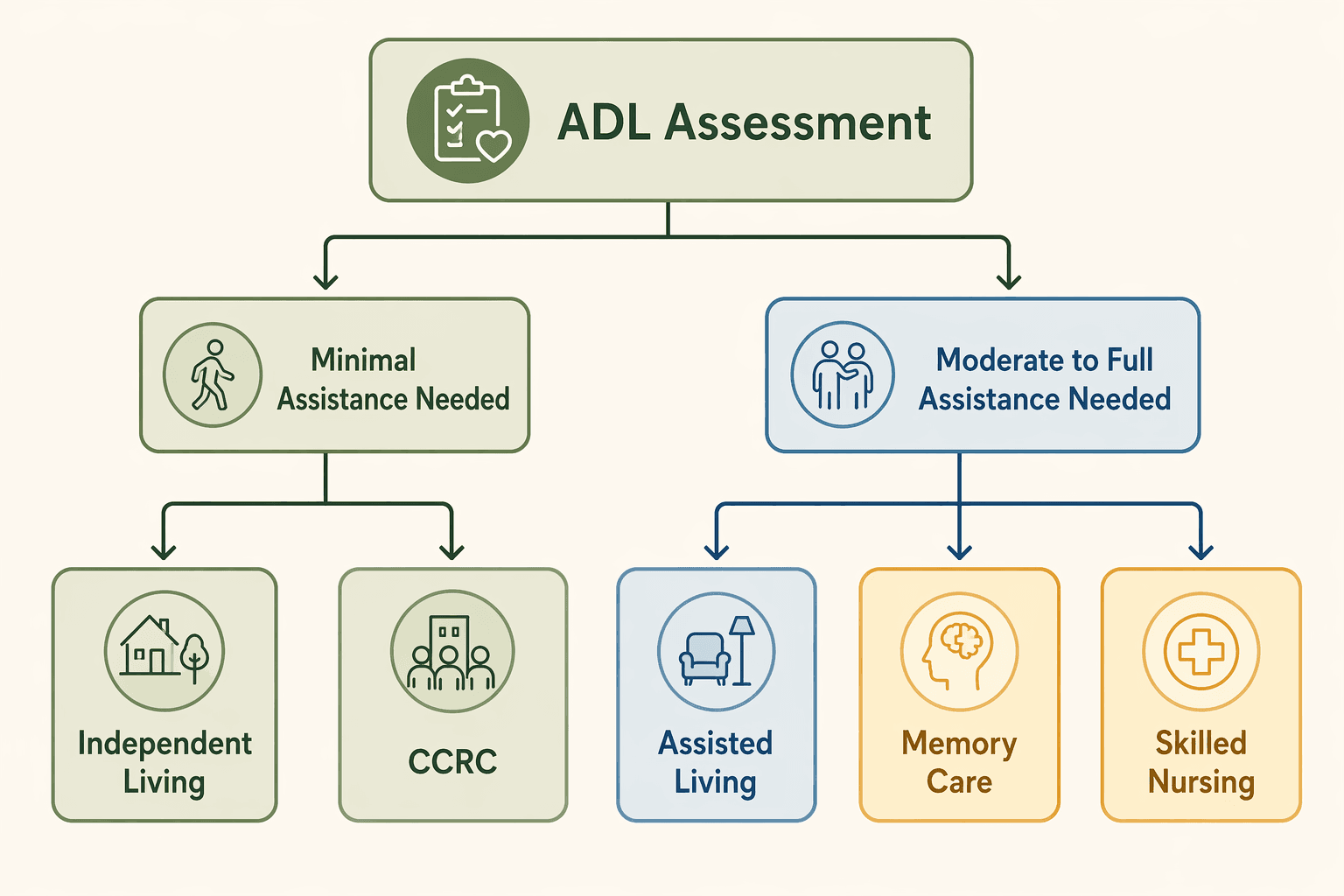
Start with an ADL assessment to determine which care level fits.
Before you can choose a facility type, you need to determine whether a facility is needed at all — and if so, at what level. The most reliable way to do this is to assess how much help the person needs with Activities of Daily Living (ADLs) and Instrumental Activities of Daily Living (IADLs).
ADLs include: bathing, dressing, toileting, transferring (moving from bed to chair), continence, and eating. IADLs include: managing medications, handling finances, preparing meals, transportation, housekeeping, and using the telephone or other communication devices.
Use the following decision points as a starting guide:
Needs help with 0–1 ADLs and no significant cognitive impairment? Independent living or a senior apartment may be sufficient. The person can still manage most daily tasks with minimal support.
Needs help with 2–3 ADLs (e.g., bathing and dressing) but is medically stable? Assisted living is the typical fit. These facilities provide personal care assistance, medication management, meals, and 24-hour supervision — but not skilled nursing.
Has a diagnosis of Alzheimer's or another dementia with behavioral symptoms (wandering, agitation, sundowning)? Memory care is the appropriate setting. These are secured, specialized units designed for cognitive impairment.
Needs 24/7 skilled nursing care, wound care, or post-hospital rehabilitation? Skilled nursing (nursing home) is required. These facilities are federally regulated and staffed with registered nurses around the clock.
Is currently independent but wants a guaranteed care continuum without moving again? A Continuing Care Retirement Community (CCRC) offers independent living, assisted living, and skilled nursing on one campus — but requires a large upfront entry fee.
If you're still unsure whether a facility is the right step, our guide Is It Time for a Senior Residential Home? provides a deeper discussion of the signs that indicate a transition may be necessary.
The Five Facility Types: Care Levels, Resident Profiles, and Costs
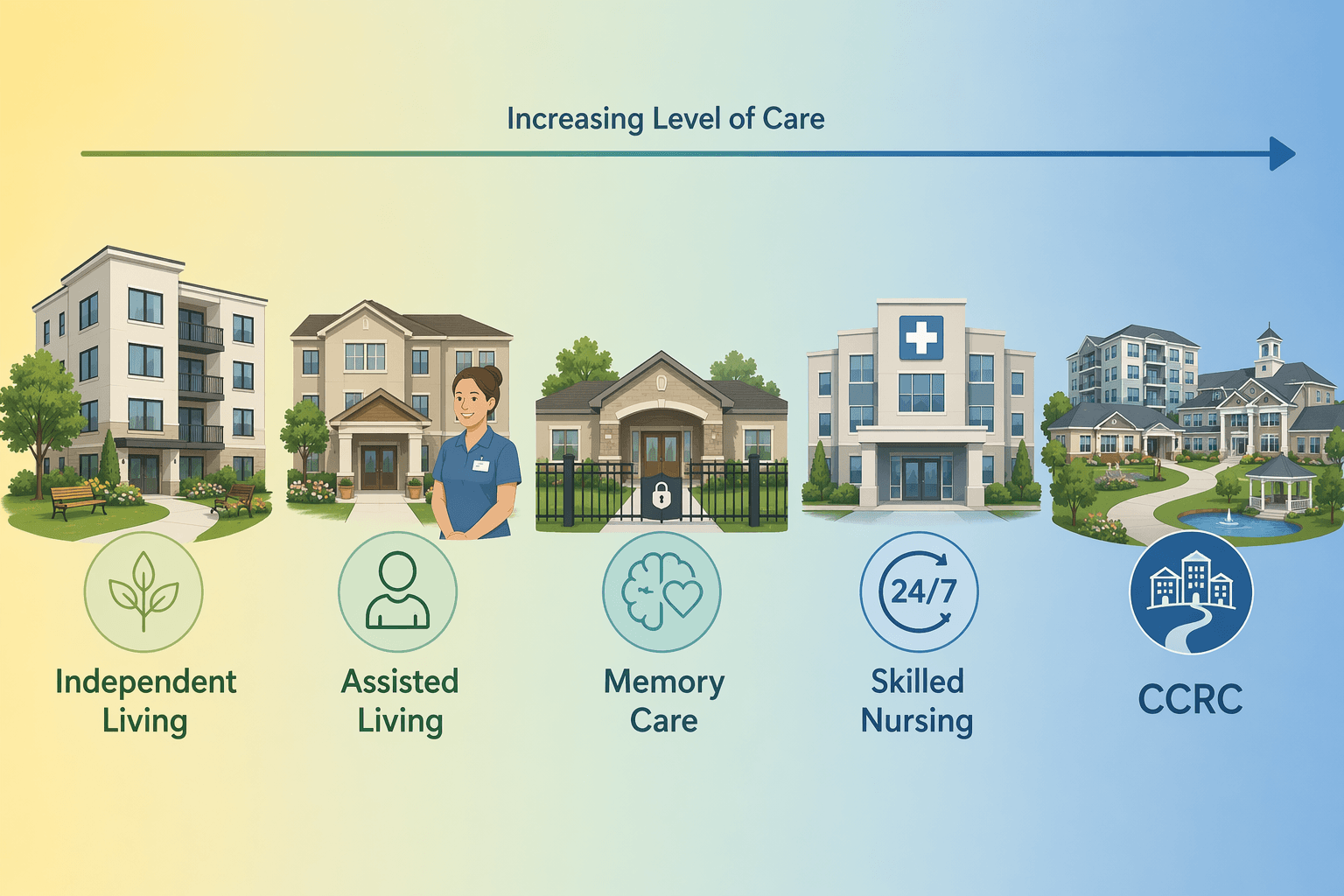
The five facility types arranged by increasing care level.
Each of the five facility types serves a different population. Understanding the distinctions — especially in regulation, staffing, and cost — is essential to making an informed choice.
1. Independent Living (Retirement Communities)
Independent living communities are designed for active older adults who need minimal to no help with daily activities. Residents typically live in private apartments or cottages and have access to communal dining, social activities, and amenities like fitness centers or transportation. No onsite caregivers are available 24/7, and these communities are not licensed to provide personal care or medical supervision.
The national median cost for independent living is approximately $3,200 per month (A Place for Mom, May 2026). Seniors-only apartments, a related option with fewer services, have a median of $1,678 per month. Regulation is minimal — these are housing, not healthcare facilities.
2. Assisted Living
Assisted living is the most common type of senior living for adults over 75 (SeniorLiving.org). According to AHCA/NCAL, more than 50% of residents need help with walking and bathing, and 42% have Alzheimer's or another dementia. Residents typically live in their own apartments and receive help with up to 2–3 ADLs, medication management, meals, housekeeping, and 24-hour supervision. Caregivers are onsite around the clock, but registered nurses are not necessarily present at all times.
The national median cost of assisted living is $6,313 per month ($75,756 per year) as of May 2026 (SeniorLiving.org). However, costs vary dramatically by state: from $4,715 per month in Mississippi to $12,000 per month in Hawaii. Memory care, a specialized subset of assisted living, can increase costs by an additional 10–15%.
3. Memory Care
Memory care units are secured, specially designed environments for individuals with Alzheimer's disease or other dementias. Staff receive specialized training in dementia care, and the physical environment is designed to prevent wandering and reduce agitation. These units are often located within assisted living facilities or nursing homes, though standalone memory care communities also exist.
Costs are higher than standard assisted living — typically 10–15% more — but generally lower than skilled nursing. The exact figure depends on location and the level of behavioral support required.
4. Skilled Nursing (Nursing Homes)
Skilled nursing facilities provide 24/7 medical supervision and are staffed with registered nurses, licensed practical nurses, and certified nursing assistants. They are appropriate for individuals who need ongoing medical care, wound care, post-hospital rehabilitation, or assistance with all ADLs. Unlike assisted living, nursing homes are federally regulated by the Centers for Medicare & Medicaid Services (CMS) and receive star ratings based on health inspections, staffing, and quality measures.
The national median cost for a semiprivate room is $9,555 per month ($114,665 per year), and a private room is $10,965 per month ($131,583 per year) (Genworth 2025, cited by SeniorLiving.org). These costs are roughly double the median for assisted living, reflecting the higher staffing and medical care requirements.
5. Continuing Care Retirement Communities (CCRCs)
CCRCs offer a full continuum of care — independent living, assisted living, and skilled nursing — on a single campus. Residents can move between levels as their needs change without leaving the community. This model reduces transition trauma (LTCFEDS.gov) but comes with a significant financial commitment.
CCRCs typically charge a large upfront entrance fee plus monthly fees. According to CBRE, the average entrance fee is approximately $402,000; the National Investment Center (NIC) reports an average of nearly $490,000. Monthly fees range from $3,000 to $5,000 (SeniorLiving.org). Some CCRCs offer partially refundable entrance fees, and a small number operate without an upfront fee. These communities are generally aimed at middle- to upper-income households, and residents often sell their primary home to fund the entry cost.
Cost Comparison Table: What You'll Really Pay
The table below summarizes national median costs for each facility type. Use it as a starting point for budgeting, but remember that actual costs vary by state, city, and the specific services your loved one requires.
National median monthly costs for senior housing types (2025–2026 data). Actual costs vary by location and level of care.
Facility Type
National Median Monthly Cost
Key Cost Drivers
Source / Year
Senior Apartment
$1,678
Rent, basic utilities
A Place for Mom, 2026
Independent Living
$3,200
Rent, meals, activities, transportation
A Place for Mom, 2026
Assisted Living
$6,313
Personal care, medication management, meals, 24/7 supervision
SeniorLiving.org, May 2026
Memory Care
$6,944 – $7,260 (est.)
Secured unit, specialized dementia care, behavioral support
10–15% above assisted living
CCRC (monthly fee)
$3,000 – $5,000
Plus entrance fee of $402,000 – $490,000
SeniorLiving.org; CBRE; NIC
Nursing Home (semiprivate)
$9,555
24/7 skilled nursing, medical care, rehabilitation
Genworth 2025
Nursing Home (private)
$10,965
24/7 skilled nursing, private room
Genworth 2025
To put these numbers in perspective: the average Social Security benefit as of January 2026 is $2,071 per month (SeniorLiving.org). That covers only about 33% of the median assisted living cost. Most families need to combine multiple funding sources to afford facility-based care.
Step-by-Step Selection Process: From Needs Assessment to Contract Review
Once you've identified the general facility type that matches your loved one's needs, the real work begins. Use this five-stage process to narrow your options and make a confident decision.
Stage 1: Formal Needs Assessment
Before touring any facility, get a professional assessment of your loved one's functional and medical needs. A geriatric care manager, primary care physician, or hospital discharge planner can help. Document the specific ADLs and IADLs that require assistance, any chronic medical conditions, cognitive status, and behavioral symptoms. This assessment becomes your benchmark for evaluating whether a facility can actually meet those needs.
Use the Eldercare Locator (800-677-1116) and Medicare's Care Compare tool to find facilities in your desired geographic area. For nursing homes, CMS star ratings provide a quick quality screen. For assisted living, you'll need to rely more on state inspection reports and word-of-mouth. Aim for a shortlist of three to five facilities.
Stage 3: Tour Facilities Using a Structured Checklist
The National Institute on Aging (NIA) and Medicare provide checklists for evaluating facilities during visits. Adapt your checklist to include the following:
Medicare/Medicaid certification and state licensing status
Cleanliness and odor (especially in common areas and bathrooms)
Staff-to-resident ratio and staff turnover rates
Warmth of interactions between staff and residents
Planned activities and resident engagement
Availability of a physician who checks on residents regularly
Special unit for dementia care (if applicable)
Visit unannounced at different times of day — including evenings and weekends — to get an honest picture of daily life. Talk to residents and family members if possible.
The NIA advises reading the contract thoroughly before signing. Pay attention to: what services are included in the base monthly fee versus what costs extra; the process for rate increases; the policy on eviction or discharge; the refund policy for entrance fees (if applicable); and the terms for transitioning to a higher level of care within the facility. If anything is unclear, ask for clarification in writing.
Stage 5: Develop a Payment Strategy
Before committing, map out how the care will be paid for over the expected duration. The next section covers the major funding sources in detail.
How to Pay for Senior Care: A Guide to Funding Sources
According to SeniorLiving.org, 70% of older adults will need some form of long-term care. Yet most families are unprepared for the cost. Here are the primary payment sources and how they work.
Out-of-Pocket Savings
Most people pay for assisted living entirely out of pocket. The NIA states that Medicare does not pay for assisted living room and board or ADL assistance. For nursing homes, Medicare may cover the first 100 days after a hospital stay (with conditions), but it does not cover long-term custodial care.
Long-Term Care Insurance
Policies vary widely. Some cover assisted living, memory care, and nursing home care; others cover only skilled nursing. Review the policy's elimination period, daily benefit amount, and benefit period carefully. If your loved one does not already have a policy, it may be too expensive or unavailable to purchase now.
VA Aid & Attendance Pension
Qualifying veterans and their surviving spouses may be eligible for the VA Aid & Attendance Pension, which provides additional monthly funds to help cover the cost of care. Eligibility requires a net worth of less than $163,699 (SeniorLiving.org, May 2026). This benefit can be used for assisted living, nursing home care, or in-home care.
Medicaid HCBS Waivers
Medicaid covers nursing home care for eligible individuals. For assisted living, coverage depends on whether the state offers Home and Community-Based Services (HCBS) waivers. According to AHCA/NCAL, 17% of assisted living residents rely on Medicaid to pay for daily services. Medicaid HCBS spending reached $145.9 billion in fiscal year 2023, representing 63.8% of total Medicaid long-term services and supports spending. However, waiver availability and eligibility criteria vary significantly by state.
Red Flags During Facility Tours: What to Watch For
Because assisted living is state-regulated only — with no federal CMS star ratings — families must act as their own inspectors. During tours, watch for these warning signs:
High staff turnover: Ask how long the average staff member has been employed. High turnover is a strong indicator of poor management and inconsistent care.
Poor cleanliness or persistent odors: Common areas, bathrooms, and resident rooms should be clean and odor-free. Unpleasant smells suggest inadequate housekeeping or insufficient incontinence care.
Lack of resident engagement: Are residents sitting alone in hallways or staring at walls? Are there planned activities visible? An engaged community is a healthier one.
Inadequate staffing levels: Ask about the staff-to-resident ratio during the day, at night, and on weekends. Understaffing leads to delayed responses to call lights and rushed care.
Reluctance to answer questions: If staff are evasive about turnover rates, inspection results, or complaint histories, consider it a serious red flag.
For nursing homes, you can check CMS star ratings online before your visit. For assisted living, contact your state's health department or long-term care ombudsman for inspection reports and complaint records.
Decision Summary Matrix: Matching Your Loved One to the Right Facility
Use the matrix below as a final quick-reference tool. It maps common care needs to the recommended facility type(s).
Quick-reference matrix matching care needs to facility types.
Care Need Profile
Recommended Facility Type(s)
Key Consideration
Minimal assistance, active, no cognitive impairment
Independent Living or Senior Apartment
No 24/7 care available; must be able to manage independently



Comments
Join the discussion with an anonymous comment.