
Senior Care Options in 2026: A Decision Framework for Family Caregivers
A stage-based framework to help family caregivers match senior care options to actual needs, with 2026 cost data and payment guidance, so they can plan before a crisis forces a rushed choice.
The first senior care decision is usually made too late: after a fall, a discharge planner’s call, a medication mistake, or the moment a spouse admits that nights are no longer manageable. Before anyone starts touring communities or hiring an aide, the useful question is narrower: what help is actually needed, who can reliably provide it, and for how long?
Senior care in 2026 is not one thing. It is a continuum that can start with a few hours of help at home and end with 24-hour skilled nursing. The right level is not determined by a family’s preferred label. It is determined by daily function, cognitive status, safety risk, caregiver capacity, and the payment plan that will still hold six months from now.

Start With Need, Not With a Facility List
A structured assessment should look at more than whether an older adult can still “manage at home.” The National Institute on Aging frames the question across home environment, mental health, physical health, and memory or cognition. That is a better starting point than asking whether Mom is “ready” for assisted living, because readiness is often a family argument. Bathing, eating, medication management, wandering risk, unpaid caregiver sleep, and the stairs to the bedroom are observable facts.[1]
The stakes are not rare or theoretical. About 70% of adults turning 65 will need some form of long-term care during their lifetime.[2] Most older adults want to remain at home, and more than 90% prefer to age in place, but only about 10% of homes are considered aging-ready.[3] Only about 5% of older Americans live in nursing homes, which means most care happens somewhere else, often with family absorbing the work.[4]
That family labor is already enormous. AARP’s 2025 caregiving report counted 53 million Americans providing unpaid care, or 63 million when including all caregivers.[5] When a care plan quietly depends on a daughter leaving work early three days a week or a spouse sleeping in short pieces to prevent nighttime wandering, that is not a sentimental detail. It is part of the care level.
The 2026 Senior Care Continuum
The table below is not a shopping menu. It is a first-pass map. Costs are national medians or reported estimates, so local quotes can move sharply by state, city, staffing needs, and dementia progression.
| Care option | Best fit when | 2026 cost signal |
|---|---|---|
| Companion or homemaker help at home | The older adult mainly needs help with meals, errands, transportation, light housekeeping, reminders, or supervision | Non-medical home care runs about $34-$35 per hour nationally; 44 hours per week is about $80,080 per year |
| Personal care aide at home | Hands-on help is needed with bathing, dressing, toileting, transfers, or eating, but the home is still safe enough with scheduled support | Usually billed hourly; costs rise quickly as hours increase |
| Adult day program | The older adult needs daytime structure, meals, social contact, or supervision while a caregiver works or rests | About $100 per day, or roughly $2,167 per month |
| Assisted living | The person needs regular help with daily activities, meals, medication support, and a safer residential setting, but not 24-hour skilled nursing | About $5,900-$6,200 per month nationally |
| Memory care | Dementia-related safety risks, wandering, agitation, or supervision needs exceed what ordinary assisted living or family care can manage | About $6,450 per month nationally, with reported state ranges from about $4,000 to $11,000 |
| Skilled nursing facility or nursing home | The person needs 24-hour nursing oversight, complex medical care, rehabilitation after qualifying hospitalization, or long-term institutional care | About $9,581 per month for a semi-private room and $10,798 per month for a private room |
| Continuing care retirement community | The older adult can enter at a lower level of need and wants access to higher levels of care on one campus as needs change | Costs vary widely by contract type, entrance fee, monthly fee, and care level |
CareScout’s long-term care cost data puts non-medical home care at about $34 to $35 per hour nationally, adult day programs near $100 per day, assisted living around $5,900 to $6,200 per month, a semi-private nursing home room at $9,581 per month, and a private nursing home room at $10,798 per month.[6] A Place for Mom reported a national median memory care cost of $6,450 per month in its 2025 figures, with state-level ranges from about $4,000 to $11,000.[7]
These numbers matter because many families are planning around prices that no longer exist. In a 2024 SingleCare survey, 56% of adults believed assisted living cost less than $4,000 per month.[8] That misunderstanding does not merely create sticker shock. It delays planning until the choices are worse and the caregiver has already been stretched thin.
Match the Care Level to the Actual Pattern of Help
Most families begin with a setting: home, assisted living, nursing home. Begin instead with the pattern of need. Activities of daily living, or ADLs, are the body-level tasks: bathing, dressing, toileting, transferring, eating, and continence. Instrumental activities of daily living, or IADLs, are the management tasks that keep life running: shopping, cooking, transportation, money management, medication organization, housekeeping, and communication.
A parent who forgets bills, misses appointments, and has stopped cooking may not need assisted living immediately. Companion care, transportation help, meal support, medication reminders, or an adult day program may close the gap. A parent who cannot bathe safely, has fallen during transfers, or needs toileting help is in a different category. The care plan now requires hands-on personal care, not just a friendly visitor.
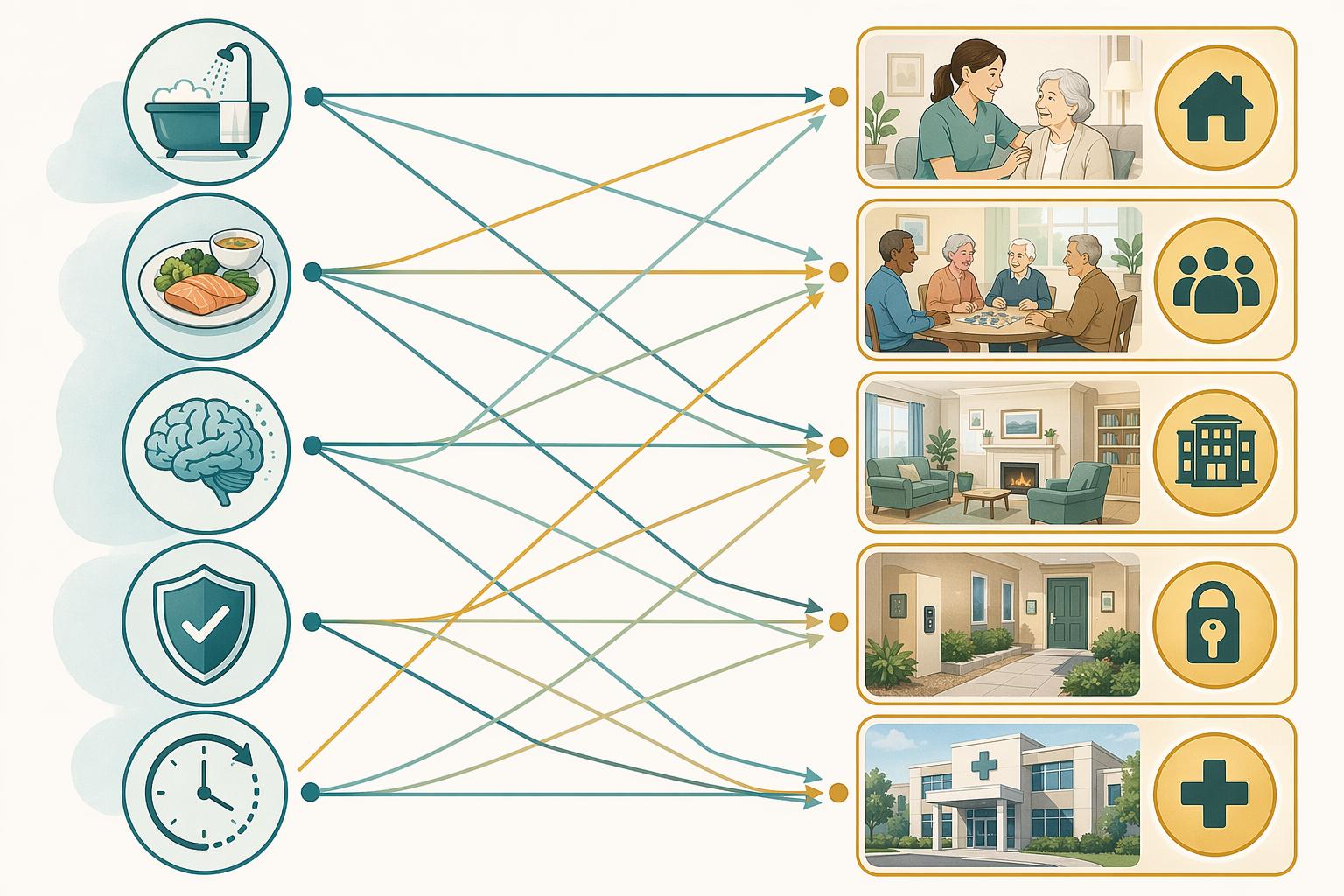
Use the following matches as a working screen, then verify them with the older adult’s clinician, discharge planner, care manager, or local aging-services agency.
| Observed need | Care options to examine first | What should make the family pause |
|---|---|---|
| Light IADL help: errands, meals, laundry, transportation, reminders | Companion care, homemaker services, meal delivery, transportation programs, family scheduling support | The plan depends on a family member becoming the backup for every missed shift, appointment, or medication refill |
| Hands-on ADL help: bathing, dressing, toileting, transfers, eating | Personal care aides at home, assisted living, short-term rehabilitation if after a qualifying medical event | The home layout makes transfers unsafe, or the person needs help at unpredictable times |
| Daytime supervision and caregiver work conflict | Adult day program, part-time home care, respite care | The caregiver is losing income, using leave, or leaving the older adult alone because no one has named the supervision need |
| Medication errors, missed meals, declining hygiene, isolation | Assisted living, medication management services, structured home-care plan | The older adult insists things are fine, but the evidence in the refrigerator, pillbox, and bathroom says otherwise |
| Wandering, unsafe cooking, paranoia, agitation, getting lost, nighttime activity | Dementia-specific home care, adult day programs with dementia capacity, memory care | The family is relying on locked doors, improvised monitoring, or one exhausted spouse |
| Wounds, feeding tubes, complex medication regimens, frequent skilled needs, 24-hour nursing oversight | Skilled nursing facility, home health for short-term skilled episodes when appropriate, palliative or hospice evaluation when clinically relevant | The family is being asked to perform medical tasks without training or reliable backup |
When Home Care Works
Home care works best when the need is schedulable and the home can be made reasonably safe. A few mornings a week for bathing, laundry, meal prep, and transportation can preserve independence without pretending the older adult is still fully independent. It can also be the right bridge after a hospitalization while the family learns whether the decline is temporary or the new baseline.
The problem is not home care itself. The problem is the phrase “we’ll keep her at home” when no one has priced enough hours, checked whether the bathroom is usable, or asked who covers nights. At $34 to $35 per hour, home care can be the most flexible option at modest hours and one of the most expensive options when it becomes daily or round-the-clock.[6]
When Adult Day Care Is the Missing Middle
Adult day programs are easy to overlook because they do not sound like a full solution. For some families, that is precisely their value. They can provide meals, supervision, social contact, activities, and a predictable daytime schedule while a caregiver works, sleeps, handles errands, or simply has hours when no one is waiting for them to solve the next problem.
At roughly $100 per day nationally, adult day services can be less expensive than adding long home-care shifts, though transportation, eligibility, dementia capacity, and local availability matter.[6] The right question is not whether an adult day program replaces family care. It is whether it prevents the family from relying on unsafe alone time or unpaid labor that is already collapsing.
When Assisted Living Becomes the More Honest Plan
Assisted living is usually considered when an older adult needs help with daily routines, meals, medication management, housekeeping, transportation, and social structure, but does not need 24-hour skilled nursing. It can be a good fit when home is still emotionally preferred but functionally brittle: the parent is eating poorly, bathing rarely, missing medications, and depending on emergency family visits to keep the week together.
The financial comparison should be done with real hours. A $6,000 monthly assisted living bill is frightening, but so is 40 or more hours a week of home care, plus rent or mortgage, food, utilities, home maintenance, transportation, and a family caregiver’s lost wages or sleep. The break-even point is local, but the math should be written down before everyone votes for the option that sounds less disruptive.
When Dementia Changes the Question
Dementia care is not just assisted living with more reminders. The family has to look at wandering, unsafe cooking, nighttime wakefulness, aggression, delusions, medication refusal, falls, and the ability of the current caregiver to keep responding without becoming unsafe themselves. The Alzheimer’s Association describes dementia care options across in-home services, adult day centers, assisted living, memory care, nursing homes, and hospice, depending on stage and needs.[9]
Memory care becomes more relevant when a secure environment, dementia-trained staff, structured routines, and closer supervision are no longer optional. AHCA/NCAL data indicates that 18% of residential care communities offer wings specifically for dementia or Alzheimer’s patients.[10] That figure is useful because it reminds families to ask what dementia capability actually exists, not simply whether a brochure mentions memory support.
When Skilled Nursing Is the Care Level
Skilled nursing enters the conversation when medical complexity, rehabilitation needs, or 24-hour nursing oversight exceed what home care or assisted living can safely provide. This may be short-term after a hospitalization, or long-term when the person needs ongoing institutional care. A private nursing home room at a national median of $10,798 per month, or $129,575 per year, is more than double the roughly $60,000 median household income for adults 65 and older cited in AARP’s affordability analysis.[11]
That is the point at which families need fewer reassuring phrases and more paperwork: income, assets, insurance policies, benefit eligibility, property ownership, powers of attorney, and a clear understanding of who is authorized to apply for what.
The Payment Reality Families Cannot Skip
The most expensive senior care mistake is assuming insurance will probably cover it. Medicare does not pay for long-term custodial care. It can cover short-term skilled nursing care under qualifying conditions, with full coverage for days 1 through 20, partial coverage for days 21 through 100, and no coverage after that benefit period. That is not a long-term assisted living plan, a home aide plan, or an indefinite nursing home payment plan.
Custodial care is the help most families are actually looking for: bathing, dressing, toileting, meal support, supervision, and help staying safe. Those needs may be essential, but that does not make them Medicare-covered. Families who discover this during discharge planning often have only days to arrange a private-pay plan, apply for Medicaid if eligible, or bring the person home with an unpaid caregiver taking the hit.
Medicaid is the main public payer for long-term custodial care for people who meet financial and functional eligibility rules. It is needs-based, administered through states, and subject to a five-year look-back rule for asset transfers. That means last-minute transfers to relatives are not a planning strategy; they can create penalties and delays when care is already needed.
Long-term care insurance can help, but it is not common enough to assume. Only about 7 million people have long-term care insurance, and 47% of applicants age 70 and older are denied. If a policy exists, families need to read the benefit triggers, elimination period, daily or monthly caps, covered settings, inflation protection, and whether the diagnosis or ADL threshold has been documented properly.
Out-of-pocket spending fills much of the gap. ASPE has reported that families cover about half of long-term care costs out of pocket.[2] AARP’s 2025 caregiving report found that nearly half of family caregivers experienced at least one major financial impact, such as taking on debt, stopping savings, or food insecurity.[5] This is where “we’ll make it work” becomes a budget line, often borne by the person whose own retirement savings are easiest to raid because they are the one closest to the problem.
Costs have also been moving faster than many household plans. AARP’s Public Policy Institute reported that home care costs surged nearly 50% from 2019 to 2024, assisted living jumped 10% in 2024 alone, and home care inflation rose 7.9% annually over five years, nearly double overall inflation.[11] A quote from two years ago is not a plan for 2026.
State Variation Is Not a Footnote
National medians are useful for orientation, but the family decision has to be priced locally. The same care category can look very different by state and county. Nursing home daily rates can range from about $150 in Mississippi to $288 in Wyoming, which is too large a difference to ignore when comparing options. Get local quotes for the likely next level of care, not only the level needed today.
What to Gather Before You Call Providers
A provider can describe its services. It cannot accurately choose the level of care if the family has only a vague story. Before calling agencies, adult day programs, assisted living communities, memory care communities, or nursing facilities, collect the facts that change placement and price.
- ADLs: which tasks require no help, cueing, standby help, hands-on help, or two-person assistance.
- IADLs: who manages medications, meals, transportation, shopping, bills, appointments, laundry, and phone or technology use.
- Cognition: diagnosis if known, memory changes, judgment problems, wandering, hallucinations, unsafe cooking, medication mistakes, and nighttime behavior.
- Falls and mobility: recent falls, transfer difficulty, stairs, bathroom access, walker or wheelchair use, and whether the person can leave home safely.
- Medical needs: wounds, oxygen, injections, feeding support, catheter care, therapy needs, pain, hospitalizations, and whether skilled nursing is required.
- Caregiver capacity: who is available, on which days, at what times, with what physical ability, emotional reserve, training, and financial limit.
- Money and authority: income, assets, insurance policies, veterans benefits if applicable, Medicaid status, power of attorney, health care proxy, and advance directives.
The caregiver-capacity line deserves the same seriousness as the medical line. The Center to Advance Palliative Care has reported that 64% of family caregivers experience high emotional stress and 55% handle medical tasks without formal training.[12] If the plan requires untrained relatives to perform skilled tasks indefinitely, the plan is relying on risk, not devotion.
How to Act in a Crisis
If the decision is happening after a hospital stay or fall, do not leave the hospital conversation with only a stack of discharge papers. Ask what level of help is needed for transfers, toileting, bathing, medications, wound care, meals, and overnight safety. Ask whether skilled home health, short-term rehabilitation, durable medical equipment, or a home safety evaluation has been ordered. Ask who is responsible for arranging each service and by what date.
If the older adult is going home, identify the first 72 hours in practical terms: who is there at night, who handles medications, how the person gets to the bathroom, what happens if the aide cancels, and who has authority to make decisions if the plan fails. A home discharge that depends on everyone being available and calm is not a plan; it is a hope with a calendar attached.
If a residential move is likely, ask each community about assessment, staffing, medication administration, dementia capability, transfer assistance, incontinence care, hospital transfer policies, price increases, move-out criteria, and what happens when needs rise. A beautiful dining room does not answer whether someone who wakes up confused at 2 a.m. will be safe.
How to Plan Before the Next Event
For families not yet in crisis, the work is simpler and more uncomfortable: document the current baseline, price the next likely level of care, and decide what family caregivers can actually sustain. Do this while the older adult can still participate in the tradeoffs. Preferences matter. They just do not erase stairs, dementia, bathing risk, medication errors, or the fact that one adult child cannot become an invisible care system.
- Write down the current ADL and IADL needs, including what has changed in the last six months.
- Identify the most likely next care need: more hours at home, daytime supervision, assisted living, dementia-specific care, or skilled nursing.
- Get local prices for that next level, not just today’s preferred option.
- Review Medicare limits, Medicaid eligibility, long-term care insurance, savings, home equity, and family contributions before the crisis.
- Name the caregiver limits in writing: hours, nights, physical tasks, money, emotional strain, and backup coverage.
- Revisit the plan after a fall, hospitalization, new dementia behavior, medication error, caregiver health change, or major cost increase.
There is no single best senior care option in 2026. There is only the option that fits the person’s needs, the home or residential setting, the available caregivers, and the money that can support the plan long enough to matter. The family’s job is to make that match before the next fall, discharge, or dementia-related safety event makes the decision for them.
References
- Does an Older Adult in Your Life Need Help? — National Institute on Aging — nia.nih.gov
- Long-Term Services and Supports for Older Americans: Risks and Financing — ASPE — aspe.hhs.gov
- Aging in Place Statistics + How to Prepare in 2026 — Choice Mutual — choicemutual.com
- Older Adults’ Health and Age-Related Changes — American Psychological Association — apa.org
- Caregiving in the U.S. 2025 — AARP — aarp.org
- Cost of Long Term Care by State — CareScout — carescout.com
- Memory Care vs. Home Care — A Place for Mom — aplaceformom.com
- Long-term care statistics 2026 — SingleCare — singlecare.com
- Dementia Care Options — Alzheimer’s Association — alz.org
- Residential Care Communities — AHCA/NCAL — ahcancal.org
- Long-Term Care Costs Outpace Income — AARP — aarp.org/caregiving
- Caregivers and Serious Illness — Center to Advance Palliative Care — capc.org
Related reading
Noticed something outdated or inaccurate on this page? Flag a correction. We review every report against CDC, NIA, and AARP HomeFit guidance before updating a page.
Part of the Fall Prevention section.