
Assisted Living vs. Memory Care: A Head-to-Head Comparison for Families Navigating Dementia
This guide helps adult children understand the critical differences between assisted living and memory care, including safety, cost, staff training, and activities. It also covers five key signs that it's time to transition and explains how some communities offer a staged move without leaving campus.
Why the Confusion Between Assisted Living and Memory Care Exists
If you have started researching residential options for a parent with dementia, you have likely noticed that the line between assisted living and memory care is anything but sharp. Many senior living communities offer both levels of care on a single campus, and they often use overlapping language in their marketing materials. A facility might advertise "memory care support" within its assisted living wing, while another calls its secured unit "enhanced assisted living." State regulations compound the confusion: some states license memory care as a distinct category, others treat it as a specialized add-on to an assisted living license, and a few have no separate regulatory definition at all.
For a family caregiver who is already navigating the emotional weight of a dementia diagnosis, this ambiguity is more than frustrating — it is risky. Choosing the wrong setting can mean a parent is under-supervised, under-stimulated, or in an environment that actually accelerates decline. The purpose of this guide is to cut through the marketing language and state-by-state variation by laying out a concrete, evidence-based comparison across five dimensions that matter most: safety, cost, staff training, physical design, and daily programming.
If you are still in the early stages of noticing changes, our guide on recognizing and responding to cognitive decline can help you evaluate where your parent currently stands before you compare housing options.

Five Key Differences Between Assisted Living and Memory Care
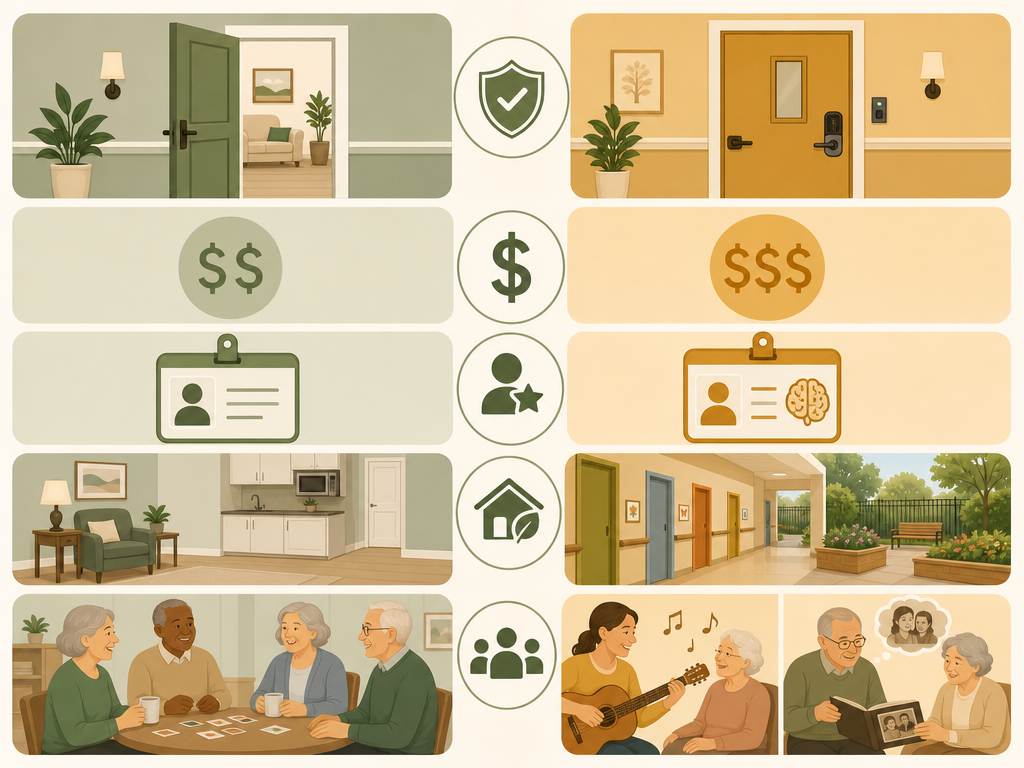
The table below summarizes the five critical dimensions that separate these two care types. The data comes from A Place for Mom's 2026 analysis of its partner communities and from SeniorLiving.org's May 2026 national cost survey. We will explore each dimension in detail in the sections that follow.
| Dimension | Assisted Living | Memory Care |
|---|---|---|
| Safety & Security | Open environment; residents come and go with minimal restriction | 88% of communities are secure facilities; 41% have a wandering management system |
| Monthly Cost (Median) | $5,419 (A Place for Mom, 2026) | $6,690 (A Place for Mom, 2026); $8,019 (SeniorLiving.org, May 2026) |
| Staff Training | General personal care training; dementia-specific training not standard | 79% of communities provide specialized dementia training for staff |
| Physical Design | Apartment-style; standard layouts and common areas | 76% are specifically designed for memory loss; 78% have enclosed courtyards |
| Activities & Therapies | General social, fitness, and recreational programs | 62% offer reminiscence programs; 76% offer art classes; 33% offer light therapy |
Safety and Security: Why Memory Care Is Designed Differently
The most fundamental difference between assisted living and memory care is the security infrastructure. Assisted living is built around the assumption that residents can navigate their environment safely with minimal supervision. Memory care starts from the opposite premise: that cognitive impairment creates specific safety risks — wandering, exit-seeking, falls from disorientation — that require a purpose-built environment.
According to A Place for Mom's 2026 partner data, 88% of memory care communities are secure facilities, meaning the building is designed to prevent residents from leaving unsupervised. More than 4 in 10 (41%) feature a dedicated wandering management system — typically a combination of alarmed doors, motion sensors, and staff protocols that track resident movement. The numbers for managing specific dementia-related behaviors are equally striking: 89% of memory care communities offer services to manage restlessness, pacing, or wandering, and 82% provide services to address exit-seeking behaviors.
In assisted living, by contrast, the environment is intentionally open. Residents are free to walk to the dining room, visit the lobby, or step outside into a courtyard. This autonomy is a benefit for someone who is cognitively intact, but it becomes a liability for someone who no longer recognizes familiar spaces or feels an urgent need to "go home." A parent who begins wandering in assisted living may trigger emergency protocols or, worse, leave the building unnoticed.
- Secured perimeters: Memory care units use keypad or fob-controlled exits that residents cannot operate independently.
- Wandering management systems: Motion sensors and door alarms alert staff when a resident approaches an exit.
- Enclosed outdoor spaces: 78% of memory care communities offer enclosed courtyards where residents can walk safely outdoors without risk of leaving the campus.
- Color-coded walls and visual cues: Many memory care units use contrasting colors on walls and floors to help residents navigate and reduce disorientation.
Cost Comparison: What You're Paying For
The cost gap between assisted living and memory care is real, but it is also narrower than many families assume. According to A Place for Mom's 2026 data, the national median monthly cost for assisted living is $5,419, while memory care runs $6,690 — a difference of about $1,270 per month, or roughly $15,000 per year. SeniorLiving.org's May 2026 survey places the national median for memory care higher, at $8,019 per month, which would widen the gap to approximately $2,600 per month.
The additional cost is not arbitrary. It pays for three concrete things: higher staff-to-resident ratios, specialized training for every staff member who interacts with residents, and the physical security infrastructure described above. Memory care units typically have one staff member for every five to seven residents, compared with one to eight or ten in assisted living. That ratio difference alone accounts for a significant portion of the cost premium.
| Cost Factor | Assisted Living | Memory Care |
|---|---|---|
| National Median (Monthly) | $5,419 | $6,690 – $8,019 |
| Annual Cost | ~$65,000 | ~$80,000 – $96,000 |
| What the Premium Covers | Room, meals, personal care assistance, general activities | All of the above + secured environment, specialized staff training, wandering management, dementia-specific therapies |
| Medicare Coverage | Does not cover room and board | Does not cover room and board |
For families weighing home care against facility care before making the leap to memory care, our analysis of the 40-hour cost threshold between home care and assisted living provides a framework for comparing those options side by side.
Staff Training: The Dementia Care Difference
The quality of care a resident receives depends almost entirely on the people delivering it. In assisted living, staff are trained in personal care tasks — bathing, dressing, medication reminders, and mobility assistance. This training is sufficient for residents who can communicate their needs, follow instructions, and recognize familiar caregivers.
Memory care requires a fundamentally different skill set. According to A Place for Mom's 2026 data, 79% of memory care communities provide specialized dementia training for their staff. This training covers how to respond to agitation and aggression without escalating the situation, how to redirect a resident who is fixated on leaving, how to communicate with someone who has lost language ability, and how to recognize the non-verbal signs of pain or discomfort that a person with dementia cannot articulate.
The practical difference is visible in daily interactions. A staff member trained in dementia care knows that a resident who becomes combative during bathing is likely experiencing sensory overwhelm or fear, not intentional aggression. They know that a resident who paces for hours is not being disruptive — they are responding to an internal drive that cannot be reasoned away. They know how to use validation techniques instead of correction. These skills cannot be learned from a manual; they require ongoing, supervised practice.
- Agitation and aggression management: 52% of memory care communities offer services specifically for anxiety, aggression, or agitation.
- Sundowning protocols: Staff are trained to recognize and respond to the late-day confusion and restlessness that affects many people with dementia.
- Communication techniques: Training in how to use simple language, visual cues, and redirection instead of verbal correction.
- Pain recognition: Understanding that behaviors like moaning, rocking, or aggression may be expressions of physical discomfort.
Activities and Therapies: Engagement That Matches Cognitive Needs
A common complaint from families whose parent is in assisted living but needs memory care is that the activities have become irrelevant or frustrating. The parent may no longer be able to follow a card game, remember the steps in a fitness class, or engage in a book club discussion. They may sit at the edge of activities, watching but unable to participate, which accelerates social withdrawal and cognitive decline.
Memory care activities are designed specifically for the cognitive abilities of residents with dementia. They emphasize sensory engagement, short attention spans, and success-oriented tasks. A Place for Mom's 2026 partner data shows that 62% of memory care communities offer reminiscence programs, which use photographs, music, and familiar objects from the resident's past to spark conversation and emotional connection. Art classes are offered by 76% of communities, providing a non-verbal outlet for expression. Light therapy, available in 33% of communities, uses timed exposure to bright light to regulate sleep-wake cycles and reduce sundowning symptoms.
These are not optional extras. For a person with dementia, meaningful engagement is a clinical intervention. It reduces agitation, improves mood, supports remaining cognitive function, and can even slow the rate of decline. An assisted living activity calendar built around bridge tournaments and lecture series cannot provide this level of therapeutic programming.
5 Signs It's Time to Move from Assisted Living to Memory Care
Knowing the differences between assisted living and memory care is only half the equation. The harder part is recognizing when your parent has crossed the line from needing one to needing the other. The transition is rarely abrupt — it unfolds through a series of warning signs that families often dismiss or rationalize. Senior Services of America identifies five specific indicators that it is time to make the move.
- The assisted living facility recommends memory care. This is the clearest signal you will get. Assisted living staff are trained to work within their scope, and when they tell you they can no longer meet your parent's needs, believe them. They are not trying to upsell you — they are protecting your parent from an environment that has become unsafe.
- Safety concerns are mounting. Wandering, unexplained bruises, difficulty eating or drinking, medication errors, and combativeness with staff are all red flags. A single wandering episode in assisted living is a crisis event. If your parent has fallen, left the building, or become aggressive with caregivers, the current setting has already failed.
- Cognitive needs are not being met. Your parent is withdrawing from activities, sitting alone in their room, or telling you the activities are "too hard" or "don't make sense." Social isolation in assisted living is a common precursor to rapid cognitive decline.
- They cannot express physical challenges. A person with advancing dementia may not be able to tell you they are in pain, have a urinary tract infection, or are losing their balance. Instead, they may become agitated, refuse to eat, or start falling. Staff who are not trained in dementia care may misinterpret these behaviors as "acting out" rather than as medical symptoms.
- Declining health is visible. Unexplained weight loss, increasing frailty, incontinence, and a decline in the ability to perform basic activities of daily living (bathing, dressing, toileting) are signs that the level of supervision in assisted living is no longer sufficient.
For a deeper exploration of each of these signs, including specific questions to ask the facility and how to assess urgency, read our comprehensive transition guide for families considering memory care.
What a Memory Care Transition Looks Like
Moving a person with dementia from one living situation to another is stressful, but the stress can be managed with planning. The goal is to make the new environment feel familiar and safe from the moment they arrive. Senior Services of America recommends three core strategies.
- Keep routines intact. If your parent has always had breakfast at 8:00 AM and a walk after lunch, ensure the memory care unit can accommodate that schedule. Bring familiar bedding, photographs, and a favorite chair. The more the new room resembles the old one, the faster the adjustment.
- Involve the staff before the move. Share detailed information about your parent's preferences, triggers, and calming strategies with the memory care team before move-in day. A staff member who knows that your parent calms down when they hear big band music or that they become agitated in crowded spaces can prevent problems before they start.
- Manage your own guilt. It is natural to feel that you have failed your parent by moving them. You have not. Dementia is a progressive disease, and the level of care it requires eventually exceeds what any family member or general assisted living facility can provide. Memory care is not a downgrade — it is the appropriate medical and social environment for your parent's current condition.
For a detailed, stage-by-stage explanation of what 24-hour care actually looks like in a memory care setting, including how care needs change as the disease progresses, see our guide on 24-hour care for a parent with dementia.
The Third Option: Communities That Offer Both on One Campus
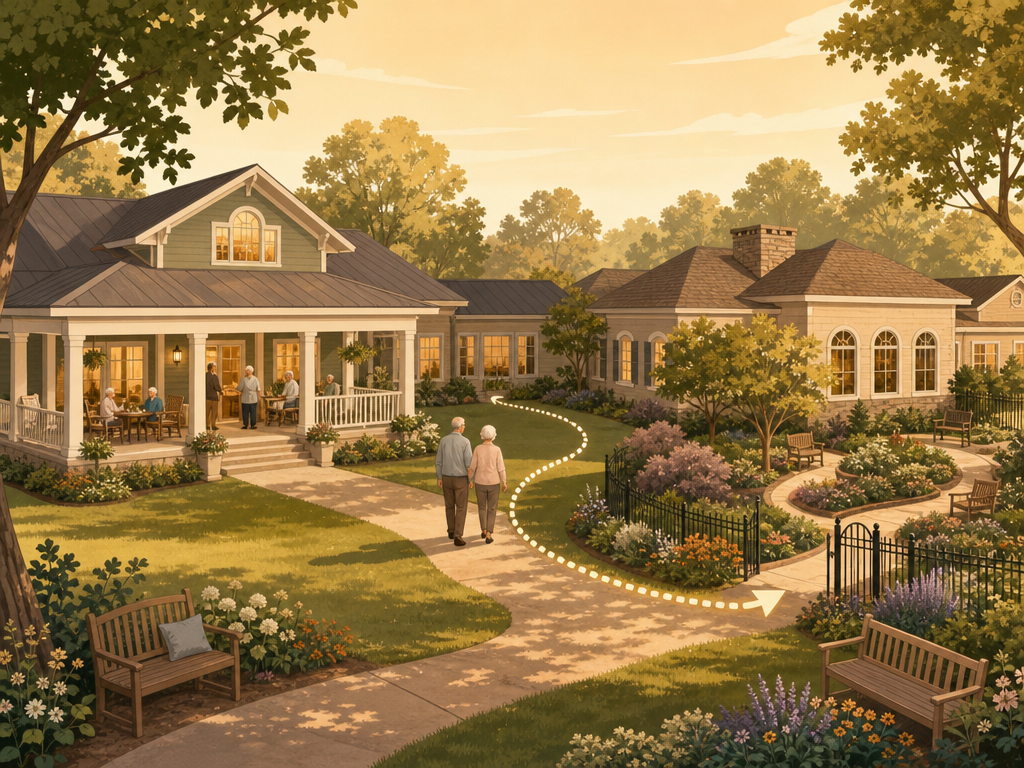
One of the most reassuring developments in senior living is the rise of communities that offer both assisted living and memory care on the same campus. According to A Place for Mom's 2026 partner data, approximately 80% of assisted living communities that partner with them also offer memory care services on-site. This arrangement allows a resident to move from an assisted living apartment to a memory care unit without leaving the community they already know.
The advantages of this model are significant. The resident keeps the same dining staff, activity directors, and many of the same caregivers. They do not have to learn a new floor plan, a new schedule, or a new set of faces. For a person with dementia, this continuity is invaluable — it reduces the disorientation that accompanies any move and preserves the fragile sense of familiarity that supports their remaining cognitive function.
For families, the staged transition means less guilt and less logistical chaos. You do not have to conduct a second round of facility tours, navigate a new contract, or coordinate a second move. The community's staff manages the transition internally, often moving the resident's belongings and setting up their new room while they are at an activity or therapy session.
The decision between assisted living and memory care is one of the most consequential choices a family caregiver will make. It is also one of the most emotionally charged. By understanding the concrete differences in safety, cost, staff training, design, and programming — and by watching for the five transition signs — you can make a decision that is driven by evidence rather than by guilt or uncertainty. And if you are fortunate enough to find a community that offers both levels of care on one campus, you may be able to make that transition in a way that feels less like a rupture and more like a natural next step.
Related reading
Noticed something outdated or inaccurate on this page? Flag a correction. We review every report against CDC, NIA, and AARP HomeFit guidance before updating a page.
Part of the Fall Prevention section.