
Caregiver decision guide
Protect Your Aging Parent from Poor Air Quality
When an air quality alert strikes, family caregivers need immediate, actionable steps to safeguard their older adult. This printable checklist covers AQI interpretation, indoor air protection, medication readiness, symptom monitoring, and emergency warning signs — all in one scannable resource.
The alert arrives, and the first job is not to understand every pollutant in the air. It is to reduce what your aging parent breathes in over the next few hours. For adults 65 and older, the U.S. Air Quality Index becomes a health concern at AQI 101, the Orange range for “unhealthy for sensitive groups.” At AQI 151, the Red range, some members of the general public may also be affected. At AQI 201 and above, the whole household should treat the event as serious, not just the person with asthma, COPD, heart disease, or diabetes.[1]
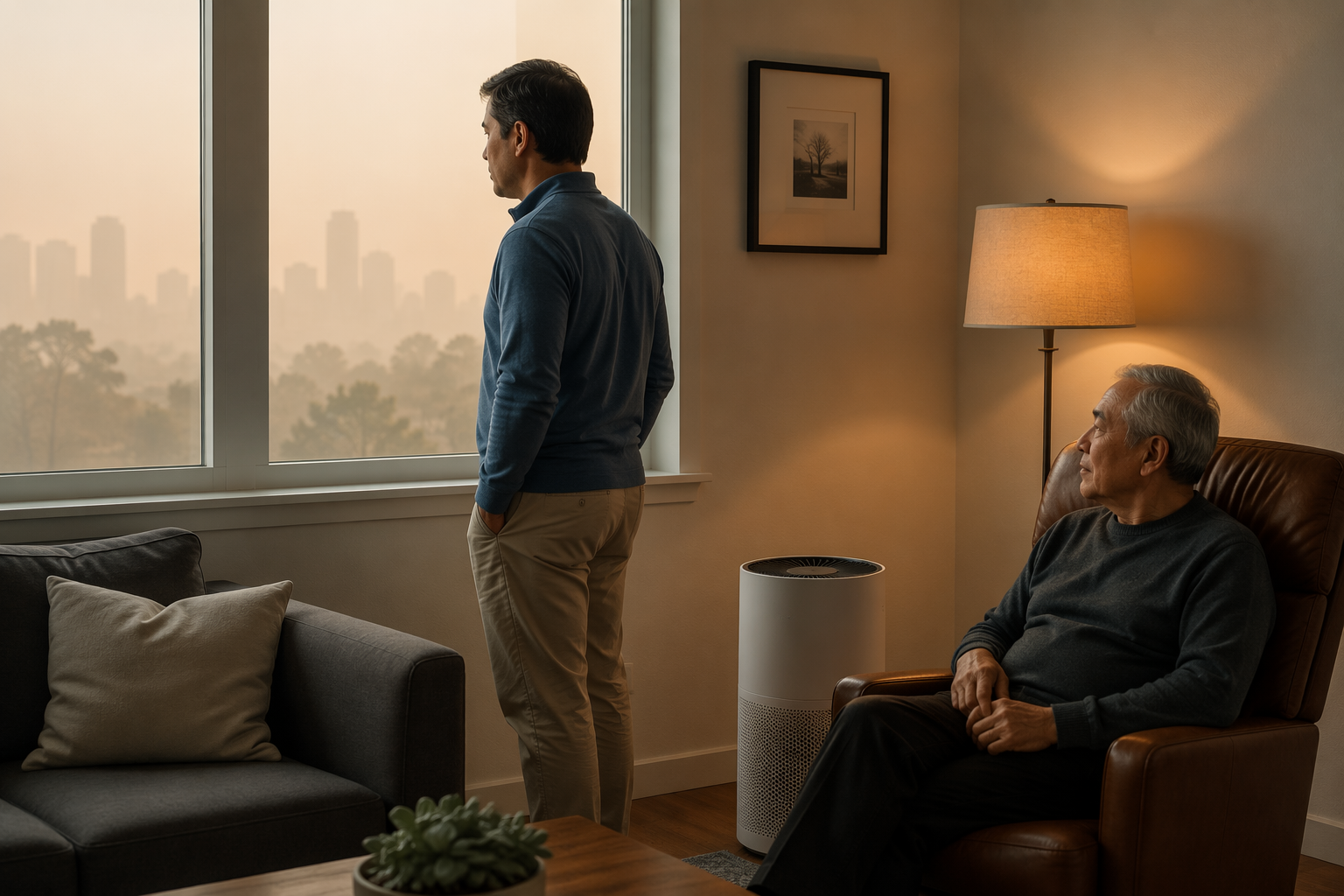
First 10 Minutes: The Caregiver Checklist
- Check the current AQI and color for the exact location where your parent is, not just the nearest major city.
- Bring your parent indoors and close windows, doors, fireplace dampers, and other obvious air leaks.
- Choose one clean room, ideally a bedroom or living room with few windows and enough space for your parent to rest.
- Run a portable HEPA air cleaner in that room, or use a properly built box-fan filter with a MERV 13 or higher filter if that is what you have available.[2][3]
- Set central air conditioning or HVAC to recirculate if the system has that option, and avoid bringing outdoor air inside.[2]
- Stop indoor particle sources: no vacuuming, frying, grilling, candles, incense, smoking, or wood-burning while the alert is active.[2][3]
- Place medications, inhalers, diabetes supplies, a charged phone, water, and a well-fitting N95 or KN95 mask in or near the clean room.
- Begin symptom checks: breathing, chest comfort, heart rhythm, alertness, speech, skin color, and whether symptoms are getting better or worse.
If you are calling from work or from another home, give the instructions in that order. The first call does not need to be perfect. It needs to get windows closed, the parent inside, filtration running, and symptoms checked.
Use the AQI Color to Set the Response

| AQI level | What it means for an older adult | Caregiver action |
|---|---|---|
| Green or Yellow | Generally lower concern, though individual medical conditions still matter. | Keep normal routines unless your parent has symptoms or their clinician has given stricter instructions. |
| Orange, AQI 101–150 | Unhealthy for sensitive groups, including adults 65 and older.[1] | Move activities indoors, close windows, run filtration, and avoid unnecessary outdoor trips. |
| Red, AQI 151–200 | The general public may be affected, and older adults are at higher risk of respiratory and cardiovascular complications.[1] | Keep your parent indoors in the cleanest room, reduce exertion, use N95 or KN95 protection for unavoidable outdoor time, and monitor symptoms more closely. |
| Purple, AQI 201–300 | Health risk is serious enough that the entire household should take stronger precautions.[1] | Cancel nonessential outings, keep filtration running, check medication access, and have a low threshold to call a clinician if symptoms start. |
| Maroon, AQI 301+ | Hazardous conditions. | Treat this as a major exposure event: stay indoors, maintain clean-room protection, follow local emergency guidance, and seek medical help promptly for warning signs. |
The easy mistake is waiting until the alert sounds dangerous for everyone. Older adults are already in the sensitive group at Orange. That does not mean every Orange day is an emergency, but it does mean the caregiver should stop treating the alert as background noise.
This matters most for parents with asthma, COPD, heart disease, prior stroke, diabetes, limited mobility, or a history of breathing trouble during heat, pollen, or smoke. It also matters for a parent who lives alone and may not notice a gradual change in breathing until they are already struggling.
Build One Clean Room Before You Try to Clean the Whole House
A clean room is not a sterile room. It is the room where you concentrate the most practical protection: closed windows and doors, fewer air leaks, active filtration, no particle-generating activities, and the supplies your parent needs within reach. The EPA and American Lung Association both recommend this approach during wildfire smoke and poor outdoor air events.[2][3]
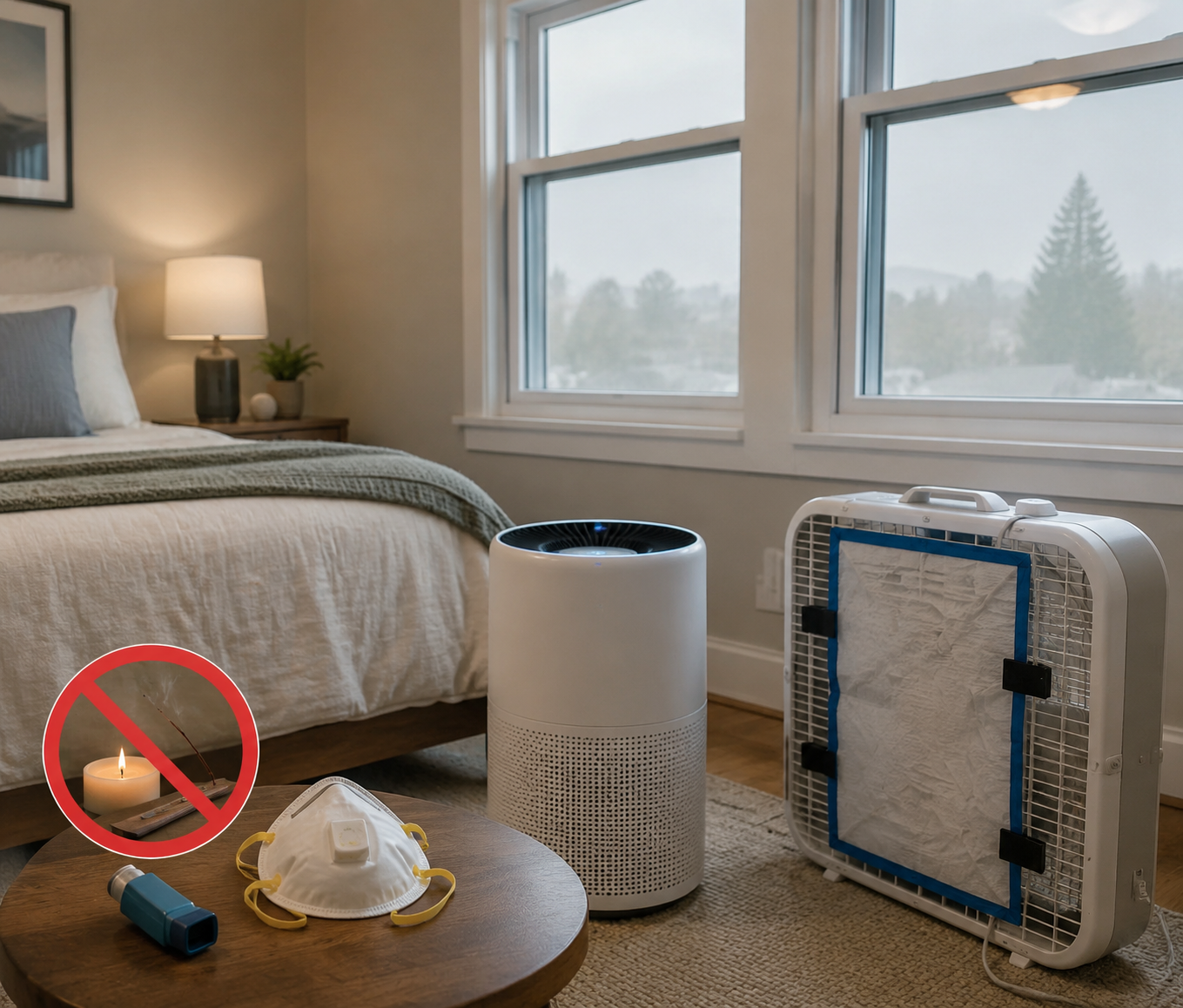
Pick the Room
Choose a room your parent can stay in comfortably for several hours. A bedroom often works because it has a door, a chair or bed, medications nearby, and fewer people walking through. If the living room is where the air cleaner already sits and your parent can rest there safely, use that instead. Do not waste the first hour debating the perfect room while smoke keeps coming in.
- Close windows and doors.
- Use towels, weather stripping, or temporary draft blockers at obvious gaps if smoke odor is coming through.
- Keep pets, visitors, and unnecessary foot traffic out when possible.
- Move the air cleaner away from walls, curtains, and furniture so air can circulate.
Run Filtration Continuously
A portable HEPA air cleaner is the simplest option if you already own one. Use the highest setting your parent can tolerate while resting, then lower it if noise interferes with sleep or communication. If you are buying a unit, match the device to the room size rather than the whole home, and avoid products that intentionally generate ozone.[4]
A box-fan filter can also reduce indoor fine particles when built safely with a MERV 13 or higher filter. The EPA and American Lung Association describe DIY box-fan units as safe when they use a newer fan, manufactured in 2012 or later, with UL or ETL safety certification.[2][3]
Do not place a box-fan filter where a confused parent may trip over the cord, lean on the fan, or block the airflow with bedding. The right setup is the one that runs safely for hours without becoming another caregiving hazard.
Stop Making Indoor Air Worse
During an alert, the indoor rule is simple: do not add particles you then have to filter. Avoid vacuuming because it can recirculate particles. Avoid frying and grilling because cooking smoke adds to the load. Skip candles, incense, fireplaces, wood stoves, and smoking indoors. These are not lifestyle judgments; they are exposure controls for a parent whose lungs and heart have less margin.[2][3]
If the home has central air, use recirculate mode when available. If there is a fresh-air intake, follow the manufacturer’s instructions for limiting outdoor air during smoke events. If the system is old, unfamiliar, or shared in an apartment building, focus on what you can control immediately: the clean room, filtration, closed openings, and avoiding indoor smoke sources.
Masks Matter Only If They Filter Fine Particles and Fit
For unavoidable outdoor time, use a properly fitted N95 or KN95. Cloth masks and surgical masks do not reliably filter the fine particulate matter that makes wildfire smoke and other poor-air events dangerous.[5][6][7]
Fit is the practical problem. The mask should seal over the nose and under the chin without large side gaps. Facial hair, oxygen tubing, dentures, confusion, or shortness of breath can make mask use harder. If your parent becomes more breathless, dizzy, panicked, or unable to communicate while wearing a mask, move them indoors and reassess rather than forcing the mask to stay on.
- Use the mask for necessary outdoor trips only, such as getting to medical care or leaving an unsafe location.
- Do not use a mask as permission for yardwork, errands, or exercise during Red, Purple, or Maroon conditions.
- Keep extra masks in the clean room, car, medication bag, and near the door your parent uses most.
Check Medications Before Symptoms Force the Issue
Air quality alerts become more dangerous when a parent is already running low on the medicine that keeps them stable. Before wildfire season or during a run of repeated alerts, caregivers should try to keep at least a 7- to 10-day supply of prescription medications, especially inhalers, heart medications, and diabetes supplies, because pharmacies may be harder to reach during evacuation or severe smoke events.[8][9]
- Confirm rescue inhalers are not empty or expired.
- Check daily heart medications, blood pressure medications, diuretics, and diabetes supplies.
- Keep a current medication list in the clean room and on the caregiver’s phone.
- Ask the clinician in advance what symptom changes should trigger a call for that specific parent.
- If oxygen, nebulizer equipment, CPAP, or other powered medical equipment is used, confirm backup power plans before the worst day arrives.
Do not change doses because of an AQI alert unless the prescribing clinician has already given that instruction. The caregiver’s job is to make sure the plan can actually be followed: medication available, device working, instructions visible, and help reachable.
Monitor Symptoms With a Clear Stop Point
Monitoring does not mean staring at your parent every minute. It means checking the signs that tell you whether home protection is working or whether the situation is moving beyond home care.
| What you notice | What to do |
|---|---|
| Mild cough, throat irritation, watery eyes, or mild shortness of breath that improves indoors | Keep your parent in the clean room, continue filtration, reduce activity, and keep watching. |
| Symptoms that are new, worsening, or not improving after moving indoors | Call the parent’s clinician, nurse line, or urgent care for guidance, especially if they have lung disease, heart disease, diabetes, or prior stroke. |
| Difficulty breathing, chest pain or pressure, irregular heart palpitations, bluish lips or fingertips, sudden confusion, or slurred speech | Seek emergency care now. These are not symptoms to watch through the afternoon.[8][5][9] |
The emergency line deserves plain language because families often lose time deciding whether they are overreacting. When those warning signs appear, monitoring stops and emergency help begins.
Why Older Adults Need Earlier Action
Poor air quality is not just a comfort problem for older adults. Fine particles can aggravate breathing conditions and place stress on the cardiovascular system, which is why public health guidance treats older adults as a sensitive group before the AQI reaches levels considered unhealthy for everyone.[1][7]
Wildfire smoke raises the stakes because it is a complex mixture of fine particles and gases. A 2024 PNAS study, reported by AARP, found wildfire smoke to be approximately 10 times more toxic than regular fossil-fuel air pollution and estimated that it has contributed up to 25% of total U.S. PM2.5 in recent years.[8]
The health system saw that risk during the 2023 Canadian wildfire smoke events. CDC data reported by AARP found asthma emergency department visits were 17% higher on days with AQI above 101; on the worst AQI day in New York City, asthma-associated emergency visits rose 82% statewide.[8]
There is also emerging research examining possible links between wildfire-smoke PM2.5 exposure and dementia risk. That research should be treated carefully: it is a reason to take repeated smoke exposure seriously, not a reason to frighten a family during a single alert day with claims the evidence cannot yet support.
If You Are Coordinating From a Distance
Many caregivers receive the alert while they are at work, in another city, or already responsible for children and a job. In that case, the checklist becomes a phone script.
- Call your parent first: ask whether they are indoors, whether windows are closed, and whether they have any breathing, chest, heart-rhythm, speech, or confusion symptoms.
- Call the person who can physically help next: spouse, neighbor, aide, building staff, nearby relative, or friend.
- Ask that person to set up the clean room, start filtration, place medications nearby, and remove indoor particle sources.
- Cancel or postpone nonessential outdoor appointments, errands, yardwork, and social visits until conditions improve.
- Set the next check-in time. During Red or worse conditions, do not leave the next call vague.
If your parent tends to minimize symptoms, ask observable questions: “Can you walk across the room without stopping?” “Are you more short of breath than this morning?” “Is your chest comfortable?” “Can you say a full sentence?” “Do your lips or fingers look normal?” Those answers are easier to act on than “Are you okay?”
Printable Alert-Day Checklist
| Task | Done |
|---|---|
| AQI checked for parent’s location | □ |
| Parent indoors | □ |
| Windows and doors closed | □ |
| Clean room chosen | □ |
| HEPA air cleaner or safe MERV 13+ box-fan filter running | □ |
| HVAC or AC set to recirculate if available | □ |
| Vacuuming, frying, grilling, candles, incense, smoking, and wood-burning stopped | □ |
| N95 or KN95 masks placed near the door and clean room | □ |
| Inhalers, heart medications, diabetes supplies, and medication list checked | □ |
| Water, phone, charger, glasses, hearing aids, and mobility aids within reach | □ |
| Symptoms checked: breathing, chest, heart rhythm, alertness, speech, skin color | □ |
| Emergency warning signs reviewed with everyone helping | □ |
| Next caregiver check-in time set | □ |
A caregiver cannot clear the smoke outside. The controllable work is smaller and more useful: reduce what gets inside, filter the room where the parent is resting, keep medication plans executable, and know the symptoms that mean home monitoring is no longer enough.
References
- Older Adults, AirNow.gov
- Create a Clean Room to Protect Indoor Air Quality During a Wildfire, U.S. Environmental Protection Agency
- How to Create a Clean Room, American Lung Association, 2023
- Guide to Air Cleaners in the Home, U.S. Environmental Protection Agency
- Safety Guidelines: Wildfires and Wildfire Smoke, Centers for Disease Control and Prevention, 2024
- Air Quality and Health, Johns Hopkins Medicine
- Protecting Yourself from Poor Air Quality, American Lung Association, 2024
- 8 Ways Wildfire Smoke Affects Your Health, AARP, July 2026
- Wildfire Smoke Isn't Just an Outdoor Problem for Older Adults, LTC News, July 2026
Questions to bring to a clinician or OT
This is not medical, legal, or a family's final decision — only a framework. Bring these questions to a clinician, occupational therapist, or your local Area Agency on Aging.
Find Local HelpRelated reading
Noticed something outdated or inaccurate on this page? Flag a correction. We review every report against CDC, NIA, and AARP HomeFit guidance before updating a page.