
Caregiver decision guide
How Airport Assistance for Elderly Travelers Works
Free airport assistance for older travelers exists at every stage of a U.S. flight, but each piece must be requested in its own specific window. This verified timeline covers airline wheelchair service by 48 hours before departure, TSA Cares at least 72 hours ahead, day-of self-identification, and what to do when the promised help doesn't arrive.
Start with the timed requests, not the airport map
If your parent cannot comfortably walk airport distances, the main request is airline wheelchair or guided assistance. For covered flights to, from, or within the United States, it is free, but it is not one single service that follows the traveler automatically from curb to car. The airline handles mobility assistance through the terminal, aircraft, connections, baggage claim, and pickup area; TSA handles screening; airport or volunteer programs, where they exist, are extra help around the edges. The timing matters.
| When | Provider responsible | What you or the traveler should do | If this step is missed |
|---|---|---|---|
| At booking | Airline | Add wheelchair or guided assistance to the reservation. Ask for help for departure, any connection, arrival, and baggage claim or pickup, not just the first airport. DOT says airlines must provide wheelchair or guided assistance free of charge from the terminal entrance through the gate, onto the aircraft, between connections, and to baggage claim or a pickup point. [1] | The help may still be requested later, but it may not be in the working airport record when staff begin planning the flight. |
| At least 72 hours before departure | TSA Cares | If the traveler needs help understanding or moving through security screening, contact TSA Cares at (855) 787-2227 or through TSA’s online process. TSA says requests should be made at least 72 hours before travel. [2] | The traveler can still ask TSA officers for help at the checkpoint, but a Passenger Support Specialist may not be arranged in advance. |
| No later than 48 hours before departure | Airline | Confirm the wheelchair or guided-assistance request with the airline. DOT tells passengers to request assistance when booking and no later than 48 hours before departure. [1] | This is the deadline families most often under-treat. Help is not magically unavailable after it, but the airport may have less time to staff the handoff. |
| Before travel day, if using a battery-powered wheelchair | Airline | Build in extra airport time. DOT says passengers using battery-powered wheelchairs should arrive one hour earlier than the airline’s normal check-in time. [1] | Battery and device handling can consume the exact cushion a slow walker cannot afford to lose. |
| Packing carry-ons | Airline and TSA | Keep assistive devices separate from ordinary luggage planning. DOT says assistive devices do not count toward carry-on limits. [1] | A family may accidentally gate-check or pack equipment the traveler needs in the terminal. |
| Airport arrival or curbside | Airline or airline contractor | Self-identify immediately: “We have wheelchair assistance in the reservation for this passenger.” Say it to curbside staff, the check-in counter, or the airline service desk. | No one may come looking for the traveler just because the request is inside the reservation. |
| Check-in | Airline | Ask the agent to confirm assistance for the whole route, including connection and arrival airport. If the traveler uses a personal wheelchair, ask how it will be tagged and returned. | The first handoff may happen, while the connection or arrival handoff is left vague. |
| Security screening | TSA and, if arranged, TSA Cares | A TSA Passenger Support Specialist may assist the traveler through screening, but TSA Cares does not exempt the traveler from screening and does not provide expedited screening. [2] | The traveler may expect a shortcut and become distressed when screening still occurs. |
| Gate and preboarding | Airline gate staff | Tell the gate agent the traveler needs extra time or assistance to board. DOT’s disability bill of rights says passengers who self-identify as needing extra time or assistance must be allowed to preboard before other passengers. [3] | The traveler may be left trying to board in the general crowd, which is the worst time to discover the aisle chair or wheelchair handoff was not ready. |
| Boarding and aircraft door | Airline | Stay with the traveler until the airline handoff is clear, if airport rules and the airline allow. Ask where the traveler’s mobility device will be returned. | Families can lose sight of the exact person responsible for the next move. |
| Connection | Airline | Before leaving the aircraft, remind the flight attendant or arriving gate staff that wheelchair assistance was requested for the connection. | The connecting airport may be where the trip fails, especially if the first flight is late. |
| Arrival | Airline | The airline assistance should continue to baggage claim or the pickup point. DOT includes arrival assistance to baggage claim or pickup in the airline obligation. [1] | A traveler may be helped only to the jet bridge or gate, then left facing the longest walk of the day. |
| Baggage claim and pickup | Airline, then family or local pickup | Choose a precise pickup point before the flight, and make sure the traveler or escort has that wording written down. | A tired traveler can end up waiting in the wrong place while the family circles the airport. |

What the free airline assistance actually covers
For airport assistance for elderly travelers, the airline piece is usually the backbone. It can include wheelchair assistance, guided assistance for a traveler who has difficulty navigating the terminal, help moving through the airport, boarding assistance, help during a connection, and assistance after arrival to baggage claim or the pickup area. DOT describes this as a free airline responsibility for passengers with disabilities who need that assistance. [1]
That does not mean the same employee stays with your parent all day. At a real airport, one person may meet the traveler at check-in, another may take over near security, another may handle the gate, and a different team may meet the aircraft on arrival. The reservation request is the instruction in the system; self-identifying at each handoff is what wakes that instruction up.
Use plain words. “My mother can walk short distances but cannot walk the terminal,” is better than “She may need a little help.” If stairs are a problem, say that. If she cannot stand in a long security line, say that. If she uses a rollator and needs wheelchair help only for distance, say that too. The goal is not to dramatize the need; it is to keep the airport from guessing.
The quiet step families miss: self-identification
DOT says passengers should self-identify to airline personnel at the airport as needing assistance, even if the request was already made in the reservation. [1] This is the part I would underline on the printout. A wheelchair note in a booking is not the same thing as a person at 5 a.m. knowing that your father in the rideshare lane is the passenger attached to that note.
At minimum, the traveler should be ready to say this at curbside or check-in: “I requested wheelchair assistance for this flight and my connection.” If cognition, hearing, fatigue, or embarrassment may get in the way, write the sentence on a card and put it with the boarding pass. For a parent who gets confused in unfamiliar places, this same self-advocacy problem deserves as much attention as packing; the warning signs discussed in CareWise Guide’s overview of cognitive changes in aging parents are especially relevant in a crowded terminal.
TSA Cares helps with screening; it does not skip screening
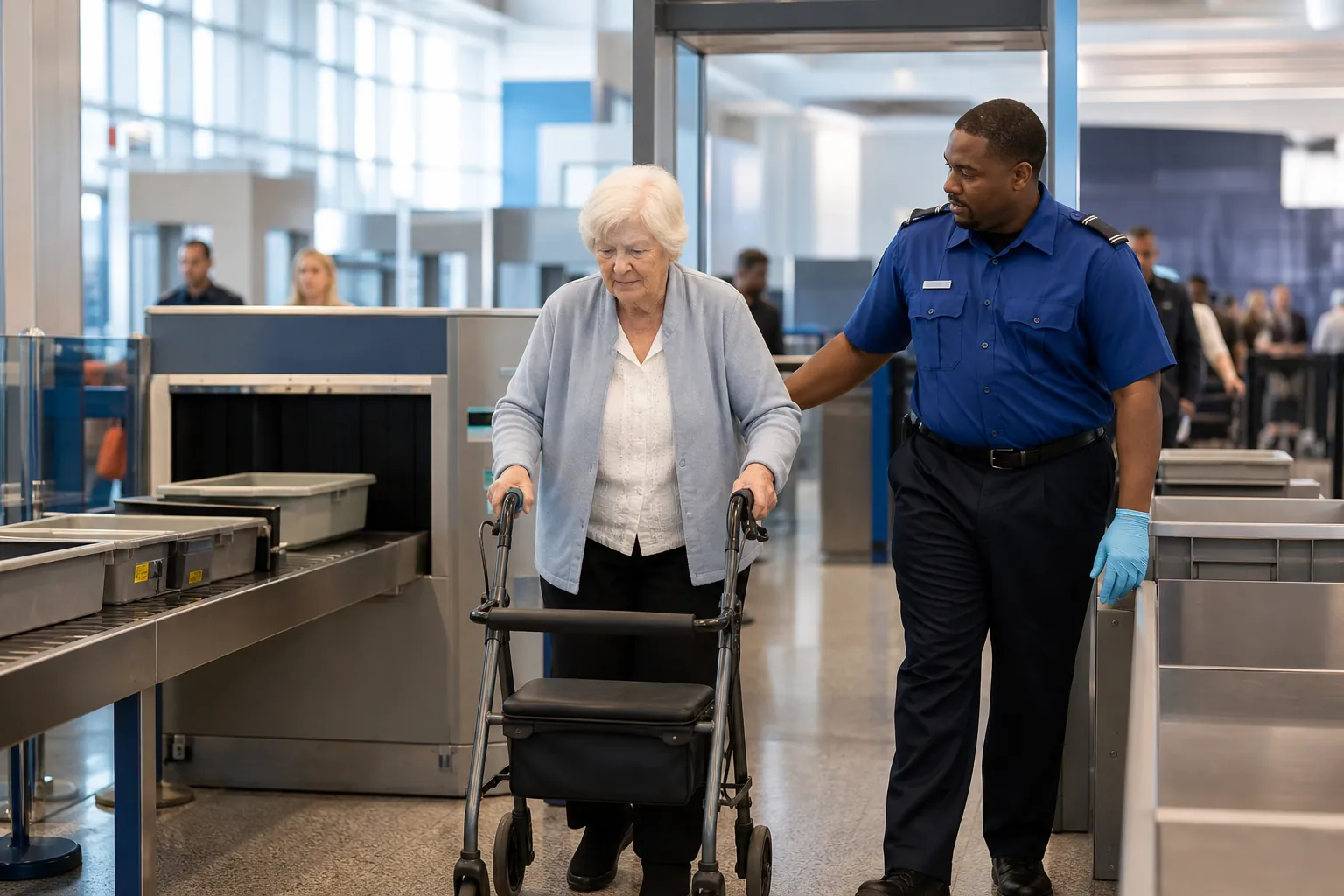
TSA Cares is for the security checkpoint, not the whole airport. TSA says travelers may request assistance at least 72 hours before travel, and a Passenger Support Specialist may help the traveler through the screening process. TSA also makes clear that this assistance does not exempt anyone from screening and does not provide expedited screening. [2]
That distinction prevents a lot of bad moods at the checkpoint. TSA Cares can be the right request for an older traveler who moves slowly, has trouble hearing instructions, uses a mobility device, becomes anxious when separated from belongings, or needs a calmer explanation of the screening sequence. It should not be sold to your parent as “they’ll take you around security.” They still go through screening.
TSA also publishes screening information specifically for passengers age 75 and older, so check that page before travel if your parent is in that age group. [4] The practical point is the same: screening rules and assistance rules meet at the checkpoint, and the person in front of the traveler is TSA, not the airline.
Expect waiting, even when you did everything right
A confirmed wheelchair request is not a guarantee that someone appears instantly. In the 2022 Paralyzed Veterans of America ACAA survey, about 59% of respondents who requested assistance reported waiting more than 10 minutes. [5] That number does not mean most older travelers will have the same wait at your airport on your day. It does mean a family should not build a connection, bathroom stop, medication schedule, or pickup plan on the fantasy that every handoff is immediate.
DOT’s disability bill of rights also says airlines may not leave a passenger who is not independently mobile unattended for more than 30 minutes. [3] That is an important rights frame, but it is not a magic button that makes an understaffed morning move faster. Use it calmly if a traveler has been parked and forgotten: “This passenger is not independently mobile and needs assistance now.”

The day-of handoffs that need your attention
The most fragile moments are the places where one provider stops and another starts. Curbside to check-in is one. Airline assistance to TSA screening is another. The aircraft door on a connection is a third. Arrival to baggage claim is the last one families underestimate, because everyone is tired and the traveler may say, “I can make it,” when the far carousel proves otherwise.
- At curbside or check-in: say the request out loud and ask where the traveler should wait for the wheelchair or escort.
- Before security: if TSA Cares was arranged, tell airline assistance and TSA staff that a TSA Cares request exists.
- At the gate: tell the gate agent the traveler needs preboarding because of mobility, balance, stamina, or transfer time.
- On the aircraft before landing: remind a flight attendant that wheelchair assistance is needed at the arrival gate or for the connection.
- At baggage claim: do not release the airline assistance until the traveler is actually at the agreed pickup point, if that was the requested destination.
Preboarding is not a favor the gate agent may or may not feel like granting. DOT says passengers who self-identify as needing extra time or assistance to board must be allowed to preboard before other passengers. [3] The key words are “self-identify.” If your parent is embarrassed to ask, the gate agent may not know there is a need until the boarding lane is already full.
What to do when the promised help does not arrive
Do not wait silently for twenty minutes because the request is “in the system.” Systems do not push wheelchairs; people do. If nobody arrives, go back to the nearest airline employee and restate the exact need.
- Say: “This passenger has wheelchair assistance requested in the reservation and cannot walk the terminal distance.”
- Ask: “Where is the assistance being dispatched from, and how long should we expect to wait?”
- If the answer is vague, escalate to the airline service desk, special-assistance desk, or gate agent.
- If boarding is approaching, say: “This passenger needs assistance and extra time to board.”
- If the traveler is left unattended and is not independently mobile, use the DOT rights language calmly and ask for a supervisor.
- Write down the time, location, airline staff role, and what happened if you later need to file a complaint.
The tone matters. You are not asking for a luxury upgrade. You are asking the airline to provide the disability-related assistance that was requested and that DOT says airlines must provide free of charge. [1]
Airport volunteer programs can help, but they are not the core request
Some airports and nonprofit programs offer meet-and-assist or volunteer help. Minneapolis-St. Paul International Airport, for example, describes a Meet and Assist program for travelers who may need help navigating the airport. [6] Travelers Aid International also describes concierge-style assistance through its network. [7]
Use these programs as supplements, not substitutes. They may be useful for finding the right counter, calming a nervous traveler, or helping a family member understand the airport layout. They do not replace the airline wheelchair request, TSA Cares, preboarding self-identification, or the airline’s responsibility for assistance through covered parts of the trip.
One airline example, and why you still have to check your own carrier
Airline workflows are not identical. American Airlines, for example, maintains a Special Assistance page for travelers who need disability-related help. [8] That is useful as one verified example of how an airline may organize these requests, but it should not be used as a script for United, Southwest, Delta, Alaska, JetBlue, or any other carrier unless that airline’s current page has been checked before booking.
When checking your airline, look for three things: where to add the request, how to confirm it after booking, and what the airline says about personal wheelchairs, scooters, batteries, and connections. If the trip includes more than one airline, confirm the request with each carrier involved.
A few boundaries worth knowing before you promise too much
Standard airport assistance is mobility and navigation help. It is not a private nurse, a medical escort, a toileting aide, or a guarantee that someone will manage every delay personally. Medical travel escort companies describe those higher-touch services as a separate paid category, not as ordinary airline wheelchair assistance. [9]
You may see airline or booking systems use codes such as WCHR, WCHS, or WCHC to describe how much wheelchair help a passenger needs. Those codes can be useful inside travel systems, but families should still describe the real limitation in plain English: can walk short distances, cannot climb stairs, cannot walk to the gate, needs aisle-chair assistance, or needs help through a connection.
For international travel, do not assume the same process controls every airport. The Air Carrier Access Act framework applies to flights to, from, or within the United States; other countries and regions may use separate passenger-with-reduced-mobility systems. [10] If the itinerary includes a non-U.S. airport, check that airport and airline directly.
Also be careful with 2024 Wheelchair Rule summaries. As of this article’s last verification, DOT had paused enforcement of four 2024 Wheelchair Rule provisions—pre-departure notifications, mishandling liability, loaner wheelchairs, and cargo-hold dimension publication—until December 31, 2026 amid litigation. Do not treat those paused provisions as currently enforceable without checking DOT’s latest status. [10]
The preflight check I would not skip
- Airline wheelchair or guided assistance was requested at booking or confirmed no later than 48 hours before departure.
- Assistance was requested for departure, connection, arrival, baggage claim, and pickup—not just the first airport.
- TSA Cares was contacted at least 72 hours ahead if screening support is needed.
- Arrival time was adjusted if the traveler uses a battery-powered wheelchair.
- Assistive devices were kept out of ordinary carry-on calculations.
- The traveler has a written self-identification sentence ready for curbside, check-in, TSA, gate, and arrival.
- The pickup point is written in plain language, not just “arrivals.”
CareWise Guide educational note: this article is for general travel-planning education, not legal, medical, or clinical advice. Last verified August 3, 2026. Before publication or major update, this page should be reviewed by a credentialed occupational therapist, geriatric RN, CAPS professional, or similarly qualified accessibility reviewer.
References
- Wheelchair and Guided Assistance, U.S. Department of Transportation.
- TSA Cares, Transportation Security Administration.
- Airline Passengers with Disabilities Bill of Rights, U.S. Department of Transportation.
- Screening Passengers 75 and Older, Transportation Security Administration.
- 2022 ACAA Survey Results, Paralyzed Veterans of America, 2022.
- Meet and Assist, MSP Airport.
- Concierge Service, Travelers Aid International.
- Special assistance, American Airlines.
- What Airport Assistance for Seniors with Disabilities Can and Cannot Do, Flying Angels.
- Passengers with Disabilities, U.S. Department of Transportation.
Questions to bring to a clinician or OT
This is not medical, legal, or a family's final decision — only a framework. Bring these questions to a clinician, occupational therapist, or your local Area Agency on Aging.
Find Local HelpRelated reading
Noticed something outdated or inaccurate on this page? Flag a correction. We review every report against CDC, NIA, and AARP HomeFit guidance before updating a page.