
Caregiver decision guide
How to Spot Bacillus Cereus Symptoms in Elderly After a Food Recall
This guide explains the two types of Bacillus cereus illness, their onset times, and the specific symptoms to watch for in older adults after a food recall. It covers when dehydration becomes dangerous and when to seek emergency care.
If your older parent may have eaten a recalled food, leftover rice, pasta, sauce, meat, or vegetables, the first useful step is not to memorize bacteria names. Start the clock from the time they ate it. Bacillus cereus can cause two different foodborne illness patterns, and the timing helps you decide what to watch for next: vomiting that begins quickly, often within 30 minutes to 5 hours, or diarrhea that usually starts later, about 6 to 15 hours after eating the contaminated food.[1]
That timing matters more in an older adult than it does in a healthy younger person because the practical danger is often dehydration. A short vomiting illness can become unsafe if a 78-year-old already drinks little, takes diuretics, has diabetes or kidney disease, or cannot replace fluids fast enough.

Bacillus cereus has also been part of recent recall activity. In May 2026, FDA posted a Class I recall involving a2 Platinum infant formula because of elevated levels of Bacillus cereus and cereulide toxin.[2] That recall does not mean infant formula is a typical senior exposure. It simply shows why caregivers may be seeing Bacillus cereus in food recall notices and then wondering what symptoms to watch for in an older adult.
Use the symptom clock first
Bacillus cereus illness is usually discussed as two syndromes because the body is dealing with different toxins in different places. For a caregiver, the distinction is useful because it gives you a working timeline.
| Pattern | Typical onset after eating | Main symptoms | Foods often associated in guidance |
|---|---|---|---|
| Emetic form | 30 minutes to 5 hours | Nausea and vomiting; sometimes abdominal cramps | Rice, pasta, and other starchy foods |
| Diarrheal form | 6 to 15 hours | Watery diarrhea, abdominal cramps; vomiting is less central | Meats, vegetables, sauces, and other mixed foods |
The vomiting form is linked to pre-formed cereulide toxin. In plain language, the toxin may already be in the food before the person eats it. This is the pattern people often associate with cooked rice or pasta that was not cooled and stored safely.[1]
The diarrheal form is different. It is associated with enterotoxins produced in the intestine after the contaminated food is eaten, so symptoms usually take longer to appear. Guidance commonly describes watery diarrhea and abdominal cramps as the main features.[1]
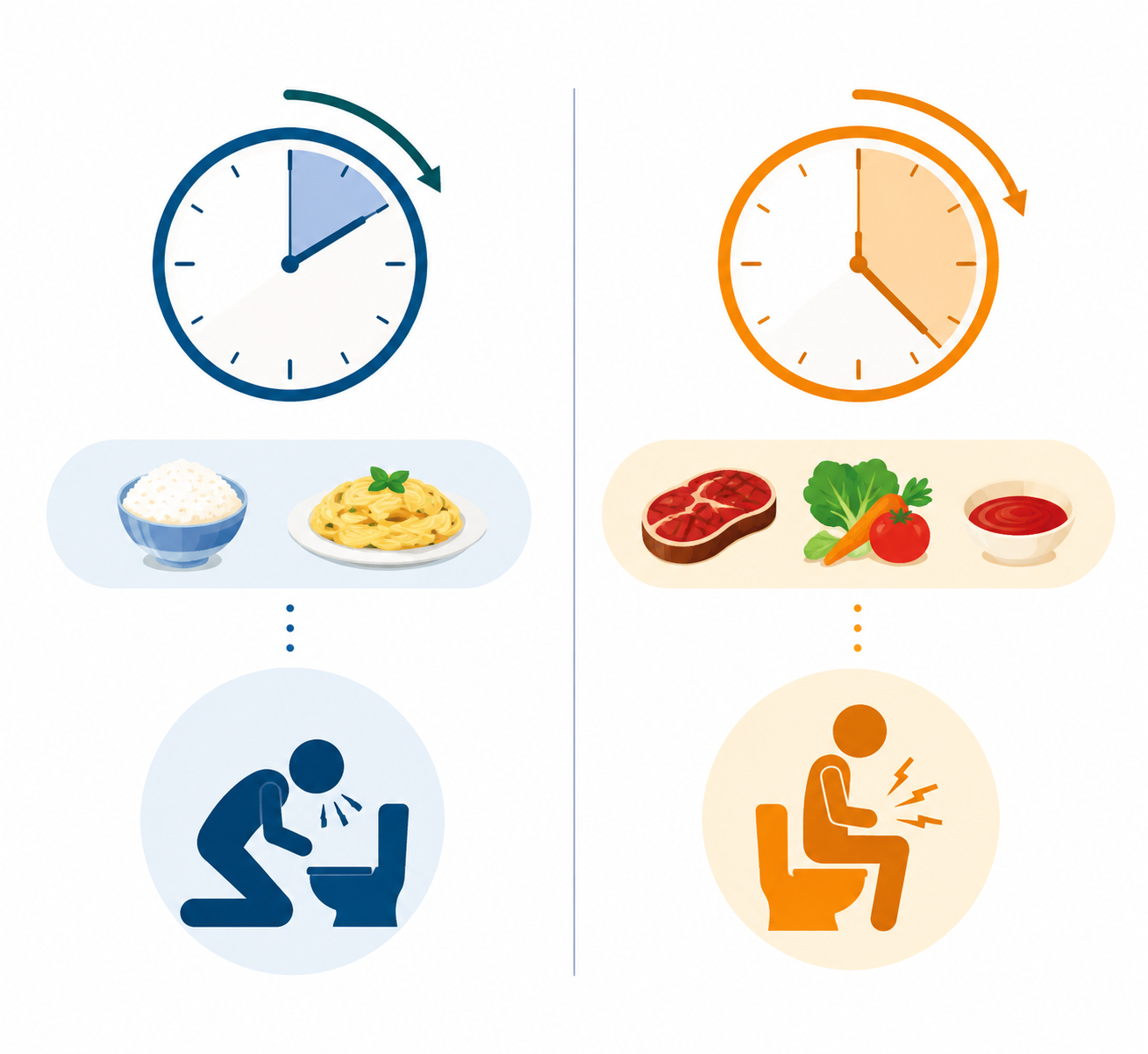
A useful kitchen-table reconstruction sounds simple: what did they eat, when did they eat it, when did the first symptom start, and what has happened since? If vomiting began two hours after leftover fried rice, that fits a different pattern than diarrhea beginning the next morning after a mixed meal. It does not prove the cause, but it gives the nurse, doctor, urgent care clinician, or poison center a clearer picture.
Do not count on reheating to fix risky rice or pasta
One common caregiver assumption deserves a hard stop: if cereulide toxin is already present, reheating the food does not reliably make it safe. Food safety sources describe cereulide as heat-stable, with reported stability up to 121°C/250°F.[3] That means a hot plate of reheated rice can still be a problem if the toxin formed while the food sat too long at unsafe temperatures.
This is especially important when an older adult says, “I microwaved it, so it was fine.” Heat can kill many bacteria when used correctly, but toxin that is already present is a different issue. If the food is part of a recall, smells wrong, has been stored questionably, or sat out for an uncertain length of time, do not serve it again while you are deciding what to do.
Why the same illness can be harder on an older adult
Most descriptions of Bacillus cereus say illness is often mild and self-limited in healthy people. That can be true and still be unhelpful at the bedside of an older adult who has vomited three times, is afraid to drink, and has not urinated since morning.
Older adults have several built-in disadvantages during a foodborne illness. FoodSafety.gov notes that as people age, the gastrointestinal tract may hold food longer and produce less stomach acid, while the liver and kidneys may be less effective at removing bacteria and toxins from the body.[4] CDC also lists adults 65 and older among groups at increased risk for serious food poisoning and states that nearly half of people 65 and older with lab-confirmed illness from Salmonella, Campylobacter, Listeria, or E. coli are hospitalized.[5]
That CDC hospitalization statistic is not a Bacillus cereus-specific rate. It applies to selected major foodborne pathogens that CDC tracks in that statement, not to Bacillus cereus alone.[5] The reason it still matters here is practical: age, baseline illness, reduced reserve, and fluid loss are what turn many stomach illnesses from unpleasant into unsafe.
FDA’s food safety booklet for older adults describes immune function as beginning to decline between ages 50 and 60 and becoming substantially weakened by age 75.[6] That does not mean every 75-year-old needs an emergency room for one loose stool. It does mean the margin for waiting is narrower when vomiting or diarrhea continues.
What to watch for after possible exposure
Write down the basics if you are coordinating from another city or handing off to a sibling: suspected food, amount eaten if known, time eaten, first symptom time, number of vomiting episodes, number of diarrhea episodes, temperature if checked, fluids taken, and last urination. This record is often more useful than a long explanation of the recall.
- Vomiting within 30 minutes to 5 hours after rice, pasta, or another starchy leftover fits the emetic pattern described for Bacillus cereus.[1]
- Watery diarrhea and abdominal cramps starting 6 to 15 hours after a meal fit the diarrheal pattern more closely.[1]
- Fever is not usually the main clue in standard descriptions of Bacillus cereus food poisoning; timing and fluid loss are more useful for immediate monitoring.[7]
- Symptoms that keep returning, worsen, or do not fit the expected pattern should be treated as a reason to call a clinician rather than as proof that it is “just food poisoning.”
Cleveland Clinic describes Bacillus cereus food poisoning as causing nausea, vomiting, diarrhea, and stomach cramps, with treatment usually focused on fluids and rest for mild cases.[7] In an older adult, “fluids” is not a vague comfort measure. It is the part you actually monitor.
Dehydration signs that are easy to miss
Older adults do not always announce thirst clearly. Some already limit fluids because getting to the bathroom is hard, they fear incontinence, or they simply do not feel thirsty. During vomiting or diarrhea, that quiet baseline can become a real risk.
- Reduced urination or no urine for longer than usual
- Very dark urine
- Dry mouth, dry tongue, or cracked lips
- Weakness that is more than ordinary tiredness
- Dizziness, lightheadedness, or feeling faint when standing
- New confusion, unusual sleepiness, or not acting like themselves
New confusion deserves special respect. Families sometimes explain it away as fatigue, a bad night, or “Dad gets like this when he is stressed.” After vomiting or diarrhea, confusion can be a dehydration warning sign, especially if it comes with weakness, dizziness, or reduced urination.
If symptoms are mild and the older adult is alert, able to sip, and urinating normally, home monitoring may be reasonable while you seek individualized advice from their clinician when needed. Small, frequent sips are often easier than a full glass. Avoid making fluid replacement a test of willpower; nausea and frailty can make “just drink more” unrealistic.
When home observation is no longer enough
The decision point is not whether Bacillus cereus sounds serious on paper. The decision point is whether this older adult can stay hydrated and safe at home.
Seek urgent medical advice or emergency care if the older adult cannot keep fluids down, has repeated vomiting, has severe or persistent diarrhea, shows signs of dehydration, becomes weak or dizzy, has new confusion, faints, or seems to be declining. Escalate sooner if they have diabetes, chronic kidney disease, heart disease, are taking medications that affect fluid balance, or are already medically fragile.
For a caregiver on the phone, this may mean asking direct questions rather than waiting for a parent to volunteer details: “When did you last pee?” “Can you keep down small sips?” “Are you dizzy when you stand?” “Can you walk safely to the bathroom?” The answers tell you whether someone needs to be with them, whether to call their clinician, or whether to use emergency services.
Antibiotics are usually not the main treatment issue
Families often ask whether the older adult needs antibiotics. For typical Bacillus cereus food poisoning, that is usually not the central treatment question because the illness is toxin-mediated. StatPearls notes that antibiotic therapy is not indicated for the usual gastrointestinal syndromes caused by Bacillus cereus.[8]
That does not mean symptoms should be ignored or that every case can be managed at home. It means the urgent focus is often assessment, hydration, and monitoring for complications. A clinician may still need to evaluate the person, especially if symptoms are severe, the diagnosis is uncertain, or the older adult has other medical risks.
What to do with the food and the recall notice
If the food is named in a recall, follow the recall instructions. Do not taste it to “check.” Keep the package, lot number, receipt, or delivery information if available, because public health or the store may ask for those details. If the food is not recalled but is suspicious because of storage, odor, time left out, or symptoms after eating, discard it in a way that prevents someone else from eating it.
When calling a clinician, urgent care, poison center, or public health line, give the timeline first. A concise report is enough: “He is 78, ate leftover pasta at noon, started vomiting at 2 p.m., vomited four times, has kept down only a few sips, last urinated this morning, and has chronic kidney disease.” That is more actionable than saying only that you read about Bacillus cereus online.
After a recall or suspected exposure, timing the symptoms helps you recognize which Bacillus cereus pattern may fit. Hydration status and the older adult’s baseline health determine how urgent the situation is. If you are unsure whether they are keeping up with fluids, or if weakness, dizziness, reduced urination, dry mouth, or confusion appears, it is reasonable to seek care early rather than wait for the illness to run its course.
References
- Bacillus cereus - BCCDC
- The a2 Milk Company Issues Voluntary Recall of Limited Quantity of a2 Platinum Premium Infant Formula - U.S. Food and Drug Administration, May 2026
- Bacillus cereus Food Poisoning - UF/IFAS Extension
- Older Adults - FoodSafety.gov
- People at Increased Risk for Food Poisoning - Centers for Disease Control and Prevention
- Food Safety for Older Adults - U.S. Food and Drug Administration
- Bacillus Cereus - Cleveland Clinic
- Bacillus Cereus - StatPearls
Questions to bring to a clinician or OT
This is not medical, legal, or a family's final decision — only a framework. Bring these questions to a clinician, occupational therapist, or your local Area Agency on Aging.
Find Local HelpRelated reading
Noticed something outdated or inaccurate on this page? Flag a correction. We review every report against CDC, NIA, and AARP HomeFit guidance before updating a page.