
Caregiver decision guide
Bathing Assistance for the Elderly: A Complete Guide to Safety, Technique, and Dignity
A practical, evidence-based guide for family caregivers on helping an older adult bathe safely and with dignity. Covers bathroom safety preparation, step-by-step bathing techniques, emotional intelligence strategies for overcoming resistance, equipment comparisons with cost and funding, and when to bring in professional help.
Why Bathing Is the Hardest ADL for Family Caregivers
Of the six core Activities of Daily Living (ADLs) — bathing, dressing, toileting, transferring, continence, and feeding — bathing is the one that most commonly requires assistance. According to the CDC's National Center for Health Statistics, approximately 75% of participants in adult day services centers need help with bathing. This single statistic hints at a deeper reality: bathing is not just a physical task; it is a deeply personal, often vulnerable act that combines safety risk, technical complexity, and emotional sensitivity in ways that other ADLs do not.
The stakes are high. The National Institute on Aging reports that roughly 80% of falls among older adults occur in the bathroom, making it the most dangerous room in the home. A fall during bathing can result in fractures, head trauma, or a cascade of health declines that accelerate loss of independence. Research published in the Journal of the American Geriatrics Society (Gill et al., 2006) found that bathing disability is an independent predictor of long-term nursing home admission — meaning that the inability to bathe safely is itself a marker for a trajectory toward institutional care, even when other functional abilities remain intact.
Yet many family caregivers jump straight to the technique — how to wash someone who cannot wash themselves — without first addressing the two other pillars that determine success: environmental safety and emotional intelligence. This guide is organized around a three-part framework — safety × technique × emotional intelligence — because each component reinforces the others. A caregiver who masters all three will reduce fall risk, preserve their parent's dignity, and protect their own physical and emotional health.

Before You Begin: Making the Bathroom Safe
Safety preparation is not an optional upgrade — it is a prerequisite. The bathroom presents a perfect storm of fall hazards: wet, slippery surfaces; hard, unforgiving fixtures; confined spaces that limit movement; and temperature extremes that can cause dizziness or burns. Before you attempt to help anyone bathe, the environment must be assessed and modified.
Essential Safety Checklist
- Grab bars: Install grab bars at the tub or shower entry, next to the toilet, and inside the shower area. Avoid suction-cup grab bars — they can detach without warning. Use bars that are anchored into wall studs or blocking, rated to support at least 250 pounds. Stainless steel or chrome-plated brass bars with a textured grip surface provide the best combination of durability and traction.
- Non-slip surfaces: Place non-slip mats or adhesive strips inside the tub or shower floor. Outside the shower, use a bath mat with a rubber backing. Avoid small scatter rugs that can slide or bunch up.
- Shower chair or transfer bench: A sturdy, adjustable shower chair with rubber feet allows the person to sit during the entire bath, eliminating the need to stand on a wet surface. A transfer bench straddles the tub wall, allowing the person to sit on the bench outside the tub, swing their legs over, and slide inward — a much safer alternative to stepping over a tub edge.
- Handheld showerhead: A handheld showerhead with a long hose (at least 60 inches) allows the caregiver to control water direction and pressure while the person remains seated. This reduces the need for the person to reposition or reach.
- Water temperature safety: Set your water heater thermostat to no higher than 120°F (49°C). Older adults have thinner skin and reduced temperature sensitivity, putting them at higher risk for scalding. Test the water temperature with your wrist or a thermometer before the person enters the water.
- Adequate lighting: Use bright, glare-free lighting. Nightlights or motion-sensor lights are helpful for middle-of-the-night bathroom trips. Ensure light switches are accessible from the doorway and from the seated position.
- Clear pathways: Remove clutter, laundry baskets, scales, and unnecessary furniture from the bathroom floor. The path from the bedroom to the bathroom should be clear and wide enough for a walker or wheelchair if needed.
Bathing Techniques: Step-by-Step for Every Situation
Once the environment is safe, the next step is mastering the technique. The right approach depends on the person's mobility level, the type of bathing fixture available, and the caregiver's physical capacity. Below are step-by-step instructions for the three most common scenarios.
Scenario 1: Tub Bathing with a Transfer Bench
A transfer bench is the safest way to bathe someone who cannot step over a tub wall. The bench straddles the tub edge, so the person sits on the bench outside the tub, swings their legs over, and slides across into the tub.
- Position the transfer bench so half is outside the tub and half is inside. Ensure the bench is stable and the rubber feet are secure.
- Have the person sit on the outside half of the bench, facing the faucet.
- Assist them in swinging their legs over the tub wall one at a time.
- Ask them to slide across the bench into the tub using their arms and your support if needed.
- Once seated inside, fill the tub to a safe level (waist-high or lower) and proceed with washing.
- To exit, reverse the process: drain the water first, then slide back to the outside half of the bench and swing legs out.
Scenario 2: Shower Bathing with a Shower Chair
A shower chair is ideal for walk-in showers or for situations where the person can stand briefly but cannot stand for the duration of a shower.
- Place the shower chair in the shower, positioned so the person can reach the controls without leaning.
- Help the person sit on the chair. If they can stand briefly, have them back up to the chair until their legs touch it, then lower themselves down.
- Use the handheld showerhead to wet and rinse the person section by section, starting from the neck and shoulders and working downward.
- Apply soap to a long-handled sponge or wash mitt — this allows the person to wash as much of their own body as possible, preserving independence.
- For areas the person cannot reach (back, legs, feet), use the wash mitt with gentle, firm strokes. Never scrub sensitive or fragile skin.
- Rinse thoroughly. Residual soap can cause itching and skin irritation.
Scenario 3: Bed Bath (for Limited Mobility)
When the person cannot get to the bathroom at all — due to severe weakness, post-surgery recovery, or advanced illness — a bed bath is the safest alternative.
- Gather supplies: a basin of warm water (tested at 105°F–110°F), washcloths, towels, mild soap, and clean linens.
- Protect the bed with a waterproof pad or absorbent sheet under the person.
- Wash and dry one section of the body at a time, keeping the rest covered with a towel to preserve warmth and dignity. Work from cleanest to dirtiest: face, arms, chest, abdomen, legs, feet, then back and perineal area.
- Change the water when it becomes soapy or cool.
- Pat dry thoroughly, paying attention to skin folds where moisture can cause irritation or infection.
- Apply moisturizer to prevent dry skin, which is common in older adults.
Caregiver Body Mechanics
Protecting your own body is essential. Bathing assistance involves bending, reaching, and sometimes lifting — all of which can strain your back, shoulders, and knees if done improperly.
- Keep your back straight: Bend at your hips and knees, not your waist. Engage your leg muscles when lifting or supporting.
- Stay close to the person: The farther you reach, the more strain on your lower back. Position yourself as close as possible.
- Use a gait belt: A gait belt worn around the person's waist gives you a secure handhold for transfers and support without grabbing their arms or clothing.
- Never lift alone: If the person cannot bear weight or assist with transfers, do not attempt to lift them yourself. This is a sign that you need a mechanical lift or professional assistance.
The Emotional Side: Preserving Dignity and Overcoming Resistance
Bathing is an intimate act. For the person receiving care, it can feel like a profound loss of privacy, autonomy, and adulthood. For the caregiver — especially an adult child — it can feel awkward, emotionally draining, and a reversal of roles that neither party asked for. This emotional dimension is not a distraction from the task; it is a core component of doing it well.
Strategies for Preserving Dignity
- Towel draping: Keep a towel draped over the person's shoulders, lap, or chest throughout the bath. Only uncover the area you are actively washing. This simple practice preserves a sense of modesty and warmth.
- Offer choices: Control is often the first thing lost when receiving care. Offer choices wherever possible: "Would you like to bathe in the morning or afternoon?" "Should I use the blue washcloth or the green one?" "Do you want to wash your face first or your arms?" These small decisions restore a sense of agency.
- Step-by-step coaching: Instead of doing everything for the person, narrate each step and invite their participation. "I'm going to wash your left arm now. Can you hold the washcloth?" This treats the person as a partner in the process, not a passive recipient.
- Same-gender preferences: If the person is uncomfortable being bathed by someone of a different gender, honor that preference. This may mean arranging for a same-gender family member or a home health aide.
- Privacy: Close the bathroom door and window. Draw the shower curtain. Play soft music or run the water to mask sounds. These small measures signal that bathing is a private, protected time.
Overcoming Resistance
Resistance to bathing is common and can stem from fear of falling, discomfort with cold or water, confusion, or a simple desire to assert control. The following techniques can help de-escalate resistance without turning bath time into a battle.
- Therapeutic fib: If the person has cognitive impairment, a gentle untruth can reduce anxiety without causing harm. For example: "The doctor said we need to check your skin today" or "Let's just wash your back — you can do the rest." This is not deception; it is redirection toward a goal that the person cannot otherwise understand.
- Distraction: Engage the person in conversation about a favorite topic — a grandchild, a past vacation, a hobby — while you work. The distraction can shift focus away from the discomfort of bathing.
- Positive framing: Instead of saying "You need a bath," try "Let's get you warmed up with a nice shower" or "I have some new lavender soap I think you'll like." Frame bathing as a pleasant experience, not a chore.
- Pick your battles: If the person is adamantly refusing, do not force the issue. A missed bath is not a crisis. Try again later in the day or the next day. Consistency and patience are more effective than confrontation.
Choosing the Right Equipment: A Decision Framework
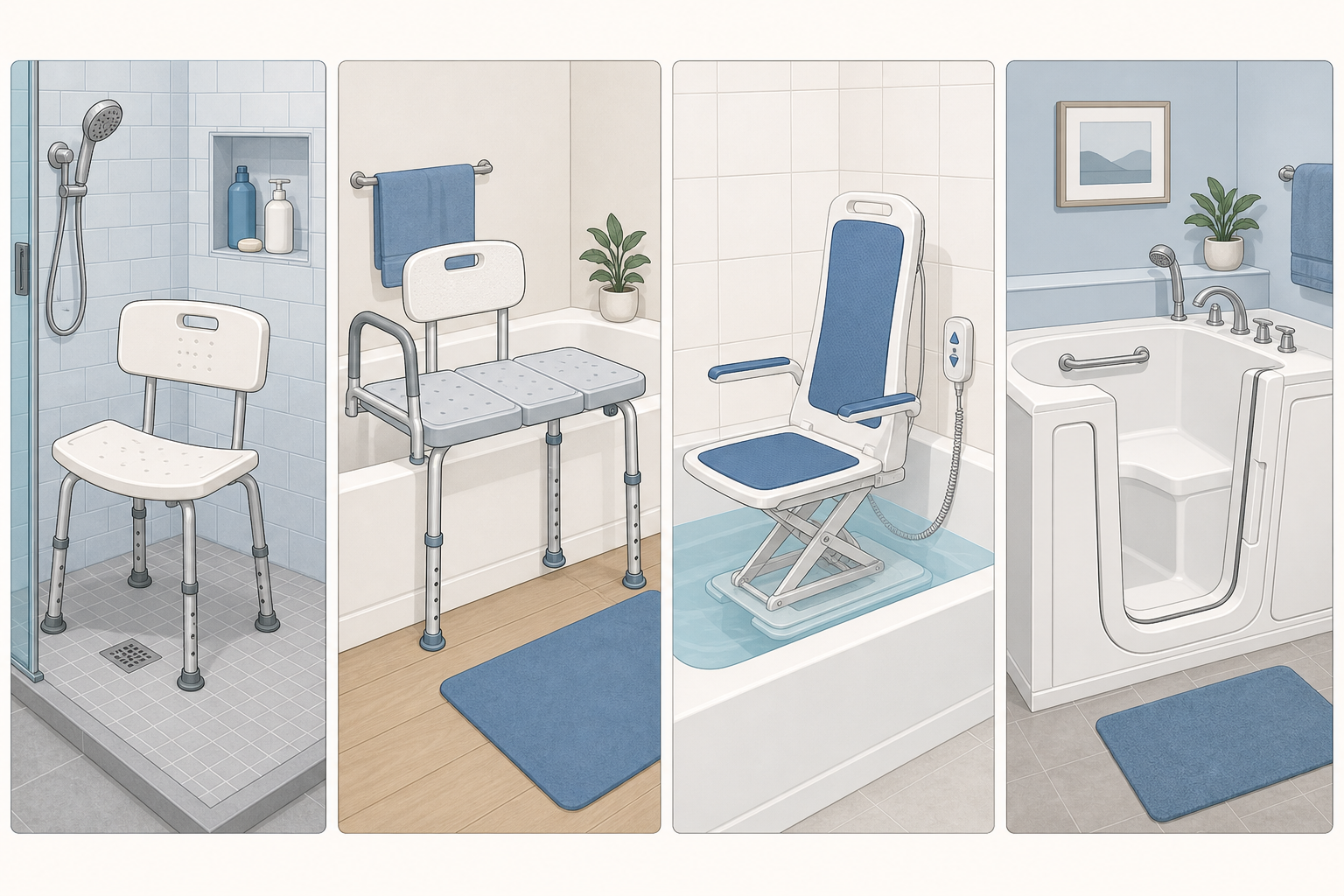
The market offers a wide range of bathing aids, and choosing the right one can feel overwhelming. The key is to match the equipment to the person's current mobility level and functional needs — not to the most advanced or most affordable option. Below is a decision framework organized by mobility level.
| Equipment | Best For | Key Features to Evaluate | Approximate Cost Range |
|---|---|---|---|
| Shower chair (with backrest) | People who can sit unassisted but cannot stand for the duration of a shower | Adjustable height, non-slip rubber feet, weight capacity (250+ lbs), backrest height, armrests | $50 – $200 |
| Transfer bench | People who cannot step over a tub wall but can sit and slide | Width to straddle tub wall, weight capacity, padded seat, removable armrests, non-slip feet | $80 – $250 |
| Bath lift | People who cannot lower themselves into a tub or stand to exit | Battery life, weight capacity, remote control, ease of cleaning, installation requirements | $800 – $2,500 |
| Walk-in tub | People with significant mobility limitations who prefer tub bathing and have budget for renovation | Door seal quality, seat height and comfort, water temperature control, grab bar placement, installation cost | $2,500 – $17,000 |
| Handheld showerhead | All situations — essential for seated bathing | Hose length (60+ inches), spray settings, pause button, easy-grip handle, mounting bracket type | $30 – $100 |
How to decide: Start with the simplest, least expensive option that meets the person's current needs. A shower chair and handheld showerhead are sufficient for most situations. Only move to a bath lift or walk-in tub if the person cannot safely use a shower chair or transfer bench. An occupational therapy assessment can provide a professional recommendation tailored to the individual's specific mobility, strength, and home layout.
Funding and Insurance: What Medicare Covers (and What It Doesn't)
One of the most common questions family caregivers ask is whether insurance will pay for bathing equipment. The answer, for most people, is disappointing: Original Medicare (Parts A and B) generally does not cover grab bars, shower chairs, transfer benches, bath lifts, or walk-in tubs. These items are classified as home modification or convenience items, not as Durable Medical Equipment (DME), which Medicare defines narrowly as equipment that is medically necessary for use in the home, reusable, and primarily used for a medical purpose.
There are, however, several potential funding sources worth exploring:
- Medicare Advantage (Part C): Some Medicare Advantage plans offer an annual allowance for home modifications, typically ranging from $200 to $2,000. This may cover grab bars, shower chairs, and other safety equipment. Coverage varies by plan and by year. Contact the plan directly and ask about "home modification benefits" or "supplemental benefits."
- VA benefits: Veterans and surviving spouses may be eligible for the VA Home Improvements and Structural Alterations (HISA) grant, which provides up to $4,100 for service-connected disabilities and up to $2,000 for non-service-connected disabilities. The VA also offers the Special Housing Adaptation (SHA) grant for more extensive modifications.
- State Medicaid waiver programs: Many states offer Home and Community-Based Services (HCBS) waivers that can cover home modifications, including bathroom safety equipment. Eligibility and coverage vary widely by state. Contact your state's Medicaid office or Area Agency on Aging to inquire.
- Nonprofit and community programs: Organizations like Rebuilding Together, Habitat for Humanity's Aging-in-Place program, and local faith-based groups may provide free or low-cost bathroom modifications for low-income seniors. Waitlists can be long, so apply early.
- Tax deductions: Medically necessary home modifications may be tax-deductible as a medical expense if they exceed 7.5% of your adjusted gross income. Consult a tax professional for guidance.
When to Bring in Professional Help
Family caregivers are often reluctant to ask for help, viewing it as a personal failure or a sign that they are not doing enough. In reality, knowing when to bring in professional support is a sign of good judgment — and it can prevent injuries, reduce burnout, and improve the quality of care for your loved one.
Signs That Professional Help Is Needed
- You cannot safely transfer the person: If the person cannot bear weight or assist with transfers, and you are straining to lift or support them, you are at high risk for a caregiver back injury. This is the most common reason to seek professional help.
- The person is aggressive or combative during bathing: If bathing consistently triggers physical aggression, screaming, or severe distress, a home health aide or occupational therapist trained in dementia care may have techniques that de-escalate the situation more effectively than a family member can.
- You are experiencing caregiver burnout: If you dread bath days, feel resentful, or are physically exhausted after each bathing session, these are signs that the current arrangement is not sustainable. Bringing in help for even one or two baths per week can provide relief.
- The person has had a recent fall or hospitalization: After a fall or hospital stay, mobility and strength may be temporarily reduced. An occupational therapy assessment can identify new safety risks and recommend equipment or techniques that match the person's current abilities.
Types of Professional Support
- Occupational therapist (OT): An OT can conduct a home safety assessment, recommend specific equipment, teach transfer techniques, and train both the caregiver and the care recipient in safe bathing practices. This is often the first and most valuable professional step. An OT evaluation may be covered by Medicare Part B if it is ordered by a physician.
- Home health aide (HHA): A home health aide can provide hands-on bathing assistance, typically for 1–2 hours per visit. HHAs are trained in personal care, including bathing, dressing, and grooming. Services may be covered by Medicare if the person is homebound and receiving skilled care (nursing or therapy), or by Medicaid waiver programs for eligible individuals.
- Private caregiver: If insurance does not cover home health aide services, hiring a private caregiver for bathing assistance is an option. Rates vary by region but typically range from $20 to $35 per hour. Agencies handle background checks, training, and scheduling, which reduces the administrative burden on the family.
Alternative Bathing Strategies for Challenging Days
Not every day is a full-bath day. Illness, fatigue, pain, or simply a bad mood can make a full shower or tub bath impossible. On those days, having alternative strategies ensures that hygiene is maintained without adding stress to an already difficult situation.
Sponge Bath
A sponge bath can be done at the sink or in bed. Use a basin of warm water, a washcloth, and mild soap. Wash the face, underarms, hands, and perineal area. This covers the areas most prone to odor and bacterial growth and takes only 10–15 minutes.
No-Rinse Bathing Products
No-rinse cleansers, foam baths, and pre-moistened bath wipes are widely available and require no water. They are applied directly to the skin and wiped off, leaving no residue. These products are especially useful for bed baths, travel, or situations where the person cannot tolerate the sensation of water. Look for products labeled "no-rinse" or "disposable bath."
Towel Bath
The towel bath method involves soaking a large towel in a warm, soapy solution (using no-rinse cleanser), wringing it out, and wrapping it around the person's body. After a few minutes, the towel is removed and the skin is patted dry. This method provides a more thorough clean than a sponge bath while requiring minimal repositioning.
Frequency Guidance
A full bath or shower 2–3 times per week is sufficient for most older adults. On the other days, a sponge bath or spot-cleaning is adequate. Daily full bathing is not necessary and can actually be harmful to aging skin. The goal is not perfection — it is maintaining hygiene, comfort, and dignity without causing stress or skin damage.
Questions to bring to a clinician or OT
This is not medical, legal, or a family's final decision — only a framework. Bring these questions to a clinician, occupational therapist, or your local Area Agency on Aging.
Find Local HelpRelated reading
Noticed something outdated or inaccurate on this page? Flag a correction. We review every report against CDC, NIA, and AARP HomeFit guidance before updating a page.