
Caregiver decision guide
How to Read Boston's Heat and Cold Warnings for Senior Safety
Understand what Boston's heat advisory, heat emergency, cold advisory, and cold emergency declarations mean for your elderly parent's safety — and know exactly which steps to take at each alert level. This guide bridges the gap between city warning numbers and senior-specific health risks.
If today's Boston forecast has just turned into a heat advisory, heat emergency, cold advisory, or cold emergency, do not wait for the most severe label before checking on an older parent. Boston’s public thresholds are useful, but they are written around citywide conditions. A frail 82-year-old in a third-floor apartment, someone on a diuretic, or a parent who insists the fan is “fine” may need action before the city reaches its emergency line.
The numbers matter. Boston has described a heat advisory as a heat index of 100–104°F for at least two hours, an excessive heat warning as 105°F or higher for at least two hours, and a heat emergency as a heat index of at least 95°F sustained for two or more hours per day on two or more consecutive days.[1] On the cold side, Boston has described a cold advisory as wind chill at or below 0°F and a cold emergency as wind chill at or below -10°F for one day or more.[2]
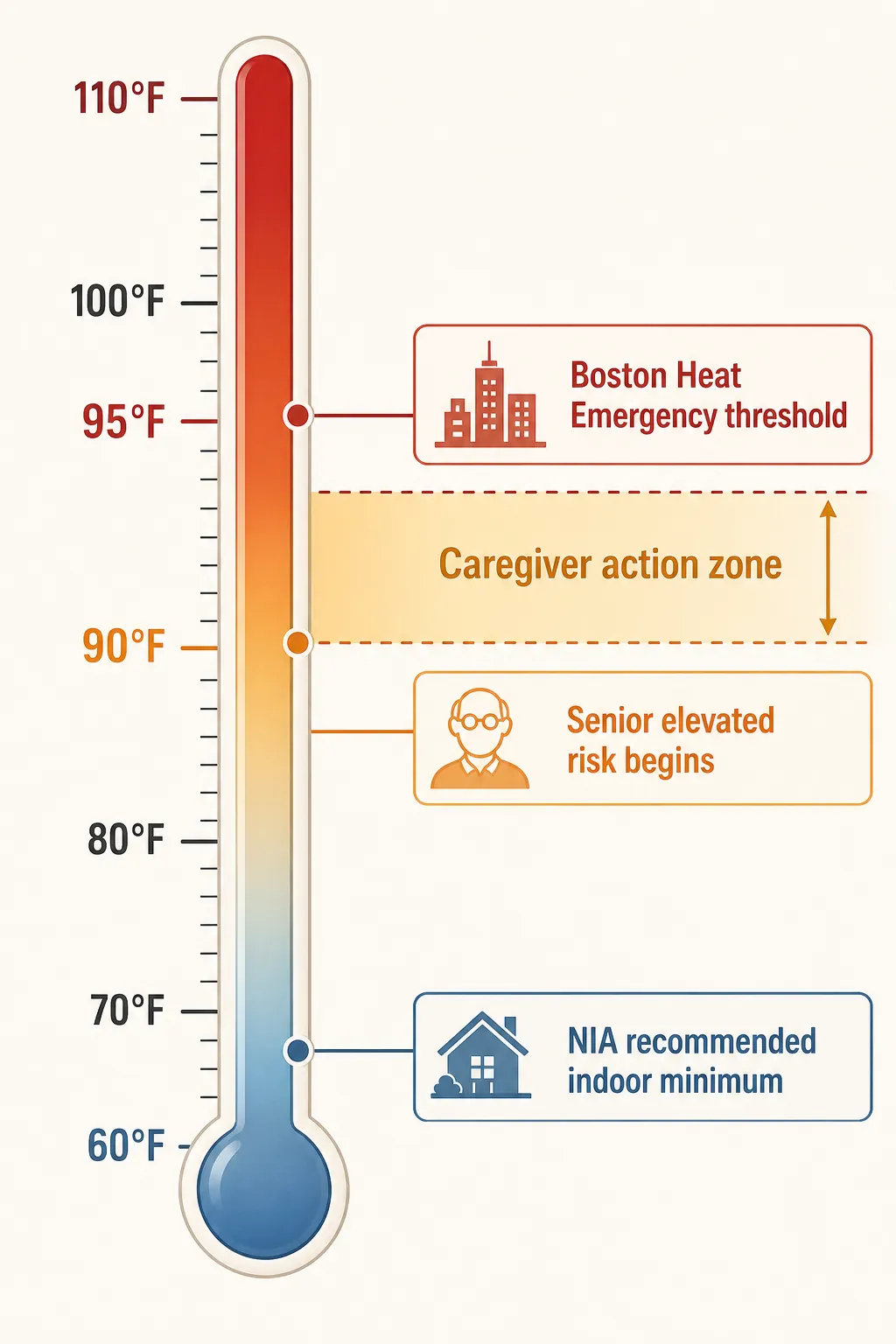
For an older adult, those labels should not be read as “safe until then.” The CDC says adults 65 and older do not adjust as well as younger people to sudden temperature changes, and Mass.gov says older adults face elevated heat risk beginning at 90°F.[3][4] That leaves a practical gap: a parent can be in the caregiver action zone before Boston declares a heat emergency.
Translate the Boston Alert Into Caregiver Action
Use the city alert as the first piece of information, not the whole decision. The next question is always local and personal: what is happening inside your parent’s home, and how well can that particular person regulate heat or cold today?
| Boston alert or condition | What the number means | What to do for an older parent today |
|---|---|---|
| Hot forecast near or above 90°F, even before a Boston heat emergency | Mass.gov identifies older adults as facing elevated heat risk starting at 90°F.[4] | Call early. Ask for the indoor temperature, whether the AC is working, what they have drunk, and whether they feel dizzy, weak, confused, nauseated, unusually tired, or have a headache. If they do not have reliable cooling, arrange a visit, a ride, or a cooling location before the apartment heats up. |
| Boston heat advisory | Boston has used heat index 100–104°F for at least two hours as a heat advisory threshold.[1] | Treat this as an action alert for seniors. Confirm the home is cooled, not just ventilated. Ask them to close blinds on sunny windows, avoid cooking, drink fluids if medically allowed, and move to a cooler room or public cooling space if indoor heat is rising. |
| Boston excessive heat warning | Boston has used heat index 105°F or higher for at least two hours as the excessive heat warning threshold.[1] | Do not rely on a casual phone check. Arrange an in-person check if possible. If no AC is available, make a same-day plan for a cooling center, a relative’s home, or another air-conditioned place. Review medications that affect heat response and watch for behavior changes. |
| Boston heat emergency | Boston has declared heat emergencies when the heat index is expected to reach at least 95°F for two or more hours per day on two or more consecutive days.[1] | Assume ordinary comfort measures may fail. Confirm a specific cooling plan, transportation, and a next check-in time. Use Boston resources such as BCYF cooling centers, 311, AlertBoston, Age Strong Shuttle, and emergency wellness check options when needed. |
| Boston cold advisory | Boston has described a cold advisory as wind chill at or below 0°F.[2] | Shift attention indoors. Ask for the thermostat reading, whether heat is working in every room used for sleeping or sitting, whether pipes or windows are creating drafts, and whether the parent is more tired, confused, clumsy, or withdrawn than usual. |
| Boston cold emergency | Boston has described a cold emergency as wind chill at or below -10°F for one day or more.[2] | Confirm the apartment is at a safe temperature, arrange a wellness check if you cannot verify safety, and use warming centers or city help if heat is inadequate. Do not accept “I’m fine” as enough if the home is cold or the parent sounds confused. |
Before relying on those thresholds for a live event, check the current Boston.gov heat or cold page, because city language can be updated from one season to another. The caregiving logic does not change: the official alert tells you the city is under strain; the indoor condition tells you whether your parent is safe.
Heat: The Five-Degree Gap That Changes the Call
The most dangerous misunderstanding is waiting for the phrase “heat emergency” before acting. Mass.gov’s senior-risk marker begins at 90°F, while Boston’s heat emergency threshold has been tied to a 95°F heat index sustained over two or more hours per day on two consecutive days.[1][4] That is not a contradiction. It is a reminder that a city declaration and an older adult’s vulnerability measure different things.
At 90°F and above, start with a call that produces facts, not reassurance. “Are you okay?” often gets a polite answer. Better questions are concrete: What does the thermostat say? Is the AC on and blowing cold air? Which room are you sitting in? Have you urinated normally today? Did you eat? Are you lightheaded when you stand? Has anyone been in the apartment?
If the answer is vague, shorten the interval before the next check. If the indoor temperature is rising, or your parent cannot confirm that the AC is working, move from phone advice to logistics: who can stop by, who can bring them somewhere cooler, whether they can safely use a rideshare, and whether they need the Age Strong Shuttle or another arranged ride.
A heat advisory deserves special respect in elder care because it can sound less urgent than it is. In Boston’s published language, a heat advisory can mean a heat index of 100–104°F for at least two hours.[1] For a healthy adult walking between air-conditioned places, that may be unpleasant. For an older person without reliable cooling, it can mean the apartment is moving toward a level where “drink water and use a fan” is no longer a plan.
The Fan Caveat Is Not Fine Print
Mass.gov and Boston.gov both warn that fans alone do not prevent heat-related illness when temperatures rise above 95°F, and that fans may create a false sense of cooling.[5][6] This is the sentence to remember when a parent says the fan is enough.
A fan can make someone feel air movement while the body is still absorbing heat. If the room is hot, the parent is sweating heavily or not sweating at all, or they are weak, dizzy, nauseated, confused, or unusually sleepy, stop treating the fan as a safety measure. Move them to air conditioning, arrange help, or seek medical guidance depending on symptoms.
- If the home has working AC: confirm it is on, set low enough to cool the room, and not blocked by furniture or a closed door.
- If the home has only fans: arrange air-conditioned time elsewhere before the hottest part of the day.
- If the parent resists leaving: offer a specific destination and pickup time instead of a general warning.
- If symptoms appear: treat the situation as medical, not as a comfort problem.
Cold Alerts Are About Wind Chill; Your Parent’s Risk Is Indoors
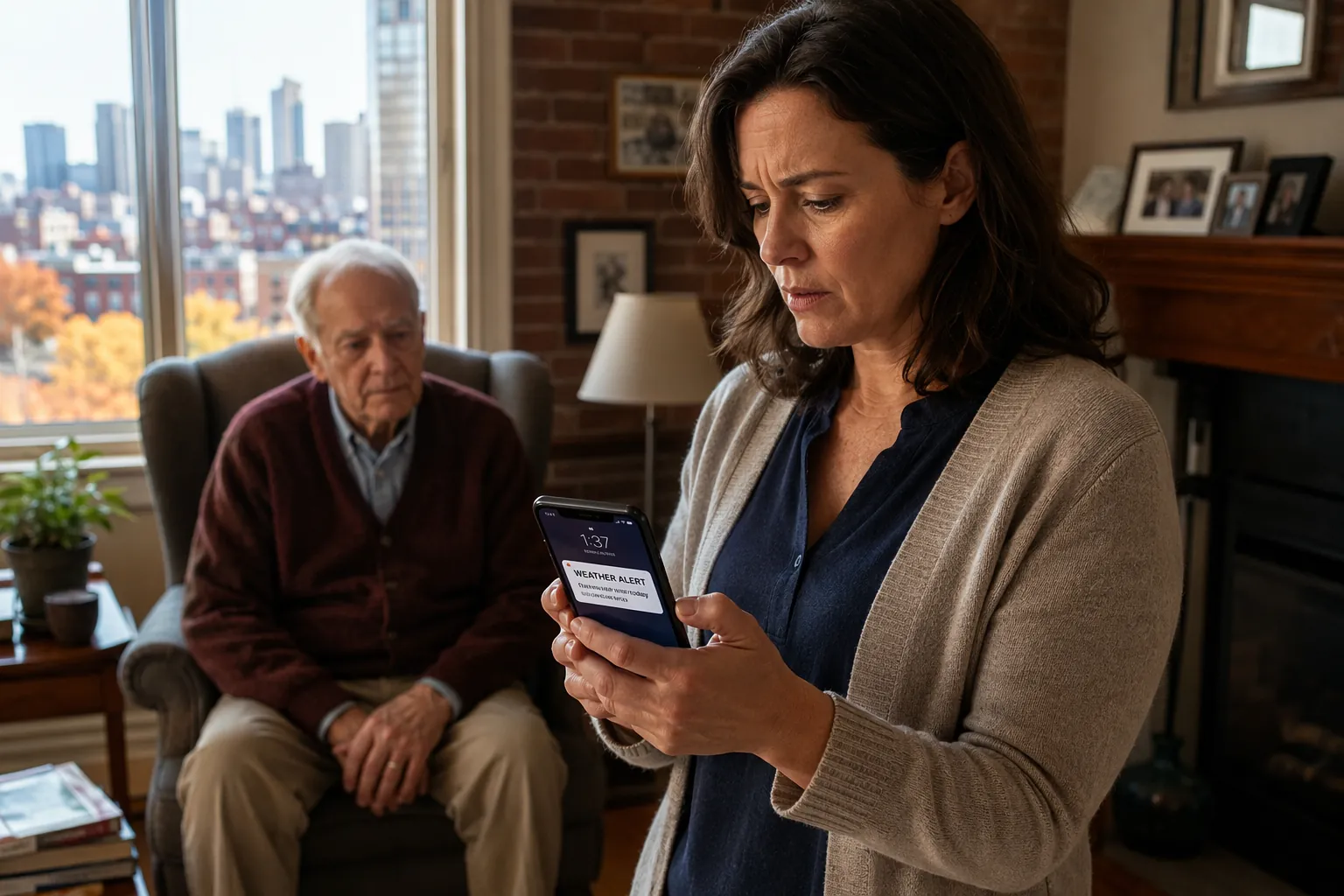
Cold alerts can be harder to interpret because the city number is usually an outdoor wind chill, while the older adult’s danger may be developing quietly inside. Boston’s cold advisory threshold has been wind chill at or below 0°F, and its cold emergency threshold has been wind chill at or below -10°F for one day or more.[2] Those numbers tell you the outdoor environment is dangerous. They do not tell you whether your parent’s bedroom is warm enough at 2 a.m.
The National Institute on Aging recommends keeping an older adult’s home at least 68°F, and Boston notes that Massachusetts sanitary code requires property owners to maintain 68°F between 7 a.m. and 11 p.m. during the heating season from September 15 through June 15.[7][8] That indoor number is the one to ask for. If your parent cannot read the thermostat, ask a neighbor, aide, building staff member, or relative to check.
Do not rely on shivering as the deciding sign. HealthInAging.org notes that older adults with hypothermia may not shiver, which makes the usual mental picture of cold distress unreliable.[9] Confusion, sleepiness, slurred speech, poor coordination, shallow breathing, or unusual quietness can matter more than whether someone says they feel cold.
During a cold advisory, the task is verification. Is the thermostat at least 68°F? Are the rooms they actually use warm, or only the hallway? Are they wearing dry layers? Did they lose heat in one room because a window will not close? Are they using a stove, oven, or unsafe heater to compensate? If the answer suggests inadequate heat, call 311 for resource guidance or a wellness check rather than waiting for the advisory to become an emergency.
During a cold emergency, make the plan explicit: who is checking the apartment, who is responsible for transportation if the home is not safe, and where the parent will warm up. Boston says BCYF warming centers open during cold emergencies, and its cold weather guidance points residents to 311 for non-emergency help.[8]
Why Seniors Need an Earlier Threshold
Older bodies have less margin during sudden weather swings. The CDC’s warning about adults 65 and older not adjusting as well to sudden temperature changes is not an abstract health note; it explains why a parent can seem fine in the morning and be in trouble by late afternoon during a heat wave.[3]
Chronic conditions and medications can narrow that margin further. The CDC identifies heart, lung, and kidney disease, diabetes, and medications including diuretics, beta blockers, and anticholinergics as factors that can increase heat risk or affect the body’s ability to cool itself.[3] A caregiver does not need to become a pharmacist during a weather alert, but the medication list should change the level of caution.
That means two older adults in the same neighborhood may need different decisions under the same Boston alert. One parent with central air, steady hydration, and a daily home aide may be safe with scheduled check-ins. Another with a window unit they rarely use, heart medication, and a habit of underreporting symptoms may need to leave the apartment before the city label sounds dramatic.
Cold works the same way, but with less visible drama. A parent may not complain. They may sit still under a blanket, skip meals, or sound a little off on the phone. If the indoor temperature is below the recommended minimum or cannot be verified, the decision should be based on the conditions, not on pride or politeness.
Use Boston Resources as Tools, Not Background Information
The useful question is not whether Boston has resources. It is which resource removes the next barrier. If your parent is safe at home but you need alerts, sign up for AlertBoston. If the apartment may be unsafe and you cannot get there, call 311 and ask what kind of wellness check or city guidance is available. If transportation is the barrier, look at Age Strong Shuttle options for older adults. If food delivery is part of your parent’s normal support, ask whether Meals on Wheels check-ins are happening during the emergency.
During heat emergencies, Boston has opened BCYF cooling centers; during cold emergencies, it has opened BCYF warming centers.[1][8] For a caregiver, the center is not a vague recommendation. It is a destination that requires timing, transportation, medication, a phone charger, mobility support, and a plan for getting home.
- Use Boston.gov to confirm whether the alert is active and which centers are open.
- Use 311 for non-emergency city help, resource questions, or guidance when a home may be unsafe.
- Use 911 if the parent has dangerous symptoms, is confused, fainting, hard to wake, having chest pain, or may already be experiencing heat illness or hypothermia.
- Use a neighbor, building staff member, home aide, or relative when the missing fact is the indoor temperature or the parent’s actual condition.
Remote caregivers should be especially strict about replacing reassurance with verification. A phone call can tell you tone and orientation. It cannot tell you whether the bedroom is 64°F, whether the AC is actually cooling, or whether the parent is sitting in direct sun beside a closed window. If no one can verify the home condition, the plan is incomplete.
A Repeatable Protocol for the Next Alert
The point is to make the next weather alert less improvisational. Keep the protocol short enough to use before work, from another city, or in the middle of a family argument about whether anything needs to be done.
- Check the official alert. Confirm whether Boston is under a heat advisory, excessive heat warning, heat emergency, cold advisory, or cold emergency, and check the current Boston.gov language for that event.
- Check the indoor condition. For heat, confirm cooling and the room your parent is using. For cold, confirm the thermostat and whether the lived-in rooms are at least 68°F.
- Check symptoms and medications. Ask about dizziness, weakness, confusion, nausea, unusual sleepiness, poor coordination, and whether heat-sensitive medications or serious chronic conditions are part of the picture.
- Decide whether staying home is safe. A safe home has working cooling or heating, a parent who can respond normally, and someone who will check again. If one of those is missing, escalate.
- Use the resource that solves the actual problem. Cooling or warming center for unsafe indoor temperature, 311 for city guidance or wellness check questions, Age Strong transportation support when a ride is the barrier, 911 for medical danger.
- Document the next check. Write down who will call or visit, at what time, and what would trigger a higher level of help.
For heat, the CDC HeatRisk Dashboard and the National Weather Service HeatRisk tool can also help caregivers look several days ahead instead of waiting for a city declaration; both provide color-coded heat risk forecasts.[10][11] That is especially useful when a parent needs transportation planning, an aide schedule change, or a family member to stop by before the worst hours arrive.
Reported emergency call patterns are another reason not to treat these alerts casually. NBC Boston reported in July 2026 that Boston EMS data showed 911 calls can increase by 10–15% during heat waves; because that figure is reported through a news outlet rather than directly verified here with Boston EMS or the Boston Public Health Commission, it should be read as reported data, not an independently confirmed figure.[12]
Boston’s declarations are valuable public signals. For an elderly parent, they are not the starting gun for concern. They are confirmation that the checking, cooling or warming plan, transportation decision, and next call should already be underway.
References
- Mayor Wu Declares Heat Emergency June 22 Through June 24, Opens BCYF Cooling Centers All, Boston.gov, link
- Cold Advisory Elevated to Cold Emergency in Boston, Boston.gov, link
- Heat and Older Adults Aged 65+, CDC, link
- Preparing for Extreme Heat, Mass.gov, link
- Extreme Heat Safety Tips, Mass.gov, link
- Keeping Cool in the Heat, Boston.gov, link
- Cold Weather Safety for Older Adults, National Institute on Aging, link
- Cold Weather Safety Tips, Boston.gov, link
- Tip Sheet: Winter Safety for Older Adults, HealthInAging.org, link
- CDC HeatRisk Dashboard, CDC, link
- NWS HeatRisk, National Weather Service, link
- Extreme heat warning in Boston: Cooling centers, splash pads, NBC Boston, July 2026, link
Questions to bring to a clinician or OT
This is not medical, legal, or a family's final decision — only a framework. Bring these questions to a clinician, occupational therapist, or your local Area Agency on Aging.
Find Local HelpRelated reading
Noticed something outdated or inaccurate on this page? Flag a correction. We review every report against CDC, NIA, and AARP HomeFit guidance before updating a page.