
Caregiver decision guide
Is a Boutique or Small-House Senior Community Right for Your Loved One? Evaluating the Suite-Style Model
This guide helps family caregivers evaluate boutique and small-house senior living communities by examining the evidence behind the model — including clinical outcomes, staffing ratios, and quality-of-life trade-offs — so you can make an informed decision for your loved one.
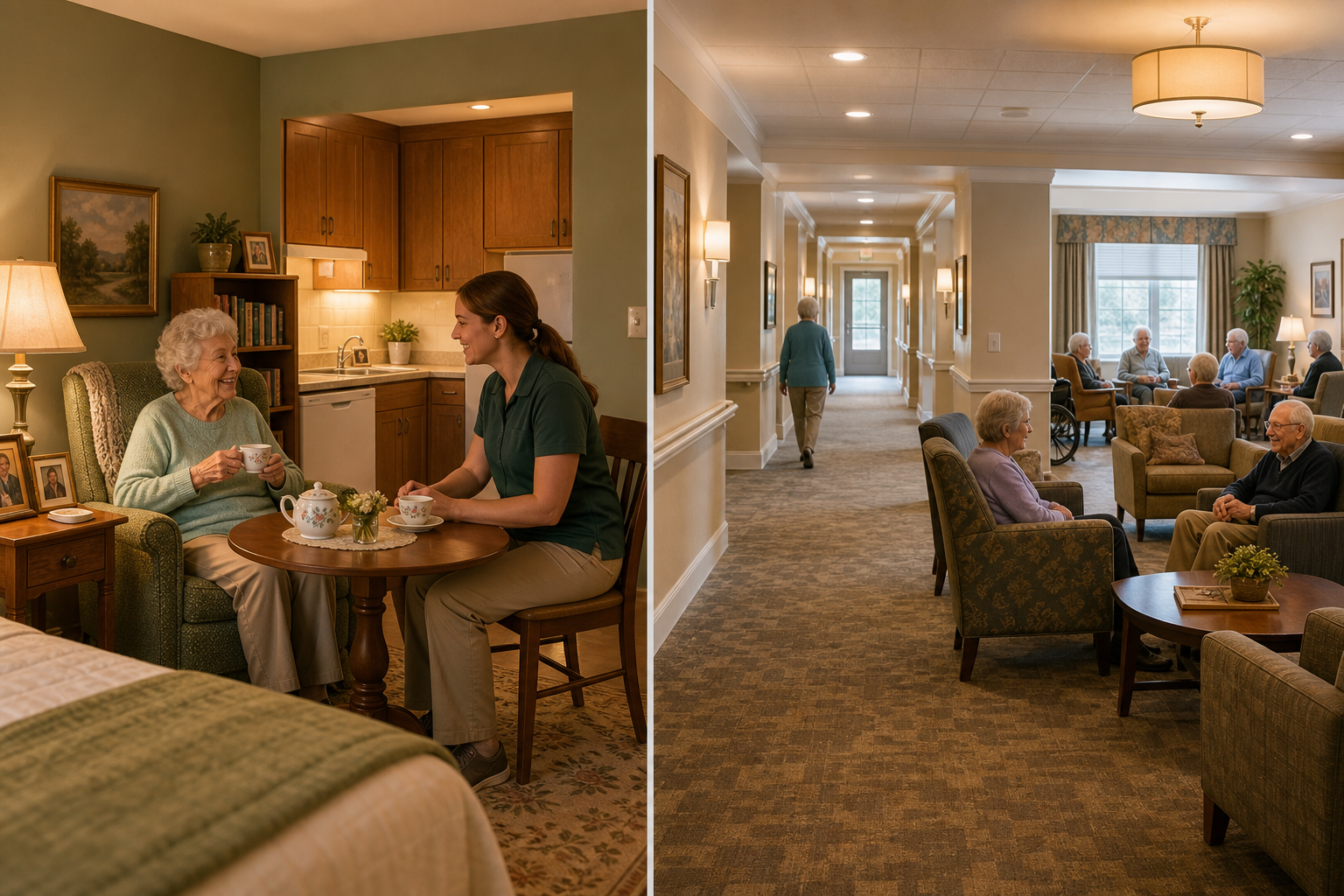
What Is a Boutique or Small-House Senior Community?
When families first encounter terms like "suite living," "care suites," or "boutique assisted living," it is easy to assume they describe a luxury version of a traditional nursing home. In practice, these labels point to a fundamentally different model of senior care — one defined not by granite countertops or spa services, but by intentional small size, person-centered philosophy, and a physical environment designed to feel like a real home.
The most rigorously studied version of this model is the Green House project, developed by Dr. Bill Thomas in the early 2000s. Green House homes are purpose-built residences that typically house 10 to 12 residents in private rooms arranged around a shared kitchen, dining area, and living room. They are licensed as skilled nursing facilities in most states — 87% of the roughly 300 Green House homes across 32 states hold skilled nursing licenses, according to a 2021 AARP report — but they look and operate nothing like a conventional nursing home. Certified Nursing Assistants, called Shahbazim in the Green House model, receive specialized training in dementia care, culinary skills, and relationship-based caregiving. They wear street clothes, not scrubs. There are no nurses' stations, no medication carts in the hallway, and no overhead paging systems.
The broader boutique/small-house category includes communities that follow similar principles without being formally licensed as Green House homes. These communities typically accommodate 10 to 25 residents. They are purpose-built or extensively renovated to include wide hallways, grab bars, and accessible bathrooms — not converted single-family homes, which is a key distinction from residential care homes (board-and-care). The defining features are small scale, consistent caregiver assignments, flexible daily routines, and a deliberate absence of institutional cues.
The Evidence: What the Research Shows About Small-House Outcomes
The small-house model is not just a matter of preference or aesthetics. A growing body of peer-reviewed evidence suggests it produces measurably better clinical outcomes than traditional institutional settings. The most frequently cited data comes from a 2015 study comparing Green House residents to residents in traditional nursing homes, published in The Gerontologist and highlighted in the AARP Long-Term Services and Supports Scorecard.
| Outcome Measure | Green House Model | Traditional Nursing Home | Relative Difference |
|---|---|---|---|
| Residents bedridden | 16% lower likelihood | Baseline | −16% |
| Pressure ulcers (bedsores) | 38% lower likelihood | Baseline | −38% |
| Catheter use | 45% lower likelihood | Baseline | −45% |
| Hospital readmission rates | Lower | Higher | Statistically significant |
| COVID-19 deaths per 1,000 residents (through July 2020) | 2.8 deaths | 38 deaths | 93% lower |
Questions to bring to a clinician or OT
This is not medical, legal, or a family's final decision — only a framework. Bring these questions to a clinician, occupational therapist, or your local Area Agency on Aging.
Find Local HelpRelated reading
- Senior Home Living Options Decoded: A Decision Framework Based on Mobility and Independence Level
- How to Assess Your Parent's Daily Living Needs and Match Them to the Right Senior Housing
- The Cost of Waiting: What It Really Costs Families — in Money, Choice, and Wellbeing — to Delay the Elderly Housing Decision
Noticed something outdated or inaccurate on this page? Flag a correction. We review every report against CDC, NIA, and AARP HomeFit guidance before updating a page.