
Caregiver decision guide
Residential Care Homes: The Overlooked Senior Living Option Families Need to Know About in 2026
Many families evaluating assisted living never learn about residential care homes (also called board and care homes) — smaller, often more affordable, and more personalized alternatives that provide comparable care. This guide explains what they are, how they compare to assisted living, 2026 costs, who thrives there, and how to vet them safely.
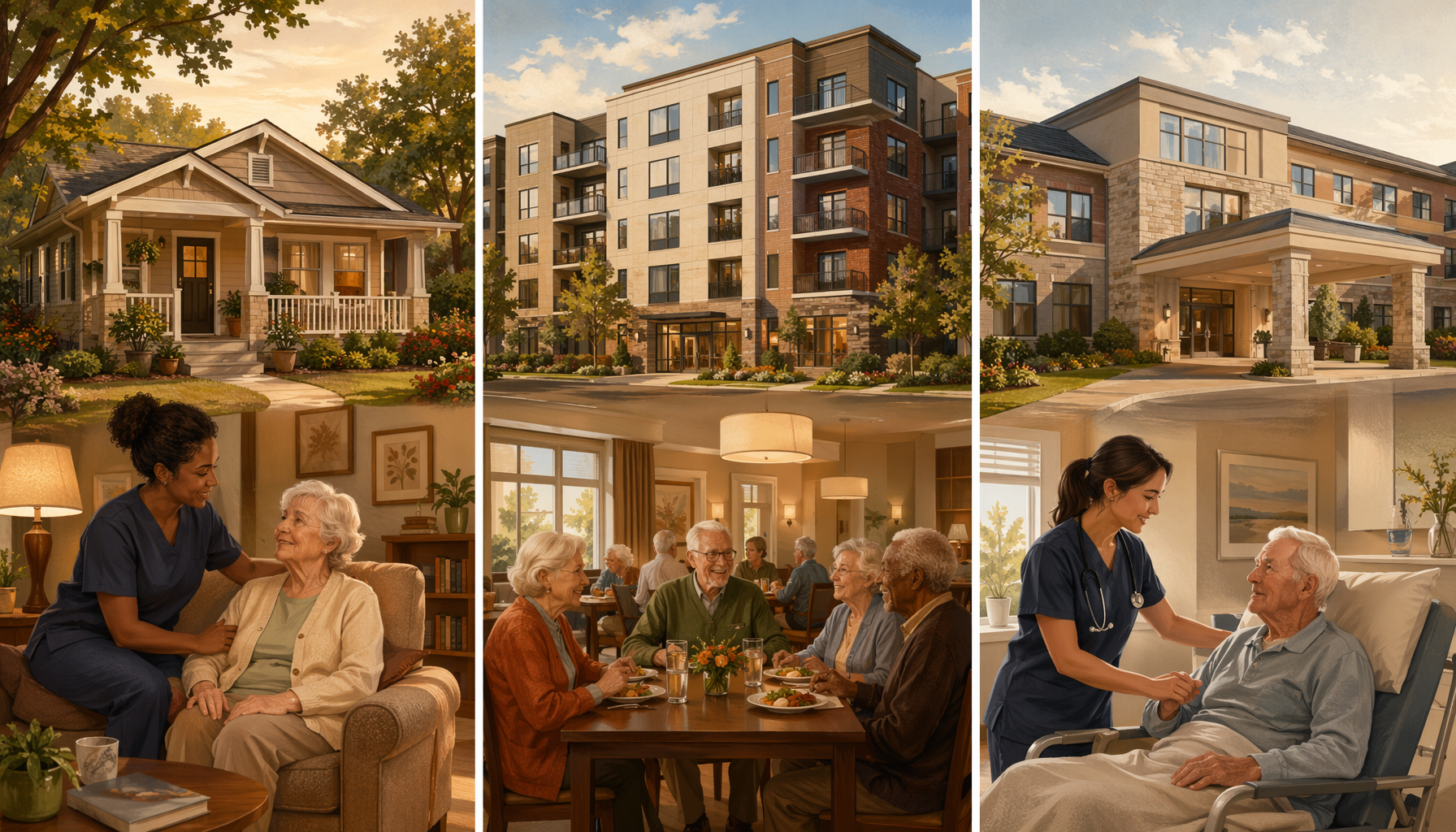
What Is a Residential Care Home? Defining the Overlooked Option
A residential care home — also called a board and care home, adult family home, or residential care facility for the elderly (RCFE) — is a small, privately operated residence that provides housing, meals, personal care, and 24-hour supervision for typically 4 to 10 older adults. These homes are almost always converted single-family houses located in ordinary residential neighborhoods. They look and feel like a home because they are one.
It is critical to understand what a residential care home is not. It is not an assisted living community, which typically houses 25 or more residents in an apartment-style building with communal dining, organized activities, and often a full activities calendar. It is not a skilled nursing facility (nursing home), which provides around-the-clock medical care and rehabilitation services under licensed nursing staff. And it is not a dedicated memory care unit, though some care homes accept residents with mild cognitive impairment if they do not require specialized dementia programming.
The National Institute on Aging defines board and care homes as "small private facilities, also called residential care facilities or group homes, usually have 20 or fewer residents. Rooms may be private or shared. Residents receive personal care and meals, and staff are available around the clock." The NIA also notes that nursing and medical care are usually not provided at the home itself.
Why Most Families Never Hear About This Option
The senior living industry spends heavily on marketing. Large assisted living chains operate websites, run television ads, employ sales counselors, and maintain national call centers. A family searching online for "assisted living near me" will encounter dozens of polished listings, virtual tours, and promotional offers within seconds.
Residential care homes operate on a fundamentally different economic model. Most are small businesses — often owned and operated by a single family or a small group of caregivers. They have no marketing budget, no national directory presence, and no sales team. Their reputation spreads through word of mouth, local referrals from hospitals or social workers, and listings on state licensing registries that few families know how to navigate.
- No national directory: Unlike assisted living, which is aggregated by sites like A Place for Mom and SeniorLiving.org, care homes are inconsistently listed. Many are not listed at all.
- Variable naming: The same type of facility may be called a "board and care home" in California, an "adult family home" in Washington, a "residential care home" in Texas, or an "RCFE" in Oregon. Families searching for one term may miss facilities licensed under another.
- Minimal online footprint: Many care homes do not have websites. Those that do often have basic pages with limited information, no virtual tours, and no online reviews.
- Regulatory fragmentation: State oversight ranges from rigorous (annual inspections, detailed staffing requirements) to minimal (registration-only, no routine inspections). This inconsistency makes it difficult for families to know what standards to expect.
This systemic invisibility is the article's core thesis: residential care homes provide comparable personal care to assisted living — often with higher staff-to-resident ratios and lower costs — yet remain hidden from the families who might benefit most from them.
Residential Care Homes vs. Assisted Living: Same Care, Different Scale
Both residential care homes and assisted living communities provide personal care — assistance with activities of daily living (ADLs) such as bathing, dressing, toileting, transferring, and medication management. Neither provides skilled nursing care on site (though both may coordinate with home health agencies for visiting nurses). The difference lies in scale, atmosphere, and amenities.
| Dimension | Residential Care Home | Assisted Living Community |
|---|---|---|
| Typical size | 4–10 residents | 25–150+ residents |
| Setting | Converted single-family home in residential neighborhood | Purpose-built apartment-style building |
| Staff-to-resident ratio | Higher (often 1:4 or better during waking hours) | Lower (varies by facility, often 1:8 to 1:15) |
| Room types | Private or shared (semi-private) bedrooms | Private apartments (studio, 1-bedroom, 2-bedroom) |
| Meals | Home-cooked, family-style dining | Restaurant-style dining room with menu options |
| Complimentary transportation | 38% offer (A Place for Mom, 2025) | 73% offer (A Place for Mom, 2025) |
| Onsite devotional activities | 38% offer (A Place for Mom, 2025) | 76% offer (A Place for Mom, 2025) |
| Room service | 20% offer (A Place for Mom, 2025) | 64% offer (A Place for Mom, 2025) |
| Organized activities calendar | Limited; more informal and resident-driven | Extensive; scheduled daily activities and outings |
| Care coordination | Personal care and 24-hour supervision; no skilled nursing on site | Personal care and 24-hour supervision; no skilled nursing on site |
The amenity gap is real but may not matter to every senior. A resident who values quiet, routine, and one-on-one attention may find a care home's informal atmosphere far more comfortable than a bustling community with scheduled activities. Conversely, a socially active senior who thrives on group exercise classes, card games, and organized outings may feel isolated in a small home.
2026 Costs: How Residential Care Homes Compare on Price
Cost is where residential care homes often — but not always — have an edge. According to A Place for Mom's proprietary data (last updated May 29, 2026), the national median monthly cost of a residential care home is $5,500 for a private room and $4,500 for a semi-private room. By comparison, the same source cites the national median for assisted living at $5,419 per month, while SeniorLiving.org's May 2026 research estimates the assisted living median at $6,313 per month ($75,756 per year).
| State | Care Home Private (Median) | Care Home Semi-Private (Median) | Assisted Living (Median) |
|---|---|---|---|
| California | $5,800 | $4,500 | $6,000–$7,000 |
| Florida | $4,500 | $3,500 | $4,500–$5,500 |
| Texas | $5,000 | $4,000 | $4,500–$5,500 |
| New York | $7,250 | $4,500 | $6,500–$8,000 |
| Massachusetts | Unavailable | Unavailable | $9,610 |
| Mississippi | Unavailable | Unavailable | $4,715 |
A Place for Mom notes that care homes may be more negotiable on price than larger assisted living communities because they are owned by small businesses with more flexibility. The national median medication administration fee is approximately $300 per month, which may be included or added separately depending on the home.
For families in the "overlooked middle" — seniors who do not qualify for Medicaid but cannot afford high-end private assisted living — the semi-private rate of $4,500/month can be a meaningful difference. However, the gap narrows in high-cost states like New York and California, where care home private rates approach or exceed assisted living medians.
Who Thrives in a Residential Care Home — and Who Should Look Elsewhere
Residential care homes are not a universal solution. They work exceptionally well for a specific profile of senior and are a poor fit for others. Understanding this distinction is essential to making an informed decision.
Ideal candidates for a residential care home
- Seniors who value intimacy and prefer a less institutional setting — a home-like environment with a small group of familiar faces.
- Individuals who are introverted, have lower social needs, or find large group activities overwhelming or unappealing.
- Those who need personal care (bathing, dressing, medication management, toileting assistance) but do not require skilled nursing or specialized dementia programming.
- Seniors with mild cognitive impairment who are stable and do not exhibit wandering, aggression, or other behaviors requiring a secured memory care environment.
- Families seeking a more affordable option, particularly if the senior is comfortable with a shared (semi-private) room.
Who should NOT choose a residential care home
- Seniors who need 24/7 skilled nursing care, wound care, IV therapy, or rehabilitation services — these require a skilled nursing facility.
- Individuals with moderate to advanced dementia who require a secured environment, specialized behavior management, or dementia-specific programming (wandering prevention, structured redirection).
- Socially active seniors who thrive on a full calendar of organized activities, group outings, and a large peer community.
- Those who require a private apartment with a kitchenette, separate living area, or significant personal space — care home bedrooms are typically just bedrooms.
How to Find and Vet Residential Care Homes: A Step-by-Step Protocol
Finding a residential care home requires more legwork than searching for assisted living. There is no single national directory. The following protocol is designed to help families systematically identify, evaluate, and select a safe, well-run home.
Step 1: Use your state's licensing database
Every state's health department or department of social services maintains a database of licensed care facilities. Search for "[your state] department of health assisted living license lookup" or "[your state] board and care home registry." These databases typically include inspection reports, complaint histories, and current license status. This is the single most reliable source for identifying licensed homes in your area.
Step 2: Contact your local Area Agency on Aging
Area Agencies on Aging (AAAs) are local organizations funded by the Older Americans Act that provide free, unbiased information about senior services. They often maintain lists of licensed care homes and can provide referrals based on your specific needs. The Eldercare Locator (1-800-677-1116) can connect you to your local AAA.
Step 3: Request and review inspection records
Once you have identified a few candidates, request their most recent state inspection reports. Look for deficiencies related to medication management, staffing, food safety, and resident care. A clean inspection history is a strong positive signal. Repeated deficiencies in the same area — especially medication errors or staffing violations — are red flags.
Step 4: Conduct unannounced visits
Schedule a tour, but also visit unannounced at a different time of day — ideally during a meal or in the evening. An unannounced visit reveals the home's true operating conditions: Is the staff attentive? Are residents engaged? Is the home clean and odor-free? Do residents appear well-groomed and comfortable? A home that refuses unannounced visits is a significant red flag.
Step 5: Ask about staff training, turnover, and background checks
Ask the operator: How many staff members work here? What training do they receive? What is the staff turnover rate? Are all staff members subject to criminal background checks? In a home with 6 residents, one untrained or overworked caregiver has a disproportionate impact on quality of life.
Step 6: Verify medication management protocols
Ask specifically how medications are stored, administered, and documented. Who is responsible for medication administration? Are they trained? Is there a system for tracking refills and missed doses? Medication errors are one of the most common deficiencies cited in care home inspections.
Step 7: Review the resident agreement for fees and discharge policies
The resident agreement (contract) should clearly state: monthly rate, what is included (meals, housekeeping, laundry, transportation, medication management), what costs extra (incontinence supplies, specialized diets, medication administration fees), the notice period for rate increases, and the conditions under which a resident can be discharged. Look for vague discharge language like "if the resident's needs exceed the home's capabilities" — this should be defined in specific, measurable terms.
| Vetting Step | Key Questions to Ask | Red Flags |
|---|---|---|
| State license verification | Is the home currently licensed? Are there any past or pending violations? | Home cannot produce a license number; license is expired or suspended |
| Inspection records | May I see the most recent state inspection report? | Refuses to share; repeated deficiencies in medication or staffing |
| Unannounced visit | May I visit at a different time than the scheduled tour? | Refuses or requires advance notice for all visits |
| Staff background checks | Are all staff subject to criminal background checks? What is staff turnover? | Cannot confirm background checks; turnover rate above 50% annually |
| Medication management | Who administers medications? What training do they have? How are errors tracked? | No formal medication administration record; untrained staff handle medications |
| Resident agreement | What is included in the monthly rate? What triggers a discharge? | Vague discharge criteria; no written notice period for rate increases |
Licensed vs. Unlicensed: Understanding the Risks and How to Verify
The most critical distinction in the residential care home landscape is between licensed and unlicensed facilities. A licensed home has been inspected by the state, meets minimum staffing and safety standards, and is subject to ongoing oversight. An unlicensed home operates outside this regulatory framework — sometimes legally, sometimes not.
The U.S. Department of Health and Human Services' Office of the Assistant Secretary for Planning and Evaluation (ASPE) published an exploratory study in 2015 that remains the most authoritative federal examination of unlicensed care homes. The study found that these homes "often serve very vulnerable individuals such as individuals with serious mental illness or other disabilities, or older adults with functional limitations and limited financial resources." Critically, the findings "highlight potential issues of safety, abuse and financial exploitation in unlicensed care homes."
State laws on unlicensed operation vary widely:
- Some states (e.g., California, Oregon) require licensure for any home serving two or more unrelated individuals. Operating without a license is illegal.
- Other states allow unlicensed operation for homes with three or fewer residents, creating a legal gray area where small homes can operate without any state oversight.
- A few states have no specific licensing category for small residential care homes, meaning they may fall through regulatory cracks entirely.
Concrete steps to verify licensure and identify red flags:
- Ask for the home's state license number and verify it through your state's online licensing database. If the home cannot provide a license number, consider it a major red flag.
- Be wary of cash-only payment arrangements. Licensed homes typically accept checks, credit cards, or electronic payments and provide written receipts.
- If the home refuses to share inspection records or claims they "don't have any," this is a significant warning sign. Licensed homes are required to maintain and share inspection documentation.
- High staff turnover — especially if the same operator has had multiple caregivers leave in a short period — can indicate poor management or working conditions that may affect resident care.
- If the home's operator is evasive about their licensing status or becomes defensive when asked about inspections, trust your instinct and look elsewhere.
Paying for Residential Care: Funding Sources and Next Steps
Residential care homes are primarily paid for through private funds. Original Medicare does not cover the cost of room, board, or personal care in a residential care home. However, several other funding sources may be available depending on the individual's circumstances and state of residence.
- Private pay: This is the most common payment method. Families use personal savings, retirement funds, or income from Social Security and pensions.
- Medicaid HCBS waivers: Some states offer Home and Community-Based Services (HCBS) waivers that can cover the cost of care in a residential care home for individuals who meet Medicaid eligibility criteria. Availability and coverage vary significantly by state.
- VA Aid & Attendance: Veterans and surviving spouses who qualify for VA pension benefits may be eligible for the Aid & Attendance benefit, which can be used to help pay for care in a residential care home.
- Long-term care insurance: Policies that cover assisted living may also cover residential care homes, but coverage terms vary. Review the policy carefully to confirm.
- Reverse mortgages: Some families use a reverse mortgage on the senior's home to generate funds for care home payments.
If you are ready to begin your search, start with your state's licensing database and your local Area Agency on Aging. These two resources will give you the most reliable, unbiased starting point. From there, use the seven-step vetting protocol above to evaluate each candidate home thoroughly.
Residential care homes are not right for everyone. But for the right senior — one who values intimacy, personal attention, and a home-like setting — they can be a superior alternative to the more visible, more marketed assisted living communities. The challenge is finding them. With a systematic approach, families can uncover this overlooked option and make an informed decision that truly serves their loved one's needs.
Questions to bring to a clinician or OT
This is not medical, legal, or a family's final decision — only a framework. Bring these questions to a clinician, occupational therapist, or your local Area Agency on Aging.
Find Local HelpRelated reading
Noticed something outdated or inaccurate on this page? Flag a correction. We review every report against CDC, NIA, and AARP HomeFit guidance before updating a page.