
Caregiver decision guide
Senior Home Living Options Decoded: A Decision Framework Based on Mobility and Independence Level
Choosing a senior living option can feel overwhelming. This guide provides a clear, clinically grounded framework based on the older adult's functional abilities (ADLs and IADLs) to help families match care needs with the right living arrangement — from aging in place to skilled nursing.

Why Starting with Facility Types Fails Families
When a parent begins to struggle — a missed medication dose, a fall in the bathroom, a noticeable weight change — most families do what feels natural: they search for "assisted living near me" or "nursing home costs." This facility-type-first approach is the default because it is what search engines and provider directories optimize for. But it is also the wrong place to start.
The problem is fundamental: facility names like "independent living" and "assisted living" are marketing categories, not clinical definitions. One state's assisted living may require a minimum level of independence, while another's allows residents who need significant help with multiple daily tasks. A community that calls itself "independent living" may offer medication reminders and meal service, while another with the same label provides none. When families lead with facility type, they end up comparing apples to oranges — or worse, they choose a setting that is either too supportive (wasting money and eroding independence) or not supportive enough (leading to a crisis within weeks).
A more reliable approach starts with a single question: What can this person do for themselves, and where do they need help? That question leads to a functional assessment — not a medical diagnosis, but a practical inventory of the activities that make up daily life. Once you have that inventory, the right living option reveals itself with surprising clarity.
The ADL/IADL Framework: Your Decision-Making Foundation
Clinicians have used two standardized tools for decades to determine how much support a person needs: the Katz Index of Independence in Activities of Daily Living (ADLs) and the Lawton Instrumental Activities of Daily Living (IADL) Scale. These are not obscure research instruments — they are the same frameworks that hospitals, home health agencies, and long-term care facilities use to assess patients and assign care levels. Understanding them puts you on the same page as the professionals who will eventually evaluate your parent.
The Six Basic ADLs (Katz Index)
The Katz Index measures six fundamental self-care tasks. For each task, a person is scored as independent (needs no help) or dependent (needs some or full assistance). The Cleveland Clinic, which maintains the standard reference for these scales, defines them as follows:
- Bathing: Ability to wash the entire body independently, including getting in and out of the tub or shower.
- Dressing: Ability to select appropriate clothes and put them on without assistance, except for tying shoes.
- Toileting: Ability to get to and from the toilet, use it, and clean oneself.
- Transferring: Ability to move in and out of bed or a chair without help. This is the single most important mobility marker.
- Continence: Ability to control bladder and bowel functions without assistance.
- Feeding: Ability to get food from a plate into the mouth independently.
The Eight IADLs (Lawton Scale)
Instrumental activities are more complex than basic ADLs. They require higher cognitive function and are typically the first abilities to decline. The Lawton Scale assesses:
- Managing finances: Paying bills, tracking expenses, avoiding scams.
- Managing medications: Taking the right dose at the right time, refilling prescriptions.
- Preparing meals: Planning, cooking, and safely storing food.
- Housekeeping: Cleaning, laundry, and basic home maintenance.
- Transportation: Driving, using public transit, or arranging rides.
- Shopping: Buying groceries and household necessities.
- Communication: Using the phone, managing mail, staying in touch.
A Decision Matrix: Matching ADL/IADL Needs to Living Options
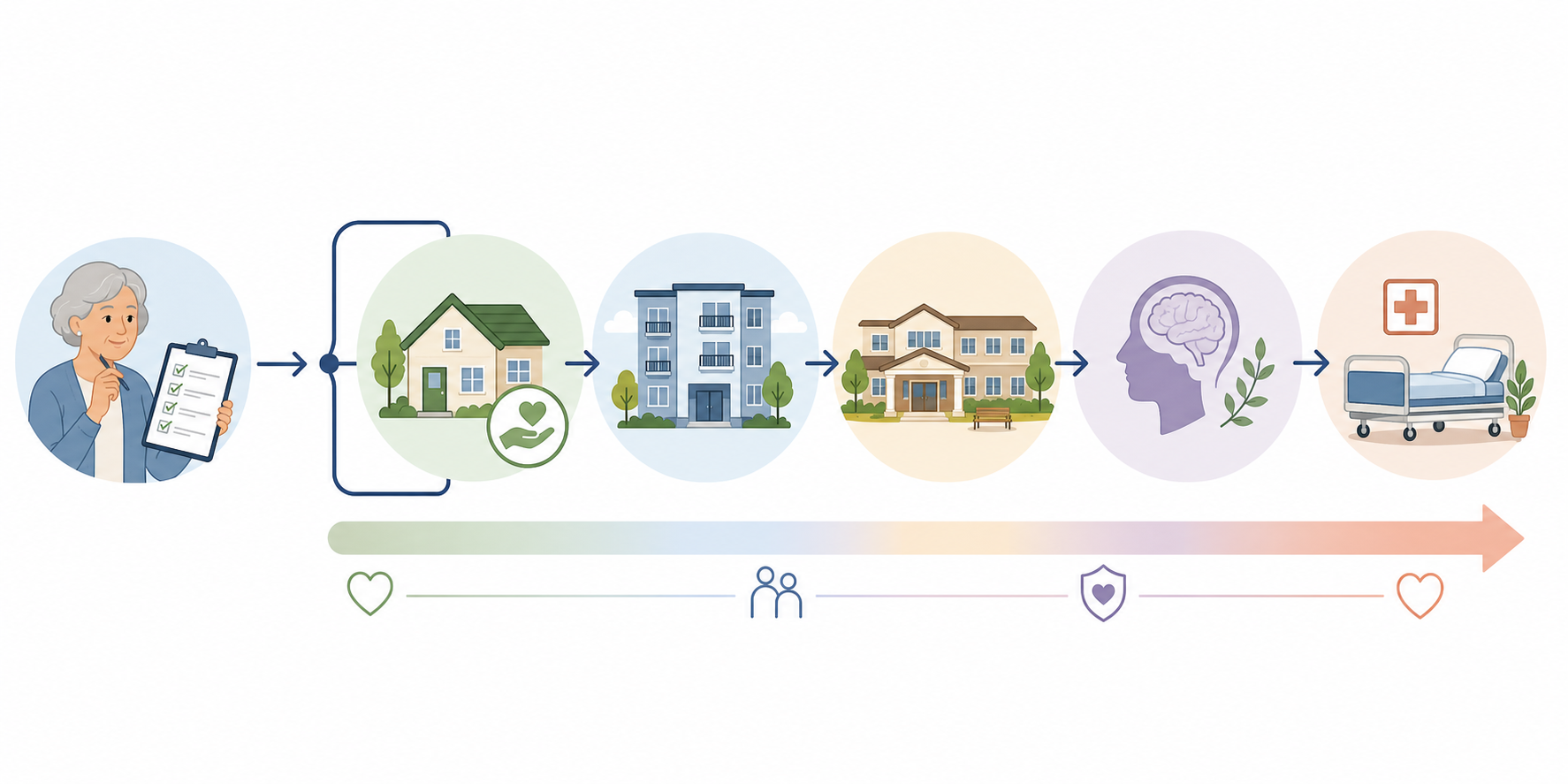
Once you have a clear picture of which ADLs and IADLs are compromised, the range of senior living options narrows considerably. The following matrix maps functional ability levels to the most appropriate living arrangements. It is a starting point, not a prescription — individual health conditions, cognitive status, and personal preferences always matter.
| Functional Profile | ADL Deficits | IADL Challenges | Recommended Option | Key Features |
|---|---|---|---|---|
| Fully independent, some IADL difficulty | 0 ADLs | 1–3 IADLs (e.g., finances, transportation) | Aging in place with home care or Independent Living | Minimal support; meal options, social activities, transportation services |
| Mild functional decline | 0–1 ADLs (usually bathing or dressing) | 3–5 IADLs (medication, meals, housekeeping) | Assisted Living (Level 1–2 care) | 24/7 staff, medication management, meals, housekeeping, personal care assistance |
| Moderate functional decline | 1–2 ADLs (bathing, dressing, transferring) | 5+ IADLs | Assisted Living (Level 2–3 care) | Hands-on help with ADLs, transfer assistance, fall prevention, incontinence care |
| Significant cognitive decline | 1–3 ADLs, plus behavioral symptoms | All IADLs compromised | Memory Care | Secure environment, specialized dementia programming, behavioral support |
| Severe functional decline | 3+ ADLs (including transferring and toileting) | All IADLs compromised | Skilled Nursing Facility | 24/7 nursing care, rehabilitation therapy, full ADL assistance |
A critical threshold to understand: assisted living communities are designed for residents who need help with no more than two ADLs. Once a person requires assistance with three or more — particularly if transferring or toileting is involved — a skilled nursing facility becomes the more appropriate setting. This is not a judgment on the person's worth or the family's dedication; it is a practical reality of staffing ratios, building design, and regulatory licensing.
Mobility-Specific Considerations: Fall Risk, Transferring, and Bathroom Safety
Mobility is the single most influential factor in determining the right living option. A person who can walk independently, even with a cane or walker, has vastly more options than someone who needs help getting out of a chair or off the toilet. Three mobility-specific factors deserve particular attention.
Fall Risk
Falls are the leading cause of injury death among adults 65 and older, according to the CDC's STEADI initiative. A single fall can result in a hip fracture, traumatic brain injury, or a cascade of complications that permanently changes a person's independence level. When assessing a living option, ask: Can this environment prevent a fall, and if one happens, how quickly will help arrive?
In a private home, fall prevention depends entirely on the family's ability to identify and remove hazards — loose rugs, poor lighting, lack of grab bars. In an assisted living or skilled nursing facility, fall prevention is built into the environment: handrails in hallways, non-slip flooring, bed alarms, and staff trained in fall response protocols. For a person with a history of falls or significant balance problems, the built-in safety of a congregate setting may outweigh the emotional appeal of staying at home.
Transferring Difficulty
The ability to transfer — moving from bed to chair, chair to toilet, or chair to standing position — is the ADL that most directly determines care level. A person who can transfer independently can live in almost any setting. A person who needs one-person assistance to transfer requires a setting with staff trained in proper body mechanics and transfer equipment. A person who needs a mechanical lift (two-person or Hoyer lift) requires a skilled nursing facility, because assisted living communities typically do not have the staffing or equipment for this level of need.
Bathroom Safety
The bathroom is the most dangerous room in any home for an older adult. Transfers on and off the toilet, stepping in and out of a shower or tub, and navigating wet floors all create fall risk. When evaluating a living option, the bathroom setup matters enormously:
- Are there grab bars at the toilet and in the shower or tub?
- Is there a raised toilet seat or a commode available?
- Is the shower walk-in or roll-in, or does it require stepping over a threshold?
- Is there a shower chair or transfer bench?
- Is the flooring non-slip?
In a private home, these modifications cost money and require coordination. In a well-designed senior living community, they are standard. If the older adult already has difficulty bathing or using the toilet safely, the bathroom environment should be a top priority in your decision.

The Real Cost of Each Option (2026 Data)
Cost is often the deciding factor, but comparing costs across options requires apples-to-apples thinking. The monthly fee for a senior living community typically bundles housing, utilities, meals, housekeeping, transportation, and social activities. Aging in place, by contrast, involves separate line items for rent or mortgage, utilities, groceries, home maintenance, in-home care, and transportation — and those costs can add up faster than families expect.
The following table presents national median costs from the 2026 A Place for Mom report (based on data from 24,000+ residents in 2025), supplemented by CareScout and LTCFEDS data. Actual costs vary significantly by state and metropolitan area.
| Living Option | National Median Monthly Cost (2026) | What's Included | Typical Move-In Fee |
|---|---|---|---|
| Independent Living | $3,200 | Rent, utilities, meals, social activities, transportation | $1,000–$3,000 |
| Home Care (20 hrs/week) | $2,944 ($34/hr) | Personal care, companionship, light housekeeping | None |
| Assisted Living | $5,419 | Rent, utilities, meals, housekeeping, personal care, 24/7 staffing | ~$3,000 |
| Memory Care | $6,690 | All assisted living services plus secure unit, dementia programming | $2,000–$5,000 |
| Nursing Home (semiprivate room) | $8,200–$9,277 | 24/7 nursing care, meals, rehabilitation therapy, full ADL assistance | Varies |
| Nursing Home (private room) | $10,646 | Same as semiprivate with private room | Varies |
A few additional cost realities to consider:
- Hidden costs of aging in place: Home modifications (grab bars, ramps, walk-in showers) typically cost $3,000–$15,000. Home maintenance (roof, appliances, lawn care) adds hundreds per month. A single fall requiring hospitalization can cost over $30,000 in medical bills.
- Medicare does not pay for assisted living: Medicare covers only skilled nursing facility stays (up to 100 days after a qualifying hospital stay) and some home health services. It does not cover long-term custodial care in assisted living or nursing homes.
- Medicaid may help: Medicaid covers nursing home care for eligible individuals and, in some states, covers assisted living through home and community-based services (HCBS) waivers. Eligibility and coverage vary widely by state.
- Long-term care insurance: If the older adult has a long-term care insurance policy, review it carefully. Most policies cover assisted living and home care, but with daily or monthly benefit caps and elimination periods.
- Medical expenses in retirement: A couple retiring today needs approximately $285,000 to cover expected medical expenses during retirement, according to a Plansponsor study. This figure underscores the importance of planning for long-term care costs.
How to Assess and Reassess Over Time
Functional decline is rarely linear. A person may remain stable for years, then experience a rapid decline after a hospitalization or a fall. This means that a single assessment is not enough — families need a system for ongoing evaluation.
Conducting the Initial Assessment
Start by observing the older adult over a week or two. Do not rely on what they tell you — many older adults minimize their difficulties out of pride or fear of losing independence. Look for concrete evidence:
- Are there unpaid bills or late notices? (IADL: finances)
- Are medications in their original bottles with doses missed? (IADL: medication management)
- Is the refrigerator empty or full of spoiled food? (IADL: meal preparation)
- Are there bruises or signs of a fall they did not mention? (ADL: transferring, mobility)
- Do they have difficulty getting out of a chair or off the toilet? (ADL: transferring)
- Are they wearing the same clothes repeatedly or neglecting hygiene? (ADL: dressing, bathing)
Use the Katz Index and Lawton Scale to organize your observations. Assign a score for each ADL and IADL. Then map the results to the decision matrix above.
Scheduling Reassessments
Plan to reassess every three to six months, or immediately after any significant health event — a fall, a hospitalization, a new diagnosis, or a noticeable change in behavior or cognition. The National Center for Assisted Living reports that the average assisted living resident stays only 22 months, which suggests that many families transition later than ideal. Regular reassessment helps you stay ahead of the curve rather than reacting to a crisis.
- After a hospitalization: Hospitalizations often cause temporary or permanent functional decline. Reassess before discharge to determine if the current living situation is still appropriate.
- After a fall: A fall is a sentinel event. Even if no injury occurred, it signals that the current environment or care level may be insufficient.
- After a dementia diagnosis: Cognitive decline changes the risk profile significantly. A person with early-stage dementia may be safe at home with support, but as the disease progresses, a memory care setting may become necessary.
- When caregiver burnout sets in: If the family caregiver is exhausted, depressed, or experiencing health problems of their own, it is time to reassess. The older adult's safety depends on the caregiver's wellbeing.
Key Questions for Facility Tours (Based on Mobility Needs)
When you tour a senior living community, the marketing materials will emphasize amenities, activities, and dining. Those matter, but for a family making a decision based on mobility and independence, the following questions are more important. Ask them of every facility you visit.
- Staff-to-resident ratio for transfers: "What is your staff-to-resident ratio during the day and at night? How many staff are trained and available to assist with transfers (bed to chair, chair to toilet)?" If the ratio is too low, residents may wait extended periods for help, increasing fall risk.
- Bathroom safety features: "Are grab bars installed at every toilet and in every shower? Are the showers walk-in or roll-in? Are raised toilet seats available? Is the flooring non-slip?" Do not accept vague answers — ask to see a typical unit.
- Fall response protocol: "What happens when a resident falls? How quickly does staff respond? Do you use personal emergency response systems (PERS) or wearable fall detectors? What is your protocol for notifying family?"
- Availability of physical therapy: "Do you have on-site physical therapy? Can residents continue therapy after a hospitalization without leaving the community?" Access to PT can slow functional decline and improve mobility.
- Policy on personal mobility aids: "Can residents use their own walkers, rollators, or wheelchairs? Are there restrictions on mobility aids in common areas? Is the community wheelchair-accessible throughout?" Some communities have policies that limit mobility aid use.
- Care level transitions: "What happens when a resident's care needs increase beyond what you can provide? Do you have a memory care unit or a skilled nursing affiliation? How much notice do you give families before requiring a move?"
- Medication management: "Who manages medications? Are medications administered by licensed nurses or trained staff? How do you handle medication changes after a hospital discharge?" Medication misuse sends more than 600,000 older adults to the emergency room annually, according to the CDC.
Your Decision Checklist: From Assessment to Action
Use this checklist as a quick-reference guide to move from observation to decision. Print it, keep it with you, and refer to it as you evaluate options.
- Step 1: Assess ADLs and IADLs. Use the Katz Index and Lawton Scale to document which activities the older adult can perform independently and which require assistance. Be honest — do not underestimate needs.
- Step 2: Identify the matching option. Use the decision matrix to map ADL/IADL deficits to the recommended living arrangement. If the person falls into more than one category, prioritize the higher-care option.
- Step 3: Research facilities. Use the NIA's guide to choosing a long-term care facility, Medicare's Care Compare tool, and the Eldercare Locator (800-677-1116) to find and evaluate facilities in your area.
- Step 4: Tour with mobility-focused questions. Use the question list above. Visit at least three facilities. Make at least one unannounced visit.
- Step 5: Compare costs. Get a detailed breakdown of monthly fees, move-in fees, and any additional charges for higher care levels. Compare against the cost of aging in place, including home modifications and in-home care.
- Step 6: Review contracts carefully. Look for clauses about care level increases, fee structures, and discharge policies. Consider having a lawyer or elder law attorney review the contract.
- Step 7: Plan for reassessment. Schedule a reassessment in three to six months, or immediately after any significant health event. The average assisted living stay is 22 months — plan for the possibility that needs will change.
- Step 8: Involve the older adult. To the extent possible, include the older adult in the decision-making process. Visit facilities together. Discuss preferences and concerns openly. A decision made with the older adult's input is more likely to succeed than one made for them.
Choosing a senior living option is one of the most consequential decisions a family will make. By starting with functional ability rather than facility type, you replace guesswork with clarity, and you give yourself the best possible chance of finding a setting where your parent can live safely, with dignity, and at the right level of support for their needs.
Questions to bring to a clinician or OT
This is not medical, legal, or a family's final decision — only a framework. Bring these questions to a clinician, occupational therapist, or your local Area Agency on Aging.
Find Local HelpRelated reading
Noticed something outdated or inaccurate on this page? Flag a correction. We review every report against CDC, NIA, and AARP HomeFit guidance before updating a page.