
Caregiver decision guide
Bus Safety Tips Every Older Adult Should Know
Falls, not crashes, are the biggest risk for older bus riders. This stage-by-stage guide shows where falls happen and how to use the bus's built-in features — kneeling, ramps, handrails, priority seating — to board, ride, and exit safely.
The best bus safety tips for older passengers begin with a plain correction: for older riders, the main worry is usually not a crash. It is a fall during a small, familiar moment — stepping up, trying to stay polite and standing while the bus pulls away, moving toward the door during braking, or stepping down before both feet have found the curb.
That does not mean the bus is an unsafe choice. It means the safety plan should match the real risk. In the United States, the CDC says 1 in 4 older adults falls each year, so any transportation plan for later life has to take falls seriously. Fall prevention is not a reason to stop going places; it is a reason to make the risky parts of a trip more deliberate. [1]
The transportation evidence points in the same direction. In UK linked national data, 62% of incidents injuring bus passengers aged 60 and older were non-collisions, including falls inside the bus and during boarding or alighting; the same UK study found that older passengers sustained 63% of all boarding injuries and 70% of bus and coach passenger fatalities. Those are UK findings, not a U.S. count, but they show why the stepwell and the aisle deserve attention. [2]
The per-trip risk is still low. A synthesis of 11 studies estimated fall risk at about 0.8 to 1.7 falls per million boardings and alightings, with injuries concentrated around the stepwell. Swedish on-bus video data found that more than half of non-collision fall events involved passengers 65 and older, with falls occurring most often after boarding during acceleration and during braking. In U.S. Federal Transit Administration bus safety data from 2008–2018, boarding and alighting injuries accounted for 90% of “other” event injuries on buses. [3][4][5]
So the useful question is not, “Is the bus dangerous?” It is, “What should my feet, hands, seat choice, timing, and request to the driver be at each point in the ride?”
| Part of the trip | Main fall moment | Safer habit |
|---|---|---|
| At the stop | Standing too close to the curb, rushing, or fumbling for fare | Stand back, arrive early, have fare ready, and let a missed bus go |
| Boarding | High first step, moving too fast, or stepping up without a firm handhold | Ask for the bus to kneel or use the ramp; hold the rail before stepping |
| Riding | Standing while the bus accelerates, brakes, or turns | Sit early, use priority seating, and keep bags and feet out of the aisle |
| Alighting | Moving to the door before a full stop or stepping down into the street | Signal early, stay seated until stopped, use the rail, and step onto the curb |
| After exiting | Crossing where the driver or other traffic cannot see you | Use the crosswalk and wait for the bus to pull away before crossing in front |
At the stop: give yourself space before the bus arrives
A safe bus ride starts before the doors open. Stand on the sidewalk 2 to 3 feet from the curb, not with your toes over the edge. PennDOT also advises riders to arrive 5 to 10 minutes early, have fare ready, and never run after a bus. [6]
That little strip of space matters. When the bus pulls in, the mirror, front corner, and curb all compete for attention. If you are already standing back, you do not have to shuffle backward while also reading the route number or waving to the driver.
- Keep your fare card, pass, phone, or cash where you can reach it without digging at the door.
- If you use a cane, hold it in the hand that leaves your stronger hand free for the bus rail, if that is safer for you.
- Keep shopping bags close to your body. A swinging bag can catch the doorway, strike another rider, or pull your balance sideways.
- If the bus is already pulling away, let it go. Running after a bus turns an ordinary missed trip into a fall setup.
If seeing the route number is hard, step forward only after the bus is nearly stopped, then make your request clearly. “Please kneel the bus” or “I need the ramp” is not special treatment. It is using the equipment put there for exactly this moment.
Boarding: ask before the risky step begins
Boarding is where embarrassment can create real risk. Many older riders try to hurry because people are waiting behind them. Others avoid asking for the kneeling feature because they do not want to “make a fuss.” But the safest request is the one made before your foot is in the air.
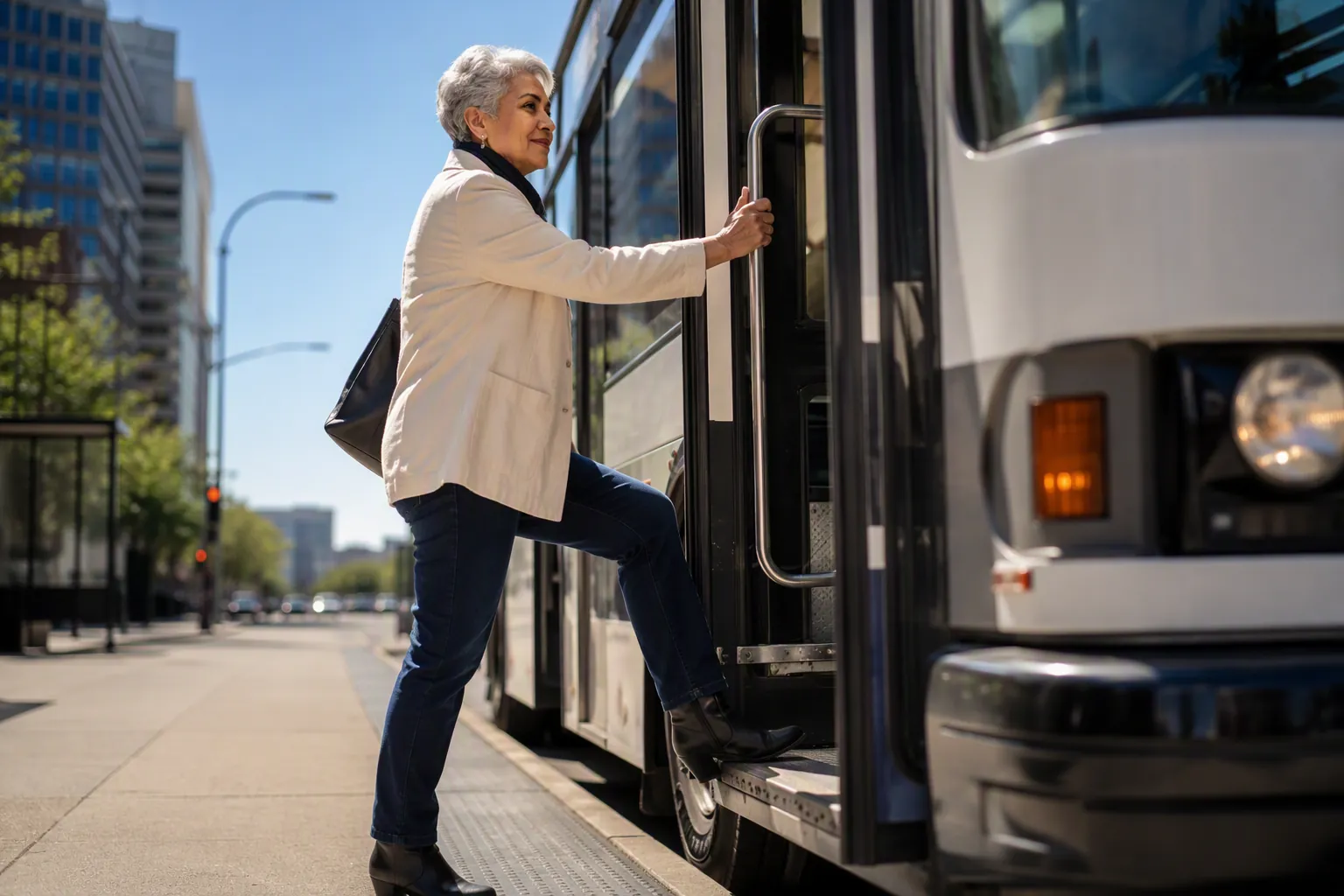
Ask the driver to kneel the bus if the first step looks high, if the curb is uneven, if your knee is stiff today, or if you simply know you board more steadily with a lower step. Some agencies make this easy to confirm: WMATA and NJ Transit both describe buses that can kneel to lower the first step for boarding. [7][8]
Check your own local transit agency, because U.S. bus designs, ramp processes, fare rules, and accessibility features vary. A rider should not have to guess at the curb. Look up the agency’s accessibility page, call customer service, or ask a driver on a non-rushed trip: Do buses kneel? Where is the ramp deployed? Should I board through the front door? Can I ask the driver to wait until I am seated?
A steady boarding sequence
- Stand back until the bus has stopped and the door is open.
- Make the request before stepping: “Please kneel the bus,” “I need the ramp,” or “Please wait until I sit.”
- Let the ramp finish moving before you start forward.
- Put one hand on the rail before lifting your foot.
- Watch the first step. It is often the step that asks the most of your hip, knee, and balance.
- Move to a seat right away instead of paying, chatting, and standing in the front area while the bus is ready to leave.
If both handrails are available and you can use them safely, use them. If you carry a bag, shorten the strap or hold it close so it does not pull your shoulder backward as you step up. Flat, closed shoes with no-slip tread are the better bus shoes; loose sandals and flip-flops can catch or jam at the stepwell.
There is one sentence worth practicing because it removes the awkwardness: “Please wait until I’m seated.” Drivers have schedules, traffic, and other passengers to manage, but they cannot read a rider’s balance from behind the farebox. A clear request made early is easier to honor than a silent struggle after the bus has started moving.
Riding: sit before the bus has a chance to surprise you
Once inside, the safest seat is usually not the one that seems most polite to leave empty. Priority seating near the front exists because acceleration, braking, turns, and crowded aisles are harder on riders with slower balance reactions. If you need that seat, use it.
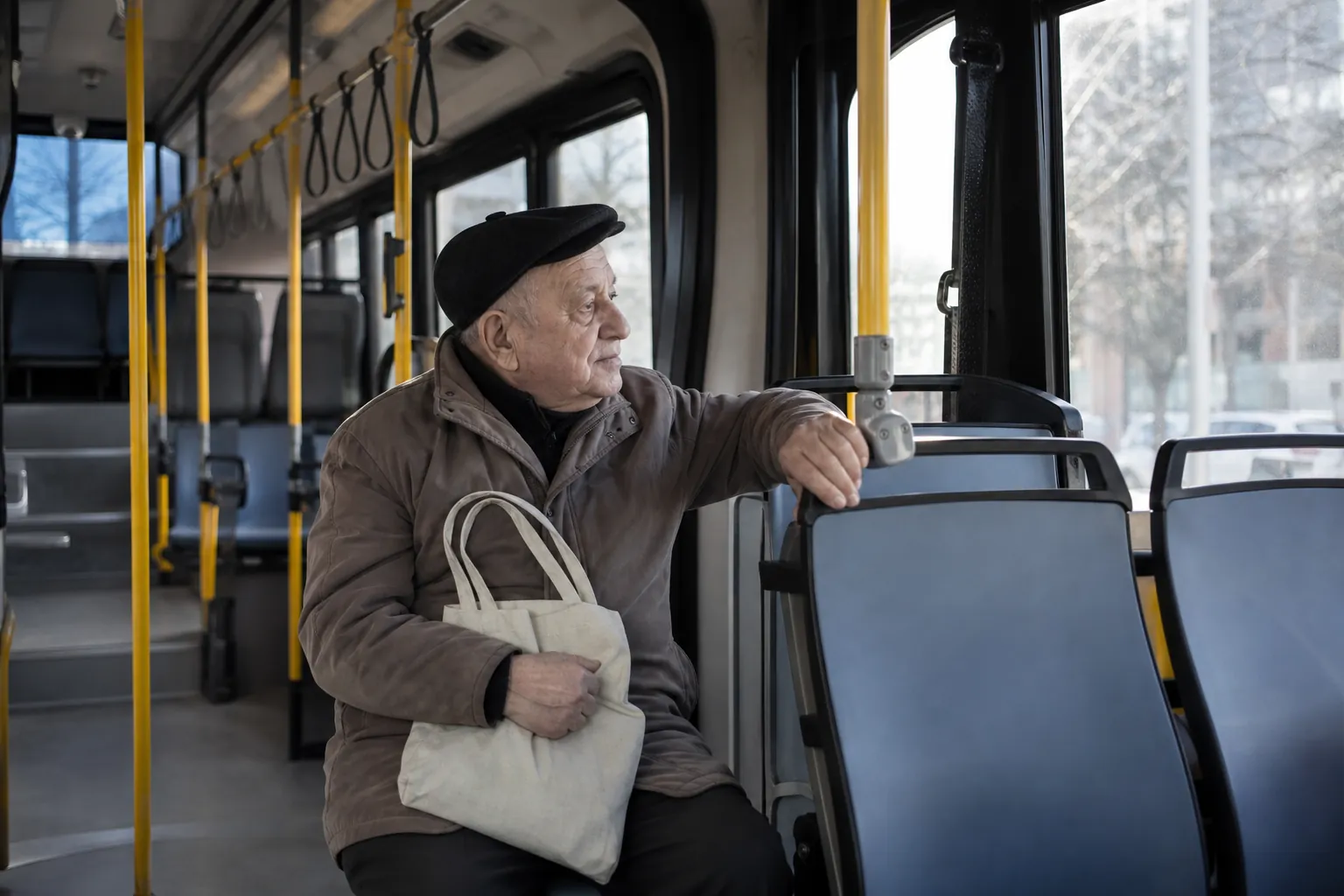
The main rule is simple: do not remain standing through acceleration or braking if a seat is available. Swedish video findings found older passenger falls most often after boarding during acceleration and during braking, which is exactly the period when many riders are still trying to reach a seat or prepare to exit. [4]
- Take the first suitable priority seat rather than walking farther down the aisle while the bus is ready to move.
- Hold the seatback, pole, or rail until you are fully seated.
- Keep both feet tucked where another passenger will not trip over them.
- Keep bags on your lap or between your feet, not in the aisle.
- If you must stand, use a vertical pole or seatback grip rather than relying on an overhead strap alone.
Use the bus’s stop information instead of waiting until the last second. Audio stop announcements, visual signs, and stop-alert buttons are meant to give riders time to prepare. If announcements are not working or you are unsure, ask the driver when you board whether they can call out your stop. Agency practices differ, but the request itself is ordinary.
If you use a wheelchair or scooter, use the securement area and follow the driver’s securement process. This is another place to check local rules ahead of time, because boarding position, securement equipment, and driver procedures are set by the transit agency, not by a single national script.
Alighting: the ride is not over when the bus reaches your stop
Getting off the bus deserves as much respect as getting on. The body wants to prepare early; the safer habit is to prepare mentally early and move physically later.
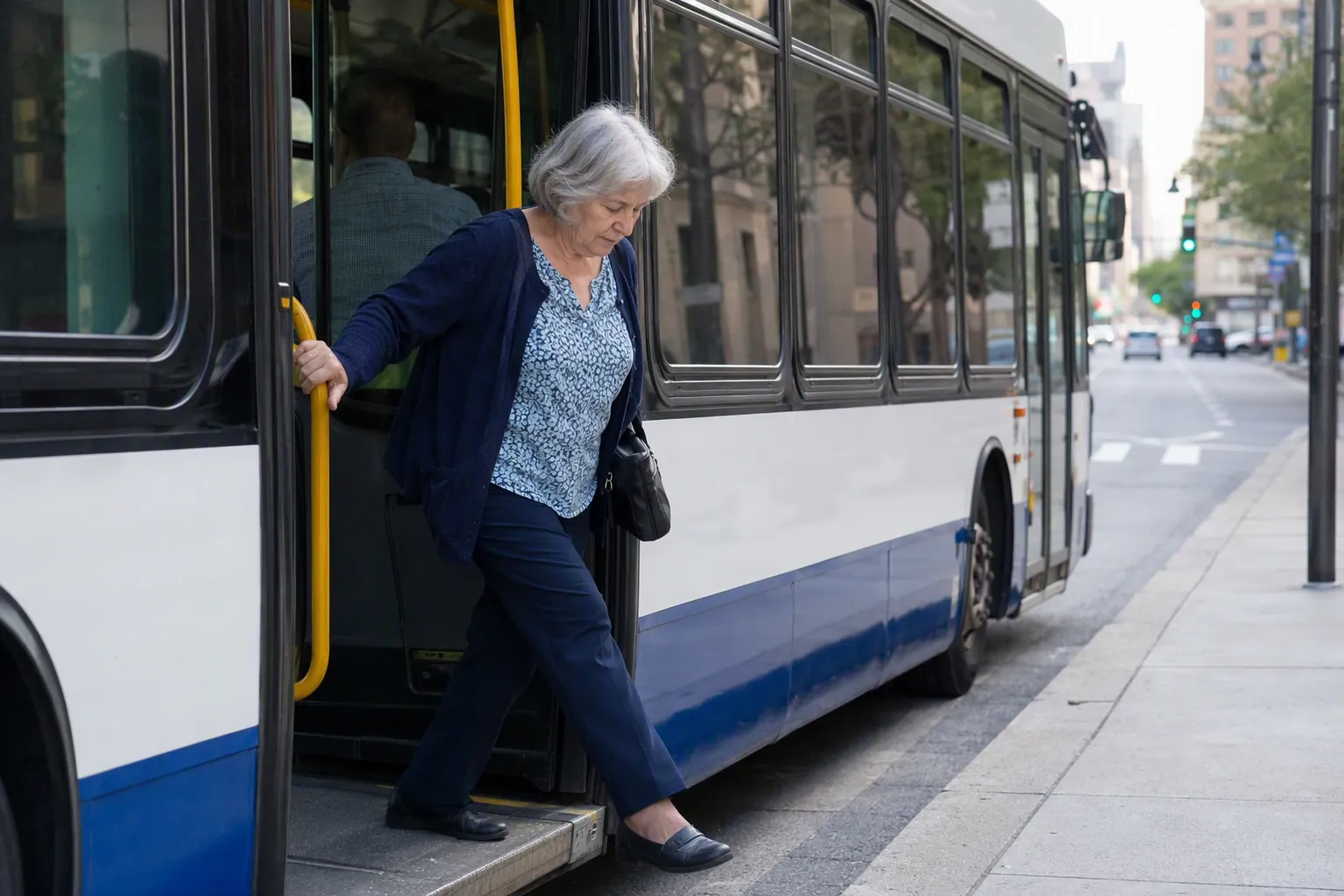
Signal early, then stay seated until the bus comes to a complete stop. PennDOT’s transit safety guidance also tells riders to use handrails, step onto the curb rather than into the street, and never walk in front of the bus. [6]
A safer exit sequence
- Press the stop-alert button or pull the cord with enough time for the driver to stop smoothly.
- Stay seated while the bus is still rolling, even if other passengers stand early.
- When the bus is fully stopped, stand up using the seatback or rail.
- Ask again for the bus to kneel or for the ramp if the step down is too far today.
- Face forward, hold the rail, and place one foot firmly before moving the other.
- Step onto the curb or sidewalk when possible. If the bus has stopped away from the curb, take extra time and ask the driver for help if you need it.
Do not let the passengers behind you set your pace. A rushed exit is one of those moments when politeness turns against the rider. The bus can wait a few more seconds; a hip, wrist, or head injury will take much longer.
After you exit: wait until you can see the street
Once both feet are on the sidewalk, pause. The bus may be blocking your view of traffic, and traffic may not see you. Use the crosswalk, obey the pedestrian signal, and wait for the bus to pull away before crossing in front of where it stopped. [6]
This is especially important when the stop is near a busy intersection or when you are carrying groceries, using a cane, or walking in low light. The safest crossing is often the one that happens thirty seconds later, after the large vehicle has moved and the street is visible again.
If you fall on or near the bus
If you fall, stay put for a moment. Do not pop up because you are embarrassed or because people are looking. Let the driver know, accept assistance, and check for pain, dizziness, bleeding, head impact, or a new inability to bear weight.
A fall is information, not a character flaw. Follow a basic post-fall triage plan: decide whether urgent care is needed, write down what happened while it is fresh, and look for the trigger. Was it the high first step, a sudden start, a bag in the aisle, a missed handhold, new dizziness, or shoes that caught on the step?
If you hit your head, feel faint, have severe pain, cannot stand, or feel newly confused, treat the ride as over and get help. The goal is not to prove you can continue the errand. The goal is to keep one fall from becoming the first fall in a bad chain.
When the regular bus may not be the right ride today
Fixed-route buses preserve ordinary independence: choosing your own time, going to familiar places, and not turning every errand into a medical outing. Still, there are days when the regular bus may be the wrong match.
- A fall happened recently and the cause has not been understood.
- Your balance, vision, walking speed, or confidence changed noticeably.
- New dizziness, weakness, medication changes, or confusion make it hard to judge traffic, stops, or when to stand.
- You cannot safely board, sit, signal, exit, and cross without help today.
That does not automatically mean staying home. Check your local transit agency for paratransit, reduced-fare rules, accessibility assistance, and travel training. These programs vary by location, and paratransit may require an application or assessment, so it is better to learn the process before a crisis. Community Transit, for example, describes older-adult transportation help and travel training as part of its local services. [9]
A good plan keeps the bus possible for as long as it is reasonably safe. On a steady day, that may mean asking for the bus to kneel, taking the front priority seat, and waiting until the bus stops before standing. On a changed day, it may mean choosing paratransit, asking someone to ride along, or postponing the trip until the reason for the fall risk is clearer.
References
- Older Adult Falls Data, CDC
- Barnes, Morris, Welsh et al. — UK linked STATS19/HES data, Public Transport, 2016
- Synthesis of 11 studies on non-collision injuries, ScienceDirect
- Silvano et al. — Swedish on-bus video, Journal of Transport & Health, 2019
- Bus Safety Data Report 2008–2018, Federal Transit Administration, 2021
- Public Transit Safety Tips, PennDOT
- Metro Bus Accessibility, WMATA
- Bus Safety, NJ Transit
- Older Adults + Travel Training, Community Transit
Questions to bring to a clinician or OT
This is not medical, legal, or a family's final decision — only a framework. Bring these questions to a clinician, occupational therapist, or your local Area Agency on Aging.
Find Local HelpRelated reading
Noticed something outdated or inaccurate on this page? Flag a correction. We review every report against CDC, NIA, and AARP HomeFit guidance before updating a page.