
Caregiver decision guide
Winter Driving Safety Checklist for Older Drivers
Generic winter driving advice rarely gives older drivers the exact numbers that matter. This printable readiness routine covers tire tread and cold-pressure checks, a 5–6 second following distance, 10-inch airbag clearance, gas kept at half a tank, medication and vision reviews, and an emergency kit stored in the back seat.
Before the 2026–27 winter arrives, the useful question is not whether an older driver is “careful enough.” It is whether the car, the supplies, and the driver have been checked against numbers that can be measured before the first freezing rain. Snow and sleet were present in 320 fatal crashes and an estimated 22,293 injury crashes recorded by NHTSA in 2023, and AAA attributes nearly half a million crashes and more than 2,000 road deaths each winter to winter storms, bad weather, and sloppy road conditions.[1][2] Those are population-wide figures, not an indictment of older drivers. The point of this winter driving safety checklist for elderly drivers is simpler: when the stakes of any crash are higher, vague advice is not good enough.
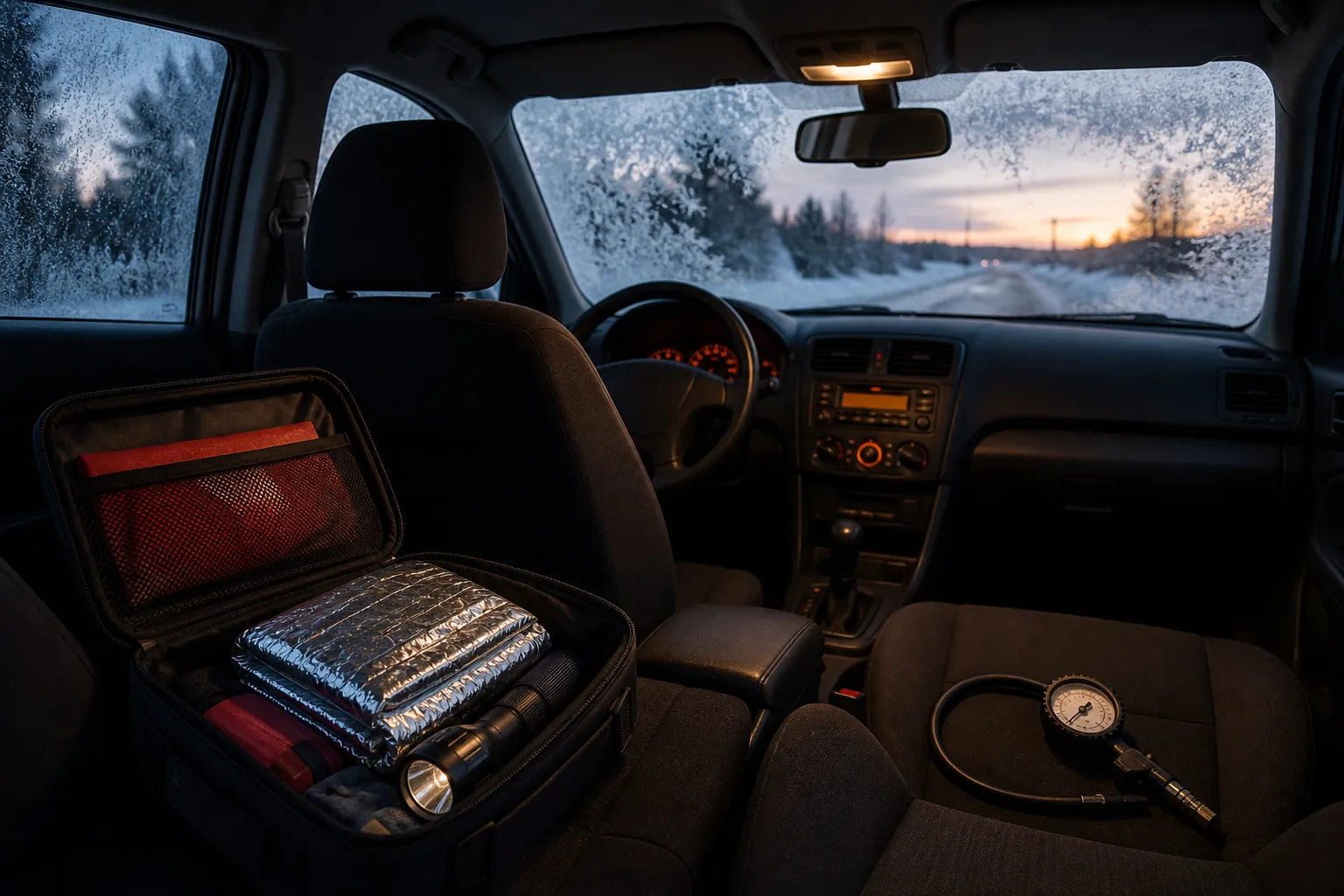
Print this once, keep it with the registration or winter kit, and do the checks while there is still daylight and no one is rushing to an appointment.
| Check | Number or standard to verify |
|---|---|
| Tire tread | At least 2/32 inch |
| Tire pressure | Cold pressure from the driver-side door-jamb label, not the tire sidewall |
| Cold tire check | Tires not driven for 3+ hours |
| Following distance | 5–6 seconds in winter conditions |
| Airbag distance | At least 10 inches from the steering wheel |
| Fuel | Keep the tank at least half full |
| Wipers | Replace if older than six months or streaking |
| Battery | Test if more than 3 years old |
| Vision | Annual eye exam from age 60 |
| Medication review | Check labels and ask specifically about driving effects before winter |
| Emergency kit | Store in the back seat, not the trunk |
Start With The Car, While It Is Parked And Cold
The car is the easiest part to inspect because most of the important checks do not require judgment. They require a gauge, a penny or tread gauge, the door-jamb label, and a few minutes before the tires have warmed up.
Tires: tread first, pressure second
Check tread depth before winter, not after the first slide at a stop sign. NHTSA’s winter driving guidance uses 2/32 inch as the minimum tread depth and says tire pressure should be checked when tires are cold, meaning the vehicle has not been driven for at least 3 hours.[1] AARP also points older drivers toward tires suited to winter conditions, including dedicated winter tires or all-weather tires with the three-peak mountain snowflake rating in cold regions.[3]
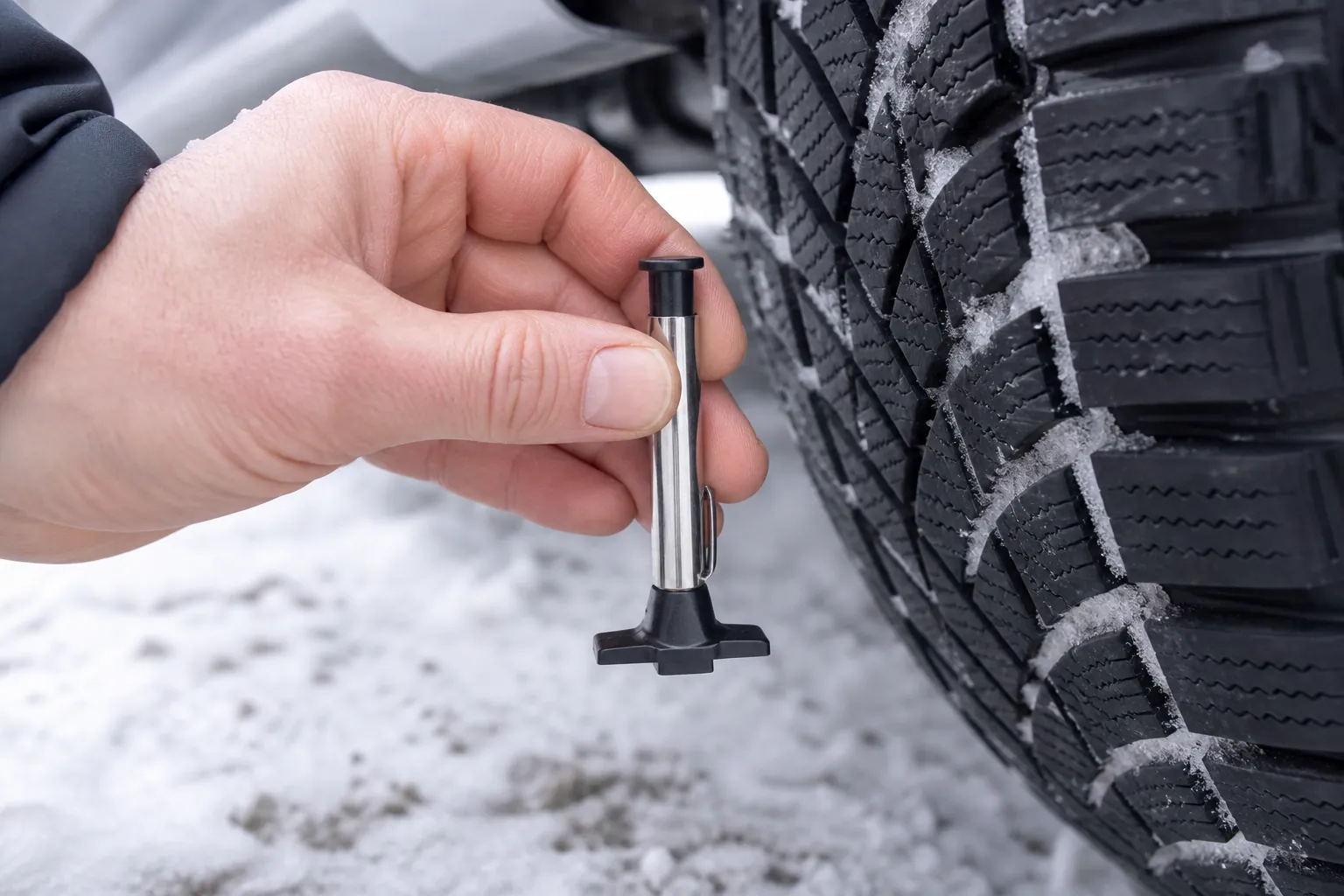
For pressure, use the number on the driver-side door-jamb label. Do not use the maximum pressure printed on the tire sidewall. NHTSA notes that tire pressure drops about 1 PSI for every 10°F drop in temperature, which is exactly why a tire that looked fine in September can be underinflated in December.[1]
- Park on level ground and let the car sit until the tires are cold.
- Find the recommended PSI on the driver-side door-jamb label.
- Check all four tires with a pressure gauge, plus the spare if the vehicle has one.
- Add air before a long trip, a medical appointment in bad weather, or a forecasted deep freeze.
Wipers, washer fluid, lights, and battery
Wipers are a small item until the windshield smears gray slush across oncoming headlights. AAA and AARP winter guidance advise replacing wipers that are worn, with AARP using six months as a practical replacement point, and AAA recommends winter de-icer washer fluid rather than plain fluid that can freeze.[2][3]
Check headlights, brake lights, turn signals, hazard lights, and the interior dome light with another person standing outside the car. If no one is available, park facing a garage door or window at dusk and use the reflection. This is not a winter-only check, but winter gives it more weight because darkness comes early and snow can cover weak or dirty lights.
The battery deserves attention before the first bitter cold morning. AAA notes that cold temperatures reduce battery capacity and recommends having the battery tested if it is more than 3 years old.[2] That test is often quick, and it is much easier to arrange from a driveway than from a pharmacy parking lot after dark.
Fuel and spacing are winter safety equipment too
Keep the gas tank at least half full in winter. AAA gives two reasons: it helps prevent fuel-line freeze and leaves enough fuel to run the engine for warmth if the driver becomes stranded.[2] For an older driver who schedules appointments by calendar and weather forecast, the half-tank mark is a good no-argument rule: below half, fill it before the next storm.
On the road, use a following distance that can be counted. AAA recommends increasing normal following distance from 3–4 seconds to 5–6 seconds in winter conditions.[2] Pick a mailbox, sign, or overpass. When the vehicle ahead passes it, count “one thousand one” through “one thousand six.” If the front of your car reaches the marker before the count is done, you are too close for winter.
Seat position: make room for the airbag
NHTSA’s older-driver guidance says drivers should sit at least 10 inches from the steering wheel airbag.[4] Measure from the center of the steering wheel to the breastbone. If moving the seat back makes the pedals hard to reach, that is not a reason to sit too close; it is a reason to look at pedal extenders, seat adjustment, or a CarFit check before winter driving becomes routine.
Pack The Emergency Kit Where You Can Reach It
A winter kit in the trunk may be neat, but Wisconsin DOT’s winter survival kit guidance says to keep the kit in the back seat because trunks can jam or freeze shut in winter.[5] That one placement choice matters. If the car is stuck, the driver should not have to get out on ice or stand in traffic to reach a blanket, medication, or flashlight.
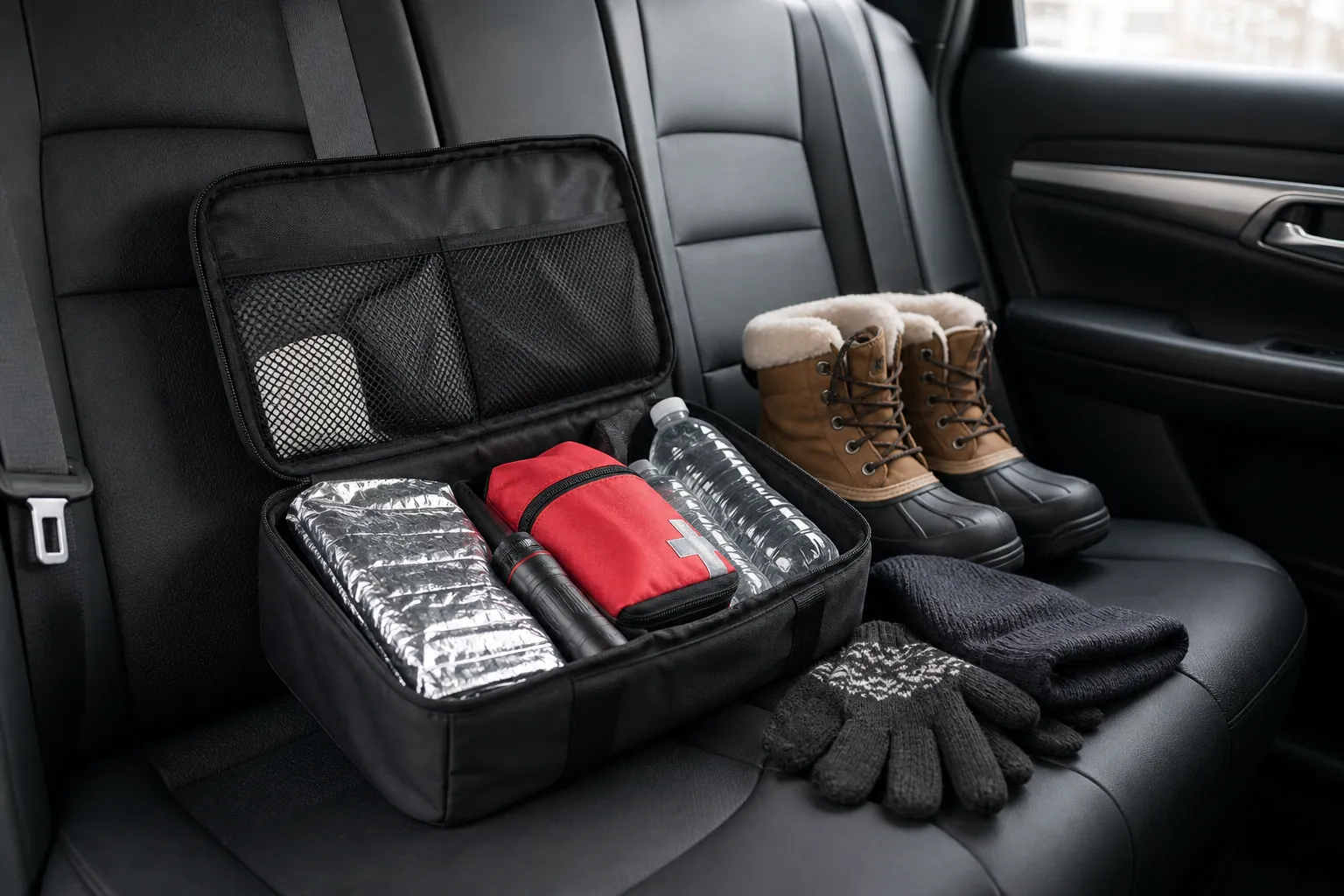
Keep the kit plain and visible. NHTSA and AAA both include medications in winter emergency supplies, and AARP’s winter kit list includes a blanket, flashlight with extra batteries, ice scraper, traction material such as sand or cat litter, jumper cables, first-aid kit, bottled water, and non-perishable snacks.[1][6] Medications belong in this list as a serious item, not as the thing remembered after everything else is packed.
- Reflective blanket or warm blanket
- Flashlight and extra batteries
- Ice scraper and small snow brush
- Sand or cat litter for traction
- Jumper cables
- First-aid kit
- Bottled water and non-perishable snacks
- A small supply of essential medication, rotated before it expires
- Phone charger or power bank kept charged
If you are helping a parent prepare the car, do not hide the kit under luggage or in a storage bin that takes two hands to open. Put it where the driver can reach it from the front seat or from an open rear door. For wider seasonal preparation beyond the car, pair this driving checklist with a home winter safety checklist and a severe-weather safety checklist, but keep the car kit small enough that it actually stays in the car.
Check The Driver Before The Weather Tests The Driver
Winter driving asks more from the driver than dry-road errands do: faster judgment in poor visibility, more glare, more patience at intersections, and more recovery time if something goes wrong. This is where older-driver winter advice is often too vague. “Be careful” does not tell anyone whether a new antihistamine, a missed eye exam, or a poor seat fit is going to matter on a snowy night.
Medication review: ask about driving, not just side effects
A medication review belongs on the winter checklist because the gap between use and warning is large. The LongROAD study found a median of 7 medications among drivers ages 65–79, while AAA reports that 69% of drivers 55 and older used at least one potentially impairing prescription but only 17.6% had been warned by a provider about possible driving effects.[7][8]
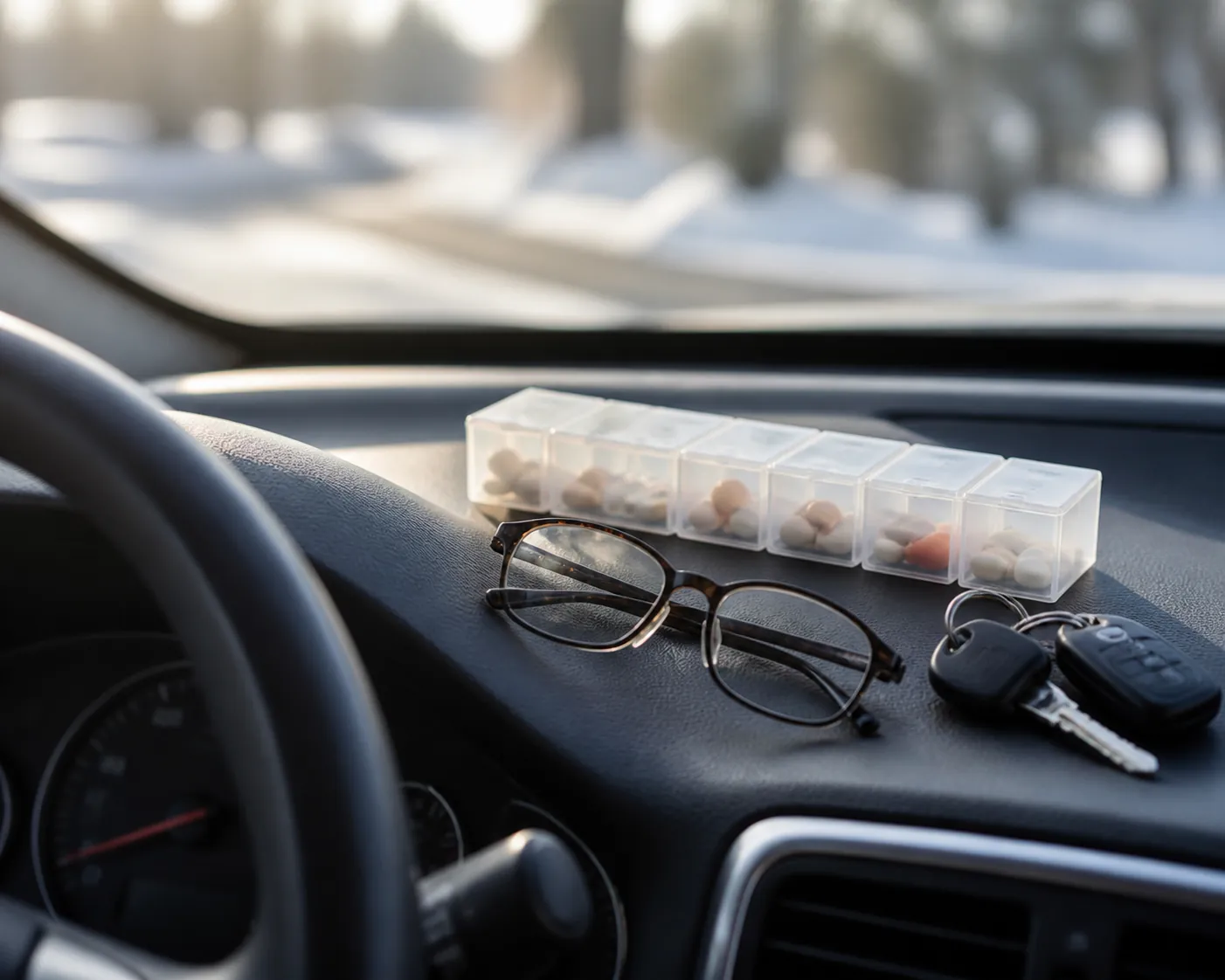
The FDA lists several medicine categories that can affect driving, including over-the-counter antihistamines, sedatives, antidepressants, and opioids.[9] The winter-ready question for a doctor or pharmacist is specific: “Could this medicine, or this combination, affect my reaction time, alertness, vision, or balance when I drive?” Ask again after a dose change, a new sleep medicine, a new pain medicine, or a cold remedy added for a few days.
- Do not test a new sedating medicine on a snowy-night drive.
- Keep an updated medication list in the wallet and in the emergency kit.
- Ask whether alcohol, missed meals, or dehydration change the driving risk of any medicine.
- If an adult child is helping, let the pharmacist review the actual list rather than relying on memory.
Vision: schedule the exam before night driving becomes the test
NHTSA recommends an annual eye exam from age 60 to check for conditions such as cataracts, glaucoma, macular degeneration, and diabetic retinopathy.[4] That appointment is more useful before winter because glare, wet pavement, early darkness, and low contrast make small vision changes show up sooner.
Do not turn every difficult drive into a character test. If oncoming headlights have become uncomfortable, if lane markings disappear in rain, or if reading signs takes longer than it used to, treat that as information. NHTSA includes discomfort from oncoming headlights among warning signs in its older-driver self-assessment materials.[4] The next step may be an eye appointment, cleaner lenses, adjusted driving hours, or choosing familiar daytime routes during winter storms.
CarFit: a 20-minute fit check, not a driving test
CarFit is a free educational check, commonly described as about 20 minutes, run by trained technicians through organizations including AAA, AARP Driver Safety, and the American Occupational Therapy Association.[10][11] It looks at how the driver fits the vehicle: seat position, mirror view, steering wheel distance, head restraint, and how easily controls can be reached.
This is useful before winter because bulky coats, stiff joints, and shorter daylight can all make a poor setup more noticeable. A better mirror angle or seat position is not a promise that winter driving is safe in every storm. It is one small correction that can remove avoidable strain before the weather adds more.
Caregivers who are trying to preserve both safety and independence may also find a broader mobility and independence guide helpful, especially when winter driving is only one part of a larger transportation plan.
If You Become Stranded, Keep The Plan Short
A stranded plan should be simple enough to remember when the driver is cold and worried. NHTSA says to stay with the vehicle, keep the exhaust pipe clear of snow to prevent carbon monoxide poisoning, and run the engine and heater only long enough to remove the chill so fuel is conserved.[1]
- Stay with the vehicle unless there is an immediate danger where the car is stopped.
- Call for help and give the road, direction of travel, nearby exit, landmark, or mile marker.
- Check that the exhaust pipe is not blocked before running the engine.
- Run the heater only enough to take off the chill, then turn it off to conserve fuel.
- Use the blanket, hat, gloves, water, snacks, and medications from the back-seat kit.
Cold exposure can be harder to judge in older adults. HealthInAging and AARP both note that shivering may be a less reliable warning sign because older adults tend to shiver less.[12][13] For more on what to watch for, use a dedicated hypothermia signs guide for seniors rather than trying to learn cold-exposure symptoms during an emergency.
Printable Pre-Winter Checklist
- Tires have at least 2/32 inch tread; winter or 3PMSF-rated all-weather tires are considered for cold regions.
- Tire pressure is checked cold, after the car has sat for 3+ hours, against the door-jamb PSI label.
- Wipers are under six months old or replaced if streaking; winter de-icer washer fluid is filled.
- Battery is tested if more than 3 years old.
- Gas tank is kept at half full or above.
- Driver can count a 5–6 second following distance in winter conditions.
- Driver sits at least 10 inches from the steering wheel airbag.
- Emergency kit is stored in the back seat, not the trunk.
- Medication list is reviewed with a doctor or pharmacist for driving effects, especially after changes.
- Annual eye exam is scheduled or completed; glare and night-driving problems are not ignored.
- Stranded plan is known: stay with the vehicle, clear the exhaust pipe, conserve fuel, and use the kit.
That is the whole job before winter: measurable checks on the car, reachable supplies, and a driver review that includes medications and vision. It protects independence better than either scolding or pretending the season does not change the work of driving.
References
- NHTSA Winter Weather Driving Tips — NHTSA
- AAA Exchange Winter Driving Tips — AAA Exchange
- AARP 9 Winter Driving Tips — AARP
- NHTSA Driving Safely While Aging Gracefully — NHTSA
- Wisconsin DOT Winter Survival Kit — Wisconsin DOT
- AARP 8 Car Emergency Kit Must-Haves — AARP
- LongROAD Study — PMC/NIH
- AAA Exchange Senior Driver Safety — AAA Exchange
- FDA Some Medicines and Driving Don't Mix — FDA
- HealthInAging Tip Sheet: Safety Tips for Older Drivers — HealthInAging
- CarFit
- HealthInAging Winter Safety for Older Adults — HealthInAging
- AARP Why Cold Weather Is So Dangerous to Aging Bodies — AARP
Questions to bring to a clinician or OT
This is not medical, legal, or a family's final decision — only a framework. Bring these questions to a clinician, occupational therapist, or your local Area Agency on Aging.
Find Local HelpRelated reading
Noticed something outdated or inaccurate on this page? Flag a correction. We review every report against CDC, NIA, and AARP HomeFit guidance before updating a page.