
Caregiver decision guide
Can Seniors Recover from Paralysis? What New Research Shows
After a stroke or spinal cord injury, many caregivers wonder whether their elderly parent can truly recover. This article presents recent peer-reviewed evidence on neurological recovery in older adults and explains what meaningful improvement looks like — so you can approach rehabilitation with realistic, data-backed hope.
After a parent is paralyzed by a stroke or spinal cord injury, the question families often whisper before they ask it out loud is painfully simple: can they really recover, or are we asking them to work toward something that age has already taken off the table?
The careful answer is yes, meaningful recovery is possible for seniors. But “recovery” has to be named precisely. It may mean stronger muscle activation, better sensation, safer transfers, more control of an arm or leg, less assistance with bathing or dressing, improved mood, more participation in family life, or a home routine that no longer feels like an emergency every hour. It does not always mean walking exactly as before.
That distinction is not pessimism. It is what keeps hope from becoming another burden on the caregiver, or another test the injured parent feels they are failing.
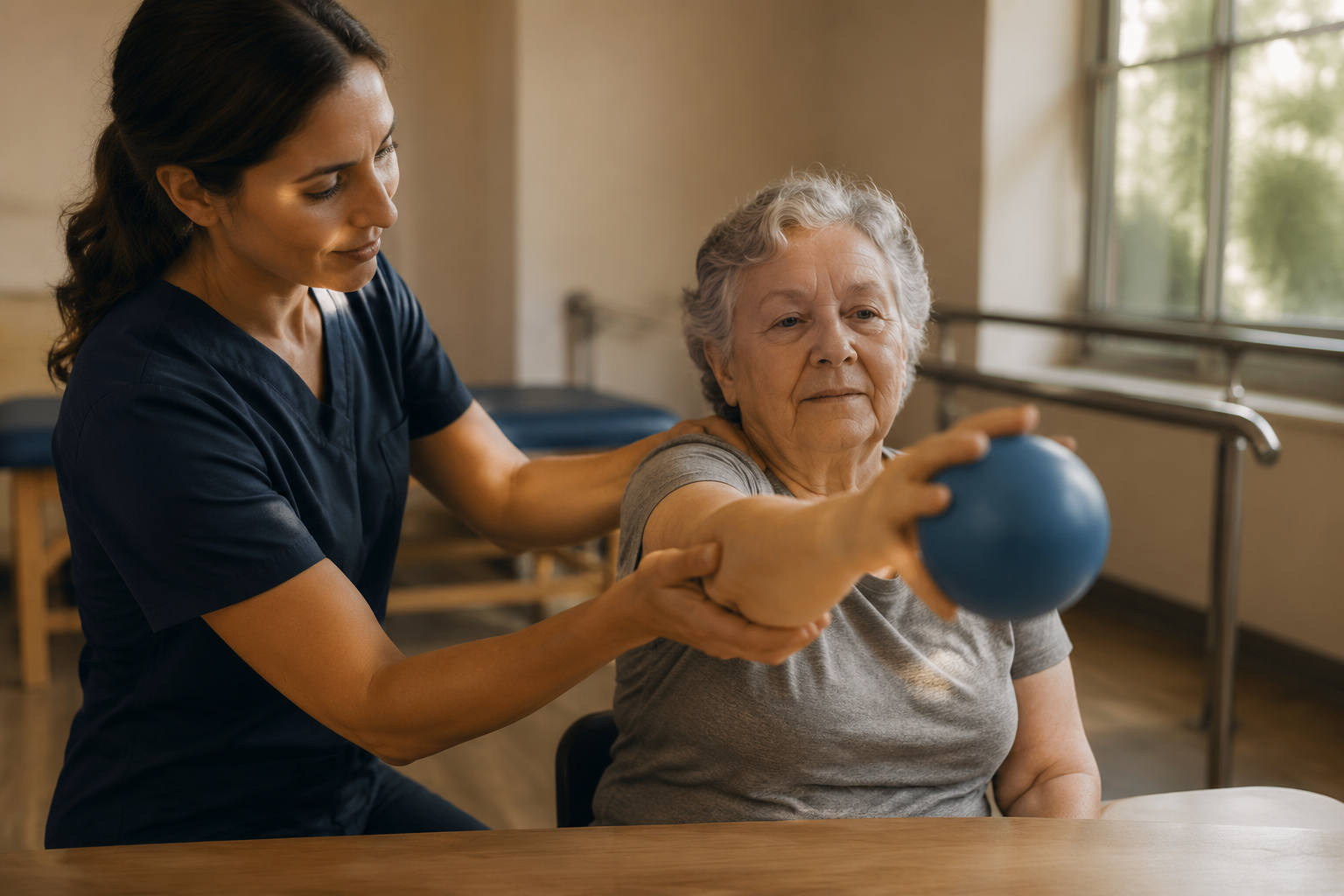
The New Spinal Cord Injury Finding Families Should Understand
A large peer-reviewed spinal cord injury data set published in December 2025 gives families a better answer than the old assumption that older nerves simply do not recover. In a study of 2,171 people with spinal cord injury, age did not affect neurological recovery: older adults regained motor strength and sensation at levels comparable to younger patients.[1]
That finding matters because it separates nerve healing from day-to-day independence. If a therapist says an older parent has regained motor strength or sensation, that is not a courtesy phrase. In this spinal cord injury data set, older adults showed real neurological recovery.[1]
The harder part is that neurological recovery did not translate into equal functional independence. The same study found a 4.3-point decrease in functional independence improvement per decade on a 0–100 scale.[1] In plain terms, an 80-year-old and a 40-year-old may both regain nerve function after spinal cord injury, but the older adult may still need more help turning that recovery into dressing, toileting, transferring, cooking, bathing, or moving safely through the house.

That gap is where families need the most honest preparation. Age may not shut down neurological healing, but it can change what the body can do with that healing. Arthritis, frailty, pain, fatigue, balance problems, vision changes, medication effects, and pre-existing heart or lung disease can all make the same neurological gain harder to use in daily life. The answer is not to expect less effort from the older adult. It is to design rehabilitation around the body they actually have.
| What is being measured | What it may look like | Why caregivers should ask about it |
|---|---|---|
| Motor recovery | A muscle begins firing, grip improves, the leg can help with standing | It shows neurological change, even if the parent still needs assistance |
| Sensory recovery | More feeling, better awareness of limb position, improved response to touch | It may improve safety and control during therapy and transfers |
| Functional independence | Less help needed for dressing, toileting, transfers, bathing, or mobility | This is where older adults may need more adaptation despite nerve recovery |
| Quality of life | More participation, confidence, comfort, mood stability, or social engagement | It captures gains that walking-focused goals can miss |
When a rehab team gives an update, it is reasonable to ask, “Are we talking about motor recovery, functional independence, or quality of life?” The answer changes what the family should celebrate and what still needs planning.
Spinal Cord Injury Evidence Cannot Be Pasted Onto Stroke
The December 2025 finding applies to spinal cord injury, not stroke.[1] That boundary matters. Stroke and spinal cord injury can both cause paralysis, but they damage different parts of the nervous system and follow different recovery patterns. A family should not hear “older adults regain motor strength after spinal cord injury” and assume the same evidence proves the same pattern after stroke.
Stroke recovery is usually discussed through neuroplasticity: the brain’s ability to reorganize, strengthen useful pathways, and relearn tasks through repeated, specific practice. Evidence for older stroke survivors needs to come from stroke rehabilitation, not from spinal cord injury research.
What Recovery Can Mean After Stroke
For older stroke survivors, meaningful gains are still possible. Neuroplasticity-based approaches such as constraint-induced movement therapy, mirror therapy, and rhythmic auditory stimulation have documented success in elderly stroke populations, and functional gains can occur even years after injury.[2]
Those therapies are not magic techniques. Their value is in repeated, task-specific practice. Constraint-induced movement therapy asks the person to use the affected limb instead of letting the stronger side take over. Mirror therapy uses visual feedback to help the brain engage the affected side. Rhythmic auditory stimulation uses rhythm to support movement timing. The common thread is practice that tells the nervous system, again and again, what movement is needed.
Caregivers often become the quiet infrastructure behind that repetition. They help the parent get to therapy, set up a safe chair, remind them to practice the assigned task, notice fatigue, and keep the home from turning every meal or transfer into a crisis. But support should not become surveillance. A parent recovering from stroke does not need every reach, step, or failed attempt graded by someone who loves them.
A better question than “Did you walk today?” might be “Did your hand open a little more?” or “Was the transfer safer than last week?” or “Could you sit up longer before getting tired?” These are still recovery questions. They are just less likely to crush the person who is doing the work.
The Timeline Is Fast Early, Then Slower and Still Real
Families often hear that stroke recovery happens in a short early window. That is partly true. The American Stroke Association notes that the most rapid recovery usually occurs during the first 3–4 months after stroke.[3] This is why the first weeks can feel so urgent: therapy appointments, discharge planning, equipment decisions, medication changes, and home safety choices all arrive before the family has emotionally caught up.
If your parent is newly discharged or still in the first wave of decisions, a practical companion such as The First 30 Days as a Caregiver for an Elderly Parent can help organize the immediate tasks without pretending the family should already feel calm.
The early window is important, but it is not the end of the story. The same caregiver guidance notes that recovery can continue into the second year and beyond.[3] The pace often changes. Big visible gains may give way to smaller improvements: a better transfer, steadier sitting balance, improved shoulder control, safer swallowing, more endurance, fewer cues during dressing, or enough confidence to join a family meal again.
This slower phase is where families are most vulnerable to despair because progress stops looking cinematic. It may also be where the most practical independence is built. A few seconds of better standing balance can change toileting. A small improvement in hand control can change feeding. Better trunk control can make wheelchair positioning safer. None of that is a miracle story. It is rehabilitation doing what rehabilitation often does: accumulating function in pieces.
Depression Is Not a Side Issue
After paralysis, families sometimes treat mood as something to address once the “real” medical work is done. That is a mistake, especially after stroke. Post-stroke depression affects an estimated 30–50% of stroke survivors, and the American Stroke Association warns that depression can hinder recovery.[3]
A parent who refuses therapy, sleeps through the day, cries often, becomes unusually irritable, or says there is no point may not be “unmotivated.” They may be depressed, grieving, exhausted, cognitively changed, in pain, or overwhelmed by a body that no longer obeys. Depression deserves medical attention because participation matters for neuroplastic recovery, and participation becomes much harder when the person cannot imagine a future worth practicing for.
The caregiver’s mood matters too. Rehabilitation depends on repeated, supported practice, which means it also depends on the person arranging rides, managing medications, encouraging exercises, negotiating insurance, cleaning up after accidents, and absorbing the parent’s fear. Burnout is not a character flaw. It is a predictable risk in a long recovery.
If the family is already running on fumes, it is worth using a caregiver wellbeing guide before exhaustion starts making all decisions for you.
Tiny Goals Are Not Lower Standards
One of the more useful ways to protect both motivation and accuracy is to stop measuring recovery only by dramatic milestones. Flint Rehab describes a “1% improvement” approach to stroke goal-setting: focus on small daily gains that can compound over time rather than waiting for a single breakthrough.[4]
That does not mean inventing progress. It means choosing goals small enough to observe honestly. A hypothetical daily goal might be tolerating five more minutes seated at the table, practicing ten careful reaches with the affected arm, completing one transfer with fewer verbal cues, or standing long enough for a caregiver to adjust clothing safely. The exact goal should come from the rehab team, but the scale should be humane.
- Ask the therapist which movement or task matters most this week.
- Track one or two observable changes instead of every possible symptom.
- Separate effort from outcome: praise the practice, not only the visible result.
- Stop before exhaustion turns practice into punishment.
- Revisit goals when pain, fatigue, depression, or medical setbacks interfere.
This is where inspiration becomes useful rather than sentimental. The parent sees that today’s effort has a shape, and the caregiver sees that they do not have to manufacture enthusiasm for an impossible finish line.
Plan the Home Around the Recovery Your Parent Has Now
A family can believe in recovery and still install grab bars. They can hope for better walking and still use a wheelchair ramp. They can celebrate new leg activation and still move the bedroom downstairs. Adaptation is not giving up; it is reducing the number of daily situations where one weak moment becomes a fall, a skin injury, or a caregiver’s back injury.
For many older adults, the functional independence gap after spinal cord injury, and the uneven pace after stroke, show up most clearly at home. Clinic movement is one thing. A narrow bathroom, loose rug, high bed, low toilet, poor lighting, and tired caregiver at 2 a.m. are another.
If mobility changes are becoming long-term, families may need to look at funding sources for home modifications when Medicare will not pay or other options for paying for an aging-in-place remodel. The right modification is not always the most expensive one. It is the one that matches the transfers, supervision needs, endurance, cognition, and equipment your parent actually uses.
For a parent returning home with new mobility limits, families may also consider whether monitoring technology can reduce in-home care strain. Monitoring cannot replace hands-on help when a person needs physical assistance, but it may support safer routines when the main concern is falls, wandering, missed activity, or knowing whether someone got out of bed.
Use Extraordinary Stories Carefully
Families sometimes reach for famous paralysis comeback stories because they need proof that the impossible can happen. There is nothing wrong with being moved by an extraordinary recovery. But an exceptional story should not become the standard your parent is silently measured against.
A rare, decades-long recovery story may encourage one person and devastate another. If your parent hears it as “therefore I should be walking if I work hard enough,” the story has stopped helping. The better use of inspiration is narrower: someone practiced for a long time, the nervous system can change, and progress may arrive in forms that are easy to miss if the only acceptable outcome is walking away unchanged.
What to Ask the Rehab Team
The most useful conversations with clinicians are often specific rather than broadly hopeful. Instead of asking only, “Will my parent recover?” ask what kind of recovery is being measured and what the next practical target is.
- Are you seeing motor recovery, sensory recovery, functional gains, or compensation strategies?
- Which daily task would make the biggest difference if it improved this month?
- What should we practice at home, and what should we avoid doing without supervision?
- How are pain, fatigue, cognition, medications, and mood affecting participation?
- What home changes are needed before discharge or before reducing supervision?
- When should depression, anxiety, or caregiver burnout trigger a medical or social work referral?
These questions keep hope tied to decisions. They also protect the caregiver from trying to interpret every twitch, plateau, or difficult therapy session alone.
A More Usable Definition of Hope
For seniors recovering from paralysis, hope should be wide enough to include motor strength, sensation, participation, safer transfers, better mood, more independence in small tasks, and quality-of-life gains. Walking may be one goal. It should not be the only evidence that recovery is real.
The new spinal cord injury evidence is genuinely encouraging: older adults can regain motor strength and sensation at rates comparable to younger patients.[1] The functional independence gap is also real, and families should plan around it rather than hide from it.[1] Stroke recovery has its own evidence base, with neuroplasticity therapies and meaningful gains possible beyond the early months.[2][3]
So the next step is not to promise your parent they will return to the exact life they had before. It is to ask what recovery is being measured, treat depression as a medical priority, build tiny daily goals that can survive fatigue, and make the home safer for the level of mobility your parent has today.
References
- Age does not stop nerve healing after spinal cord injury, ScienceDaily, December 2025.
- Proven Neuroplasticity Methods Speed Up Elderly Stroke Recovery, Activ Therapy.
- 15 Things Caregivers Should Know After a Loved One Has Had a Stroke, American Stroke Association.
- Goal Setting for Stroke Patients, Flint Rehab.
Questions to bring to a clinician or OT
This is not medical, legal, or a family's final decision — only a framework. Bring these questions to a clinician, occupational therapist, or your local Area Agency on Aging.
Find Local HelpRelated reading
Noticed something outdated or inaccurate on this page? Flag a correction. We review every report against CDC, NIA, and AARP HomeFit guidance before updating a page.